
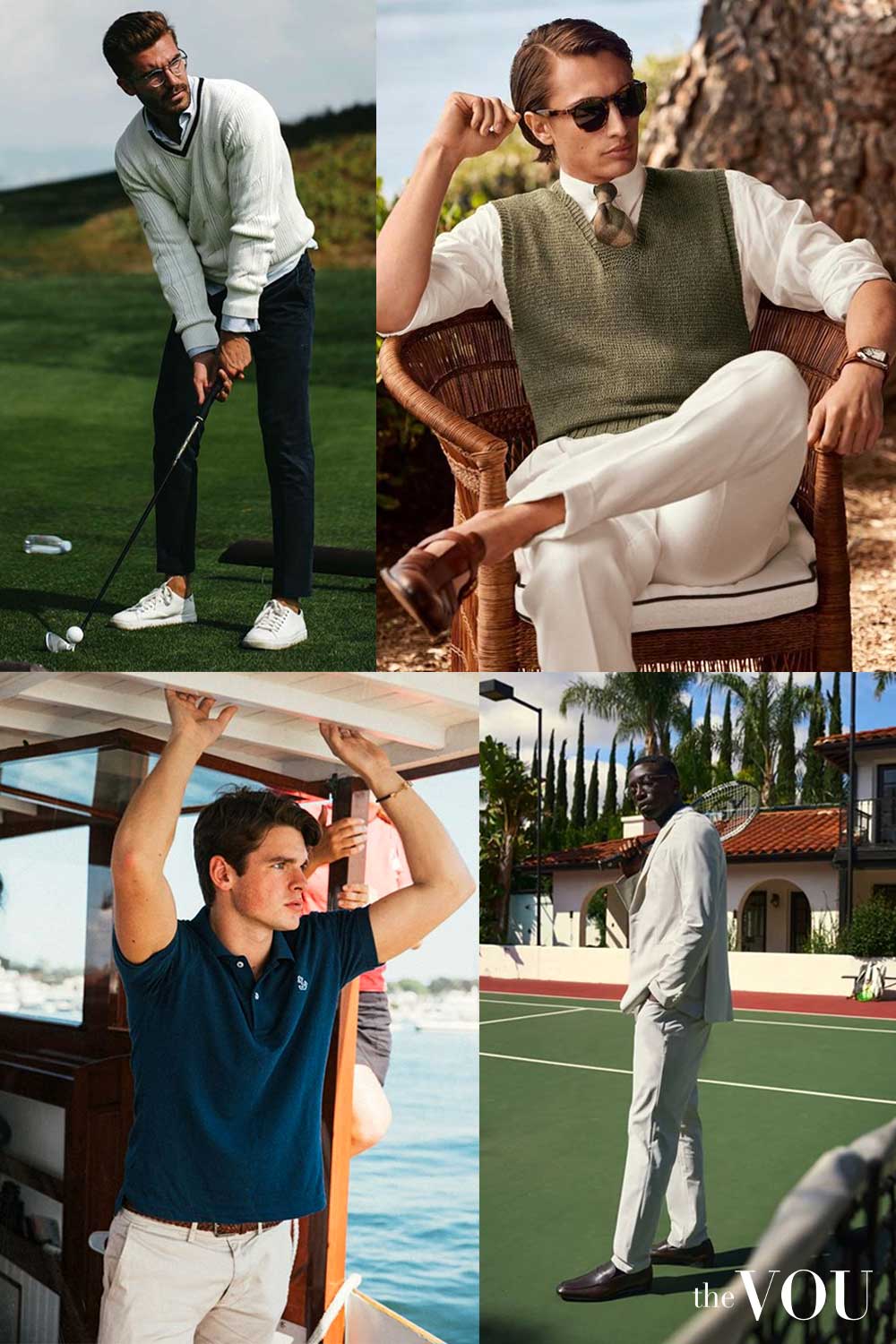
Start here
What’s This About:
Country club style for men is smart casual: a collared shirt or polo, chinos or tailored trousers, loafers and, for meals and parties, a jacket.
This guide gives five complete outfits and practical pointers, such as:
– A relaxed fairway look with a polo shirt and penny loafers
– A seersucker jacket outfit for a terrace lunch
– A pink linen shirt and cardigan for a garden party
– A tennis-watching outfit with a cable-knit sweater
– A tweed and corduroy outfit for a winter evening
and many more!
Check the club’s own dress code first, then build from the clothes you already own.
Key Points:
01Each club sets its own rules on collars, denim and jackets.
02Brands are examples only; fit matters more than the label or price.
03Keep logos small and accessories few.
04The look describes clothes, not anyone’s background or wealth.
A country club outfit for men usually means smart casual: a collared shirt or polo, chinos or tailored trousers, a leather belt and loafers, with a blazer or sports jacket added for lunch, dinner or a party.
The five outfits below cover a round of golf, a terrace lunch, a garden party, a tennis afternoon and an autumn evening indoors, in the relaxed, traditional register often called the Old Money look.
Old Money is a contemporary style label, so these clothes say nothing certain about anyone’s family, school or bank balance, and you do not need to belong to a club to wear them.
Brands are named only as examples of the kind of garment meant, and a well-fitting equivalent from any maker at any price works just as well.
Check the club’s own dress code first
Every club sets its own rules, and they often differ between the golf course, the clubhouse, the dining room and the pool.
Many clubs ask for collared shirts tucked in, limit denim and athletic wear to certain areas, and ask for a jacket in the formal dining room on certain evenings.
The Rhode Island Country Club’s published guest code, for example, allows denim throughout the clubhouse and on the terrace, but not in the dining room when it is set for formal dining, and never on the golf course or driving range.
The same code allows athletic wear downstairs and at the courts and pool, but not upstairs in the clubhouse, on the terrace or on the porches, and it asks gentlemen for a jacket in the formal dining room on Saturday evenings.
If you are a guest, ask your host or look for the guest page on the club’s website before you choose an outfit.
1. Fairway Stroll Look
For a casual walk or a relaxed round, start with a soft cotton polo shirt in a muted seafoam green, such as one from Ralph Lauren; choose a small logo or none at all if you prefer a quieter look.
Pair it with light khaki trousers in linen or cotton, for example from the Italian trouser maker Incotex.
Add dark brown leather penny loafers, such as a pair from Alden, and a woven leather belt in chestnut brown, a detail often seen in Italian old-money style and sold by makers such as Brunello Cucinelli.
Finish with a simple watch on a leather strap or metal bracelet and tortoiseshell sunglasses, two quiet accessories that suit the Old Money aesthetic.
If you are actually playing golf, swap the loafers for golf shoes and check whether the course allows linen trousers.
Wear: seafoam polo shirt, khaki linen or cotton trousers, brown penny loafers, woven brown belt.
2. Terrace Luncheon Outfit
For a relaxed lunch on the terrace, seersucker keeps you cool and looks smart.
Start with a pale blue and white striped seersucker sports jacket, such as one from Brooks Brothers, a New York clothier founded in 1818 and long linked with preppy style.
Wear it over a crisp white cotton Oxford shirt; the London shirtmaker Turnbull & Asser is one option, and any well-fitting Oxford shirt works.
Pair these with light grey tropical wool trousers, a lightweight open weave that suits warm days.
Finish with chestnut brown suede tassel loafers, for example from the Northampton shoemaker Edward Green, which follows the English shoemaking tradition also found around British tailoring.
Add a woven silk tie in pale yellow if the club expects a tie, such as one from the Paris shirtmaker Charvet.
Wear: blue and white seersucker jacket, white Oxford shirt, light grey tropical wool trousers, brown suede tassel loafers, pale yellow tie.
3. Garden Party Look
For an early evening garden party, add a little colour while keeping the cut simple.
Begin with a soft pink linen shirt; Charvet makes shirts in this style, and a plain pink linen shirt from any maker does the same job.
Pair it with light cream cotton twill trousers, which look fresh and are easy to wear.
Layer a light blue cashmere or cotton cardigan for when the air cools, such as one from Loro Piana.
Complete the look with dark brown suede loafers, for example from the Naples tailoring house Rubinacci, whose relaxed approach fits the idea of sprezzatura, and a tan woven leather belt from a belt maker such as Anderson’s.
Wear: pink linen shirt, cream cotton twill trousers, light blue cardigan, dark brown suede loafers, tan woven belt.
4. Tennis Court Look
This outfit is for watching a match rather than playing; on court, follow the club’s rules for tennis clothing, which often ask for white.
Start with a crisp white cotton tennis shirt, for example from Fred Perry, the label founded by the British tennis champion of the same name.
Tuck it into light grey wool flannel trousers with a relaxed, pleated cut that allows easy movement, such as a pair from Loro Piana.
Layer a navy cable-knit cotton tennis sweater, the kind sold by Ralph Lauren Purple Label and other American heritage brands associated with the original preppy look.
Finish with plain white leather low-top trainers, such as Common Projects, and a braided leather belt in navy, for example from the British leather goods maker Ettinger.
Wear: white tennis shirt, light grey flannel trousers, navy cable-knit sweater, white leather trainers, navy braided belt.
5. Fireside Chat Outfit
For an autumn or winter evening in the club lounge, choose rich textures and warm colours such as camel, brown, green and burgundy.
If you like to think in colour seasons, our guide to the autumn colour season covers palettes close to these camel, brown, green and burgundy shades; no colour season is needed to wear this outfit.
Begin with a camel cashmere or merino turtleneck, such as one from Brunello Cucinelli, and dark brown corduroy trousers.
The soft, brushed texture of corduroy gives the outfit a gently vintage style.
Layer a dark green wool tweed sports jacket, for example from J. Press, the clothier founded at Yale in 1902 and long associated with Ivy League dressing.
Finish with dark brown suede Chelsea boots, such as a pair from the Northampton shoemaker Crockett & Jones, and a burgundy woven scarf, for example from the Scottish scarf maker Begg x Co.
Wear: camel turtleneck, dark brown corduroy trousers, dark green tweed jacket, brown suede Chelsea boots, burgundy scarf.
Country Club Style Do’s and Don’ts
These general pointers help whatever the club’s own rules say.
Scroll horizontally to see all columns →
| Do | Don’t |
|---|---|
| Choose natural or breathable fabrics such as cotton, linen, wool and cashmere | Assume a famous label or a high price guarantees quality or fit |
| Use soft greens, pale blues, cream and warm earth tones | Wear neon colours that clash with a green, outdoor setting |
| Get the fit right at the shoulders, waist and trouser length | Wear clothes that are too tight or too loose to move in |
| Choose one or two accessories with a clear purpose | Wear large logos or several branded accessories at once |
| Keep shoes clean and polished and clothes pressed | Ignore the club’s rules on collars, denim and sportswear |
Fit and the silhouette you prefer are different choices, so a relaxed pleated trouser and a trimmer flat-front trouser can both look right if each fits you well.
Bringing the outfits together
Country club style balances neat, traditional clothes with a relaxed, approachable feel.
Start with the garments you already own, such as a polo shirt, chinos, an Oxford shirt and a navy or tweed jacket, and add one new garment at a time.
For ideas on mixing this look with current clothes, see our guide to modern Old Money style.
If you would like help building a wardrobe for club occasions, The VOU’s styling services include paid consultations.
Free quizzes and personal help from The VOU
None of these tools is needed to wear the outfits above, but some readers like extra help when choosing clothes.
Take our three free quizzes first, then book a consultation if you want personal help.
1. Check your body shape
Check your body shape with the free body shape quiz for men.
2. Find your seasonal colours
Find your seasonal colours with the free seasonal colour quiz for men.
3. Take the fashion style quiz
Take the free fashion style quiz for men to see which styles and outfit ideas match what you like wearing.
Book a consultation for personal help
For personal help, you can book paid consultations with The VOU’s image consultants and stylists, including a fashion style analysis for men.
Mandy Meyer’s focus at The VOU is men’s body-shape styling, garment fit and outfit proportions. Her coverage addresses the practical questions behind a wardrobe choice: how a jacket sits across the shoulders, how trousers fall and how different cuts change the silhouette a wearer wants to create.
Her subject areas include the triangle, inverted triangle, rectangle, oval, trapezoid, hourglass and diamond labels used in body-shape styling. These provide starting references for comparing visible proportions; they do not capture every body or prescribe one correct way to dress. The focus connects those observations with garment shape, construction, length and the relationship between the upper and lower parts of an outfit.
Mandy’s editorial coverage combines visual comparisons with fit checks for comfort and movement. Readers can consider whether a cut gives them the room they need, where clothing pulls or gathers and which changes might support their preferred look. The aim is to make menswear choices more understandable while keeping personal preferences and the wearer’s own styling goals central.