
Start here
What’s This About
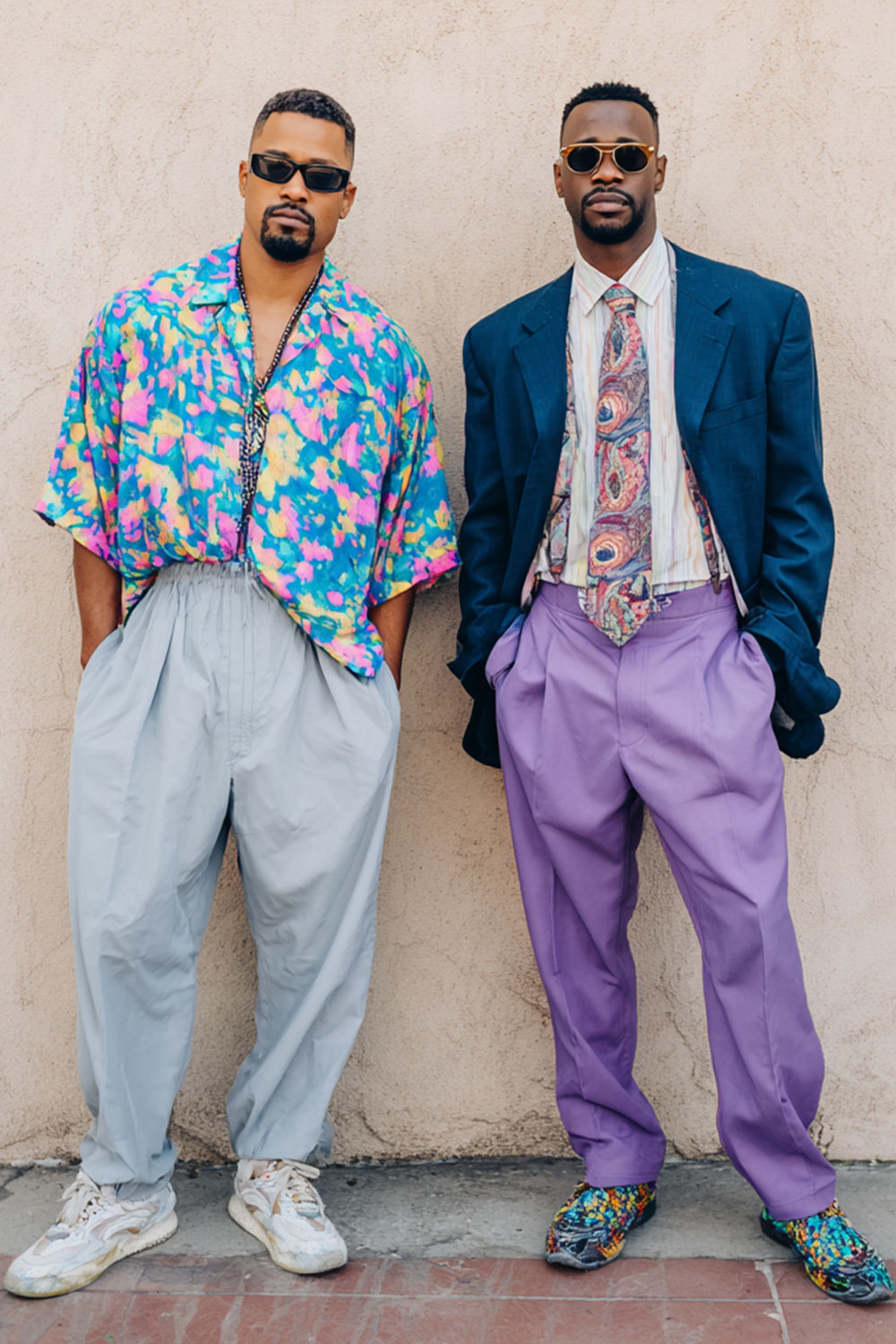
The essentials of 1990s menswear were loose jeans, cargo trousers, bomber and denim jackets, flannel shirts, graphic T-shirts, sportswear, chunky trainers and work boots.
This guide explains how men wore each garment in the 1990s and how to buy and wear it now, such as
Baggy jeans, from JNCO’s wide legs to relaxed straight cuts
The MA-1 bomber jacket and its orange lining
Flannel shirts, graphic T-shirts, logo tops and the grunge cardigan
Sports jerseys, basketball shoes and Timberland boots
Bucket hats, caps and beanies
and many more!
One or two 1990s garments mixed with clothes you already own usually look better than an outfit from a single decade.
Key Points
01Many 1990s garments crossed between grunge, skate, hip-hop and rave dressing, so the combination matters more than the garment.
02Loose cuts still need to fit at the shoulders and end at a sensible length.
03Older trainers can have hardened or crumbling soles, so check before buying a vintage pair to wear.
04Band T-shirts, jerseys and logo clothing carry associations, so choose ones you are happy to be asked about.
The garments that defined 1990s menswear were loose jeans and cargo trousers, bomber and denim jackets, flannel shirts, graphic T-shirts, sportswear, chunky trainers and work boots, finished with caps, bucket hats and beanies.
This guide takes each garment in turn, covering how men wore it in the 1990s, what to look for if you buy one now, and what to wear it with.
Many of these garments crossed between scenes, so the same flannel shirt or pair of boots could appear in grunge, skate and hip-hop outfits; our guide to six 90s men’s fashion styles explains those scenes, and our 90s celebrity outfit ideas show how actors and musicians combined them.
The Museum at FIT’s Fashion History Timeline entry for the 1990s gives a useful overview of the decade, from grunge flannel to the sportswear that hip-hop brought into everyday dress.
1. Jeans and trousers
Baggy jeans
Loose, wide jeans are probably the garment most people picture first when they think of 1990s menswear.
The widest came from labels such as JNCO, founded in Los Angeles in 1985, whose standard styles had leg openings of 20 to 23 inches and whose sales peaked in 1998, according to Mental Floss.
In Britain, the V&A holds a pair of wide, flared Joe Bloggs jeans, made in 1994 and shown in its Streetstyle exhibition to represent Manchester’s late-1980s baggy “Madchester” look.
Not every 1990s jean was extreme, and relaxed straight cuts such as Levi’s long-running 550 offered a milder version.
What to look for now is a relaxed or loose straight leg that fits at the waist without a belt pulling it up, with enough length to sit on your shoes.
Wear them with a plain or graphic T-shirt, an open flannel shirt or a hooded sweatshirt, and chunky trainers or work boots.
Cargo trousers
Cargo trousers came from military uniforms and reached civilian wardrobes through surplus shops, workwear and outdoor clothing.
Writing in 032c, Adriano Sack lists cargo and camouflage trousers among the uniform and military clothes that 1990s clubgoers adopted, and skaters wore similar loose workwear trousers.
What to look for now? Sturdy cotton twill or ripstop, side pockets that lie flat when empty, and a straight or slightly tapered leg.
Pair them with a plain T-shirt or sweatshirt, a bomber jacket and skate shoes or boots.
2. Jackets
Bomber jackets
The MA-1 flight jacket, adopted by the US military in the 1950s, has a nylon shell, knitted cuffs, collar and hem, and, from 1963, a bright orange lining chosen as a rescue colour, according to a history of Alpha Industries, its best-known maker.
The same history notes that Alpha Industries began selling to civilian customers in the 1970s, and by the 1990s MA-1-style bombers were familiar casual jackets.
Today, look for a jacket that ends at the waist, with snug rib cuffs and hem and enough room through the body for a jumper underneath.
Wear it with a white T-shirt, straight jeans or cargo trousers and boots or trainers.
Denim jackets
Trucker-style denim jackets, with chest pockets and a waist-length cut, were worn throughout the decade, often over flannel shirts and hooded sweatshirts and sometimes covered in patches and badges.
What to look for now. A shoulder that fits, a body roomy enough for a layer underneath, and a wash that contrasts with your jeans if you wear both.
It works with a hooded sweatshirt or flannel shirt, black or contrasting jeans and boots.
Windbreakers and track tops
Lightweight nylon windbreakers and track tops, often colour-blocked in bright shades, carried sportswear into everyday dress, and the FIT timeline notes that hip-hop fashion brought “baseball caps and jackets, basketball shorts, tracksuits, and hoodies” into menswear.
Rave dressing also borrowed sportswear, and many clubgoers chose bright or reflective outer layers.
If you buy one now, look for a lightweight shell with an elasticated or adjustable hem, in one strong colour or a simple two- or three-colour block.
Wear one with a plain T-shirt, loose jeans or track trousers and running trainers.
3. Shirts and tops
Flannel shirts
Brushed cotton or wool checked shirts came from workwear, and grunge made them a defining garment of the early 1990s; FIT describes the look as “an oversized flannel shirt, sometimes worn over a t-shirt, and jeans”.
Men wore them open over a T-shirt, buttoned up, or tied around the waist.
What to look for now is a soft, brushed fabric, a shoulder that sits at your own shoulder even if the body is roomy, and a length that covers the waistband when worn open.
Pair one with a plain or band T-shirt, loose jeans and leather boots.
Graphic T-shirts and logo tops
T-shirts printed with band artwork, skateboard company graphics, sports teams and brand logos were among the decade’s most common tops.
Logo clothing became a signal in its own right. Snoop Doggy Dogg wore a Tommy Hilfiger rugby shirt with the brand’s name across the chest on Saturday Night Live in March 1994, and Complex’s oral history reports that the shirts sold out the next day.
What to look for now? A heavier cotton that holds its shape, a print you would be happy to explain, and a cut with dropped shoulders if you want the loose 1990s line.
Wear them with loose jeans or cargo trousers, an open flannel shirt or bomber jacket, and trainers.
Sports jerseys
Basketball, American football and baseball jerseys were worn oversized as everyday tops, and from the 1991 to 1992 NBA season through 1996 to 1997, Champion held the league’s exclusive uniform licence, so many replica basketball jerseys from the period carry its label.
What to look for now is a replica or vintage jersey whose team or player you are happy to be associated with, sized so the shoulders still sit near your own.
Wear one with a plain T-shirt underneath, loose jeans and basketball trainers.
Cardigans and knitwear
Loose cardigans and patterned jumpers belonged to the grunge wardrobe, and the olive cardigan Kurt Cobain wore for Nirvana’s MTV Unplugged performance, an acrylic, mohair and Lycra blend, sold at auction for $334,000 in 2019.
Today, look for a soft, slightly loose cardigan in a muted colour, with sleeves long enough to push up.
Pair it with a striped or plain T-shirt, faded jeans and canvas trainers.
4. Footwear
Basketball and running trainers
Basketball shoes moved from the court to the street, and the Air Jordan 11, which Michael Jordan first wore in May 1995 and which went on sale that November, was the first basketball shoe to use patent leather, according to Andscape.
Running shoes with visible cushioning were also widely worn, among them the Nike Air Max 95, which Sergio Lozano designed with reference to human anatomy.
What to look for now. A reissue or a similar chunky trainer that fits comfortably, as older pairs can have soles that have hardened or crumbled with age.
Wear them with loose jeans, a sweatshirt or jersey and a cap.
Work boots
Timberland’s yellow nubuck six-inch boot had joined hip-hop’s unofficial dress code in New York by the early 1990s, according to Mr Porter’s history of the boot.
When buying now, look for a padded collar, a waterproof nubuck upper and a sole with good grip if you will wear them in wet weather.
They work with loose jeans that sit over the top of the boot and a hooded sweatshirt or puffer jacket.
Dr. Martens and other leather boots
The Dr. Martens 1460 boot, first made in 1960, became a staple of grunge and alternative dressing in the early 1990s, according to Wikipedia’s history of the brand.
What to look for now is leather that is supple enough to bend at the ankle, and a size that leaves room for thick socks.
Pair them with straight or loose jeans, a flannel shirt or cardigan and a beanie.
Skate shoes
Suede skate shoes with padded collars were the everyday shoes of the skate scene, and Vans says its Old Skool, introduced in 1977, became a favourite of street skaters in the 1990s.
What to look for now? A flexible sole and reinforced toe if you skate, or a plain colourway if you only want the look.
Wear them with wide jeans or workwear trousers, a graphic T-shirt and a hooded sweatshirt.
5. Accessories
Caps, bucket hats and beanies
Baseball caps came with sportswear, beanies with grunge and skate dressing, and bucket hats with both hip-hop and Manchester’s music scene.
LL Cool J made the fuzzy Kangol bucket hat a hip-hop staple from the mid-1980s, and the Stone Roses’ drummer Reni was rarely seen without a bucket hat in the late-1980s Madchester scene, according to Complex’s history of the bucket hat.
If you buy one now, look for a hat that fits your head without pressing, in a colour that repeats one in your outfit.
Chains, wallet chains and other jewellery
Gold chains and pendants were common in hip-hop dressing, while wallet chains clipped to a belt loop were common among skaters, punks and grunge fans.
What to look for now. One chain sized in proportion to your outfit, rather than several competing ones, and a wallet chain short enough not to catch on furniture or a skateboard.
How to wear 90s essentials today
Mix one or two 1990s garments with clothes you already own, such as a flannel shirt or a bomber jacket with plain jeans and trainers, rather than dressing head to toe in the decade.
Loose and oversized cuts still need to fit at the shoulders and end at a sensible length, which separates a deliberate shape from the wrong size.
Second-hand shops are a good source of original jackets, flannel shirts and jeans, and our guide to buying vintage menswear explains how to check age, size and condition.
Band T-shirts, sports jerseys and logo clothing carry associations, so wear the ones you understand and are happy to be asked about.
For how these garments fed into today’s casual dressing, see our guide to streetwear.