Use a mirror for this free face-shape test for men. Take your result to the barber, the glasses shop or your next hat-shopping trip.
Face shapes for men: the styles to try
Your result narrows this library to the closest shape and explains the features behind it. You can also explore every guide here.
This guide uses eight face-shape profiles: round, square, oval, rectangle, oblong, heart, diamond and triangle. Pear is another name for triangle here; heart is also called inverted triangle. Sources group and name shapes differently. We use rectangle for a longer angular outline and oblong for a distinctly longer curved outline; other guides combine those two names.
Round — haircuts, beards, glasses and hats
Round
A comparatively compact outline with curved jaw corners.
Also called: Circular.
Compare with square when the corners look more defined, and oval when the face looks longer.
Haircuts
Textured quiff or side part
Quiff: lift the front up and back. Side part: direct the hair to either side of a visible part.
Some height and tidy, tapered sides add definition to a rounded outline.
Put it to use: Ask your barber for texture on top and controlled width at the sides.
Beard styles
Angular boxed beard or tapered full beard
Boxed beard: a defined, neatly maintained cheek and jaw outline. Tapered beard: reduce bulk at the sides and shape the transition towards the chin. Trim the edges regularly; fuller styles depend on your natural coverage.
A defined outline and a little chin length introduce structure.
Put it to use: Keep the cheeks controlled; shape the beard rather than letting it spread sideways.
Glasses
Rectangular or browline frames
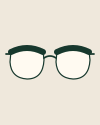
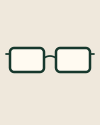
Browline: a heavier upper rim with a thin lower rim beneath it. Rectangular: lenses wider than they are tall, with defined corners.
Clear corners contrast with softly curved features.
Put it to use: Try a frame close to your face width, with a comfortable bridge and temples.
See frame examples
Schematic style examples; lens tint and protection are separate choices.
Sunglasses
D-frame or geometric sunglasses
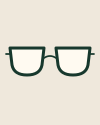
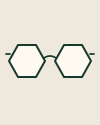
D-frame: a broad upper edge above rounded, gently tapering lower corners. Geometric: several straight sides, such as this softly cornered hexagon.
A firmer upper line adds definition without requiring a very heavy frame.
Put it to use: Compare medium-sized frames before choosing an oversized pair.
See frame examples
Schematic style examples; lens tint and protection are separate choices.
Hats
Creased fedora or structured flat cap
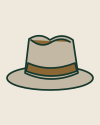
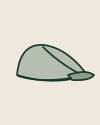
Fedora: a creased, pinched crown with a brim all the way around. Flat cap: a low, sloping crown ending in a short front peak.
A defined crown and a slight tilt can add vertical emphasis.
Put it to use: Try the hat at different angles and check the whole silhouette in a mirror.
Square — haircuts, beards, glasses and hats
Square
A comparatively compact outline with more defined jaw corners.
Also called: Square-shaped.
Round shares similar proportions with softer corners. Rectangle describes a longer, angular outline.
Haircuts
Buzz cut or textured side part
Side part: direct the hair to either side of a visible part. Buzz cut: a very short clipper cut following the scalp.
A short cut shows the jaw; a textured top gives a softer finish.
Put it to use: Choose the amount of texture and side length with your barber.
Beard styles
Stubble or a rounded short beard
Stubble: very short facial hair that leaves the skin visible. Rounded beard: a curved lower outline rather than squared corners. Trim the edges regularly; fuller styles depend on your natural coverage.
Stubble keeps the jaw visible; a rounded finish softens its corners.
Put it to use: For a softer look, keep the sides controlled and round off the beard below the chin.
Glasses
Round, oval or panto frames
Panto: a rounded lower rim with a slightly flattened upper edge. Oval: smooth lens outlines that are wider than they are tall. Round: near-circular rims, with curves all the way around.
Curves provide contrast to the jaw’s straighter lines.
Put it to use: Compare softer corners with a sharply squared frame to see the difference.
See frame examples
Schematic style examples; lens tint and protection are separate choices.
Sunglasses
Rounded aviators or soft D-frames
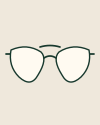
D-frame: a broad upper edge above rounded, gently tapering lower corners. Aviator: a teardrop-style lens outline, often with a second bridge bar.
Curved lenses can balance a strong angular outline.
Put it to use: Choose a width that sits comfortably at the temples without squeezing.
See frame examples
Schematic style examples; lens tint and protection are separate choices.
Hats
Bucket hat or soft-brim fedora
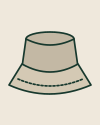
Fedora: a creased, pinched crown with a brim all the way around. Bucket hat: a flat-topped crown with a soft brim that slopes down around it.
Rounded crowns and curved brims soften the overall outline.
Put it to use: Check that the crown sits comfortably and the brim does not overwhelm your face.
Oval — haircuts, beards, glasses and hats
Oval
An outline that looks moderately longer than wide, with curved corners and no strongly dominant width zone.
Also called: Egg-shaped, Elliptical.
Oval describes the moderately longer, curved profile here. A more elongated curved outline is called oblong; a clearly cheekbone-dominant outline is called diamond.
Haircuts
Classic taper with a side part or short quiff
Quiff: lift the front up and back. Side part: direct the hair to either side of a visible part. Taper: gradually shorten the hair around the ears and nape; it need not expose skin.
Moderate top texture works with an outline that has no strongly dominant width zone.
Put it to use: Use your hair texture and the styling time you prefer to choose between them.
Beard styles
Stubble or a neat short boxed beard
Stubble: very short facial hair that leaves the skin visible. Boxed beard: a defined, neatly maintained cheek and jaw outline. Trim the edges regularly; fuller styles depend on your natural coverage.
Both keep the outline clear without adding a lot of extra length.
Put it to use: Maintain the edges and choose a length your beard growth supports evenly.
Glasses
Soft rectangular or panto frames
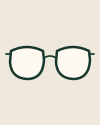
Panto: a rounded lower rim with a slightly flattened upper edge. Rectangular: lenses wider than they are tall, with defined corners.
An oval outline leaves room to compare both angular and curved styles.
Put it to use: Prioritise bridge comfort, temple fit and a frame proportionate to your face.
See frame examples
Schematic style examples; lens tint and protection are separate choices.
Sunglasses
D-frames or aviators
D-frame: a broad upper edge above rounded, gently tapering lower corners. Aviator: a teardrop-style lens outline, often with a second bridge bar.
Both are useful starting points for an evenly tapered outline.
Put it to use: Compare lens depth and overall width; a fashionable shape still needs a good fit.
See frame examples
Schematic style examples; lens tint and protection are separate choices.
Hats
Fedora or flat cap
Fedora: a creased, pinched crown with a brim all the way around. Flat cap: a low, sloping crown ending in a short front peak.
An oval outline works with a broad range of crown and brim shapes.
Put it to use: Choose the scale and material to match your outfit and the occasion.
Rectangle — haircuts, beards, glasses and hats
Rectangle
An outline longer than wide with more defined jaw corners.
Also called: Rectangular, Extended square.
Rectangle and oblong are used interchangeably in some guides. Here, rectangle names the longer angular outline, while oblong names the longer curved outline.
Haircuts
Scissor-cut side part or light textured fringe
Side part: direct the hair to either side of a visible part. Fringe: hair sits forward over the forehead; a side-swept fringe goes across it. Scissor cut: use scissors to shape and blend length, retaining the side fullness you discuss.
Controlled height and some side fullness work with a longer, angular outline.
Put it to use: Ask for a low-profile top rather than a tall quiff with very tight sides.
Beard styles
Stubble or a rounded short beard
Stubble: very short facial hair that leaves the skin visible. Rounded beard: a curved lower outline rather than squared corners. Trim the edges regularly; fuller styles depend on your natural coverage.
Keeping the chin shorter limits extra length; softer edges contrast with jaw corners.
Put it to use: Watch the silhouette from the side as well as straight on.
Glasses
Panto or rounded-square frames
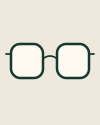
Panto: a rounded lower rim with a slightly flattened upper edge. Rounded square: a fuller lens shape with soft corners and similar height and width.
Softer corners and enough lens depth break up a long, angular outline.
Put it to use: Avoid choosing a very small frame just because its shape looks right.
See frame examples
Schematic style examples; lens tint and protection are separate choices.
Sunglasses
Deeper aviators or soft D-frames
D-frame: a broad upper edge above rounded, gently tapering lower corners. Aviator: a teardrop-style lens outline, often with a second bridge bar.
A fuller lens shape gives the upper face more presence.
Put it to use: Try a proportionate width and depth together, rather than simply sizing up.
See frame examples
Schematic style examples; lens tint and protection are separate choices.
Hats
Low-crown fedora or Panama
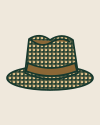
Fedora: a creased, pinched crown with a brim all the way around. Panama straw hat: a woven straw hat; this example uses a fedora-shaped crown and brim.
A lower crown and a broader brim emphasise width instead of extra height.
Put it to use: Compare crown heights in the mirror; the tallest option is not always the most balanced.
Oblong — haircuts, beards, glasses and hats
Oblong
An elongated outline with smoother jaw corners.
Also called: Elongated oval, Extended oval, Soft rectangle.
Oblong is also called elongated oval or soft rectangle. Here, smoother jaw corners distinguish it from the rectangular profile.
Haircuts
Textured fringe or classic scissor cut
Fringe: hair sits forward over the forehead; a side-swept fringe goes across it. Scissor cut: use scissors to shape and blend length, retaining the side fullness you discuss.
Width at the sides and a lower top work with pronounced face length.
Put it to use: Keep some side fullness; avoid relying on a tall top for the finished shape.
Beard styles
Short boxed beard or stubble
Stubble: very short facial hair that leaves the skin visible. Boxed beard: a defined, neatly maintained cheek and jaw outline. Trim the edges regularly; fuller styles depend on your natural coverage.
A shorter chin and controlled side fullness limit added length.
Put it to use: Keep a longer beard’s chin section trimmed relative to its sides.
Glasses
Browline or fuller rectangular frames
Browline: a heavier upper rim with a thin lower rim beneath it. Rectangular: lenses wider than they are tall, with defined corners.
A clear horizontal line helps give the upper face more breadth.
Put it to use: Look for useful lens depth and a comfortable bridge, not an undersized narrow frame.
See frame examples
Schematic style examples; lens tint and protection are separate choices.
Sunglasses
Deep D-frames or browline sunglasses
Browline: a heavier upper rim with a thin lower rim beneath it. D-frame: a broad upper edge above rounded, gently tapering lower corners.
A fuller frame can balance a long, softly curved outline.
Put it to use: Check that the frame remains proportionate instead of extending far beyond your temples.
See frame examples
Schematic style examples; lens tint and protection are separate choices.
Hats
Low-crown Panama or broad-brim fedora
Fedora: a creased, pinched crown with a brim all the way around. Panama straw hat: a woven straw hat; this example uses a fedora-shaped crown and brim.
A lower crown and more brim width give a horizontal emphasis.
Put it to use: Try the brim level and slightly angled forward; keep whichever proportion you prefer.
Heart / inverted triangle — haircuts, beards, glasses and hats
Heart / inverted triangle
A wider upper face that narrows towards the jaw.
Also called: Inverted triangle, Heart-shaped.
Diamond places the clearest width at the cheekbones rather than the forehead/upper face. A widow’s peak is not required for this label.
Haircuts
Side-swept fringe or soft, layered side part
Side part: direct the hair to either side of a visible part. Fringe: hair sits forward over the forehead; a side-swept fringe goes across it. Layers: different lengths that let the hair move and separate.
A softer sweep frames the forehead and keeps the overall shape from becoming top-heavy.
Put it to use: Ask for controlled texture and some side length rather than an aggressive high fade.
Beard styles
Short full beard or defined stubble
Stubble: very short facial hair that leaves the skin visible. Full beard: connected coverage across cheeks, chin and moustache where your growth allows. Trim the edges regularly; fuller styles depend on your natural coverage.
Facial hair gives the narrower lower face more presence.
Put it to use: If growing a beard, retain useful width around the jaw rather than sharpening it to a long point.
Glasses
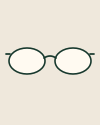
Light oval or thin metal frames
Oval: smooth lens outlines that are wider than they are tall.
Lighter lines give you options without adding a heavy bar across the forehead.
Put it to use: Try on different rim weights; check fit before deciding from the shape name.
See frame examples
Schematic style examples; lens tint and protection are separate choices.
Sunglasses
Rounded aviators or slim D-frames
D-frame: a broad upper edge above rounded, gently tapering lower corners. Aviator: a teardrop-style lens outline, often with a second bridge bar.
Curved lens bottoms and a lighter upper line are useful contrasts to a tapering lower face.
Put it to use: Compare modest frame widths rather than automatically choosing oversized sunglasses.
See frame examples
Schematic style examples; lens tint and protection are separate choices.
Hats
Medium-brim fedora or newsboy cap
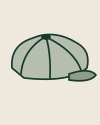
Fedora: a creased, pinched crown with a brim all the way around. Newsboy cap: a fuller, rounder panelled crown above a short peak, often with a top button.
Moderate proportions can work with a broader forehead and narrower jaw.
Put it to use: Try a slight tilt and compare the crown with your forehead width.
Diamond — haircuts, beards, glasses and hats
Diamond
Cheekbones stand out as clearly wider than both forehead and jaw.
Also called: Diamond-shaped, Rhombus.
Heart is wider at the upper face. A small cheekbone-width difference can fit oval or another outline; it does not automatically make a diamond.
Haircuts
Side-swept fringe or scissor-cut layers
Fringe: hair sits forward over the forehead; a side-swept fringe goes across it. Scissor cut: use scissors to shape and blend length, retaining the side fullness you discuss. Layers: different lengths that let the hair move and separate.
Some fullness around the temples works with prominent cheekbones.
Put it to use: Keep the sides soft enough to frame the upper face; adapt the volume to your hair texture.
Beard styles
Rounded short beard or softly shaped full beard
Rounded beard: a curved lower outline rather than squared corners. Full beard: connected coverage across cheeks, chin and moustache where your growth allows. Trim the edges regularly; fuller styles depend on your natural coverage.
Softer beard contours contrast with angular cheekbones.
Put it to use: Keep the cheek line natural rather than cutting it unusually low.
Glasses
Panto, oval or softly rounded browline frames
Panto: a rounded lower rim with a slightly flattened upper edge. Oval: smooth lens outlines that are wider than they are tall. Browline: a heavier upper rim with a thin lower rim beneath it.
Curves soften angles; an upper accent can give a narrower forehead more presence.
Put it to use: Avoid solving width by oversizing a frame that does not fit your bridge.
See frame examples
Schematic style examples; lens tint and protection are separate choices.
Sunglasses
Round or soft D-frame sunglasses
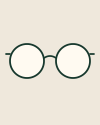
D-frame: a broad upper edge above rounded, gently tapering lower corners. Round: near-circular rims, with curves all the way around.
Softer lens edges work with a cheekbone-led outline.
Put it to use: Check both the brow line and the widest part of the frame against your face.
See frame examples
Schematic style examples; lens tint and protection are separate choices.
Hats
Medium-brim fedora or softly angled beret
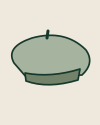
Fedora: a creased, pinched crown with a brim all the way around. Beret: a soft, brimless crown that can sit with more fullness on one side.
A brim or sideways sweep gives the upper outline more width.
Put it to use: Use the mirror to compare the hat’s width with your cheekbones.
Triangle / pear — haircuts, beards, glasses and hats
Triangle / pear
A wider jaw with a narrower upper face.
Also called: Pear, Pear-shaped, Triangular, Pyramidal.
Triangle and pear name the same jaw-wide family here. Heart or inverted triangle describes the opposite orientation: a wider upper face and narrower jaw.
Haircuts
Layered side part or low taper with a textured top
Side part: direct the hair to either side of a visible part. Taper: gradually shorten the hair around the ears and nape; it need not expose skin. Layers: different lengths that let the hair move and separate.
Texture near the top corners gives a narrower forehead more presence.
Put it to use: Ask for some fullness at the temples rather than a very high, tight fade.
Beard styles
Tapered full beard or clean-shaven
Tapered beard: reduce bulk at the sides and shape the transition towards the chin. Clean-shaven: remove the beard to show your natural jaw outline. Trim the edges regularly; fuller styles depend on your natural coverage.
A shaped full beard can taper a broad jaw; clean-shaven keeps its natural outline visible.
Put it to use: If growing it, control bulk at the jaw corners and shape the sides deliberately.
Glasses
Browline or D-frame glasses
Browline: a heavier upper rim with a thin lower rim beneath it. D-frame: a broad upper edge above rounded, gently tapering lower corners.
A stronger upper frame draws attention towards the narrower upper face.
Put it to use: Compare upper-rim weight while keeping the same comfortable fit.
See frame examples
Schematic style examples; lens tint and protection are separate choices.
Sunglasses
Browline sunglasses or aviators with a defined brow bar
Browline: a heavier upper rim with a thin lower rim beneath it. Aviator: a teardrop-style lens outline, often with a second bridge bar.
A defined top line gives the forehead area more visual presence.
Put it to use: Choose a frame with comfortable temple spacing and well-positioned lenses.
See frame examples
Schematic style examples; lens tint and protection are separate choices.
Hats
Fuller flat cap or medium-brim fedora
Fedora: a creased, pinched crown with a brim all the way around. Flat cap: a low, sloping crown ending in a short front peak.
Trying more presence above the forehead can balance a jaw-led outline.
Put it to use: This is a proportion-based starting point: compare crown width and tilt in your mirror.
How the face-shape comparisons work
Compare forehead, cheekbone and jaw widths, length, jaw corners and chin tip. Clear width dominance selects an upper-wide, cheekbone-wide or lower-wide family; length and corners remain part of your description. When widths are similar, length and corners select the general outline. At one oval/heart boundary—similar forehead and cheekbones, narrower jaw, moderate length and curved jaw corners—a rounded or flatter chin favours oval, while a pointed tip favours heart. When both ends are wider than the cheekbones, compare those ends directly. Similar ends use the general outline, with the narrower middle explicitly recorded. The last comparison opens your result. You can change any answer from the result; a newly required comparison must be answered before the result updates.
Choose the closest visible feature. Use Similar for small width differences. The result follows these stated rules and the answers you choose; it does not provide a measured accuracy percentage.
Sources and styling approach
Adapt the shortlist to your hair texture, beard growth and preferred look. Glasses and hats should fit comfortably. Use these face-shape suggestions as a shortlist to try, and keep the options you prefer.
Guidance prepared with AI assistance using the references below.
- Paul Mitchell school: seven qualitative face shapes — Definitions of jaw, temple and cheekbone patterns; not validation of this questionnaire.
- University of Kentucky: Face Shape and Hair Care — Pages 2–3 describe the broad families, including pear and rectangle; illustrative proportions are not quiz thresholds.
- The VOU: existing nine face-shape names — Editorial naming inventory; not evidence of assessment accuracy.
- Milady: facial-shape terminology — Publisher-indexed page 47 groups triangle/pear and rectangle/oblong. Full PDF fetch was unavailable during this review; naming only.
- Warby Parker: face shapes and frame fit — Shape terms, inverted-triangle/heart alias, and the importance of fit and personal preference.
- London School of Barbering: face-shape styling — Qualitative styling discussion; its diamond/triangle naming differs from ours.
- Le Petit Lunetier: diamond/rhombus naming — Primary eyewear brand explicitly uses diamond and rhombus for the same face-shape name.
- Bespoke Unit: round face-shape styling
- Bespoke Unit: square face-shape styling
- Bespoke Unit: oval face-shape styling
- Bespoke Unit: oblong face-shape styling
- Bespoke Unit: heart face-shape styling
- Bespoke Unit: diamond face-shape styling
- Bespoke Unit: triangle face-shape styling
- Warby Parker: glasses for face shapes and fit
- Lock & Co.: choosing hats for face shape
- Christys: crown, brim and face proportions
- Warby Parker: frame shapes and names
- Maison Mata: recognising panto and other frames
- Bailey Hats: hat glossary
- Wahl: cutting and blending hair
- Braun: short boxed beard outlines
Oblong, Rectangle, Long face, Elongated face: Usage varies. This quiz uses oblong for a long curved outline and rectangle for a long angular outline; long or elongated alone does not settle that distinction.
Trapezoid, Inverted heart, Wide-base face: Used in The VOU’s pear discussion for a narrower upper face and wider jaw. Treat these as descriptions of the triangle/pear family, with the orientation stated.
Reverse triangle, Inverted pyramid: Direction is ambiguous across descriptions. Check which end is widest; do not map these words to a result without that information.
Angular face, Strong jaw, Cheekbone-dominant face, Wide forehead, Narrow forehead: These describe individual features and are not precise interchangeable names for a complete face shape.
Model face, Masculine face, Muscular face, Ideal face, Balanced face, Proportional face: These are evaluative or non-specific descriptions, not extra geometrical categories.
Illustrative AI-generated portraits. The guides mark the features to compare. Guide 6.4.0 · Updated 9 September 2026.
Make your face-shape result useful
Keep the styles you like and use the reasons to compare alternatives. At the barber, discuss your hair texture and how much styling you want to do. When shopping, try the suggested frame or hat shapes in a few sizes: a shape name cannot replace a comfortable fit.
How do I find out my face shape as a man?
Look straight into a mirror with your hair away from your forehead. Compare your jaw corners, face length, forehead width, jaw width and chin. This men’s face-shape test guides you through those observations and explains the closest match. A sixth comparison appears only when the forehead and jaw both look wider than the cheekbones.
Is this a face-shape test, a haircut quiz or a photo detector?
It starts with a visual face-shape quiz and then gives you shape-specific styling ideas. A mirror is all you need for the comparisons. The haircut suggestions are starting points to discuss with a barber, who can adapt them to your hair texture, density and growth pattern.
How can I use my result for haircuts and beard styles?
Compare the named cuts and beard outlines in your result, read why they work with that face shape, and copy your style notes. Show the shortlist at your next appointment and discuss the length, texture and finish you prefer. You can emphasise your natural outline or choose a contrasting shape.
Which glasses and sunglasses suit my face shape?
Your result suggests useful frame shapes to try. Curves and corners can either echo or contrast with your face, but fit remains essential: check the bridge, temple comfort, frame width and lens position. For sunglasses, check the lens protection information separately from the frame’s appearance.
Can my face shape help me choose a hat?
Yes. Crown height, brim width and the angle you wear a hat can change the overall silhouette. Your result gives you starting styles and a simple mirror check. Choose a hat that sits comfortably and works with your outfit as well as your face.
How accurate is a face-shape quiz?
This is a closest-match guide based on the observations you choose. Lighting, a tilted head, a hidden or receding hairline and beard bulk can affect those comparisons. Face shapes overlap, so the result keeps your actual observations and explains nearby categories. No measured accuracy percentage is claimed.
Why do different guides use different face-shape names?
Some guides combine rectangle and oblong; this quiz separates longer angular and distinctly longer curved outlines. Triangle and pear describe the same jaw-wide family here. Heart is also called inverted triangle. The definitions above explain the convention used for your result.
Is the quiz free, and can I change an answer?
The quiz and complete style result are free. A valid email address is required: enter the code we send before viewing or copying your personal result. This does not sign you up for newsletters or promotional emails. Your answers are saved for up to 24 hours while you verify, and each verified completion stays in your private quiz history for 12 months. Use Back during the comparisons or Change in your result to edit an answer. You can also start a separate retake.
Explore the men’s styling quiz collection or browse the men’s styling guides for other decisions. This face quiz is the starting point for the appearance choices covered here.