
Start here
What’s This About
Poplin is a smooth plain weave and twill is a diagonal weave; both make good business shirts, so judge the actual shirt rather than the weave name.
This guide answers the questions shoppers ask when a product page says poplin or twill, such as
What difference can I actually see between the two weaves?
How does each work with a suit, a plain jacket or an open neck?
How do I check a white shirt for opacity before buying?
Which suits a warm commute, a long seated day or a photographed event?
Where does Oxford cloth fit?
and many more!
Start with poplin for a crisp, quiet shirt or twill for visible texture, then check the shirt itself for opacity, feel and care.
Key Points
01Poplin and twill describe weave structures, not the fibre content.
02A diagonal pattern identifies twill; poplin has a more uniform plain-weave surface.
03Weight, yarn, finish and colour can change how two shirts of the same weave behave.
04Neither weave guarantees an opaque white shirt or a wrinkle-free day.
The difference you can see
Look closely at a twill shirt and you will usually see diagonal lines running across the fabric.
On a poplin shirt, the surface looks more even and less visibly patterned.
Proper Cloth’s fabric reference explains twill and the close relationship between poplin and broadcloth.
Retailers may sell poplin and broadcloth under either name, so product descriptions are more useful than expecting consistent terminology across shops.
Both weaves can be made with cotton, but the weave name is not a fibre declaration.
Read the composition label if you want cotton, a blend or a particular care routine.
How each can work in an outfit
Poplin for a quiet, crisp surface
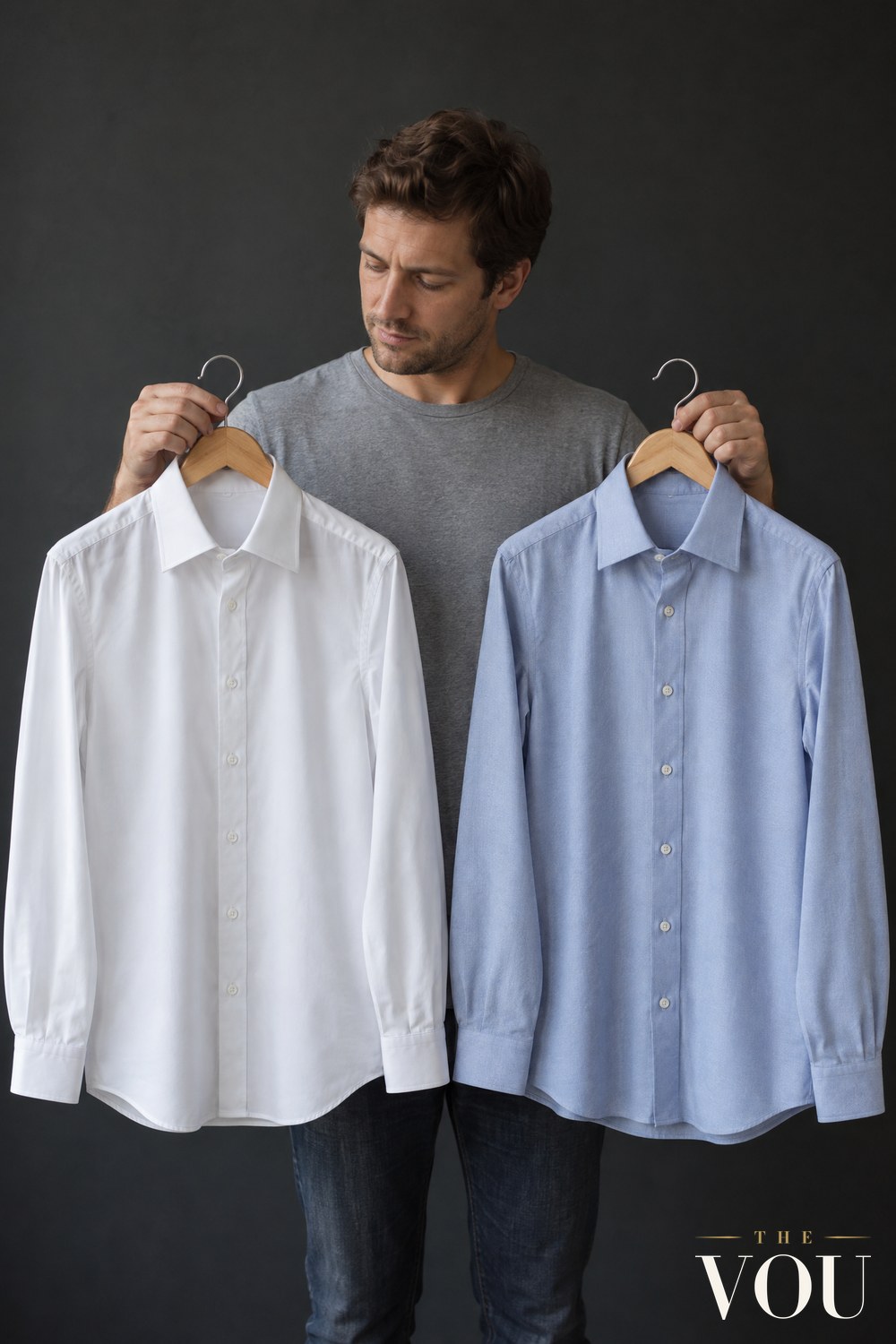
A white or pale-blue poplin shirt is a straightforward starting choice with a navy or charcoal suit.
Its relatively unobtrusive surface lets the tie and jacket provide the texture.
Poplin is not restricted to business clothing.
A softer casual construction, different colour or relaxed cut can change the shirt’s character.
Judge collar, cuffs and hem alongside the cloth.
Twill for visible texture
A pale-blue twill can add subtle texture under a plain jacket or work open-neck with grey trousers.
Some twills have a noticeable sheen; inspect the cloth in ordinary light if you prefer a matte finish.
Harvie & Hudson’s comparison describes its twills as softer and easier to iron than its poplins.
Treat that as a useful comparison to investigate, not a guarantee that every twill from every maker behaves the same way.
Check opacity before buying a white shirt
Hold the cloth against a contrasting background or examine the retailer’s opacity information where available.
A photograph taken under flattering studio lighting may not tell you how the shirt looks in a bright office.
Do not use “twill” as a substitute for checking whether an undershirt or your skin will show through.
Two white fabrics may differ in thickness and density even when they share the same weave name.
Proper Cloth notes that white broadcloth, the cloth it treats as poplin, “can be slightly transparent”, so a white poplin especially needs this check.
Try the shirt with the underlayer you intend to wear.
Choose for the day you actually have
As a rule of thumb, poplin is the lighter, crisper cloth, which suits a warm commute; Harvie & Hudson describes its poplin as “smooth, crisp and lightweight”.
Twill usually resists creasing better and irons more easily, which suits a long seated day; Proper Cloth says twill is “relatively easy to iron and more resistant to wrinkles”, and Harvie & Hudson says its twill “resists creasing more effectively”.
The weight and finish of the particular shirt still decide, so compare the shirts themselves before you buy.
For an event with photographs, try the whole outfit in daylight.
Check whether the shirt’s surface competes with a patterned tie or textured jacket.
If it does, simplify whichever of the tie, the jacket or the shirt is easiest to change, rather than assuming the shirt itself is wrong.
An easy comparison is to try a plain pale-blue poplin and a similarly coloured twill with the same jacket and trousers.
Keeping the colour and outfit stable makes the fabric difference easier to judge.
Where Oxford cloth fits
Oxford is another weave category, with a more pronounced texture in the familiar casual Oxford cloth button-down.
It should not be treated as simply another name for twill.
The VOU’s OCBD guide describes that garment itself, covering its cloth, its soft collar roll and its history.
If you already own several smooth business shirts, an Oxford button-down may provide a different casual option; it is not automatically the better replacement for a shirt you wear with formal tailoring.
A practical buying check
Read fibre composition and care instructions.
Inspect the surface for texture and sheen.
Check opacity in the colour you plan to buy.
Compare weight and feel where possible.
Try it with your intended jacket, trousers and underlayer.
Assess fit independently, because a preferred weave cannot rescue the wrong collar or sleeve size.
Frequently Asked Questions
Q. Is twill more formal than poplin?
Neither name settles the entire dress code.
A plain, well-chosen shirt in either weave can work with a business suit.
Colour, collar, cuffs, finish and the event all contribute.
Q. Is poplin the same as cotton?
No.
Poplin describes the weave; cotton is a fibre.
A product must state its composition separately.
Q. Does twill mean non-iron?
No.
Non-iron is a separate product claim or treatment.
Read the particular shirt’s description and care label.