

Start here
What’s This About:
Steampunk fashion mixes Victorian and Edwardian clothing with imagined steam-age technology, from waistcoats and long coats to brass, leather and goggles.
This guide explains the style’s science-fiction roots and how men can wear it, such as:
• Where the word steampunk came from and how the clothing scene grew
• How steampunk differs from Victorian dress, goth and punk
• The core men’s garments, from the waistcoat to boots and a top hat
• Three ways to wear it, from an everyday nod to a full convention outfit
• Building an outfit on a budget with charity-shop finds and simple changes
and many more!
Steampunk is a costume-friendly style with no single correct version, so build the outfit around where you are going and the character you enjoy.
Key Points:
01The term is usually credited to the writer K. W. Jeter in 1987, and the clothing scene grew in the 2000s around makers and conventions.
02A waistcoat over a band-collar or wing-collar shirt is the simplest starting point for men.
03Match the amount of detail to the setting: one period garment for every day, more accessories for a themed evening, a full character outfit for a convention.
04Check event rules on prop weapons and plan for heat before wearing several wool layers indoors.
Steampunk fashion is a way of dressing that mixes Victorian and Edwardian clothing with imagined steam-age technology: waistcoats, long coats, boots and top hats, finished with brass, leather, goggles and gears.
It grew out of science fiction, which is why the look often tells a story about an inventor, explorer or airship pilot rather than reproducing real nineteenth-century dress.
This guide explains where steampunk came from, how it differs from goth, punk and Victorian dress, and how men can wear it, from a subtle everyday nod to a full convention outfit.
Where steampunk came from
The name comes from science fiction.
The writer K. W. Jeter is generally credited with coining “steampunk” in a tongue-in-cheek letter to the magazine Locus in 1987, describing Victorian-set fantasies that he and fellow writers were producing; his 1979 novel Morlock Night is one of those books.
The idea behind it is retrofuturism: a nineteenth century in which steam power, clockwork and brass machines went much further than they did in reality.
Steampunk clothing grew into a scene of its own in the 2000s, helped by online communities, makers and costume events.
SalonCon, held in 2006, is often described as the first convention devoted to steampunk, and from October 2009 to February 2010 Oxford’s Museum of the History of Science held a steampunk exhibition of art, design and working machines.
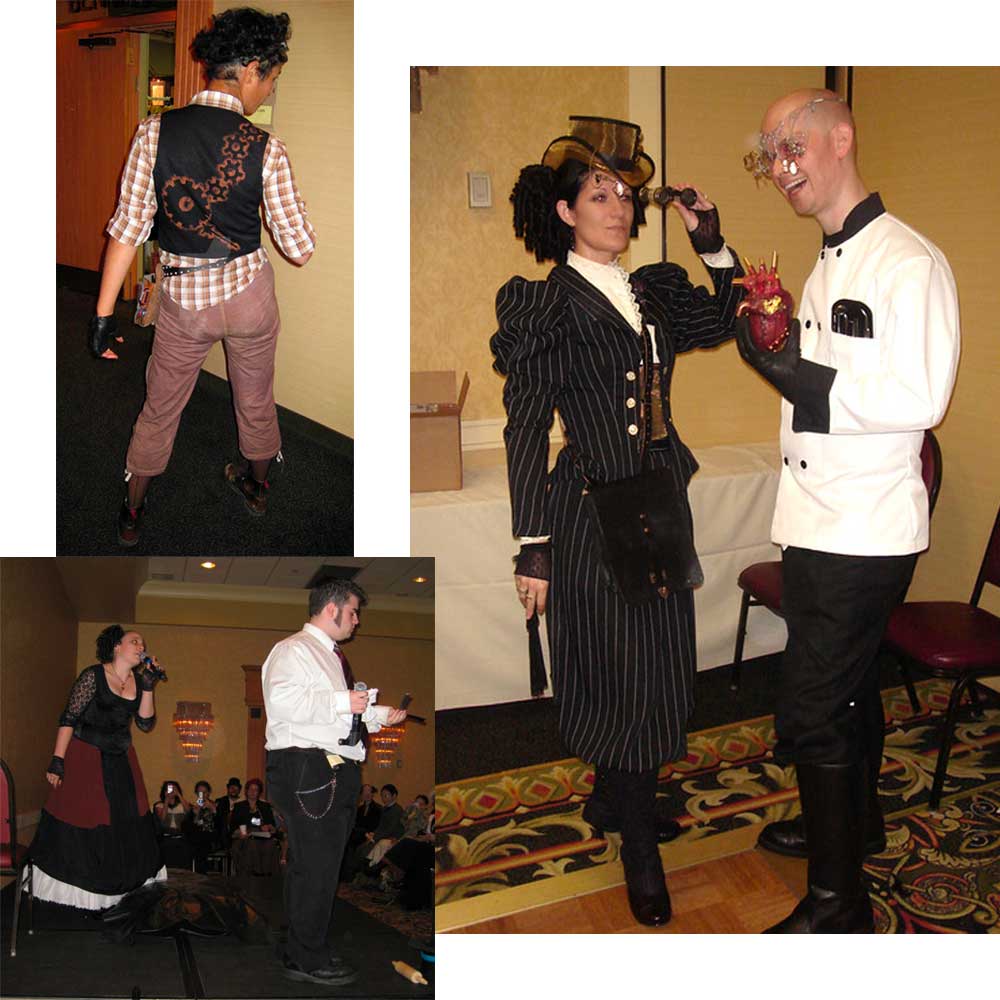
The photographs above show how varied convention outfits are: a waistcoat with a gear motif over a checked shirt, a pinstriped outfit with a small top hat, and a white high-collared jacket worn with goggles.
Steampunk in books, film and television
Alan Moore’s comic series The League of Extraordinary Gentlemen, set in an imagined Victorian Britain with characters from nineteenth-century fiction, is a frequently cited reference.
Films such as Wild Wild West and Van Helsing, and Guy Ritchie’s Sherlock Holmes, use Victorian clothing alongside invented gadgets and are often named as visual references, even though not all of them are steampunk in the strict sense.
Television has also dropped into the subculture: the crime series Castle set a 2010 episode, “Punked”, among a steampunk society.
Use these as sources of ideas for silhouettes and accessories rather than costume blueprints.
Steampunk, Victorian dress, goth and punk
These styles share some clothes, such as waistcoats, long coats, boots and dark colours, but they come from different places.
Scroll horizontally to see all columns →
| Style | Starting point | Typical menswear details |
|---|---|---|
| Steampunk | Science fiction imagining a steam-powered nineteenth century. | Waistcoats, long coats, boots, brass and leather accessories, goggles, gadgets. |
| Victorian dress | Real clothing of 1837 to 1901. | Frock coats, waistcoats, high collars, cravats and top hats, worn without invented technology. |
| Goth | The post-punk music scene of the late 1970s and early 1980s. | Dark layers, velvet, lace and dramatic contrasts. |
| Punk | Music scenes of the 1970s in New York and London. | Altered garments, band graphics, tartan, studs and safety pins. |
For the history of the period clothing steampunk borrows from, see our Victorian menswear guide; for the music-linked styles, see our goth fashion guide and punk fashion guide.
The core garments of men’s steampunk
Most men’s steampunk outfits are built from a small set of garments, so you can start with one or two and add the rest over time.
Waistcoat: the most useful single garment. Tweed, wool, canvas, brocade or leather all work; brass or metal-look buttons add to the effect.
Shirt: a white, ivory or striped shirt, ideally with a band collar or wing collar. An ordinary button-down shirt works if you add a cravat or keep the collar open.
Neckwear: a cravat, ascot or narrow bow tie in place of a modern tie.
Trousers: high-waisted trousers in plain wool, tweed, pinstripe or canvas, held up with braces (suspenders).
Coat: a frock coat, long duster, military-style jacket or tailcoat, depending on the character you want to suggest.
Footwear: lace-up leather boots, or plain dark shoes with spats.
Hat: a top hat, bowler, flat cap or aviator cap.
Accessories: goggles, a pocket watch on a chain, leather belts and satchels, gauntlets and gear or brass details.
Earth tones such as brown, tan and olive dominate, along with grey, black, ivory and deep jewel colours like burgundy.
Brass and copper are the usual metal accents.
Natural fibres suit the look, but synthetic fabrics and faux leather are perfectly usable, especially for a costume worn a few times a year; choose them by how they look and feel rather than avoiding them on principle.
Three ways to wear steampunk
Decide first where you are going: an ordinary day, a themed evening and a convention call for very different amounts of detail.
1. An everyday nod
Wear: a grey or brown tweed waistcoat over a white band-collar shirt, dark straight trousers, brown leather boots and a pocket watch or a watch on a leather strap.
The waistcoat and collar carry the Victorian reference while the rest of the outfit stays current, so this works for a casual day or a relaxed office that allows it.
Leave goggles and gadgets at home for this version.
2. A themed evening or party
Wear: a brown waistcoat with brass buttons, high-waisted pinstripe or tweed trousers with braces, a wing-collar shirt with a cravat, a long dark coat, lace-up boots and a bowler hat.
Add one accessory with a story, such as a pocket watch on a chain or goggles worn on the hat band.
Check the venue’s dress code and how much standing and walking you will do before choosing boots and layers.
3. A full convention outfit
At a convention, many people build their outfit around a character.
Airship pilot: a leather or canvas jacket, a scarf, a flying cap, goggles, high-waisted trousers and boots.
Inventor or engineer: a canvas waistcoat with pockets, rolled shirtsleeves, a leather apron or tool belt and brass gadgets.
Gentleman explorer: a frock coat, waistcoat, cravat, top hat, a cane and a satchel.
Read the event’s rules before you go, particularly on prop weapons and large accessories, and plan for heat: several wool layers under convention lighting can get very warm.
Steampunk in hot weather
Swap wool for cotton or linen: a lightweight shirt and a cotton, linen or canvas waistcoat keep the outline without the warmth.
Leave the coat off, roll the shirtsleeves, and let the hat, goggles and brass details carry the look.
Carry water and choose footwear you have already worn for a full day.
Build it on a budget
Steampunk rewards making and adapting rather than buying everything ready-made.
Charity shops and thrift stores are good sources of waistcoats, tweed jackets, leather belts and old brass fittings.
Swapping plain buttons for brass or metal ones, adding a watch chain or attaching small gears to a hat band can change ordinary clothes into steampunk with little cost.
If you sew or glue decorative fittings, test placement while you move so nothing catches or digs in.
Common questions about steampunk fashion
Q. Is steampunk the same as Victorian fashion?
No.
Victorian fashion is real clothing from 1837 to 1901, while steampunk adds imagined technology, invented characters and modern costume-making to that starting point.
Q. Do I need goggles?
No, but they are one of the most recognisable accessories.
For a subtle outfit, a waistcoat, collar and pocket watch say steampunk clearly enough.
Q. Can I wear steampunk every day?
Yes, in a toned-down form: one or two period garments, such as a waistcoat and a band-collar shirt, with current trousers and boots.
Q. Where should I start?
Start with a waistcoat and a shirt you already own, then add one accessory with a story and build from there.
Sources
Dictionary.com, “steampunk” (Jeter’s 1987 Locus letter; SalonCon in 2006).
The Encyclopedia of Science Fiction, “Steampunk”.
Museum of the History of Science, Oxford, Steampunk exhibition, 13 October 2009 to 21 February 2010.