
Start here
What’s This About
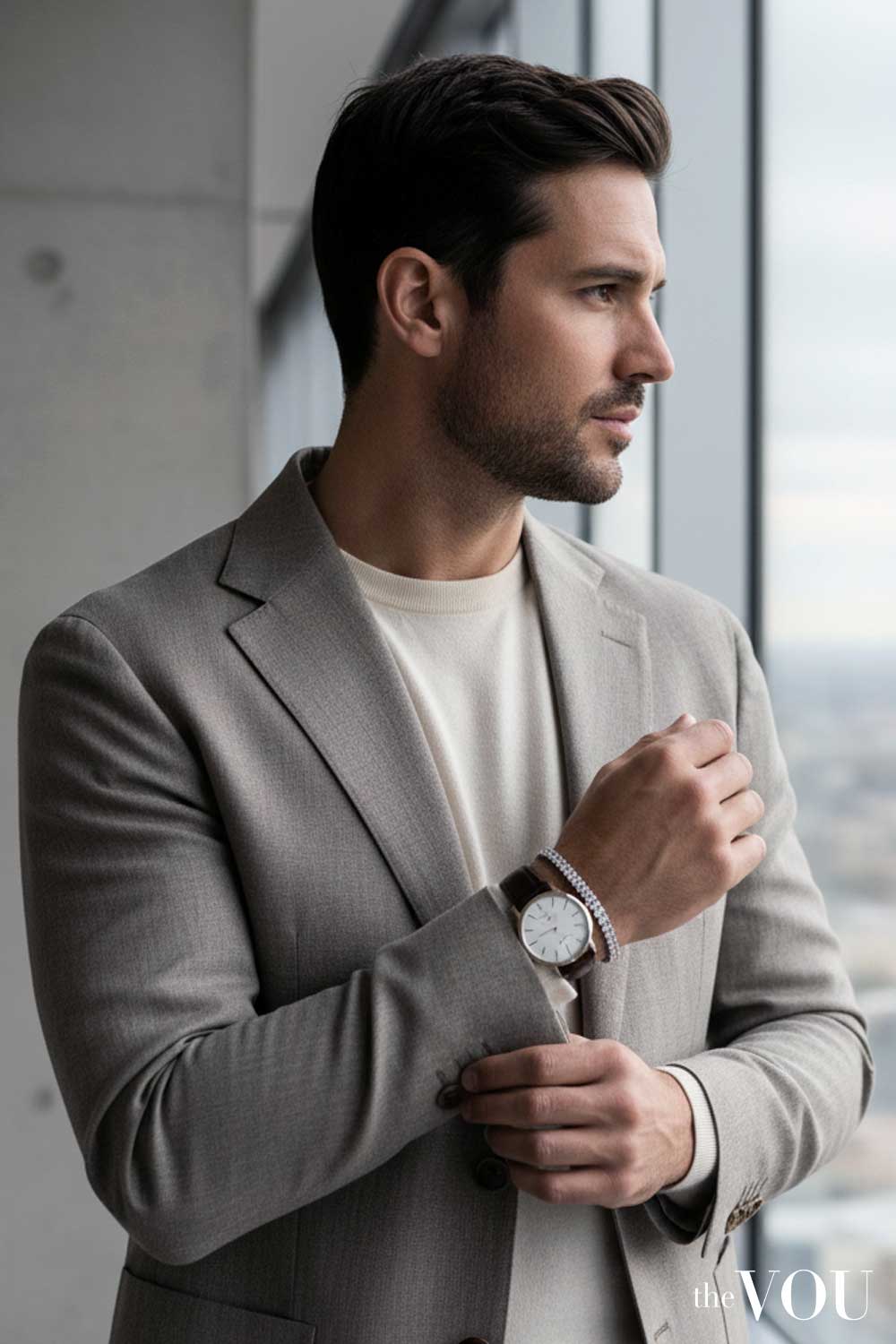
A tennis bracelet is a flexible line of matching stones, and a man can wear one with a suit or casual clothes if he keeps the width, metal and fit in proportion to his wrist and watch.
This guide explains how to choose and wear a tennis bracelet as a man, such as:
Where the name comes from
How snug the fit should be and how to measure your wrist
Whether to wear it with a watch and on which wrist
Outfit ideas for the office, weekends and evenings
What to know about natural and lab-grown diamonds
and many more!
Start slim and simple, and let the bracelet work with the rest of your outfit.
Key Points
01The name is linked to Chris Evert, whose diamond bracelet broke during a match at the 1978 US Open.
02A tennis bracelet should sit close to the wrist, with room for about one finger.
03Wear your watch on the other wrist, or choose a leather strap, because diamonds can scratch metal.
04Lab-grown diamonds have essentially the same properties as natural ones and FTC guidance calls for them to be clearly described as lab-grown.
A tennis bracelet is a flexible bracelet set with a continuous line of matching stones, usually diamonds or a diamond alternative, each in its own small setting.
Tennis bracelets are best known as women’s jewellery, but some men wear one, either on its own or alongside a watch.
Because the design is simple and the stones are small and evenly matched, it can look discreet under a shirt cuff or more noticeable with a T-shirt.
This guide explains where the name comes from, how a man can wear one, how it should fit and what to check before you buy.
Where the Name Comes From
The name is usually linked to the American tennis player Chris Evert.
According to a statement from her publicist reported by Mental Floss in 2024, Evert’s diamond and gold bracelet broke and fell onto the court during an early round of the 1978 US Open, and play stopped while she looked for it.
Mental Floss also notes that the term “tennis bracelet” was in use by the mid-1980s and that the 1978 incident was not widely reported at the time, so the story may not be the whole origin of the name.
How to Wear a Tennis Bracelet as a Man
Choose a Width That Suits Your Wrist
A slim line of small stones looks discreet and sits easily under a shirt cuff.
A wider line with larger stones is more noticeable and suits casual or evening outfits, or a larger wrist.
If this is your first bracelet, start with a slim one; it works with more of your wardrobe.
Get the Fit Right
A tennis bracelet should sit close to the wrist, with room for about one finger underneath, so it does not slide down over your hand or twist.
To find your size, wrap a tape measure or strip of paper around your wrist just above the wrist bone, then add about half an inch (around 1.25 cm) for a snug fit.
Decide How to Wear It With a Watch
The simplest approach is to wear your watch on one wrist and the bracelet on the other.
If you wear both on the same wrist, diamonds can scratch a metal watch case or bracelet, so a watch on a leather or fabric strap is the safer partner.
Keep the two different in width so neither competes with the other.
Match the Metal
Match the bracelet’s metal to your watch case, belt buckle and any ring: white gold, platinum or silver with steel, and yellow gold with yellow gold.
Mixing metals can work; it usually looks more deliberate when one metal clearly leads.
Outfit Ideas
Office: a slim bracelet worn under the cuff of a white or light blue shirt, with a navy suit, a dark tie and black or dark brown leather shoes.
Smart casual: a fine-gauge navy knit polo or a crew-neck jumper with grey wool trousers and suede loafers.
Weekend: a white T-shirt, an unbuttoned overshirt, dark jeans and white leather trainers.
Evening: a black or charcoal knit, black trousers and polished shoes, which let the stones stand out against the dark colours.
In a conservative workplace, keep the bracelet slim and mostly under the cuff, and let your clothes and grooming do most of the work; our guide to building a polished overall look, from wardrobe to grooming and accessories covers the wider picture.
Natural Diamonds, Lab-Grown Diamonds and Alternatives
Most tennis bracelets use natural or lab-grown diamonds, or a diamond alternative such as moissanite or cubic zirconia.
The Gemological Institute of America (GIA) states that a laboratory-grown diamond has essentially the same chemical, physical and optical properties as a natural diamond.
Lab-grown diamonds vary in quality, so they are not automatically flawless, and specialist equipment is needed to tell them from natural stones.
In June 2025 GIA announced that, from later that year, it would no longer describe lab-grown diamonds with the colour and clarity grades it uses for natural diamonds, and would call them “premium” or “standard” instead.
Some other laboratories, such as IGI, still grade lab-grown diamonds on colour and clarity, so read the report for the stones you are buying.
The US Federal Trade Commission’s Jewelry Guides call for a lab-grown diamond to be clearly described, for example as “laboratory-grown” or “laboratory-created”.
Moissanite and cubic zirconia are different materials that look similar to diamond and cost less; a seller should name them clearly too.
What to Check Before You Buy
The clasp: a box clasp with a safety catch, or a double catch, helps prevent the bracelet from falling off.
The settings: claw or bezel settings should hold every stone firmly, with no stone that moves when you tap it lightly.
The flexibility: the bracelet should lie flat and move smoothly, without stiff links or gaps.
The paperwork: look for a metal hallmark or stamp and, for larger diamonds, a grading report from an independent laboratory.
The aftercare: ask about resizing, cleaning and repairs, and check the returns policy.
A higher price does not guarantee a better bracelet for you, so compare the stones, metal, settings and clasp rather than the brand name.
Other Jewellery to Consider
If you enjoy wearing a tennis bracelet, our guide to men wearing pearls looks at another kind of jewellery that some men wear.
Sources
Ellen Gutoskey, “Tennis bracelet origins”, Mental Floss, 28 June 2024.
Gemological Institute of America, “GIA to Use New Descriptive Terminology for Laboratory-Grown Diamonds”, press release, 2 June 2025.
Whiteflash, “GIA Redefines Laboratory-Grown Diamond Grading: What You Need to Know”, 7 October 2025 (IGI and GCAL grading).
Gemological Institute of America, “The difference between natural and laboratory-grown diamonds”, 31 May 2019.
JCK, “The FTC Gets Tough on Lab-Grown Diamond Disclosure”, 3 April 2019.
USA Jewels, men’s bracelet sizing guide.