Start here
What’s This About
The “2 finger rule” is a rough waistband test, and it is not wrong so much as incomplete, because how snug a waistband should be depends on the trousers, the cloth and whether you wear a belt.
This guide explains the rule and the fuller set of checks that tell you whether trousers fit, such as
why The VOU prefers about one finger of room for belt-free trousers
when two fingers of room and a belt are perfectly reasonable
seat, thigh and rise checks, standing and seated
choosing a trouser length and break
and many more!
No single finger count replaces trying the trousers on and sitting down in them.
Key Points
01The two-finger test gives a rough idea of waistband room, but it ignores the cloth, the rise and whether the trousers are meant to be worn with a belt.
02For tailored trousers worn without a belt, The VOU prefers about one finger of room, so the waistband is snug enough to stay up on its own.
03A belt that holds up a waistband with no pinching or bunching is not a sign of bad fit; gathered cloth at the waist is.
04Seat, thigh, rise and length matter as much as the waistband, and a taper or a break is a style choice made after the fit is right.
Common “rules of thumb”, like the “2 finger rule for pants”, circulate as quick ways to judge whether trousers fit.
They are useful as far as they go, but a single waistband test cannot tell you whether a pair of trousers fits you.
The two-finger test does not tell you whether belt-free tailored trousers will stay up on their own, and it says nothing about the seat, thighs, rise or length.
This article explains what the 2 finger rule is, where it falls short, and the fuller set of checks you can use to judge how your trousers fit.
The “2 Finger Rule” Defined as a Common but Incomplete Test
The “2 finger rule” is a simple, widely cited test to determine if the waistband of a pair of pants or trousers is too tight.
The rule states that you should be able to comfortably slide two fingers (horizontally, side-by-side) into the waistband while wearing the trousers.
If you cannot fit two fingers, the trousers are deemed too tight.
If you can fit more than two fingers (e.g., a whole hand), they are too loose.
The logic behind this rule is to build in an allowance for comfort, accounting for a large meal, sitting down or the added bulk of a tucked-in shirt.
That allowance is reasonable; the question is how much room your particular trousers need.
Where the 2 Finger Rule Falls Short
The test treats every pair of trousers the same.
Two fingers of room can be right for jeans or chinos designed to be worn with a belt, and more than The VOU would allow for tailored trousers meant to stay up on their own.
How much room feels right also depends on the cloth (stretch cloth needs less), how firm the waistband is, where the rise places it on your body, and how your waist changes when you sit.
Finger widths differ too, so the test is approximate by nature.
The real sign of a waistband that is too big is not the belt itself but what the belt has to do.
If cinching the belt gathers the cloth into folds or puckers around the waist, the waistband is too large for you and is worth taking in.
A belt or braces that simply hold a well-fitting waistband in place, with no pinching, sagging or bunching, are doing their normal job.
The VOU’s Preference for Belt-Free Trousers Is About One Finger
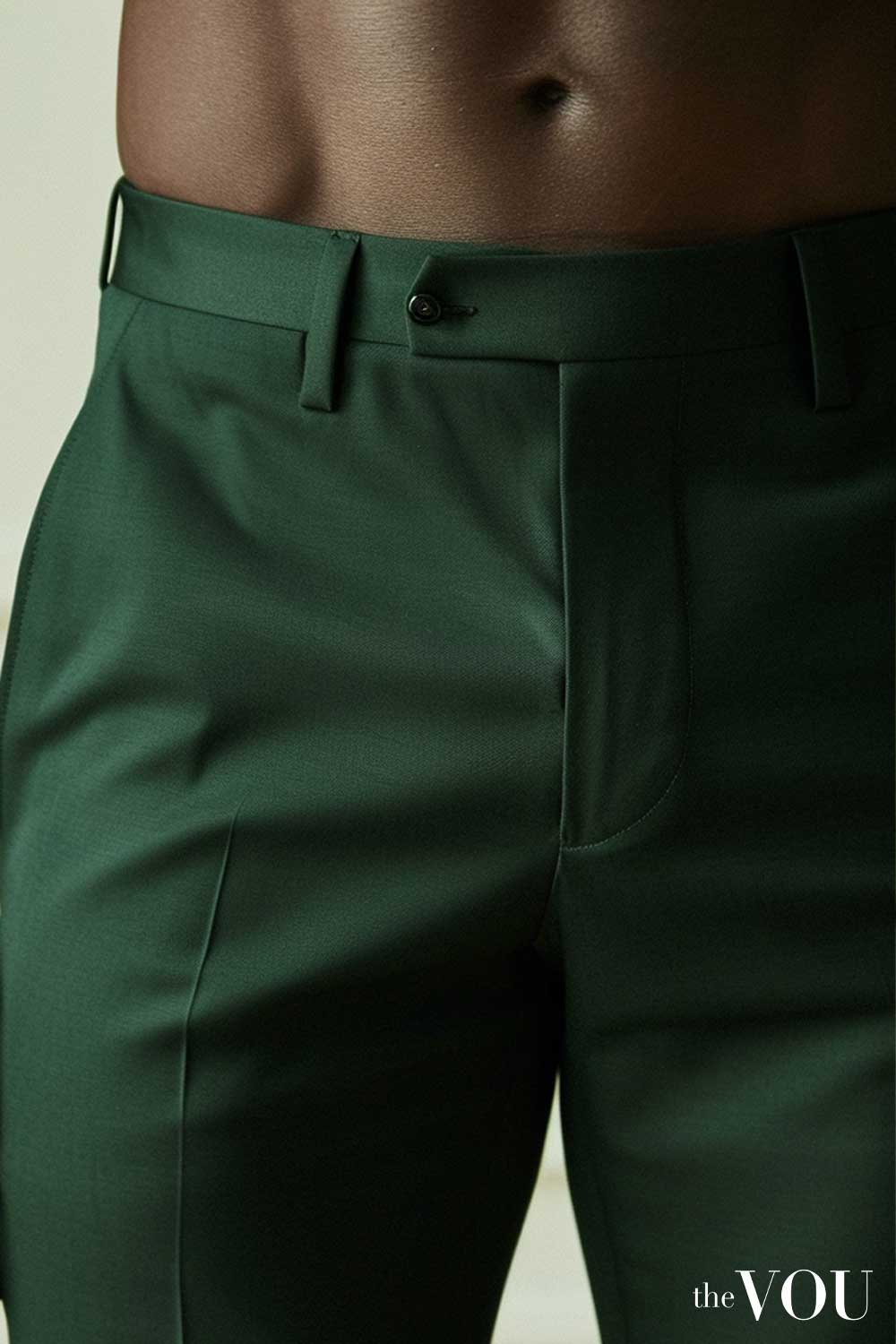
For tailored trousers worn without a belt, The VOU prefers a snugger waistband, which could be termed the “1-finger” fit.
Tailoring guides put the same aim in general terms, describing it as snug enough that a belt or braces are a choice rather than a necessity.
A belt-free waistband should sit securely where the trousers are designed to sit, whether that is your natural waist or lower on the hips, without needing a belt.
About one finger of room usually leaves space for a tucked shirt and normal movement while letting the waistband stay up on its own.
Published tailoring guides vary on this, from about one to three fingers, so treat one finger as The VOU’s preference rather than a fixed standard.
Check it seated as well as standing.
If the waistband digs in when you sit, it is too tight, whatever the finger count.
Your natural waist and the fullest point of your abdomen can be in different places, so if your middle is fuller, decide first where you want the waistband to sit, then judge the room at that position.
Trousers with side adjusters or brace buttons are made for this kind of fit; jeans and most chinos are cut to be worn with a belt, so the two-finger allowance is often fine for them.
Addressing Confusion Over the “2:1 Neck-to-Waist Rule”
It is important not to confuse the “2 finger rule” with another popular sizing “hack” known as the “2:1 neck-to-waist rule.”
This theory claims that the circumference of your waist is approximately double the circumference of your neck.
Therefore, you can supposedly test a pair of trousers by wrapping the buttoned waistband around your neck, and if the two ends meet, they should fit.
This is a highly unreliable method.
Human body proportions vary significantly, and this trick does not account for differences in body type, muscle mass, or the specific rise of the trousers.
It is not a substitute for trying the trousers on.
The Fuller Checks for How Trousers Should Fit
The waistband is only one check.
The seat, thighs, rise and length decide whether trousers fit just as much, and each is easiest to judge standing, walking and sitting.
1. The Seat and Hips
The fit across your seat and hips is critical.
If the trousers are too tight, you will see horizontal stress lines and the front pockets will flare open in a phenomenon known as “pocket bowing.”
This is a clear sign the trousers are too tight across the seat or hips.
Conversely, if the trousers are too loose, the seat sags, leaving folds of excess fabric below your seat.
2. The Thighs
A useful companion to any “finger rule” is the “Pinch Test” for the thighs.
While standing, try to pinch a little cloth on either side of your thigh.
If you cannot pinch any, the trousers are too tight there, and you will see strain lines and feel them when you sit or climb stairs.
How much spare cloth you want beyond that is a choice of silhouette rather than fit.
A slim, tapered leg leaves little room; a straight or fuller leg leaves more, and both can fit well as long as the cloth does not pull or twist.
3. The Rise
The rise (the distance from the crotch seam to the waistband) decides where the waistband sits on your body.
If the rise is too short for you, it will be uncomfortable and create pulling or “whiskering” across the front.
If it is too long, the crotch hangs low, with excess fabric that can catch your stride.
Rise labels such as low, mid and high vary between makers, so check where the waistband actually sits standing and seated, and compare the rise measurement on the maker’s size chart where one is given.
4. The Length (The “Break”)
The length of your trousers decides the “break”, the fold of fabric that forms where the hem meets your shoe.
For a tailored look, we suggest a slight break, where the front of the hem rests gently on the top of your shoe, and the back falls some way down the heel of the shoe.
Tailors and menswear writers place these points a little differently, so treat this as a convention rather than a measurement.
A no-break hem that just grazes the shoe gives a cleaner, shorter line, and a cropped ankle length is a separate, deliberate choice.
Several folds of cloth piling on the shoe usually mean the trousers are simply too long.
Judge the length with the shoes you will actually wear.
Conclusion
The “2 finger rule for pants” is a rough comfort test, not a definition of fit.
It suits belted casual trousers better than tailored ones, and it says nothing about the rest of the garment.
For tailored trousers worn without a belt, The VOU prefers about one finger of room.
Beyond the waistband, look for a seat that neither pulls nor sags, enough thigh room to pinch a little cloth, a rise that places the waistband where you want it, and a length that suits your shoes.
Taper and break are then choices of style, made once the fit is right.
Frequently Asked Questions (FAQs)
Q. What is the 2 finger rule for pants?
The 2 finger rule is a common guideline stating you should be able to fit two fingers into the waistband of your trousers.
It can work for belted jeans and chinos, but for tailored trousers worn without a belt The VOU prefers about one finger of room, so the waistband stays up on its own.
Q. Should I need a belt to hold my trousers up?
Not for tailored trousers made to be worn without one. A well-fitted pair should sit securely where it is designed to sit without a belt.
Jeans and many chinos are cut to be worn with a belt, and that is fine as long as the belt is not gathering excess cloth into folds at the waist.
Q. What is “pocket bowing” on trousers?
“Pocket bowing” (or pocket flare) is when the side pockets of your trousers are pulled open, exposing the inner pocket bag.
This is a clear indication that the fit is too tight across the hips or seat.
Q. What is the “pinch test” for trousers?
The pinch test is a quick way to judge the fit in the thigh.
While standing, you should be able to pinch a little spare fabric on either side of the thigh.
If you cannot, the trousers are too tight there; how much more room you want depends on whether you prefer a slim or a fuller leg.