
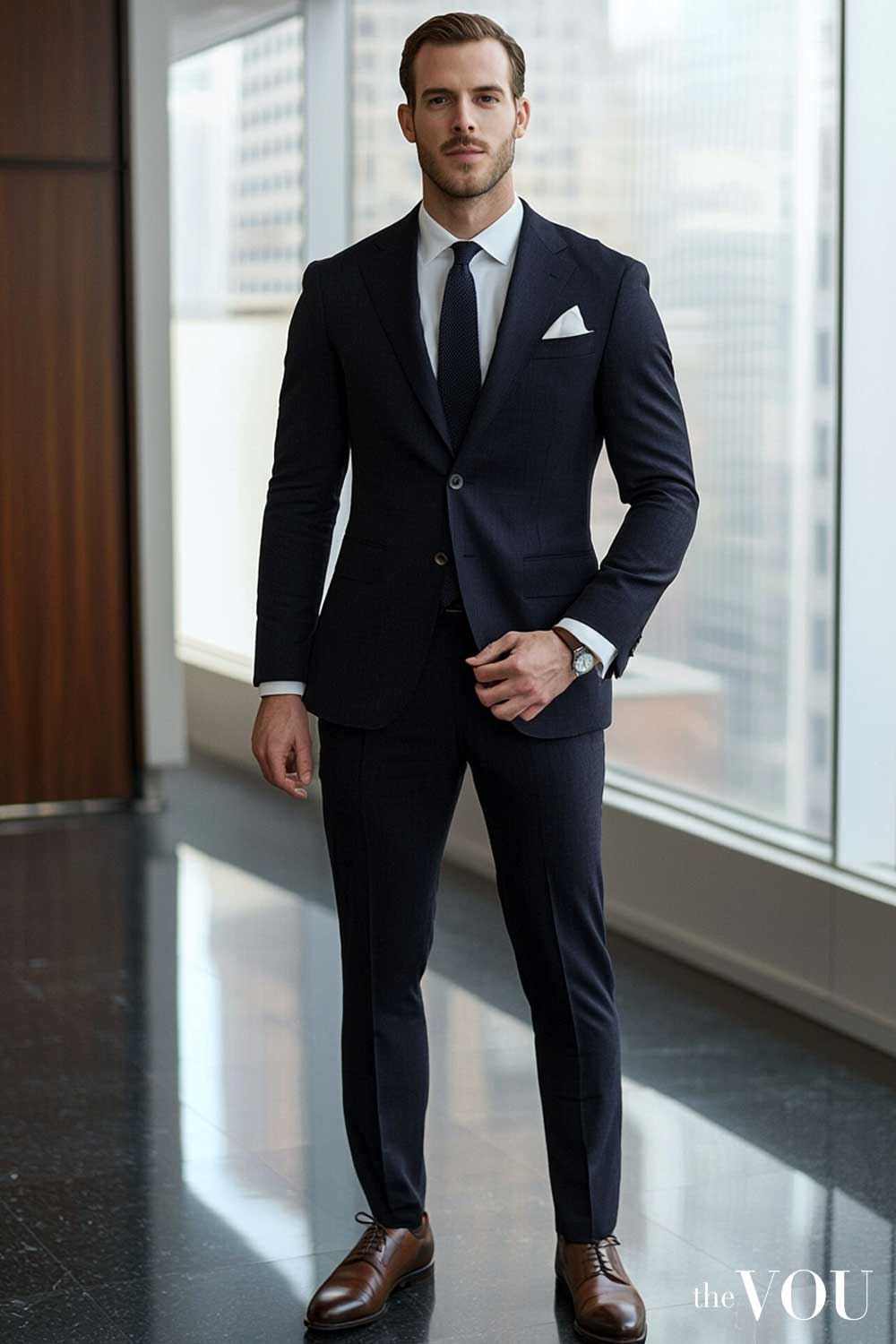
In the world of men’s style, trends are fleeting, but principles are eternal.
For the man who navigates boardrooms and exclusive lounges with equal aplomb, style is not about slavishly following fashion; it is about mastering a set of foundational truths.
These are not restrictive rules but liberating guidelines (the unspoken constitution of sartorial excellence that separates the truly well-dressed from the merely well-off).
To internalise these commandments is to acquire the power to command respect without uttering a single word.
They are the architecture of a lasting impression, the secret to looking impeccable in any situation, at any age.
1. Master the Fit
Before brand, before fabric, before price, there is fit.
An impeccably tailored garment is the single most important element of personal style.
It is the difference between wearing a suit and inhabiting it.
An ill-fitting suit, no matter its cost, projects carelessness, whilst a perfectly cut ensemble flatters your physique, sharpens your silhouette, and communicates an unerring attention to detail.
Key areas demand perfection; the shoulder seams of a jacket must align with your natural shoulder, the waist should be gently suppressed, and the trousers must exhibit the correct break over your shoes.
Consider a trusted tailor not an expense, but an essential partner in your sartorial strategy.
2. Invest in Quality, Not Quantity
The discerning gentleman builds a curated arsenal of high-calibre, versatile pieces, not a cluttered wardrobe of disposable fashion.
The principle of ‘cost-per-wear’ is your guide; a finely crafted watch or a pair of Goodyear-welted shoes are not purchases but investments that pay dividends in durability and distinction for decades.
Focus on cornerstone items; a formidable navy suit, an elegant timepiece, a classic trench coat, and shirts woven from superior cotton.
Furthermore, respect these investments.
Learning to properly care for your clothing is as crucial as the acquisition itself, ensuring your legacy pieces endure.
3. Understand Colour Theory
Colour is a powerful, non-verbal language.
Mastering a sophisticated palette is essential for projecting authority and taste.
Your wardrobe should be anchored in a foundation of versatile, neutral colours; navy, charcoal grey, black, and subtle beiges.
These hues form a cohesive base from which you can build any look.
From there, introduce complementary colours with precision.
A flash of burgundy in a tie or a forest green pocket square can elevate an entire outfit.
The goal is harmony, not cacophony.
A disciplined approach to colour ensures your appearance is always polished and intentional.
4. Prioritise Footwear
Many will argue that a man is judged first by his shoes, and for good reason.
Your footwear grounds your entire ensemble, both literally and figuratively.
They are the foundation upon which your sartorial statement is built.
Investing in quality leather shoes (classic Oxfords, versatile Derbies, elegant loafers) is non-negotiable.
Scuffed, worn, or inappropriate footwear can instantly nullify the effort put into the rest of your attire.
Keep your collection immaculately maintained through regular polishing and the use of cedar shoe trees to preserve their shape and integrity.
Your shoes are not an afterthought; they are the starting point.
5. Develop a Signature Scent
Style transcends the visual.
Your fragrance is an invisible, yet unforgettable, component of your personal brand.
A carefully chosen scent should be a subtle signature, an olfactory handshake that lingers in your absence.
The objective is not to announce your arrival from across the room, but to be discovered.
Find a fragrance that complements your natural chemistry and personality, whether it be a woody, citrus, or spicy accord.
Apply it with restraint (a spritz to the pulse points is all that is required).
Remember, the most alluring scent is one that invites closer proximity.
6. Accessorise with Intention
Accessories are the finishing touches that distinguish a polished look from a merely adequate one.
However, the guiding principle must be deliberate restraint.
Each accessory should serve a purpose and add a note of refinement.
A classic dress watch, a fine leather belt that precisely matches the colour of your shoes, understated cufflinks, or a silk pocket square folded with precision. These are the hallmarks of a man who understands nuance.
The aim is to enhance, not to overwhelm.
An excess of ornamentation is a sign of insecurity; a few well-chosen pieces signal quiet confidence.
7. Keep It Simple
In a world saturated with visual noise, simplicity is the ultimate sophistication.
A clean, uncluttered aesthetic is invariably more powerful and elegant than one burdened by excessive detail.
Resist the temptation to over-layer, combine multiple bold patterns, or flaunt conspicuous logos.
A minimalist approach (focusing on exceptional fit, superior fabric, and a harmonious colour palette) will always project more authority.
As Coco Chanel famously advised, “Before you leave the house, look in the mirror and take one thing off.”
This principle of elegant reduction is the key to timeless style.
8. Know the Dress Code
Understanding and respecting the context of an occasion is a fundamental sign of social intelligence.
The ability to navigate the nuances between black tie, business professional, smart casual, and beyond is not merely about following rules; it is about showing respect for your host, your colleagues, and the event itself.
Everything is a-ok.
To arrive appropriately dressed is to communicate that you are a man of the world, one who understands decorum and social subtleties.
It is a silent demonstration of your competence and sophistication.
9. Pay Attention to Grooming
Your clothing is only one part of the complete presentation.
Impeccable style is rendered meaningless by neglected grooming.
A sharp, well-maintained haircut, a cleanly shaven face or meticulously cared-for facial hair, and clean, manicured hands are the essential pillars that support your wardrobe.
It is this holistic attention to detail that creates a truly polished image.
Grooming is not a chore but a ritual, the final, crucial step in preparing to present the best version of yourself to the world.
It is the polish that completes the masterpiece.
10. Cultivate Confidence
This is the final and most crucial commandment, for without it, all others are void.
The finest suit and the most expensive watch are but hollow shells if worn without conviction.
True style is an internal state projected outwards.
It emanates from a man who is comfortable in his own skin, whose clothing is not a costume but an authentic extension of his character.
Confidence is what allows you to own your look, to wear the clothes rather than letting the clothes wear you.
It is the invisible thread that ties everything together, transforming a well-assembled outfit into an unforgettable presence.
Ultimately, these ten commandments are not a rigid dogma but a strategic framework for a life of elevated style.
They are the principles that will guide you beyond the transient whims of fashion towards a permanent state of elegance.
Mastering them is a lifelong pursuit. A journey of refinement, self-discovery, and the quiet, unshakeable confidence that comes from knowing you are always in command of your presentation.
Aidan Russell’s focus at The VOU is men’s face-shape styling, facial proportions and the way accessories frame the face. His coverage addresses a common starting question: how do you choose glasses, hats or necklines when standard face-shape advice does not quite describe your features?
His subject areas include comparing visible face length and width, recognising mixed features and understanding how frame size, brim shape and neckline placement change an overall look. Rather than making a shape label the final decision, this coverage connects proportions with the effect a reader wants, whether that means adding definition, softening an outline or drawing attention to particular features.
Aidan’s editorial focus also links facial styling with the rest of a man’s wardrobe. The aim is to make comparisons easier when trying on accessories or planning an outfit, while allowing for comfort, fit and personal preference. Readers looking for a starting point in face-shape styling can use this coverage to identify options worth trying, without being confined to one prescribed look.
Mandy Meyer’s focus at The VOU is men’s body-shape styling, garment fit and outfit proportions. Her coverage addresses the practical questions behind a wardrobe choice: how a jacket sits across the shoulders, how trousers fall and how different cuts change the silhouette a wearer wants to create.
Her subject areas include the triangle, inverted triangle, rectangle, oval, trapezoid, hourglass and diamond labels used in body-shape styling. These provide starting references for comparing visible proportions; they do not capture every body or prescribe one correct way to dress. The focus connects those observations with garment shape, construction, length and the relationship between the upper and lower parts of an outfit.
Mandy’s editorial coverage combines visual comparisons with fit checks for comfort and movement. Readers can consider whether a cut gives them the room they need, where clothing pulls or gathers and which changes might support their preferred look. The aim is to make menswear choices more understandable while keeping personal preferences and the wearer’s own styling goals central.
Sara Law’s focus at The VOU is men’s capsule wardrobes, outfit formulas and wardrobe curation. Her coverage addresses readers who want to get more useful combinations from their clothes, particularly across everyday and business-casual settings.
Her subject areas include coordinating shirts, trousers, knitwear, jackets and footwear, identifying gaps and understanding why certain combinations work together. This focus starts with the wearer’s routine and preferences rather than a fixed number of garments. A capsule wardrobe should reflect the situations a man needs to dress for, including the level of formality and the practical demands of his day.
Sara’s editorial coverage gives readers a way to organise existing pieces before deciding what to add. Outfit formulas provide repeatable starting points that can be adjusted through colour, texture, proportions and accessories. The aim is to reduce the difficulty of getting dressed while preserving variety, helping men build a wardrobe that feels connected without making every outfit look the same.