
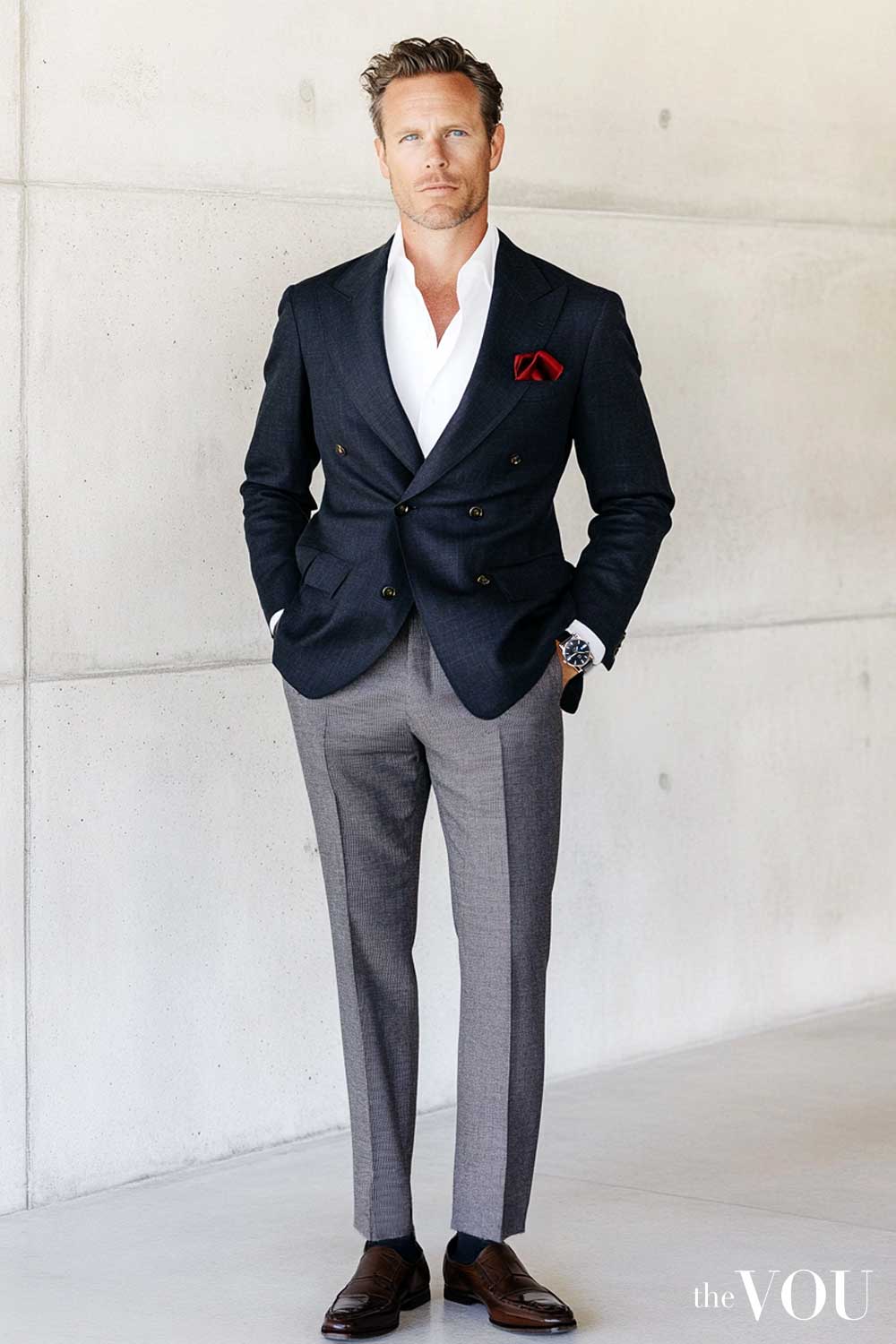
In the world of men’s style, true mastery is about understanding the underlying principles of composition and balance; where a systematic approach proves invaluable.
Enter the 2 3 1 3 rule; a sartorial formula designed to eliminate guesswork and ensure a perfectly calibrated ensemble, every single time.
It is less a restrictive mandate and more a sophisticated framework for achieving that coveted sense of effortless polish, transforming the daily ritual of dressing into a strategic art form.
What is the 2 3 1 3 Rule?
At its core, the 2 3 1 3 rule is a styling equation that dictates a specific number of items to create a visually harmonious and complete outfit.
It provides a clear, structured method for layering garments, selecting accessories, and adding personal details, preventing an ensemble from appearing either too sparse or excessively cluttered.
This formula ensures every component serves a distinct purpose, contributing to a cohesive and intentional final look.
The numerical breakdown is precise and logical, categorising your attire into four distinct groups;
- 2 (Tops): This refers to two upper-body garments, typically a base layer and an outer layer. This could be a shirt and a blazer, a fine-gauge knit and a sports coat, or a quality t-shirt and a leather jacket.
- 3 (Bottoms): This category comprises the three elements that ground your look from the waist down; your trousers, your socks, and your shoes. Each is considered a distinct and equally important component.
- 1 (Accessory): This dictates the inclusion of one primary, impactful accessory. This is your statement piece, selected to anchor the outfit. Think a luxury timepiece, a distinctive belt, or a signature pair of sunglasses.
- 3 (Details): Finally, this refers to three smaller, more subtle personal effects. These are the nuanced elements that add depth and character, such as a signet ring, a discreet bracelet, a pocket square, or a pair of elegant cufflinks.
How to Apply the 2 3 1 3 Rule to Your Wardrobe
Adopting this framework is a straightforward process that begins with a well-curated wardrobe.
The rule’s efficacy is magnified when applied to a collection of high-quality, versatile essentials.
Here is the strategic, step-by-step approach to implementation.
Step 1: Curate Your Core Components (2 Tops, 3 Bottoms)
The foundation of any successful ensemble lies in its primary garments.
The 2 3 1 3 rule compels you to think in terms of complementary layers and a cohesive lower half.
Ensure your wardrobe is stocked with interchangeable, premium-quality pieces that work in multiple combinations.
This is not about volume, but about versatility and impeccable fit.
For your two tops, consider classic pairings such as a crisp Oxford button-down beneath a tailored navy blazer, or a premium Supima cotton t-shirt layered under a suede bomber jacket.
For your three bottoms, a typical combination would be a pair of well-cut tailored trousers, a pair of fine merino wool dress socks, and a pair of polished leather loafers or brogues.
Each element must be chosen with intention, ensuring harmony in colour, texture, and formality.
Step 2: Select a Singular, Impactful Accessory (1 Accessory)
The single accessory serves as the focal point of your ensemble. A deliberate choice that communicates authority and taste.
The objective here is impact, not ostentation.
This piece should be significant enough to draw the eye but elegant enough not to overwhelm the entire look.
The choice speaks volumes about your attention to detail and personal brand.
A classic Swiss timepiece on a leather strap is an unimpeachable choice.
Alternatively, a beautifully crafted leather belt with a refined buckle can anchor the divide between your upper and lower body.
In sunnier climes, a pair of timeless, well-constructed sunglasses from a heritage brand serves this purpose with panache.
Step 3: Integrate Subtle, Personal Details (3 Details)
The final three details are where true personality is injected into the formula.
These are the subtle flourishes that elevate an outfit from merely well-dressed to truly stylish.
They are smaller in scale but significant in impact, signalling a deeper understanding of sartorial nuance.
These elements should feel personal and authentic to you.
Consider a combination such as a family signet ring, a discreet metal bracelet, and a silk pocket square offering a subtle pop of colour against your blazer.
Other excellent options include a tie bar, elegant cufflinks, or even a lapel pin.
The key is that these three items work together harmoniously without competing for attention, adding a final layer of polish and individuality.
Why Does the 2 3 1 3 Rule Work?
The psychological efficacy of the 2 3 1 3 rule lies in its ability to create perfect visual balance.
The human eye appreciates structure and cohesion, and this formula provides a blueprint that is inherently pleasing and easy to process.
It prevents the common style missteps of under-dressing (looking incomplete) and over-dressing (looking cluttered and try-hard).
By assigning a number to each category, it imposes a welcome discipline on the styling process.
Moreover, the rule champions intentionality.
Every piece in a 2 3 1 3 ensemble is there for a reason, having been deliberately selected to fulfil a specific role within the formula.
This conscious decision-making process invariably leads to a more considered, sophisticated, and polished appearance.
It removes ambiguity and replaces it with a clear, executable strategy for sartorial success.
Is the 2 3 1 3 Rule a Definitive Law of Style?
It is crucial to understand that the 2 3 1 3 rule is a guideline, not a gospel.
It is a powerful tool for building a foundation and developing an innate sense of what works.
For the man honing his personal style or for the seasoned veteran seeking a reliable method for daily dressing, it provides an invaluable framework that guarantees a well-put-together result.
However, true style artistry involves knowing when and how to bend the rules.
Once you have mastered the principle of balance that underpins this formula, you can begin to adapt it.
Perhaps an occasion calls for a fourth detail, or a minimalist look demands only one top layer.
The rule provides the knowledge; your experience and context will provide the wisdom to diverge when necessary.
Consider it your sartorial training wheels, designed to be cast aside once your balance is perfected.
Conclusion
The 2 3 1 3 rule is more than a viral trend; it is an elegant, logical system for mastering the art of dressing.
It offers a clear and effective formula for achieving a balanced, intentional, and impeccably polished look with remarkable consistency.
For the modern man who commands respect in all areas of his life, this rule provides a strategic advantage, ensuring his presentation is always as sharp and considered as his thinking.
By embracing this framework, you equip yourself with a reliable method for constructing ensembles that are, without fail, the very definition of sophisticated style.
Aidan Russell’s focus at The VOU is men’s face-shape styling, facial proportions and the way accessories frame the face. His coverage addresses a common starting question: how do you choose glasses, hats or necklines when standard face-shape advice does not quite describe your features?
His subject areas include comparing visible face length and width, recognising mixed features and understanding how frame size, brim shape and neckline placement change an overall look. Rather than making a shape label the final decision, this coverage connects proportions with the effect a reader wants, whether that means adding definition, softening an outline or drawing attention to particular features.
Aidan’s editorial focus also links facial styling with the rest of a man’s wardrobe. The aim is to make comparisons easier when trying on accessories or planning an outfit, while allowing for comfort, fit and personal preference. Readers looking for a starting point in face-shape styling can use this coverage to identify options worth trying, without being confined to one prescribed look.
Mandy Meyer’s focus at The VOU is men’s body-shape styling, garment fit and outfit proportions. Her coverage addresses the practical questions behind a wardrobe choice: how a jacket sits across the shoulders, how trousers fall and how different cuts change the silhouette a wearer wants to create.
Her subject areas include the triangle, inverted triangle, rectangle, oval, trapezoid, hourglass and diamond labels used in body-shape styling. These provide starting references for comparing visible proportions; they do not capture every body or prescribe one correct way to dress. The focus connects those observations with garment shape, construction, length and the relationship between the upper and lower parts of an outfit.
Mandy’s editorial coverage combines visual comparisons with fit checks for comfort and movement. Readers can consider whether a cut gives them the room they need, where clothing pulls or gathers and which changes might support their preferred look. The aim is to make menswear choices more understandable while keeping personal preferences and the wearer’s own styling goals central.
Sara Law’s focus at The VOU is men’s capsule wardrobes, outfit formulas and wardrobe curation. Her coverage addresses readers who want to get more useful combinations from their clothes, particularly across everyday and business-casual settings.
Her subject areas include coordinating shirts, trousers, knitwear, jackets and footwear, identifying gaps and understanding why certain combinations work together. This focus starts with the wearer’s routine and preferences rather than a fixed number of garments. A capsule wardrobe should reflect the situations a man needs to dress for, including the level of formality and the practical demands of his day.
Sara’s editorial coverage gives readers a way to organise existing pieces before deciding what to add. Outfit formulas provide repeatable starting points that can be adjusted through colour, texture, proportions and accessories. The aim is to reduce the difficulty of getting dressed while preserving variety, helping men build a wardrobe that feels connected without making every outfit look the same.