
Start here
What’s This About
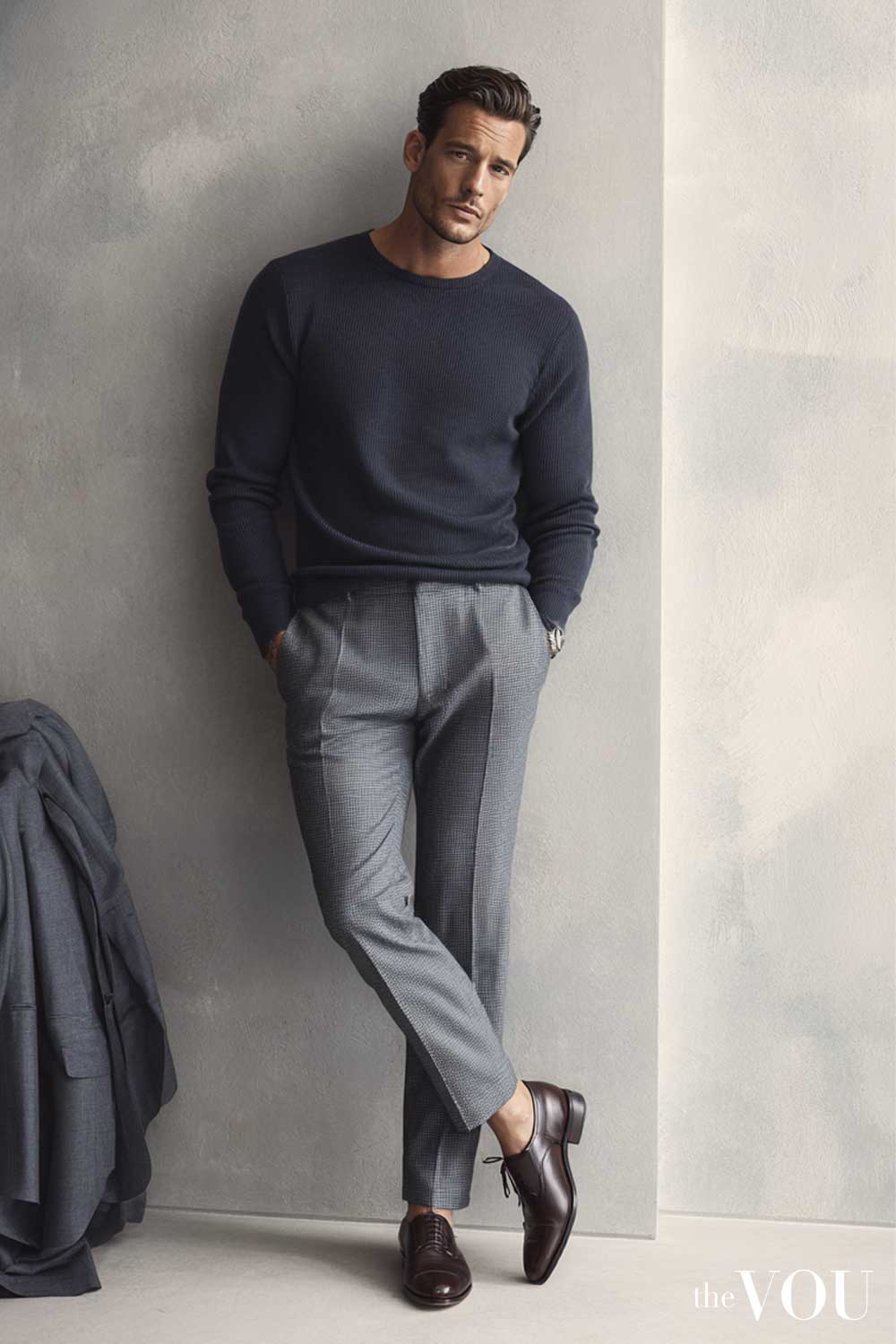
A fine-knit crew neck sweater works for business casual when it fits neatly and is worn with tailored trousers, either on its own, over a collared shirt or under a blazer.
This guide shows how to wear a crew neck sweater for work, such as:
choosing the fabric, fit and colour
layering it over a shirt or under a blazer
three dependable business and weekend outfit formulas
crew neck or V-neck for different settings
shoes, accessories and how to care for knitwear
and many more!
Check your workplace’s dress code, as a sweater replaces a shirt and tie only where business casual is accepted.
Key Points
01Fine-gauge merino or cashmere looks smartest at work, while chunkier knits suit weekends.
02The sweater should skim your body, with shoulder seams near the edge of your shoulders and enough room for a shirt underneath if you layer one.
03Navy, charcoal, grey, camel and stone are the easiest colours to combine with work trousers and jackets.
04Wash wool knitwear as its care label says, dry it flat and store it folded.
A crew neck sweater is one of the most adaptable garments in a business casual wardrobe: it can stand in for a shirt and tie in a relaxed office, layer over a shirt for a smarter look, or sit under a blazer for meetings.
Choosing a Crew Neck for Work
Fabric
Scroll horizontally to see all columns →
| Fabric | What it is like | Good for |
|---|---|---|
| Merino wool | Fine, smooth, breathable and easy to layer | Everyday office wear |
| Cashmere | Very soft with a slight sheen, but more delicate and more expensive | Smarter days and cold weather |
| Fine cotton | Lighter and cooler than wool | Spring, summer and warm offices |
| Lambswool | Warmer and a little more textured | Cold weather and weekends |
A fine gauge, meaning a thin, closely knitted fabric, looks dressier and layers more easily under a jacket than a chunky knit.
Fit
The shoulder seams should sit near the edge of your shoulders, and the body should skim your torso rather than cling to it or billow around it.
For layering under a blazer, choose a closer, thinner sweater; for wearing over a shirt, leave enough room that the shirt does not bunch.
Relaxed, heavier sweaters are best kept for weekends.
Colour
Navy, charcoal and grey go with almost any work trousers and jacket.
Camel, stone and oatmeal are softer neutrals that suit business casual and look good against darker tailoring.
Black is sharp in monochrome outfits but can look severe in daylight, and olive, burgundy or forest green add variety in relaxed offices.
Layering
Over an Undershirt
A thin undershirt under a sweater absorbs sweat and protects the knit; choose a V-neck or low scoop neck if you prefer the undershirt not to show at the neckline, and see our undershirt guide for options.
Over a Collared Shirt
Tuck the shirt in, then put the sweater on and lay the collar points neatly inside the neckline so only the collar shows.
A button-down or a collar with some structure stays in place well, and the look should feel relaxed rather than stiff; our guide to sprezzatura explains the idea of studied ease.
Under a Blazer
A fine-gauge crew neck in navy or charcoal under an unstructured blazer is a smart business casual alternative to a shirt and tie, as long as the sweater is thin enough for the jacket to sit cleanly.
On Its Own
In smart casual or creative offices, a fine merino or cashmere crew neck over a hidden undershirt looks clean and modern, provided it fits well and shows no pilling.
Three Crew Neck Outfit Formulas
Business Casual Office
Sweater: fine-gauge merino or cashmere in charcoal or navy
Trousers: tailored wool trousers in a contrasting shade, such as light grey with charcoal
Jacket: an unstructured blazer or sport coat
Shoes: polished leather loafers or monk straps
Creative Office or Networking Event
Sweater: mid-weight merino or cotton in camel, stone or olive
Trousers: dark, undamaged jeans or well-fitting chinos
Shoes: clean minimal leather trainers or suede chukka boots
Weekend in the Country
Sweater: a chunkier lambswool or textured knit in an earthy colour
Layer: a quilted gilet
Coat: a waxed cotton field jacket or a wool overcoat
Trousers: corduroy, moleskin or sturdy chinos
Shoes: leather boots or country brogues
Crew Neck or V-Neck
Scroll horizontally to see all columns →
| Neckline | Works best | Notes |
|---|---|---|
| Crew neck | On its own, over a collared shirt, under a blazer | The most versatile choice for business casual without a tie |
| V-neck | Over a shirt and tie | Frames a tie well; a deep V without a tie can show a lot of undershirt |
Both necklines are correct; the crew neck is simply the easier choice when you are not wearing a tie, and a V-neck remains a good option with a shirt and tie.
Shoes and Accessories
Loafers: penny or bit loafers suit office and smart weekend outfits
Boots: Chelsea or chukka boots in suede or polished leather suit colder months
Trainers: clean, minimal leather trainers only where your workplace accepts them
Watch: a simple watch that suits the rest of the outfit
Pocket square: a neat touch in a blazer pocket when you wear a sweater underneath
Scarf: a wool or cashmere scarf under an overcoat in cold weather
Buying and Caring for Knitwear
Look for a dense, even knit, neat seams and cuffs and a hem that recovers its shape after a gentle stretch; well-made merino and cashmere from specialist knitters last much longer than loosely knitted sweaters.
Air between wears: wool is naturally odour resistant, so it rarely needs washing after every wear
Wash by the label: Woolmark’s care guidance notes that wool can be machine or hand washed, so follow the care label
Dry flat: lay sweaters flat to dry unless the label says they can be tumble dried
Store folded: fold knitwear in drawers rather than hanging it, and store it clean to deter moths
Mandy Meyer’s focus at The VOU is men’s body-shape styling, garment fit and outfit proportions. Her coverage addresses the practical questions behind a wardrobe choice: how a jacket sits across the shoulders, how trousers fall and how different cuts change the silhouette a wearer wants to create.
Her subject areas include the triangle, inverted triangle, rectangle, oval, trapezoid, hourglass and diamond labels used in body-shape styling. These provide starting references for comparing visible proportions; they do not capture every body or prescribe one correct way to dress. The focus connects those observations with garment shape, construction, length and the relationship between the upper and lower parts of an outfit.
Mandy’s editorial coverage combines visual comparisons with fit checks for comfort and movement. Readers can consider whether a cut gives them the room they need, where clothing pulls or gathers and which changes might support their preferred look. The aim is to make menswear choices more understandable while keeping personal preferences and the wearer’s own styling goals central.