Start here
What’s This About:
For a slim or narrow build, the suit that looks best is the one that fits your shoulders, chest and legs without excess cloth, whatever its label says.
This guide walks through ten suit choices for a slim build, such as:
– fit labels, cloth weight and texture
– shoulder structure, lapel width and button stance
– colour, pattern and double-breasted jackets
– trouser leg shape and shirt collars
and many more!
A slim build is not a problem to correct, so each choice explains what it does and when you might prefer the alternative.
Key Points:
01Fit comes before cut labels: a “slim fit” from one maker can be roomier than a “regular” from another, so judge the suit on your body.
02Light shoulder structure, a textured or mid-weight cloth and a double-breasted front are common ways to add presence if you want it, not requirements.
03Choose lapel width, button stance and trouser leg in proportion to the whole suit rather than by a fixed measurement.
04Dark and light colours, plain cloth and stripes are all options; none has a guaranteed widening or slimming effect.
Off-the-peg suits often fit a slim build at the chest but leave spare cloth at the waist, sleeves and trouser legs, or fit the length but hang loosely everywhere else.
A suit cannot change your build, and a slim build does not need hiding.
What a suit can do is fit cleanly and, if you choose, add some structure or presence.
The ten choices below explain how each detail works and when the alternative may suit you better.
1. Judge the Fit, Not the Fit Label
A slim-fit or modern-fit suit is often the easiest starting point for a slim build, because it is cut with less spare cloth through the chest, waist and legs.
Fit labels are not standard, though: one maker’s “classic” can fit more closely than another’s “slim”.
Try the suit on and check that the shoulders end at your own shoulders, the jacket fastens without pulling or gaping, and there is no large fold of spare cloth at the back or under the arms.
A regular cut that passes those checks, or can be taken in, is as good a choice as a slim one.
Higher armholes and a gently shaped waist, offered by many makers, let a jacket follow a narrow torso more closely while you can still raise your arms.
2. Consider Cloth Weight and Texture
Mills quote cloth weight in grams per metre or ounces per yard.
A heavier cloth tends to hang more smoothly and hold its shape, which many men with a slim build like because it keeps the jacket from clinging; a lighter cloth is cooler and suits warm weather and heated offices.
There is no correct weight.
Compare swatches or finished suits in the season you will wear them, and remember that the weave and finish change how a cloth hangs as much as its weight does.
Textured cloths such as flannel, tweed or a visible twill add surface interest, which can make a suit look more substantial without needing extra structure.
3. Decide How Much Shoulder Structure You Want
Light padding and a structured shoulder give the jacket a defined line at the top, which is a common choice if you want the shoulders to look a little broader.
A soft or unstructured shoulder follows your natural shoulder line instead.
It is more relaxed and can suit casual jackets well; if you find it makes the chest look hollow on you, a jacket with a canvas chest or light padding is the alternative to try.
On a conventionally cut jacket, the shoulder seam usually ends near the edge of your own shoulder; some relaxed cuts extend it on purpose.
Padding that extends well beyond it tends to collapse or dent at the sleeve head rather than add width.
4. Keep Lapel Width in Proportion
A moderate lapel is the easiest choice to wear, because it sits in proportion with a narrower chest and does not date quickly.
There is no correct measurement.
Judge the lapel against the width of your chest and the jacket front: a very narrow lapel can look fashion-led on any build, and a very wide lapel can dominate a narrow chest, but some men like either effect.
Your tie should usually be close in width to the lapel.
5. Compare Two-Button and Three-Button Jackets
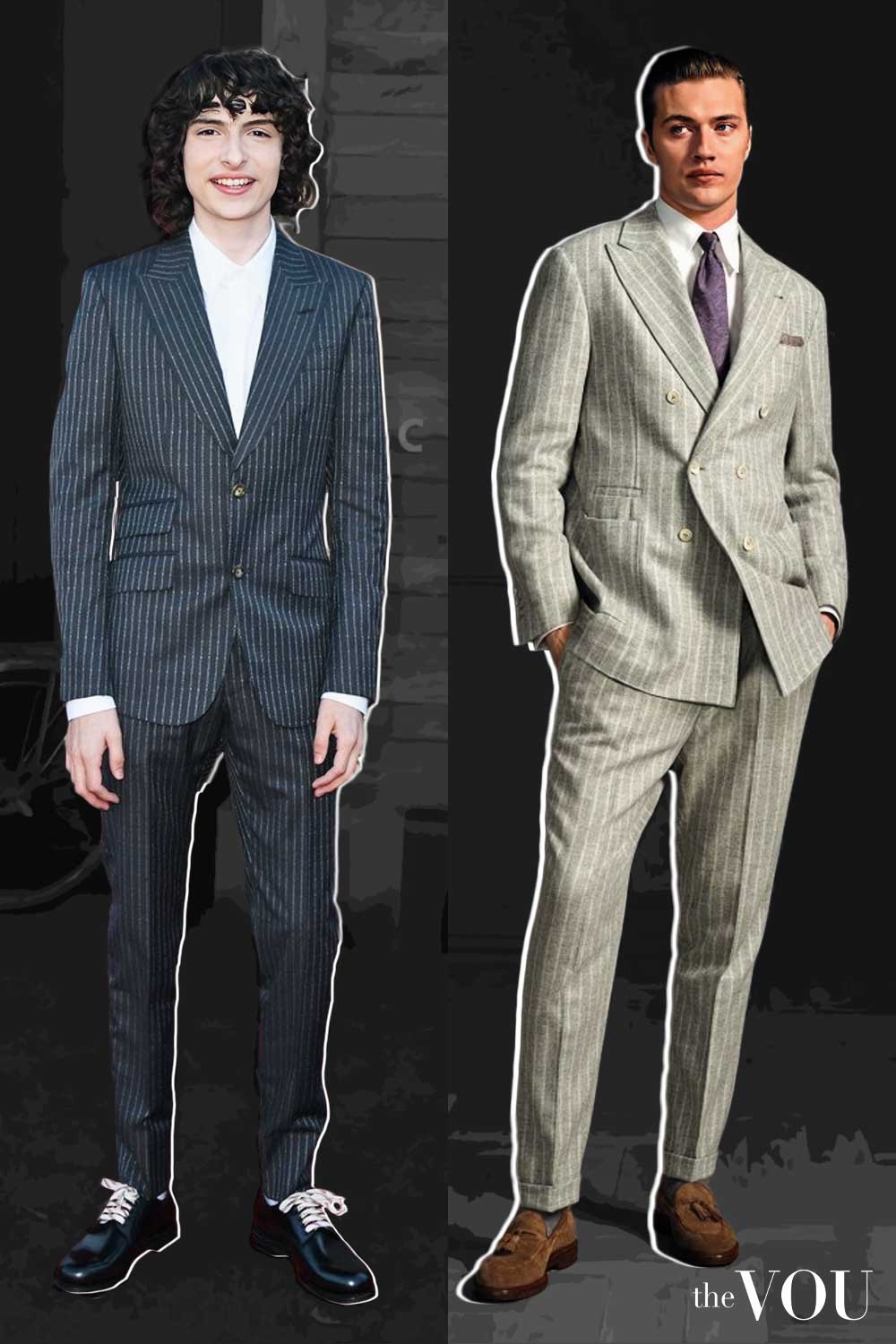
A two-button jacket opens a longer V at the front, which is meant to lengthen the line of the torso and is a widely worn choice.
A three-button jacket closes higher and shows more cloth across the chest.
Some men with a slim build like that extra coverage; others find it looks boxy.
A three-roll-two jacket, where the lapel rolls past the top button, sits between the two, so try more than one stance and compare them in a mirror.
The button height matters as much as the number: the fastening button should sit at or just above your natural waist, so check where it falls on you rather than going by the style name.
6. Choose Between Dark, Mid and Light Tones
Navy, charcoal and mid grey are the most versatile suit colours for work and formal events on any build, which makes them a sensible first suit.
Dark colours are often said to make a body look slimmer, while lighter colours are said to add size; studies comparing dark and light clothing do not establish a guaranteed effect on apparent size either way, so neither is a rule.
If you want a lighter suit in grey, stone or tan for warm weather or daytime events, it is as valid a choice on a slim build as on any other.
What matters more is how the colour suits your skin and the occasion; our seasonal colour guides cover how colours suit your skin, hair and eyes.
7. Choose a Trouser Leg That Matches the Jacket
A moderate taper from thigh to ankle is a common choice with a closer-fitting jacket, because the trouser follows the leg without spare cloth flapping at the hem.
A straight leg is the alternative if you prefer a fuller, more traditional line or a little more room; it suits a jacket with more volume.
Very skinny trousers that grip the calf are a fashion choice that sits awkwardly with tailoring for many men.
There is no ideal leg opening.
Check the trouser standing and seated, make sure the seat and thighs are not baggy, and choose a hem width that looks in proportion with your shoes.
8. Consider a Double-Breasted Suit for More Presence
A double-breasted jacket overlaps two fronts across the chest, so it puts more cloth and detail on the upper body than a single-breasted jacket.
Many men with a slim build like it for that reason.
The 6×2 arrangement, six buttons with two that fasten, is the most traditional.
A 6×1 fastens at the lower button and gives a longer, lower lapel line; it is a matter of taste rather than a wrong choice.
Wear a double-breasted jacket fastened, and check that it does not hang loosely at the waist, because spare cloth across a narrow waist undoes the effect.
9. Use Pattern for Interest, Not as an Optical Fix
Subtle stripes, such as pinstripes, rope stripes, chalk stripes or shadow stripes, add interest to a plain suit and suit business settings well.
Stripes are often said to slim or lengthen the body, while checks are said to widen it, but studies of stripes have found effects in both directions and none that settles a rule.
Choose a pattern because you like it and it suits the occasion.
The scale of the pattern relative to your build is the more useful question: a small or medium windowpane check can work well on a slim build, while a very large, bold pattern may dominate a narrow frame.
Compare swatches against your body before ordering.
10. Choose a Shirt Collar That Suits the Suit
A spread or semi-spread collar is a versatile choice with most suits and ties, and its outward-angled points are meant to add a little width at the neck.
A point collar is the traditional alternative and works well with narrower lapels and ties; a cutaway collar is a stronger, more fashion-led look.
Whatever the style, the collar should close comfortably around your neck without a gap, and the collar points should sit under the jacket lapels.
Final Thoughts: Fit First, Then Tailoring
Fit matters more than any other choice in this guide.
Ready-to-wear suits are cut to standard size patterns, so a man with a slim build often needs some alteration whatever he spends.
The most common alterations for a slim build are taking in the jacket waist, shortening the sleeves and narrowing or hemming the trousers.
Ask a tailor before buying if a jacket needs changes at the shoulders or sleeve pitch, because those depend on how the jacket is built and are not routine.
If off-the-peg suits rarely fit you, made-to-measure tailoring adjusts a base pattern to your measurements, while bespoke tailoring drafts a pattern for you with fittings.
Describe the result you want and ask how the house would achieve it.
A well-fitted suit from a mid-range maker usually looks better than an ill-fitting expensive one, so spend on fit and alterations before the label.
Mandy Meyer’s focus at The VOU is men’s body-shape styling, garment fit and outfit proportions. Her coverage addresses the practical questions behind a wardrobe choice: how a jacket sits across the shoulders, how trousers fall and how different cuts change the silhouette a wearer wants to create.
Her subject areas include the triangle, inverted triangle, rectangle, oval, trapezoid, hourglass and diamond labels used in body-shape styling. These provide starting references for comparing visible proportions; they do not capture every body or prescribe one correct way to dress. The focus connects those observations with garment shape, construction, length and the relationship between the upper and lower parts of an outfit.
Mandy’s editorial coverage combines visual comparisons with fit checks for comfort and movement. Readers can consider whether a cut gives them the room they need, where clothing pulls or gathers and which changes might support their preferred look. The aim is to make menswear choices more understandable while keeping personal preferences and the wearer’s own styling goals central.