
Start here
What’s This About:
A capsule wardrobe of 30 pieces in the True/Warm Spring palette – warm, clear colours – for anyone who wants to dress from that palette.
What is on this page:
– which sense of the word spring this page means, in the first section, because there are two
– the 30 pieces, counted by category, in warm and clear colours
– ten photographed outfits, each compared with the list rather than presented as it
– how to combine the palette without every outfit shouting
– the same list again as a checklist you can copy or print
You do not need a colour analysis to use the list. If you want to know whether this palette suits your own colouring, the True/Warm Spring colour palette guide is where that is set out.
Key Points:
0130 pieces: 2 suits, 2 blazers, 3 pairs of trousers, 5 shirts, 5 T-shirts, 3 jumpers, 2 coats, 3 pairs of shoes, 5 accessories. A suit counts as one and a pair of shoes counts as one; underwear, socks and sports kit are not counted. The checklist at the foot contains the same pieces and nothing else.
02The page applies a palette. It does not test whether the palette suits you, and you can use the list simply because you like these colours.
03Warm and clear is what the palette means in practice: golden yellow rather than lemon, coral rather than fuchsia, camel rather than grey, warm navy rather than black.
04The photographs are examples, not the specification. Each caption says what is visible first, then names the nearest listed piece – several are substitutions rather than matches.
05For how many of each your own week needs, and what to buy first, the method is on a separate page and linked at the end.
Which ‘Spring’ This Page Means
There are two quite different things called spring in men’s style writing, and this page is only one of them.
This page
Spring as a colour season
True or Warm Spring is a seasonal colour-analysis result: warm undertones with clear, bright rather than muted colour. It describes colouring, not the weather, and the wardrobe below is warm and clear all year round – in January as much as in May.
Not this page
Spring as a time of year
If what you want is a wardrobe for the months of spring – lighter layers, transitional jackets, what to wear as the weather turns – that is a different question and the colours here will not answer it. For that, use our step-by-step method for building a capsule wardrobe, which covers building for the season you are entering whatever your colouring.
Someone whose colour season is True/Warm Spring and who is also dressing for the spring months is served by both. For everyone else one of the two pages will be the more useful, which is why the distinction is at the top rather than buried. Choosing these colours because you like them is reason enough to use this page, and it does not stop you reading the method page for the months of spring.
What This Page Assumes
It assumes you want to dress from the True/Warm Spring palette. It does not assume you have had a colour analysis, and it has no way of checking one: nothing here can tell you your colouring, and no list of clothes should try.
Plenty of people arrive at a palette by analysis, and plenty arrive at it by noticing which colours they keep reaching for. Either way the list below is usable. If you want to know what the season is, how it differs from Bright Spring and Light Spring, and which colours belong to it, the True/Warm Spring colour palette guide sets that out – it is worth reading, and it is not a gate you have to pass.
Applying a palette is not the same as proving one
This page does the applying. If a different palette turns out to suit you better, take the structure – the counts, the categories, the way the neutral and statement pieces are balanced – and change the colours. Or ignore palettes entirely and build from menswear neutrals instead, which is the route the method page describes.
The list
The 30 Pieces
Warm, clear colours throughout. The counts are what one reasonably complete wardrobe looks like across casual, smart and formal wear; they are an example, not a minimum, and the checklist at the end of this page contains exactly these pieces so the two cannot drift apart.
Counting units, so the total means something: a suit counts as one because the jacket and trousers are bought and worn as a set, a pair of shoes counts as one, and each garment counts once, so two ivory shirts are two. Underwear, socks, sleepwear and sports kit are not counted. A list that counted a suit as two pieces would reach a different total from the same wardrobe.
One entry is worth explaining before you reach it. The jeans here are a medium wash, where a general capsule guide – our step-by-step method for building a capsule wardrobe included – will usually suggest a flat dark indigo, because a dark jean crosses more easily into smart casual. A medium wash is suggested here because it sits closer to the clear, warm blues this palette is built on. Dark indigo jeans are not a mistake and plenty of people in this palette wear them; it is a preference about which blue sits most comfortably with the rest of the list, and three of the photographs below show darker jeans than the list names.
Suits – 2
1 warm navy wool suit; 1 golden brown wool suit.
Blazers – 2
1 warm blue wool-blend blazer; 1 camel hair blazer.
Trousers – 3
1 pair of warm khaki chinos; 1 pair of medium-wash blue jeans; 1 pair of golden brown wool trousers.
Shirts – 5
2 warm ivory cotton dress shirts; 1 clear light blue Oxford shirt; 1 coral linen casual shirt; 1 warm green cotton-blend dress shirt.
T-shirts – 5
1 warm white cotton T-shirt; 1 golden yellow cotton T-shirt; 1 turquoise cotton T-shirt; 1 coral cotton T-shirt; 1 apple green cotton T-shirt.
Jumpers – 3
1 warm blue merino jumper; 1 grass green cashmere jumper; 1 camel cotton jumper.
Coats – 2
1 camel wool overcoat; 1 warm navy wool pea coat.
Shoes – 3
1 pair of warm brown leather brogues; 1 pair of white leather low-top trainers; 1 pair of warm navy suede loafers.
Accessories – 5
1 warm blue silk tie; 1 coral silk tie; 1 golden yellow silk pocket square; 1 turquoise silk pocket square; 1 warm brown leather belt.
That is 2 plus 2 plus 3 plus 5 plus 5 plus 3 plus 2 plus 3 plus 5, which comes to 30 pieces on the units above.
Ten Outfits, Compared With the List
These ten illustrations run with this article. Each caption says what is visible first, and then names the nearest piece on the list – as a comparison, not an identification. A photograph cannot establish a fibre, a maker or an exact shade, and several of these outfits are near the palette rather than in it, which the captions say where it applies.
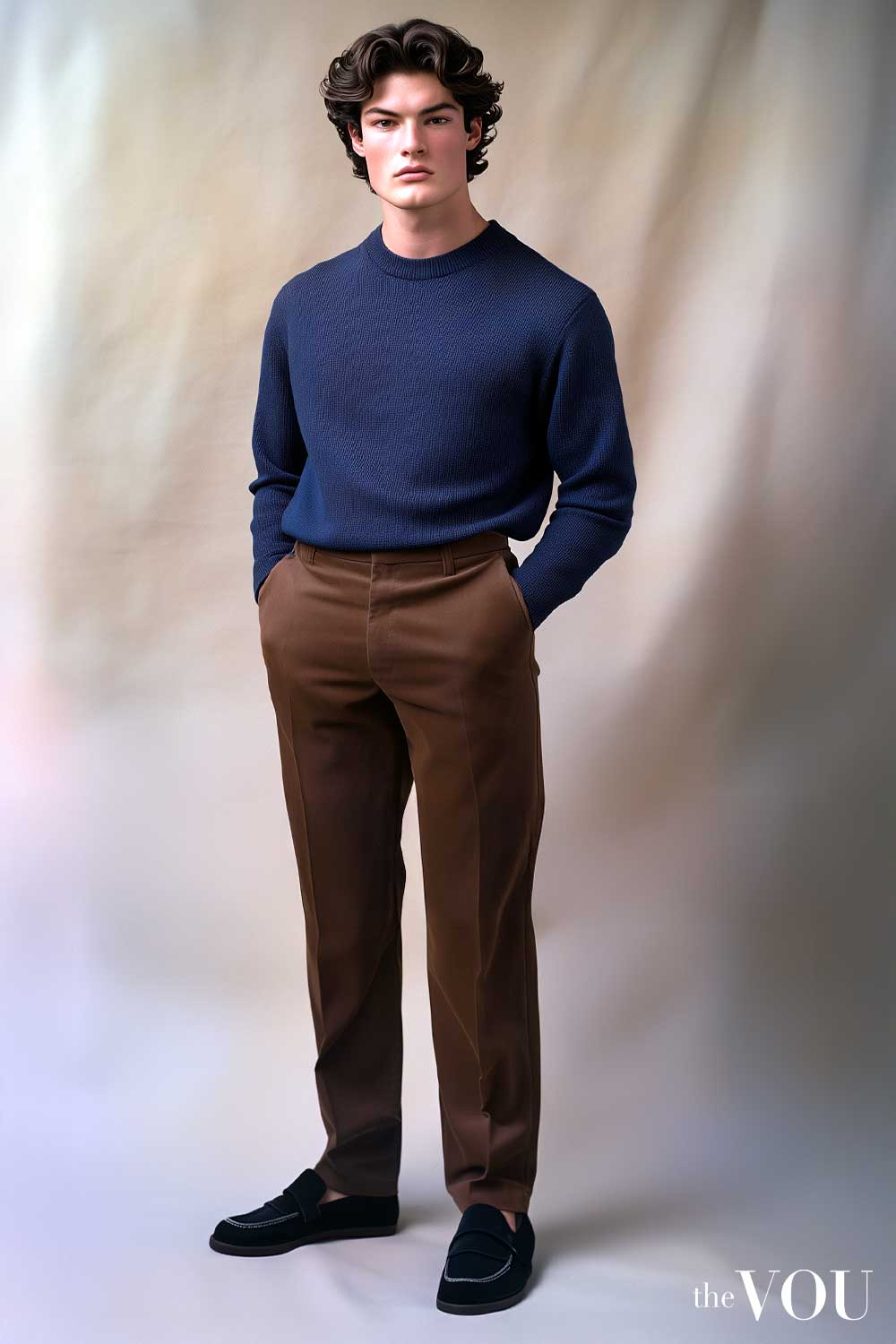
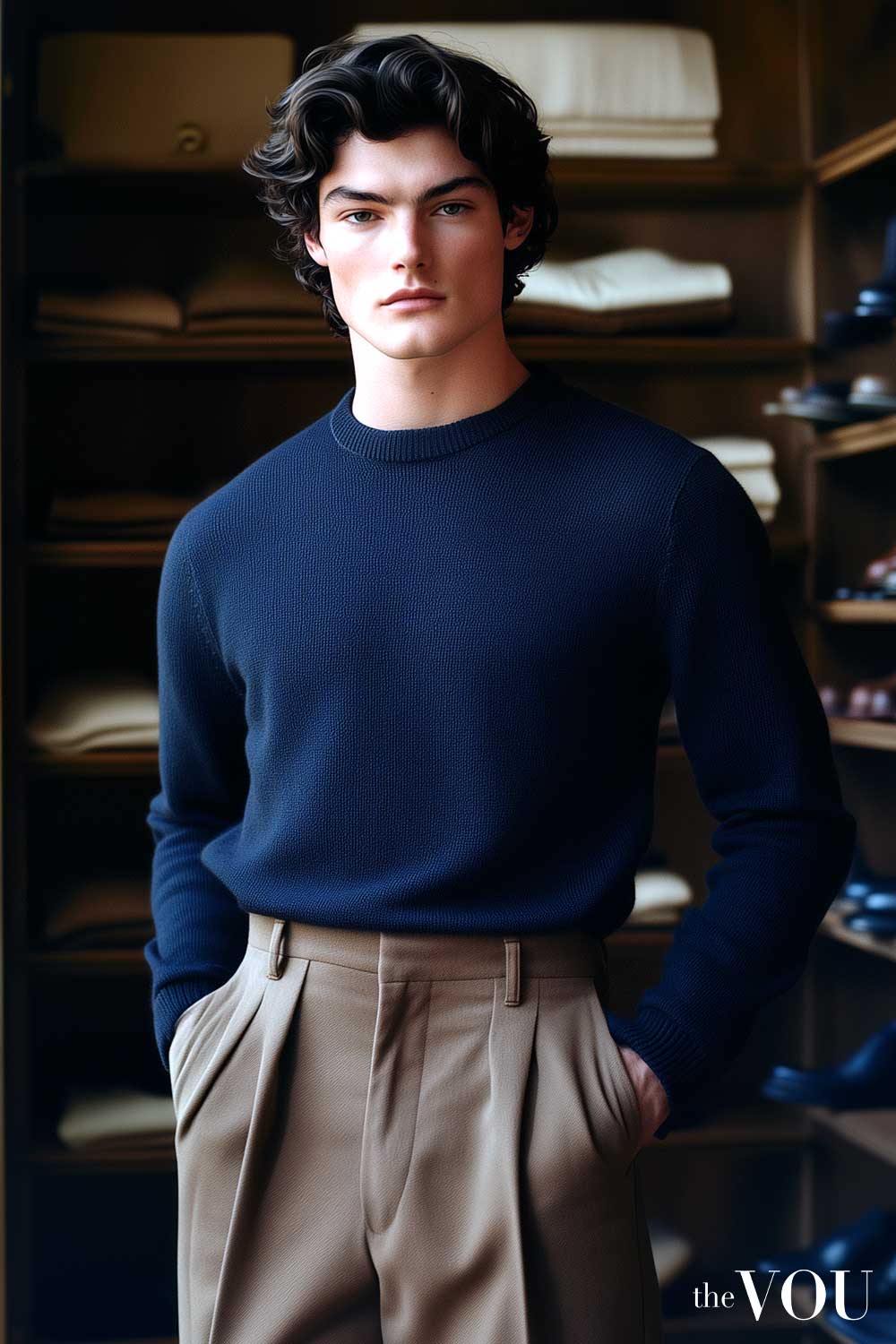
Visible: a navy knit, mid-brown trousers, dark navy matte-finished loafers. Nearest on the list: the warm blue jumper, the golden brown trousers and the warm navy loafers – the knit here is deeper than the warm blue described, and nothing identifies the trousers’ cloth.
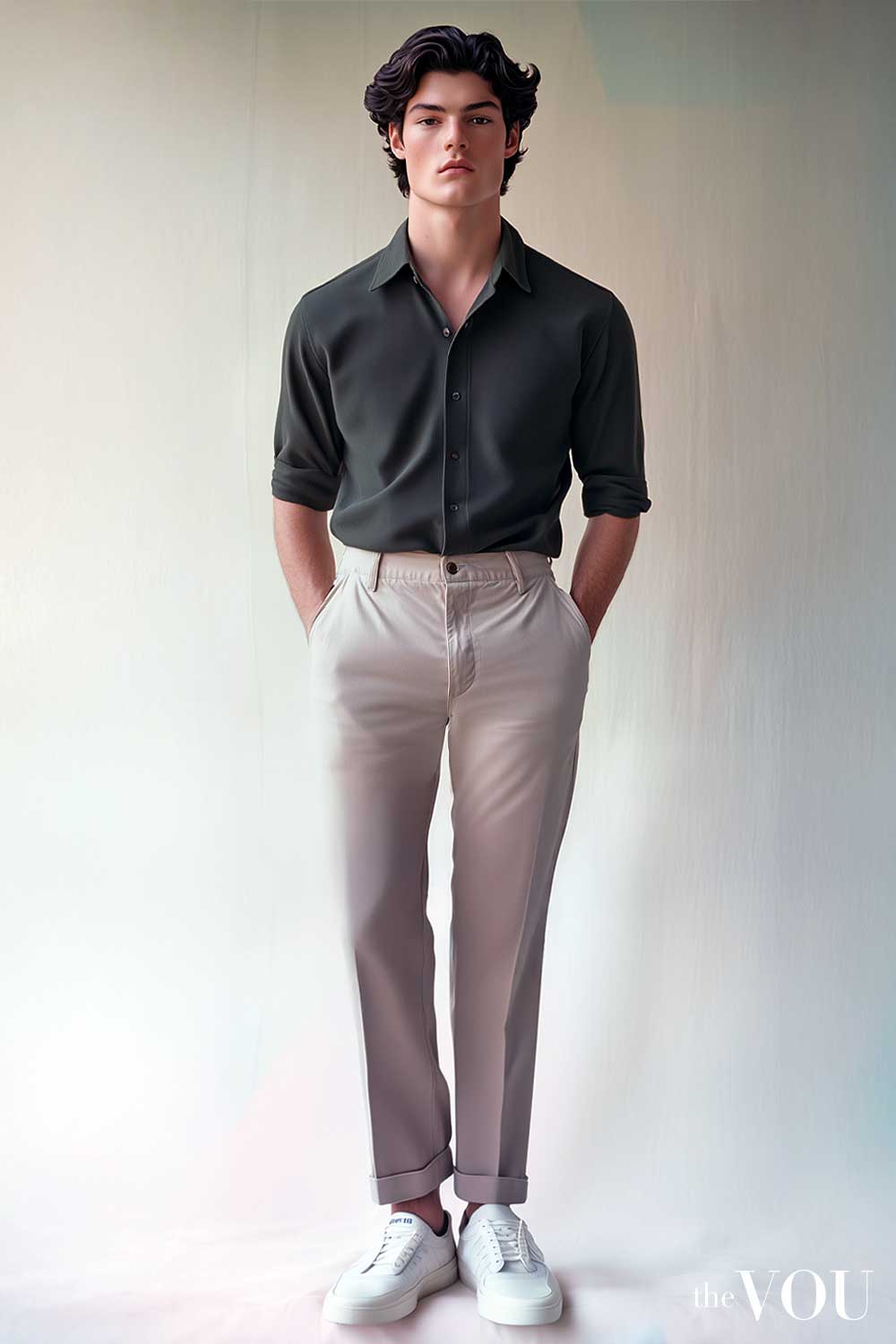
Visible: a dark olive shirt, light greige trousers, white trainers. The trainers correspond to the listed white trainers; the trousers are a lighter, greyer stone than the warm khaki on it, and olive is not one of the listed colours at all. The coral or warm green shirt is the palette version of this outfit.
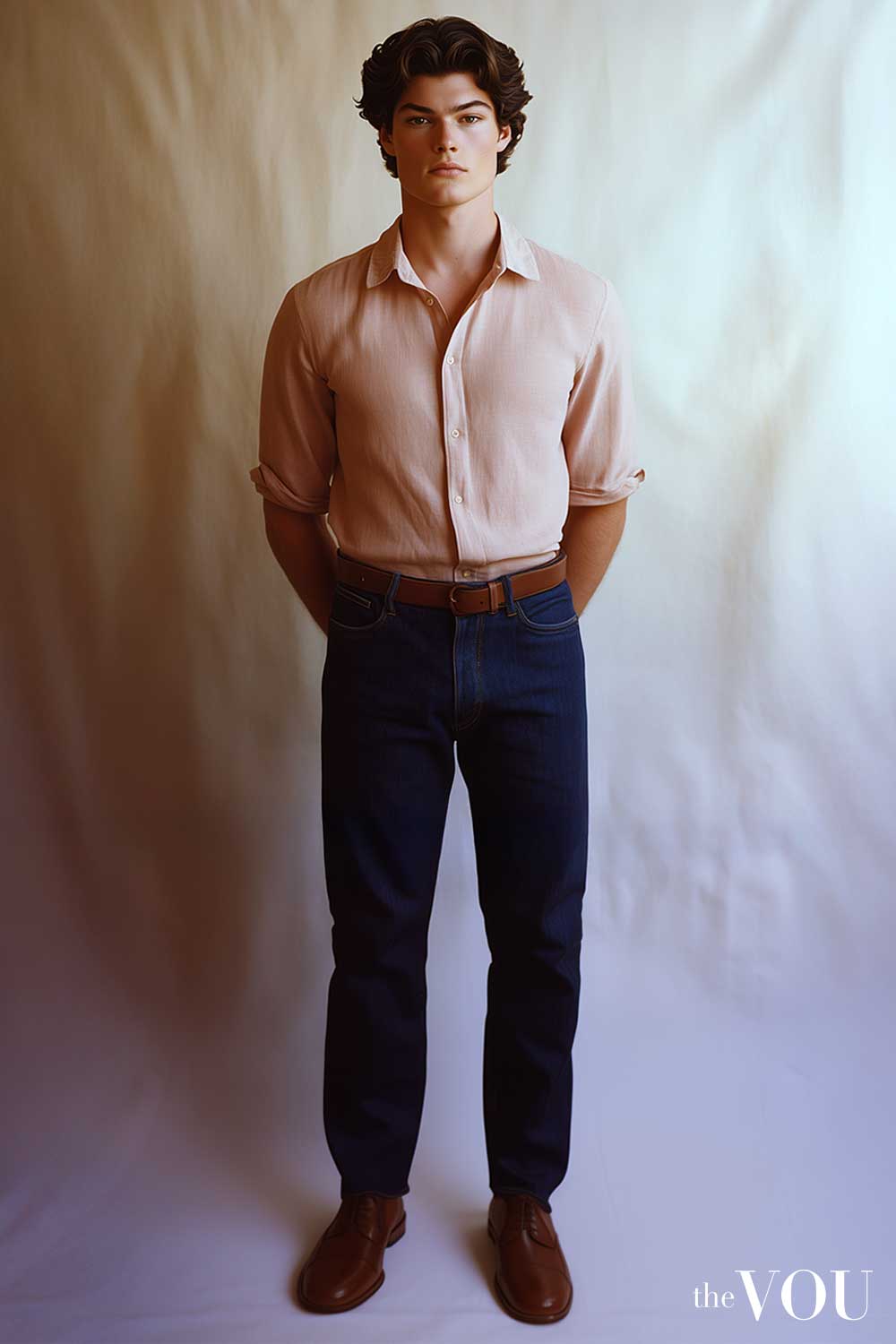
Visible: a pale pink shirt, a brown belt, dark indigo jeans, brown shoes. The pink is cooler and paler than the coral on the list, and the jeans are darker than the medium wash it names – a substitution in both cases rather than a match.
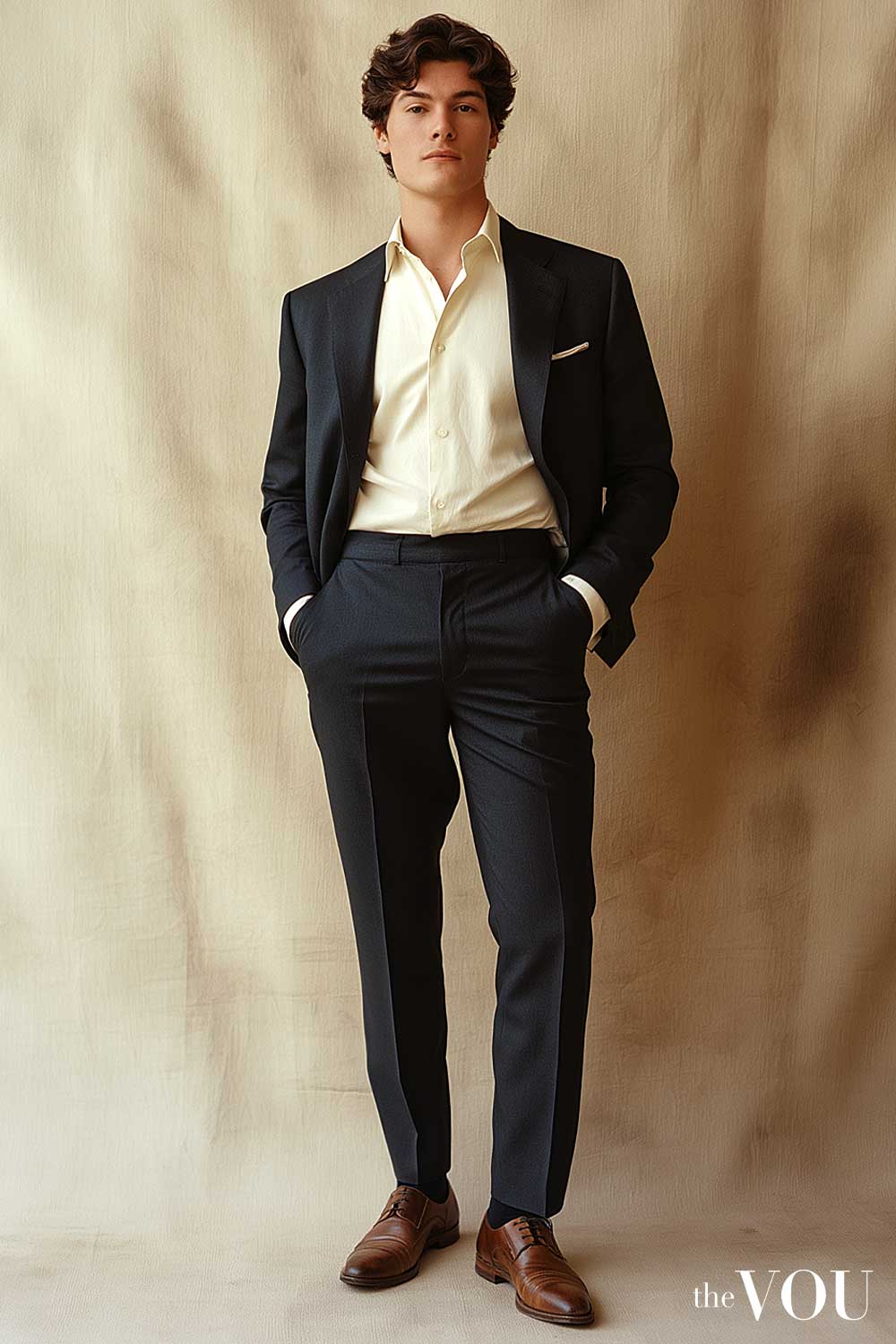
Visible: a dark navy suit, a cream shirt, a white pocket square, brown brogues. The nearest listed pieces are the warm navy suit, an ivory shirt and the warm brown brogues, though the suit photographs darker than a warm navy. Worn open-necked, this is a tailored outfit rather than a demonstration of any particular dress code.
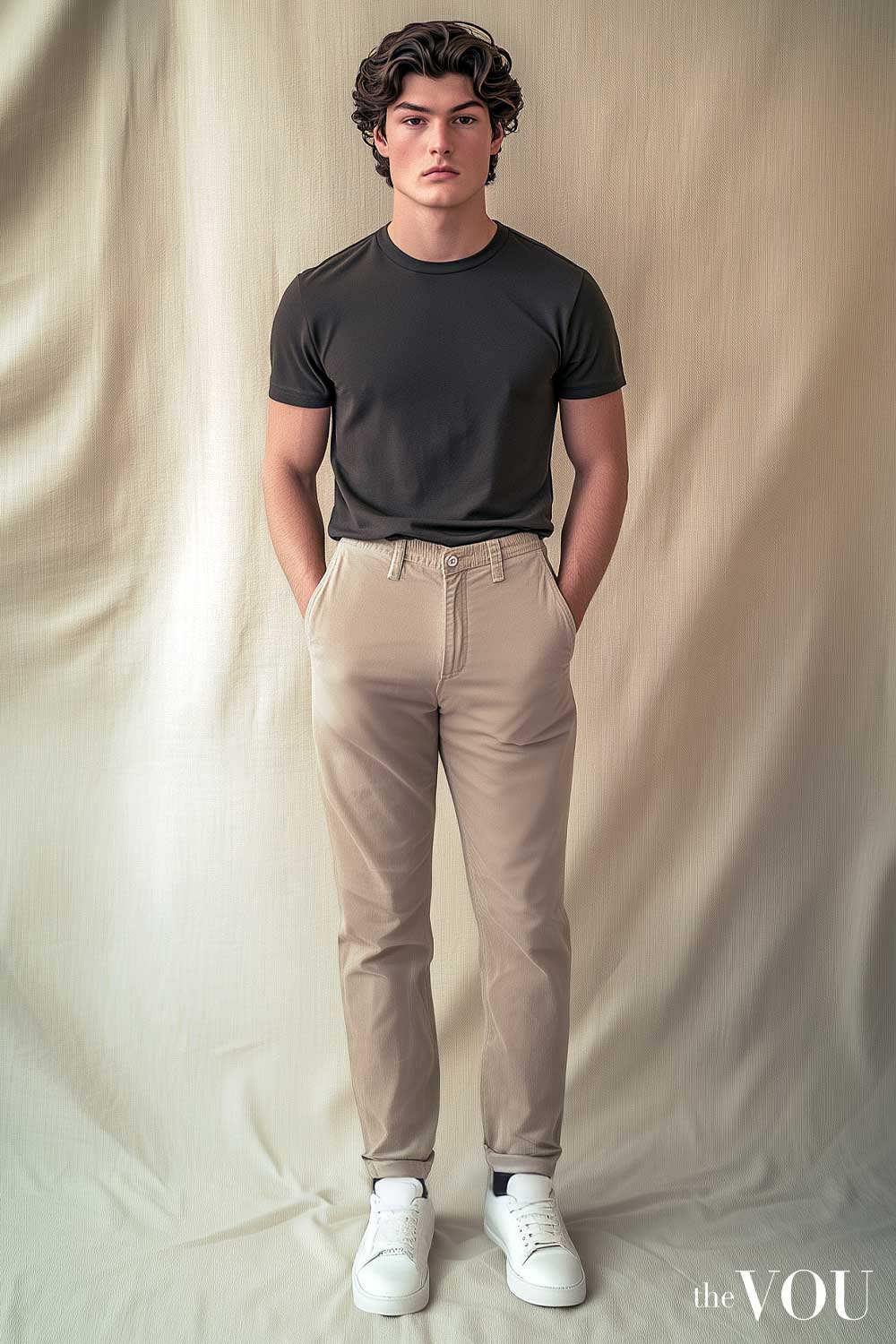
Visible: a charcoal T-shirt, stone trousers, white trainers. Charcoal is not on the list; the warm white T-shirt is the listed piece closest to this outfit, and the trousers read as a cooler stone than the warm khaki.
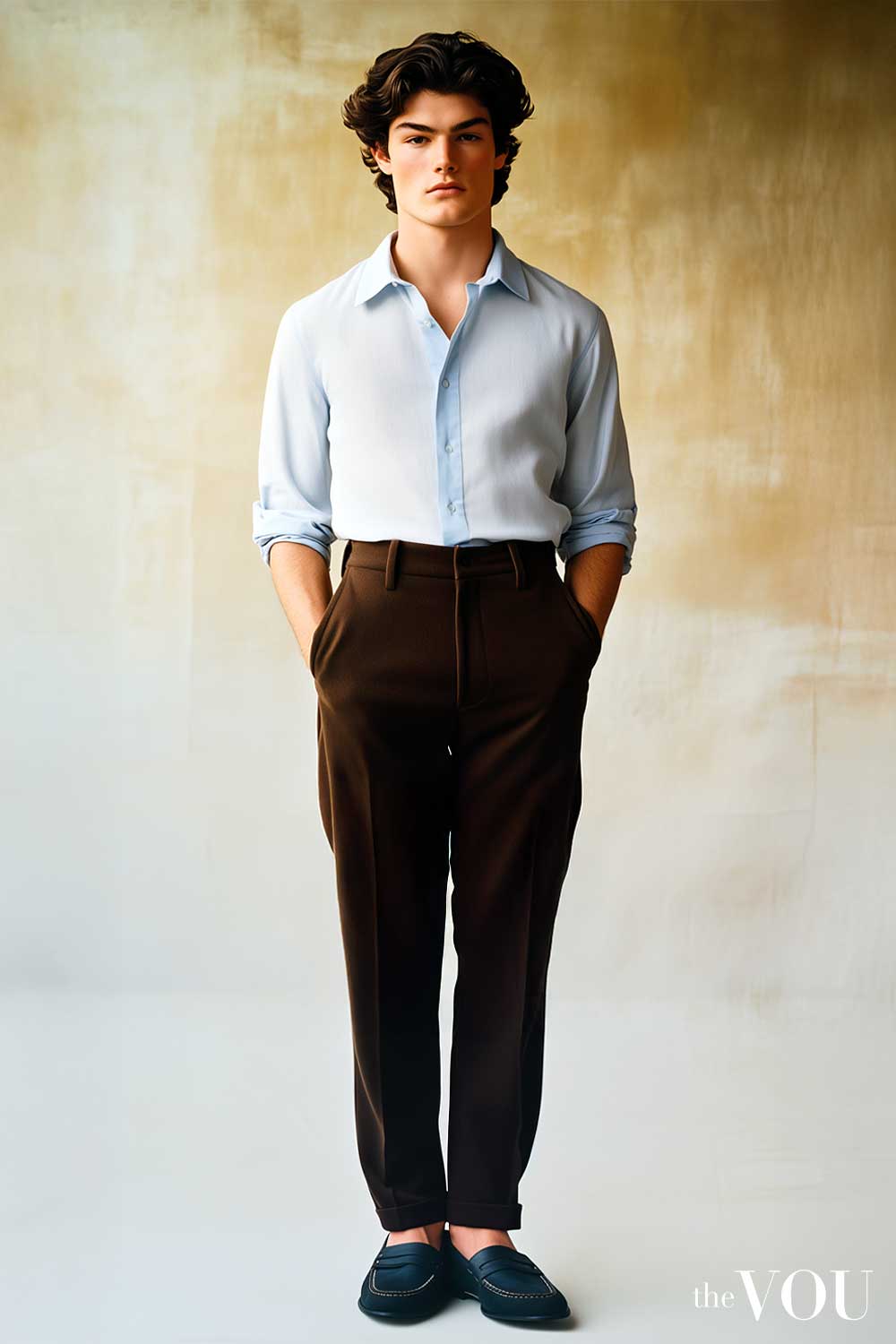
Visible: a pale blue shirt, dark chocolate-brown trousers, dark navy matte-finished loafers. The closest listed pieces are the clear light blue Oxford shirt, the golden brown trousers and the warm navy loafers; the trousers here are darker and browner than a golden brown, and the cloth is not identifiable.
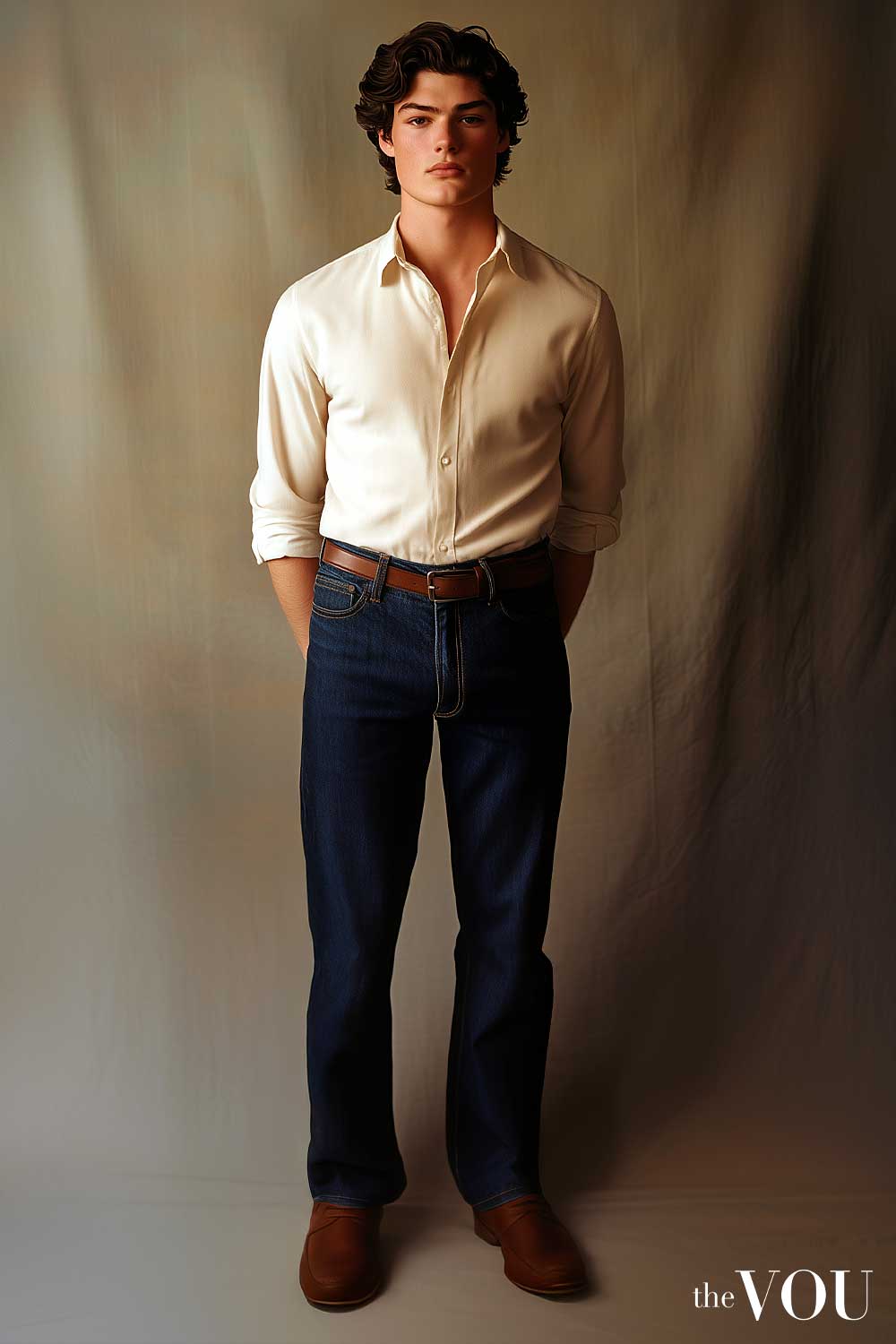
Visible: a cream shirt, a brown belt, dark indigo jeans, brown matte-finished shoes. The cream shirt is close to the warm ivory on the list; as with the pink outfit, the jeans are darker than the medium wash it names.
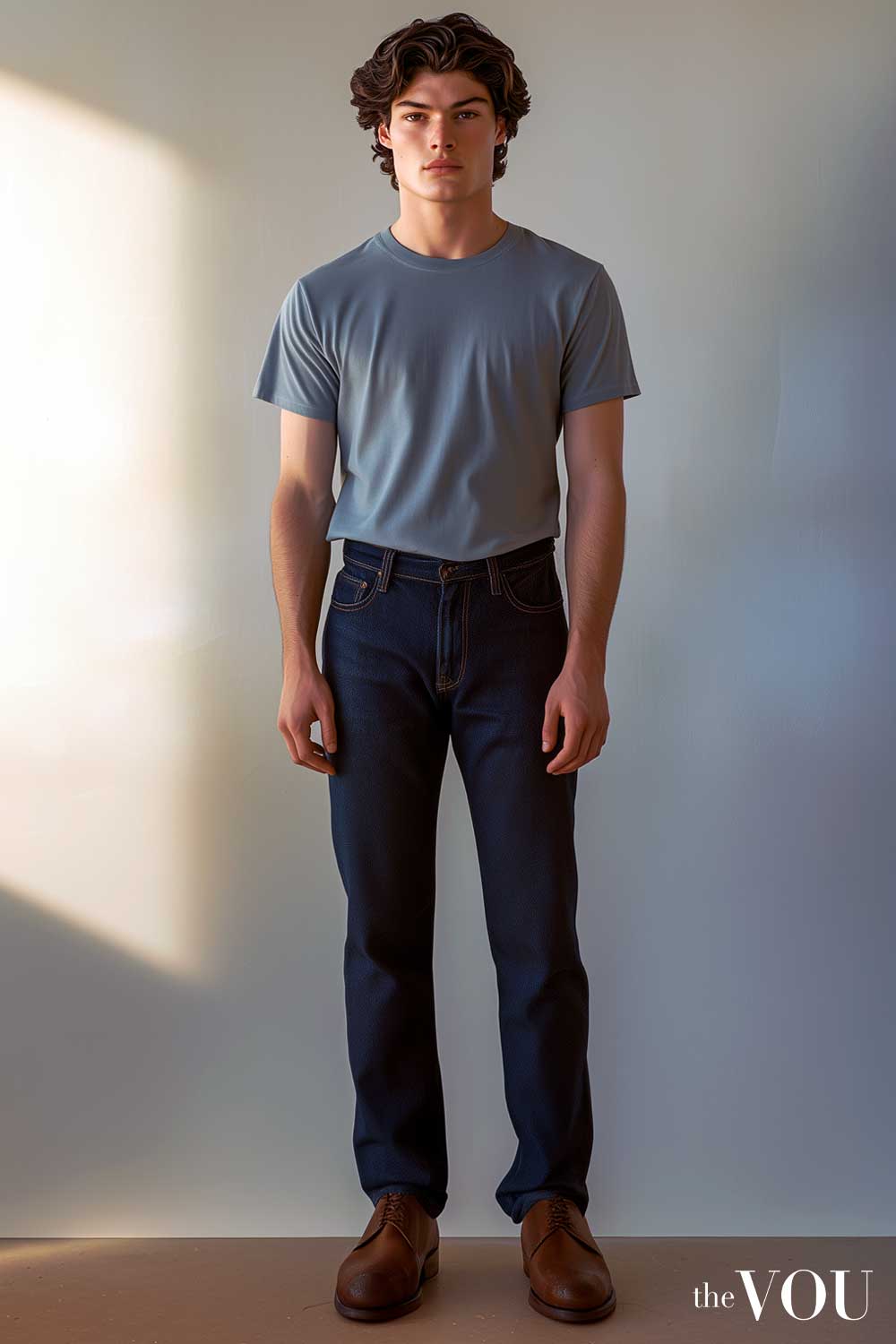
Visible: a greyed mid-blue T-shirt, a brown belt, dark indigo jeans, brown shoes. None of the listed T-shirt colours is a greyed blue, so this is the clearest example on the page of an outfit near the palette rather than in it.
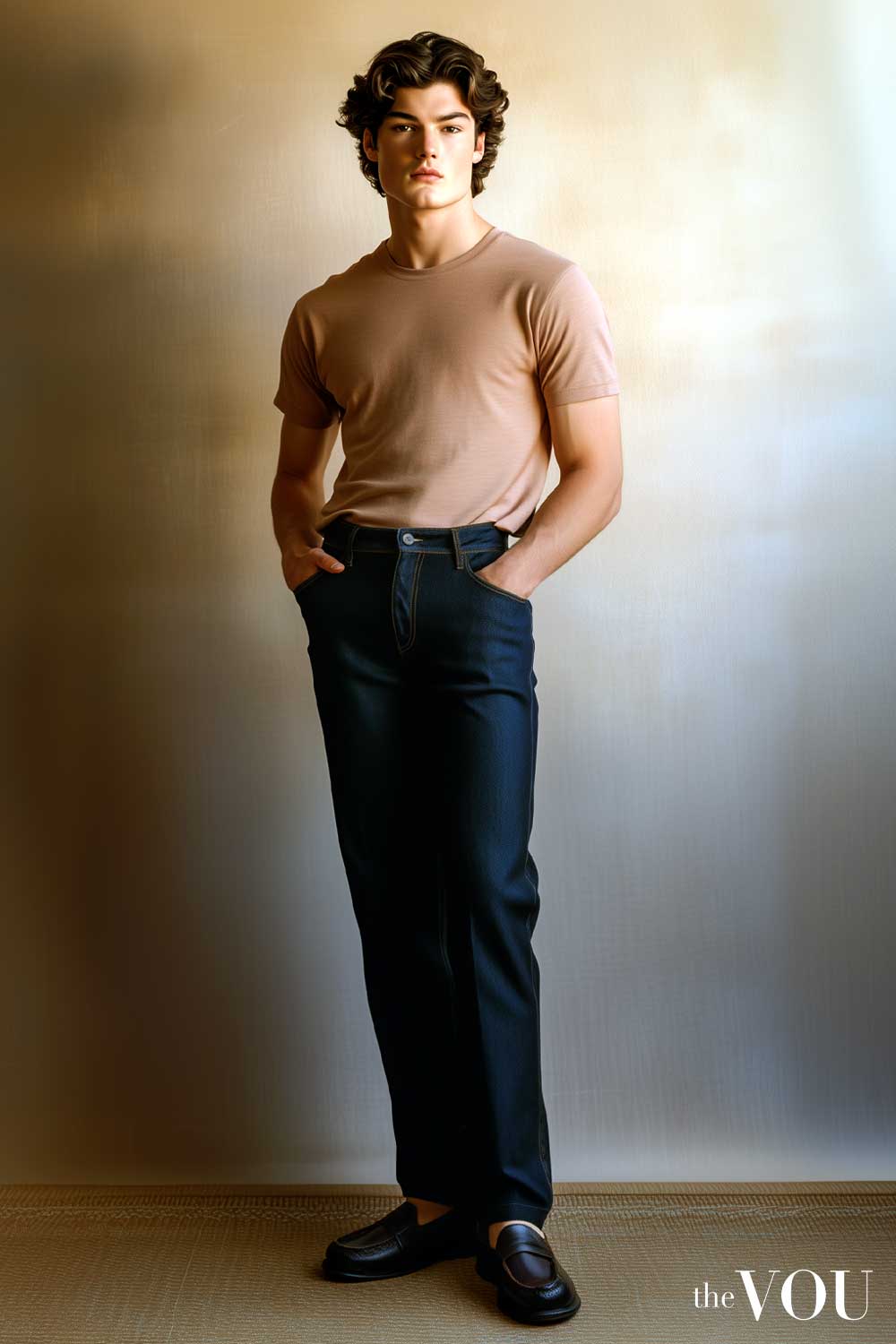
Visible: a beige T-shirt, dark navy trousers, dark brown loafers. The beige is warmer and deeper than the warm white T-shirt on the list, so treat it as a substitution; the dark navy trousers are not a listed piece at all.
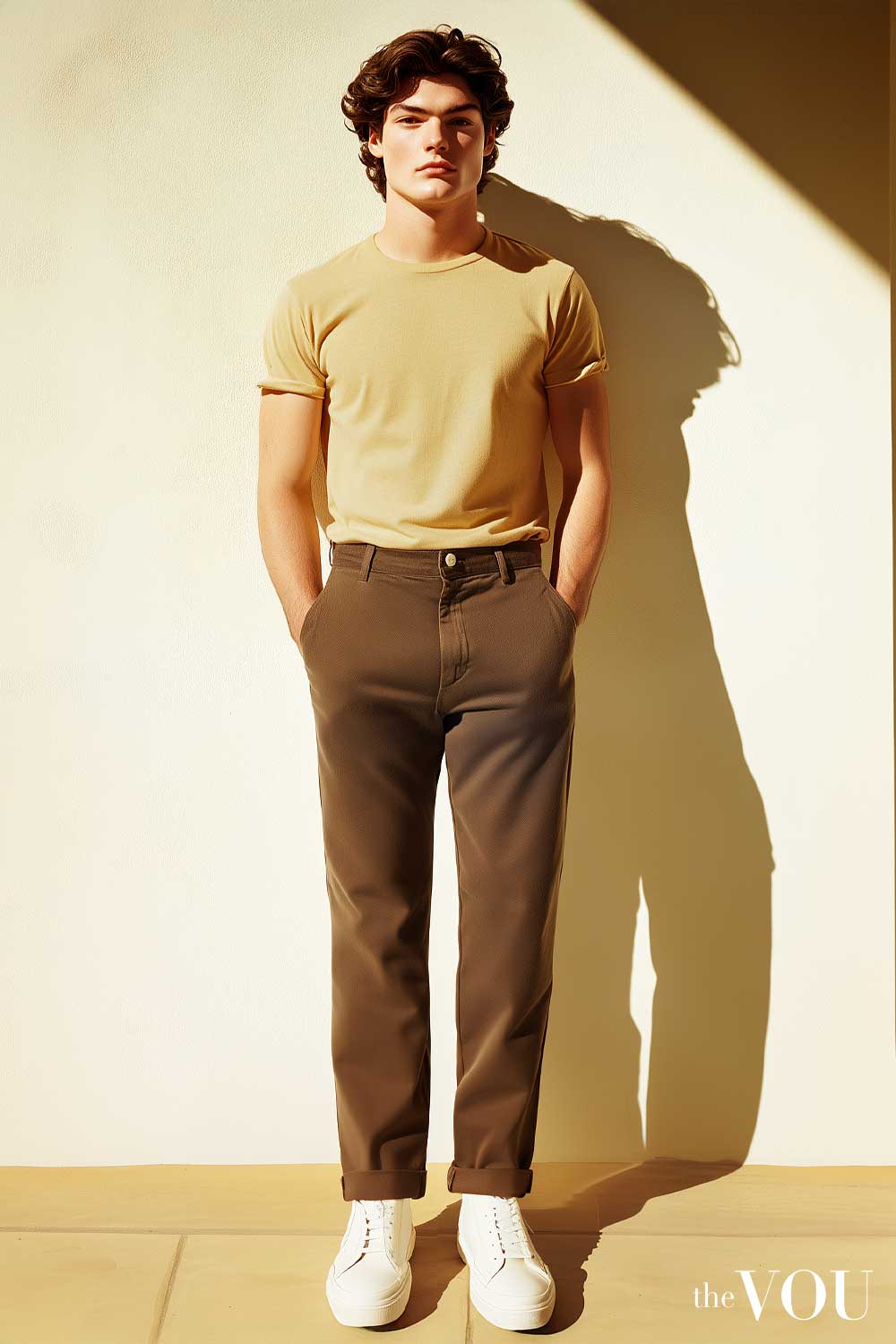
Visible: a soft yellow T-shirt, mid-brown trousers, white trainers. This is the closest the ten come to the list as written: the tee sits near the listed golden yellow T-shirt, the trainers near the listed white ones, and the trousers between the warm khaki chinos and the golden brown trousers. Near, in each case, rather than identified.
Taken together the ten cover the casual and smart-casual half of the list well and the formal half thinly: there is one suit, no blazer worn as a separate, no overcoat and no tie. A white pocket square is visible in the suit outfit. The pieces that are not pictured are on the list because the wardrobe uses them, not because a photograph exists.
Several of the outfits also sit beside the palette rather than inside it – a charcoal T-shirt, a dark olive shirt, a greyed blue T-shirt, a blush pink shirt. That is worth saying plainly rather than letting the pictures stand as the specification, and it is also a reasonable thing for a wardrobe to contain: a garment slightly outside a palette is a garment slightly outside a palette, not a fault that spreads.
Styling the Palette
One clear colour at a time is the easiest place to start
The brighter pieces here – the coral shirt, the coral and turquoise T-shirts, the warm blue blazer, the grass green jumper – carry an outfit on their own. Put one of them with camel, warm khaki, golden brown or warm ivory and the result reads deliberate with very little effort. Two of them together is harder to balance, which is a reason to start with one rather than a rule against two.
These colours share an undertone, which makes them easy to combine
Camel with golden brown, coral with warm ivory, golden yellow with warm khaki: these sit together comfortably because they share a warm undertone and a similar clarity, so nothing in the pairing reads as a clash of temperature. That is a property of any coherent palette rather than something peculiar to this one – a set of cool, muted colours combines with itself just as easily. What it does mean is that inside this list you can pair two colours without much thought.
Accessories do the colour work on a plain day
The two silk ties and the two pocket squares are an easy way to get the palette into an otherwise neutral outfit, and the easiest of all if you already own something in these colours. A navy suit, an ivory shirt and a coral tie is the same suit doing a different job.
Fit decides more than colour does
A garment in exactly the right warm coral, cut badly, looks worse than a well-cut one in a colour that is merely close. Get the fit right first; the palette is what you choose among things that already fit.
Widening it later
When the core is comfortable, add variety inside the same warm, clear range, or patterns that combine two or three of these colours – a check that mixes camel and coral, say. A cooler or more muted piece will read as a slightly different family beside these, which is worth knowing before you buy one; it will not stop the rest of the wardrobe working, and one grey jumper in a warm wardrobe is a grey jumper, not a problem.
A Note on Formal Occasions
The two suits and the two blazers cover a good deal of smart dressing, and the accessories give them variety. They do not answer every invitation. Where an invitation states a dress code – a lounge suit, morning dress, black tie – the code decides what you wear, not the palette; black tie in particular has its own outfit that no colour season changes. Debrett’s on dress codes is a useful summary of what the common codes ask for. Where no code is stated, ask the host rather than inferring one, and then choose from this list.
The Same List as a Checklist
Generated from the list above, so it says the same thing. Copy it into a note on your phone before you shop, or use your browser’s print command if you would rather carry it on paper.
Suits
– 1 warm navy wool suit
– 1 golden brown wool suit
Blazers
– 1 warm blue wool-blend blazer
– 1 camel hair blazer
Trousers
– 1 pair of warm khaki chinos
– 1 pair of medium-wash blue jeans
– 1 pair of golden brown wool trousers
Shirts
– 2 warm ivory cotton dress shirts
– 1 clear light blue Oxford shirt
– 1 coral linen casual shirt
– 1 warm green cotton-blend dress shirt
T-shirts
– 1 warm white cotton T-shirt
– 1 golden yellow cotton T-shirt
– 1 turquoise cotton T-shirt
– 1 coral cotton T-shirt
– 1 apple green cotton T-shirt
Jumpers
– 1 warm blue merino jumper
– 1 grass green cashmere jumper
– 1 camel cotton jumper
Coats
– 1 camel wool overcoat
– 1 warm navy wool pea coat
Shoes
– 1 pair of warm brown leather brogues
– 1 pair of white leather low-top trainers
– 1 pair of warm navy suede loafers
Accessories
– 1 warm blue silk tie
– 1 coral silk tie
– 1 golden yellow silk pocket square
– 1 turquoise silk pocket square
– 1 warm brown leather belt
29 lines covering the 30 pieces above, item for item.
Where to Go Next
If you want to know about the season itself
The palette explained
The True/Warm Spring colour palette guide explains what True/Warm Spring is, how it differs from Bright Spring and Light Spring, and which colours belong to it.
If you want the method rather than the colours
How many, and in what order
Use our step-by-step method for building a capsule wardrobe to work out how many pieces your own week needs, what to clear out before you buy, and what to buy first. It is written around menswear neutrals, but the sequence applies to any palette, including this one.
If you want a different register
The same idea in another idiom
For a capsule in the Old Money look, with a photograph of each category, see the Old Money capsule, category by category.
About the photographs on this page. All ten illustrations are retained from the original version of this article and are reproduced as inherited; this page has not established authorship, rights or product identity for any of them. Each caption describes what is visible and then names the nearest listed piece as a comparison. No caption claims a fibre, a maker, an exact shade or an occasion that the photograph does not show.
Mandy Meyer’s focus at The VOU is men’s body-shape styling, garment fit and outfit proportions. Her coverage addresses the practical questions behind a wardrobe choice: how a jacket sits across the shoulders, how trousers fall and how different cuts change the silhouette a wearer wants to create.
Her subject areas include the triangle, inverted triangle, rectangle, oval, trapezoid, hourglass and diamond labels used in body-shape styling. These provide starting references for comparing visible proportions; they do not capture every body or prescribe one correct way to dress. The focus connects those observations with garment shape, construction, length and the relationship between the upper and lower parts of an outfit.
Mandy’s editorial coverage combines visual comparisons with fit checks for comfort and movement. Readers can consider whether a cut gives them the room they need, where clothing pulls or gathers and which changes might support their preferred look. The aim is to make menswear choices more understandable while keeping personal preferences and the wearer’s own styling goals central.
Raf Adams’s focus at The VOU is luxury menswear, brand analysis and quiet-luxury styling. His coverage addresses men who want to understand the difference between a recognisable label, a documented garment feature and a buying choice that makes sense for their wardrobe.
His subject areas include materials, construction details, brand positioning and the understated clothing references associated with quiet luxury. This focus examines what can be established from product information and what remains a matter of appearance or preference. Price and reputation provide context, but neither replaces attention to fit, intended use and the details of the item being considered.
Raf’s editorial coverage connects those comparisons with complete outfits and repeat wear. Readers exploring premium clothing can consider how a purchase works with existing pieces, which features matter to them and whether a less conspicuous look suits their needs. The aim is to make luxury menswear easier to assess without turning a brand name into a promise of quality or personal style.
Lawrence Anderson’s focus at The VOU is old-money style, British heritage menswear and the wider strategy behind a man’s wardrobe. His coverage addresses readers who want a composed, consistent style but need practical guidance on where to begin, what to keep and which pieces deserve a place in their wardrobe.
His subject areas connect classic tailoring, knitwear, footwear and accessories with the proportions and formality of a complete outfit. British countryside clothing, preppy dressing and Ivy-inspired references provide context for understanding different versions of the look. The emphasis is on recognising the relevant details and adapting them to the wearer’s life, rather than treating an aesthetic as a requirement to buy particular labels.
Lawrence’s editorial coverage brings wardrobe planning back to the reader’s needs: everyday clothing, professional presentation, occasion dressing and a workable budget. It considers existing pieces, outfit coordination and repeat use, giving men a basis for building personal style over time. A coherent wardrobe should reflect the person wearing it and the situations they actually need to dress for.