
Observe the landscape of modern menswear and you will notice a peculiar phenomenon.
The boot-cut jeans, trucker hats, and metallic sheens of the early 2000s, styles once relegated to the annals of sartorial missteps, are re-emerging with an undeniable confidence on catwalks and city streets alike.
This is the predictable, rhythmic pulse of style known as the 20 Year Rule.
This principle, often referred to as the 20-Year Cycle, posits that fashion trends are cyclical, destined to be rediscovered and reinterpreted by a new generation approximately two decades after their initial peak.
For the discerning gentleman, understanding this rule is not about slavishly following trends; it is about mastering the art of timing, investment, and strategic wardrobe curation.
This guide will deconstruct the mechanics, history, and practical application of the 20 Year Rule, equipping you with the knowledge to navigate the currents of style with precision and authority.
The Mechanics Behind The 20 Year Fashion Cycle
The 20 Year Rule is not an arbitrary timeline but a complex interplay of generational shifts, cultural nostalgia, and technological acceleration. To truly leverage its power, one must first understand the forces that drive it.
A New Generation’s Discovery
At the core of the cycle is a simple generational dynamic. A new cohort of tastemakers, now in their late teens and early twenties, begins to explore the aesthetics that defined the world around their birth.
To them, the fashion of 20 years prior feels novel and exotic. It is distant enough not to be associated with their parents’ generation, yet familiar through the cultural osmosis of film and music.
They can adopt these styles without the ‘cringe factor’ felt by those who wore them the first time.
Trend forecasters and designers, ever alert to the nascent currents of youth culture, identify this burgeoning interest and begin to formalise it, reintroducing key silhouettes and motifs into their collections.
Nostalgia and Cultural Resonance
For those who have a faint memory of the era, the resurgence taps into a powerful sense of nostalgia.
The return of Y2K fashion, for instance, evokes a pre-9/11, pre-recession sense of optimism and digital futurism.
This psychological appeal is potent; it offers a connection to a perceived simpler or more exciting time.
The clothing becomes a vessel for the cultural resonance of that period (its iconic films, influential music artists, and defining celebrity moments), all of which are being rediscovered and re-evaluated by a new audience.
The Role of Technology and Social Media
Whilst the 20 Year Rule predates the internet, its modern manifestation is supercharged by digital platforms.
Social media, particularly TikTok and Instagram, acts as an accelerant, compressing the discovery phase of the cycle.
Archival fashion accounts can resurrect a forgotten trend in an instant, disseminating it to millions.
A new generation can research, adopt, and popularise an aesthetic from two decades ago with unprecedented speed, creating a feedback loop that forces the mainstream fashion industry to react far more quickly than ever before.
A Brief History
The concept of cyclical fashion is a well-established principle in style theory, with its intellectual roots stretching back nearly a century.
Understanding its evolution provides a crucial context for its modern-day application.
The Origins: James Laver’s Theory
The intellectual forerunner to the 20 Year Rule is ‘Laver’s Law’, a timeline conceived by the British fashion historian and museum curator James Laver in the 1930s.
He proposed a detailed schedule for how a trend’s perception changes over time:
- Indecent: 10 years before its time
- Shameless: 5 years before its time
- Daring: 1 year before its time
- Smart: In its time
- Dowdy: 1 year after its time
- Hideous: 10 years after its time
- Ridiculous: 20 years after its time
- Amusing: 30 years after its time
- Quaint: 50 years after its time
- Charming: 70 years after its time
- Romantic: 100 years after its time
- Beautiful: 150 years after its time
Laver’s timeline suggests that a style becomes “ridiculous” at the 20-year mark, the very point where a new generation, free of these negative connotations, begins to find it “amusing” and ripe for revival.
The 20 Year Rule is essentially a simplification of this critical turning point.
Historical Examples
History provides a compelling case for the rule’s validity, with each generation looking back two decades for inspiration.
The 1970s did the 1950s: The rock’n’roll rebellion of the 50s, with its leather jackets and slicked-back hair, was re-popularised in the 70s through cultural touchstones like the musical Grease.
The 1990s did the 1970s: The bohemian and disco aesthetics of the 70s, including flared trousers, wide-collared shirts, and platform shoes, saw a major revival in 90s fashion and music.
The 2010s did the 1990s: The grunge, minimalism, and logo-centric sportswear that defined the 90s became the dominant stylistic language of the 2010s, from oversized flannel shirts to Calvin Klein-inspired basics.
Today does Y2K: We are currently witnessing the rule in real-time as the early 2000s (with its low-rise trousers, mesh fabrics, and bold graphic tees) is comprehensively mined for inspiration.
How To Apply The 20 Year Rule To Your Wardrobe
For the man of style, the 20 Year Rule is not an invitation to cosplay a bygone era.
It is a strategic framework for building a resilient, multi-generational wardrobe. The goal is intelligent curation, not blind imitation.
Invest, Don’t Speculate
The rule applies to well-constructed garments, not the disposable relics of fast fashion. Instead of chasing fleeting micro-trends, focus your capital on high-quality, classic pieces crafted from superior materials.
A well-made leather jacket, a substantive piece of outerwear, or a perfectly cut blazer possesses a timeless silhouette that will endure.
These are the items that, after a period of rest, can be successfully reintroduced into a contemporary wardrobe. Think of it as a long-term investment in your personal style portfolio.
The Art of The Archive
Rather than ruthlessly purging your wardrobe every few seasons, adopt the mindset of a curator. When a high-quality item begins to feel dated, do not discard it.
Instead, archive it. This means having it professionally cleaned and storing it correctly in a cool, dry place, ideally within a breathable garment bag. This is not hoarding; it is a calculated decision to preserve a valuable asset.
The jacket you archive today may well become a key statement piece in a decade’s time, giving you an authentic edge that cannot be bought off the rack.
Modernising Vintage Pieces
The most critical element of applying the 20 Year Rule is integration. You must avoid wearing a head-to-toe period costume at all costs. The art lies in selecting a single “archived” or vintage piece and grounding it firmly in a modern context.
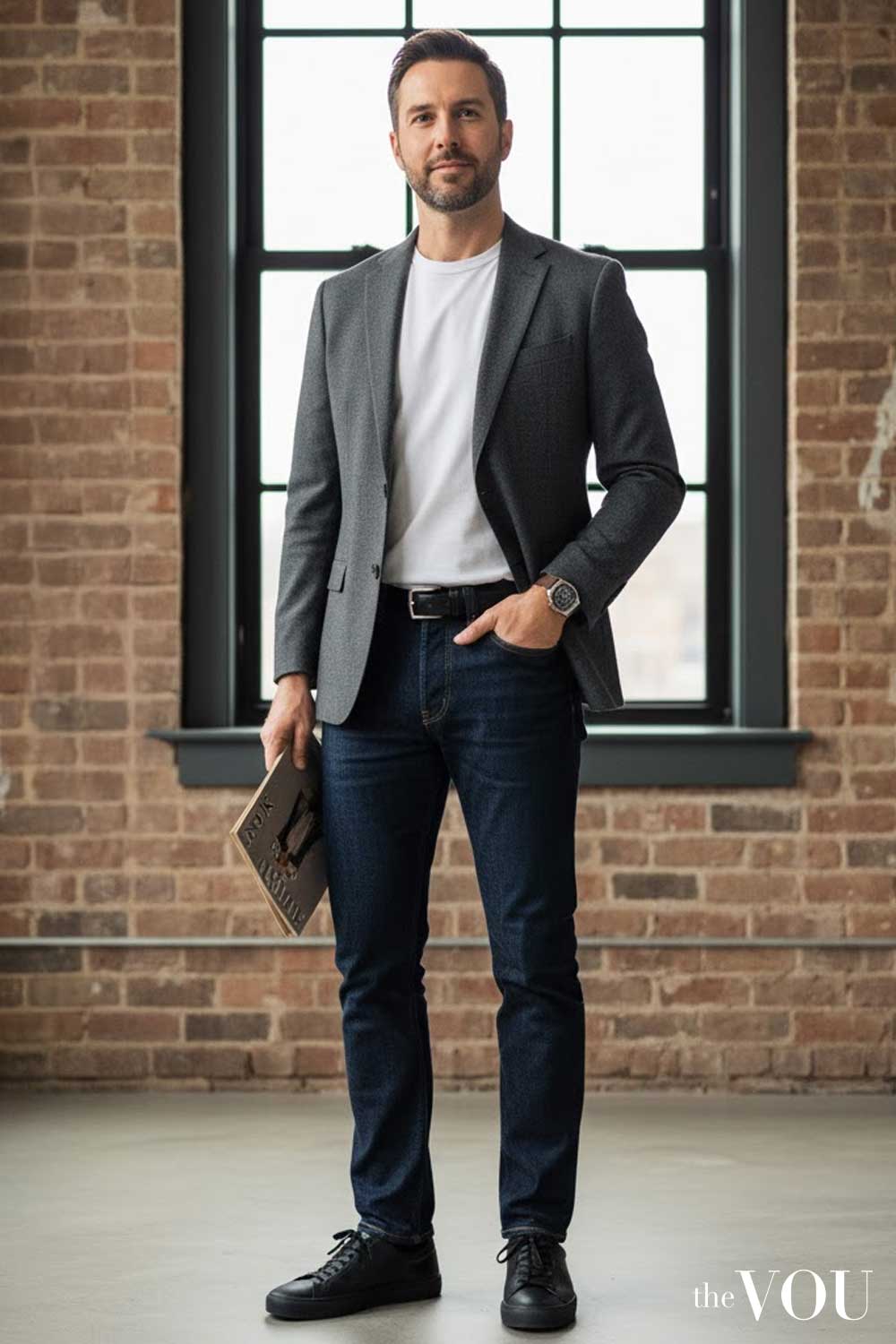
Pair a 90s-era oversized blazer with sharp, slim-fit trousers and minimalist leather trainers. Integrate a Y2K-style graphic tee into an otherwise refined outfit of dark denim and a tailored overcoat.
The contrast between the past and the present is what creates a compelling, sophisticated look. It signals that you understand the reference without being defined by it.
The Future of The 20-Year Cycle
In our hyper-connected world, the traditional rhythms of fashion are being challenged. Understanding the trajectory of the 20 Year Rule is essential for staying ahead of the curve.
Is The Cycle Accelerating?
The consensus amongst industry analysts is a resounding yes. The voracious appetite of social media for new content and the relentless production schedules of fast fashion have created a culture of perpetual novelty.
Micro-trends now emerge, peak, and vanish in a matter of months, not years. This acceleration means we are seeing aesthetics from the late 2000s and even early 2010s already being re-contextualised, suggesting the 20-year cycle may be compressing into a 15 or even 10-year loop for certain styles.
Beyond The 20-Year Rule: Other Cycles
It is prudent to recognise that the 20 Year Rule is not the only temporal force at play.
Some theorists champion a 30-year cycle, arguing that this longer period allows for a more mature and refined reinterpretation of a style, once the initial cringeworthy associations have fully faded.
Others point to a 50-year cycle, which is typically when a style moves from being merely “retro” to achieving true “classic” status, becoming a permanent fixture in the menswear lexicon.
The discerning man understands that all these cycles can operate concurrently, influencing different aspects of the sartorial landscape.
Conclusion
The 20 Year Rule of fashion is more than a mere curiosity; it is a fundamental principle governing the ebb and flow of style.
It reveals a predictable pattern of forgetting and rediscovery, driven by generational change and amplified by modern technology.
For the successful man, this knowledge is power. It provides a framework for making intelligent wardrobe investments, for curating a personal archive of timeless pieces, and for integrating elements of the past with contemporary sophistication.
To master your style is to understand its history and anticipate its future. The 20 Year Rule is not a set of instructions to be followed, but a strategic insight to be mastered, allowing you to build a wardrobe that is not only current but enduring.
Aidan Russell’s focus at The VOU is men’s face-shape styling, facial proportions and the way accessories frame the face. His coverage addresses a common starting question: how do you choose glasses, hats or necklines when standard face-shape advice does not quite describe your features?
His subject areas include comparing visible face length and width, recognising mixed features and understanding how frame size, brim shape and neckline placement change an overall look. Rather than making a shape label the final decision, this coverage connects proportions with the effect a reader wants, whether that means adding definition, softening an outline or drawing attention to particular features.
Aidan’s editorial focus also links facial styling with the rest of a man’s wardrobe. The aim is to make comparisons easier when trying on accessories or planning an outfit, while allowing for comfort, fit and personal preference. Readers looking for a starting point in face-shape styling can use this coverage to identify options worth trying, without being confined to one prescribed look.
Sara Law’s focus at The VOU is men’s capsule wardrobes, outfit formulas and wardrobe curation. Her coverage addresses readers who want to get more useful combinations from their clothes, particularly across everyday and business-casual settings.
Her subject areas include coordinating shirts, trousers, knitwear, jackets and footwear, identifying gaps and understanding why certain combinations work together. This focus starts with the wearer’s routine and preferences rather than a fixed number of garments. A capsule wardrobe should reflect the situations a man needs to dress for, including the level of formality and the practical demands of his day.
Sara’s editorial coverage gives readers a way to organise existing pieces before deciding what to add. Outfit formulas provide repeatable starting points that can be adjusted through colour, texture, proportions and accessories. The aim is to reduce the difficulty of getting dressed while preserving variety, helping men build a wardrobe that feels connected without making every outfit look the same.
Mandy Meyer’s focus at The VOU is men’s body-shape styling, garment fit and outfit proportions. Her coverage addresses the practical questions behind a wardrobe choice: how a jacket sits across the shoulders, how trousers fall and how different cuts change the silhouette a wearer wants to create.
Her subject areas include the triangle, inverted triangle, rectangle, oval, trapezoid, hourglass and diamond labels used in body-shape styling. These provide starting references for comparing visible proportions; they do not capture every body or prescribe one correct way to dress. The focus connects those observations with garment shape, construction, length and the relationship between the upper and lower parts of an outfit.
Mandy’s editorial coverage combines visual comparisons with fit checks for comfort and movement. Readers can consider whether a cut gives them the room they need, where clothing pulls or gathers and which changes might support their preferred look. The aim is to make menswear choices more understandable while keeping personal preferences and the wearer’s own styling goals central.