

Start here
What’s This About
What men wear to work varies a great deal between industries, and within each industry the employer’s own policy, the role and the client decide the detail.
This guide describes how dress expectations differ between fields, such as:
law, finance and government
technology and creative industries
healthcare and hospitality
trades and manufacturing, where safety equipment comes first
how to read an unfamiliar workplace’s expectations
and many more!
Treat each section as a description of common practice, not a rule for every employer in that field.
Key Points
01Industry tells you the likely range of dress, but your employer’s written policy, your role and your clients decide what you actually wear.
02Uniforms, protective equipment and hygiene rules are requirements, not style choices; employers set them, and who pays for uniforms varies by country and employer.
03Ask HR or your hiring manager when you are unsure, and dress slightly more formally for interviews and first days if you cannot ask.
04Clean, well-fitting and well-kept clothes look professional in every industry.
Men’s business attire is not one size fits all; expectations differ widely between industries.
Client expectations and the kind of contact you have with clients often shape how formally people dress.
The image an industry wants to project, whether tradition, innovation or creativity, also shapes its norms.
What looks right in a law firm can look out of place in a technology start-up or a creative agency.
Company culture, the practical demands of the job and long-standing traditions all influence dress codes, and practice varies between employers in the same industry.
This guide describes the common patterns in ten fields, so you can interpret what you see and ask the right questions.
The Legal Profession

Many law firms still lean towards business professional dress, reflecting the profession’s traditions, although some now use business casual on days without client or court commitments.
Where suits are expected, a dark suit in navy, charcoal grey or black is the usual choice.
Long-sleeved collared shirts in white or light blue and a conservative tie with a subtle pattern are common.
Polished leather dress shoes, such as black Oxfords or Derbies, complete the outfit.
Fit and neatness matter more than labels, and accessories such as watches or tie bars are usually understated.
Court dress is a separate matter: in England and Wales, judges and barristers wear robes in some courts, and the 2008 reforms removed wigs for judges in civil and family proceedings, so follow the court’s own requirements; in the United States, lawyers usually wear conservative suits in court.
Our guide to business attire for lawyers goes into this in more detail.
Finance and Banking

Finance and banking have traditionally been formal, particularly in client-facing roles in investment banking, wealth management and private banking.
Where that tradition continues, dark suits, white or pale-blue shirts and quiet ties are common, with polished black or dark-brown leather shoes.
Ostentatious displays tend to be avoided, and neat details such as a tidy tie knot are noticed.
Many firms have relaxed to business casual for some roles or days, especially away from client meetings, so check the firm’s policy rather than assuming the traditional standard.
The Tech Industry

Dress in the technology industry ranges from very casual to smart casual or business casual.
In many start-ups, especially in engineering roles, jeans, T-shirts, hoodies and trainers are common.
In larger companies, or in client-facing and management roles, chinos, dark jeans, polo shirts, button-down shirts and clean trainers or casual leather shoes are typical, with blazers for important meetings.
Heavy formality can feel out of place in a relaxed start-up, but the right level still depends on the company and the people you are meeting.
Creative Industries (Advertising, Media, Design)
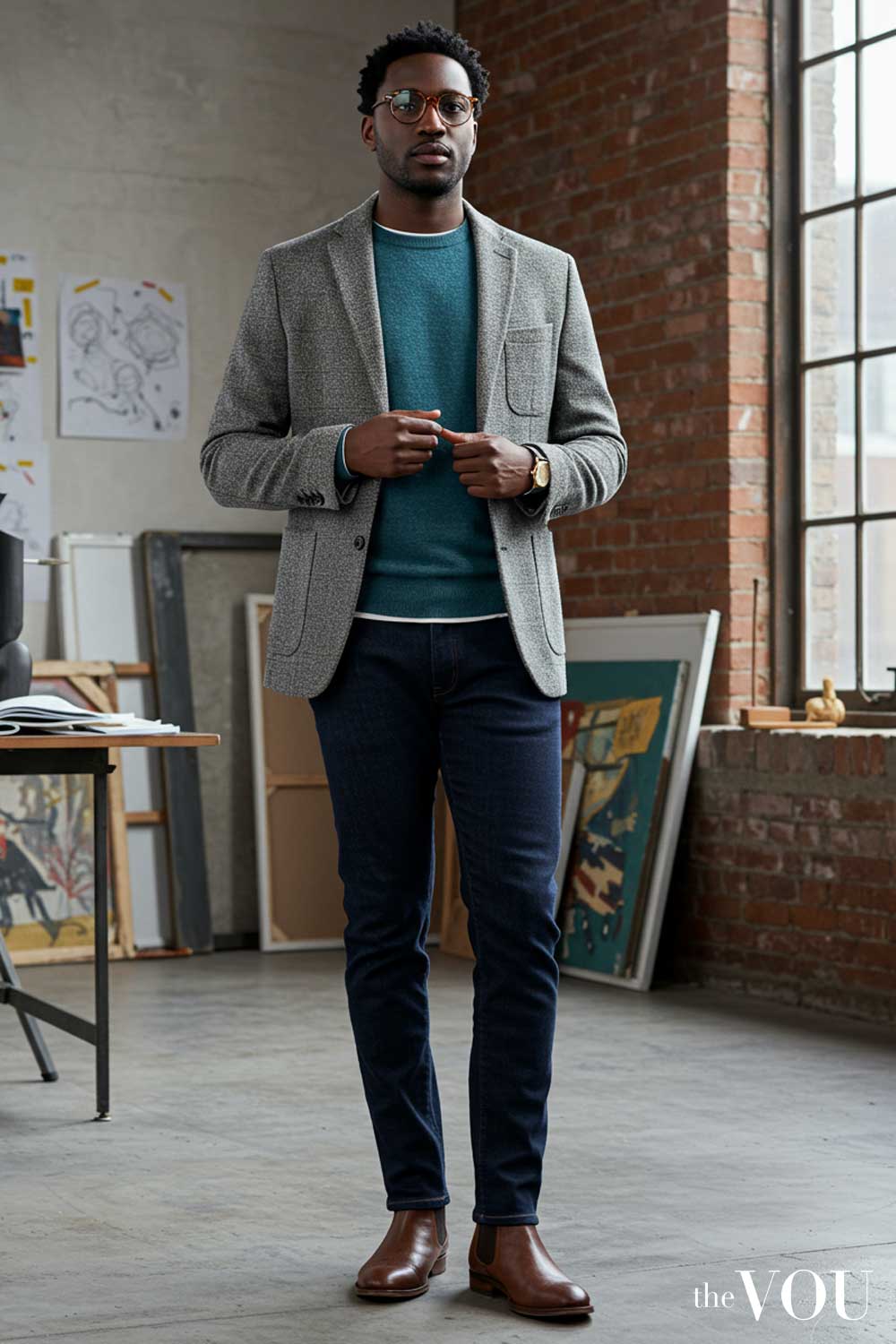
Advertising, media and design often favour smart casual or more fashion-led dress.
Personal style is usually welcome, while still looking ready to work with clients.
Dark or designer jeans, chinos in various colours, distinctive knitwear and interesting shirts are common, with fashionable trainers or smart boots.
Blazers tend to be softer, with more interesting fabrics and patterns.
When meeting traditional clients, a more formal outfit may suit the occasion better.
The aim is to look intentional and put together.
Healthcare Professionals

For many clinical staff, such as doctors and nurses, scrubs or a uniform are standard for practicality and infection control.
Employers set clinical dress rules; in England, for example, NHS uniforms and workwear guidance covers matters such as bare-below-the-elbows practice in clinical areas and accommodations for faith dress, with each trust setting local policy.
Comfortable, closed-toe shoes are common because of long hours on your feet, and jewellery is often restricted for safety and hygiene.
In non-clinical roles, or in consultations where scrubs are not worn, business casual or smart casual is common, sometimes with a tie where local rules allow.
Cleanliness is central in every healthcare setting.
Academia and Education

Dress in academia and education varies from very casual in some departments to smart casual or business casual, especially in administration or more traditional institutions.
The traditional academic look includes tweed jackets, corduroy trousers or chinos, Oxford shirts and knitwear.
Ties are less common for daily wear but may appear at formal lectures, conferences or official functions.
Comfort matters given the varied tasks of a teaching day, and individuality is generally more accepted than in corporate settings.
Graduations and research presentations usually call for more formal dress, and some ceremonies have their own academic dress rules.
Government and Public Service

In non-uniformed government and public-service roles, dress often aims to appear trustworthy and understated.
Senior officials and diplomats, especially at formal events, often wear business professional: dark suits, white or light-blue shirts and conservative ties.
Many administrative and local-government roles use a smart form of business casual: tailored trousers or chinos, collared shirts and optional blazers or knitwear, with a tie for important meetings.
The level depends on the department, the role and the occasion rather than on seniority alone, so check your department’s guidance.
Real Estate Agents

Estate and real-estate agents usually dress between smart business casual and business professional.
Suits, or blazers and sports coats with tailored trousers or dark chinos, are common, with collared shirts and clean leather shoes.
A tie is often worn for new clients or higher-value properties and may be optional in more relaxed markets.
Practical shoes matter for viewings, and dress tends to become more formal for luxury listings.
Client-Facing Hospitality

In client-facing hospitality roles, dress usually follows the brand standards of the hotel or restaurant.
Many of these roles have a specific uniform that reflects the brand’s image.
This applies to front-desk staff, concierges, restaurant servers and bar staff, and employers normally set the uniform; check who supplies and pays for it.
Managers and some senior staff may follow a dress code instead of a uniform, such as a dark suit and a specified tie or scarf.
Uniforms and dress-code clothing are expected to be clean, pressed and worn as specified.
Grooming standards are often high, including tidy hair, clean nails and little or no fragrance, especially in food and beverage service.
Comfortable, polished shoes matter for long shifts, and any required name badge should be visible.
Trades and Manufacturing

In trades and manufacturing, dress depends on the role, and safety comes first.
On the floor, durable workwear such as company polo shirts, work trousers or overalls is common, along with the protective equipment the job requires, such as safety boots, hard hats or high-visibility clothing.
Protective equipment is set by the employer’s risk assessment and the applicable rules; in the UK, for example, employers must provide suitable personal protective equipment where risks cannot be controlled in other ways, and cannot charge employees for it (see the HSE guidance on PPE), while in the US employers generally must pay for required protective equipment, with some exceptions such as ordinary safety-toe footwear.
Office-based managers and sales staff usually dress more practically than in corporate offices, often in business casual or casual clothes, with safety footwear when visiting production areas.
If your role moves between the office and the floor, ask what you need for each area.
General Tips for Reading Any Workplace’s Dress Expectations
Whatever the industry, a few steps help you understand what is expected.
Read the dress code in your employee handbook or offer pack, if there is one.
Notice what colleagues and managers wear, as a guide to unwritten expectations rather than an override of written rules.
Look at the company’s website and social media for visual cues.
Ask HR or your hiring manager before you start, and for an interview, ask the person who invited you.
If you cannot ask, dressing slightly more formally for an interview or your first few days is a common approach.
Whatever the code, clothes that fit, are clean and are in good repair look professional.
Industry Style Codes with The VOU
Dressing for your industry is easier once you know your preferences.
Explore our styling quizzes for men to refine your choices.
Our men’s styling guides cover many areas of professional dress, including business professional and business casual.
Our styling services for men are paid consultations; the shop page lists what each one includes.