Start here
What’s This About
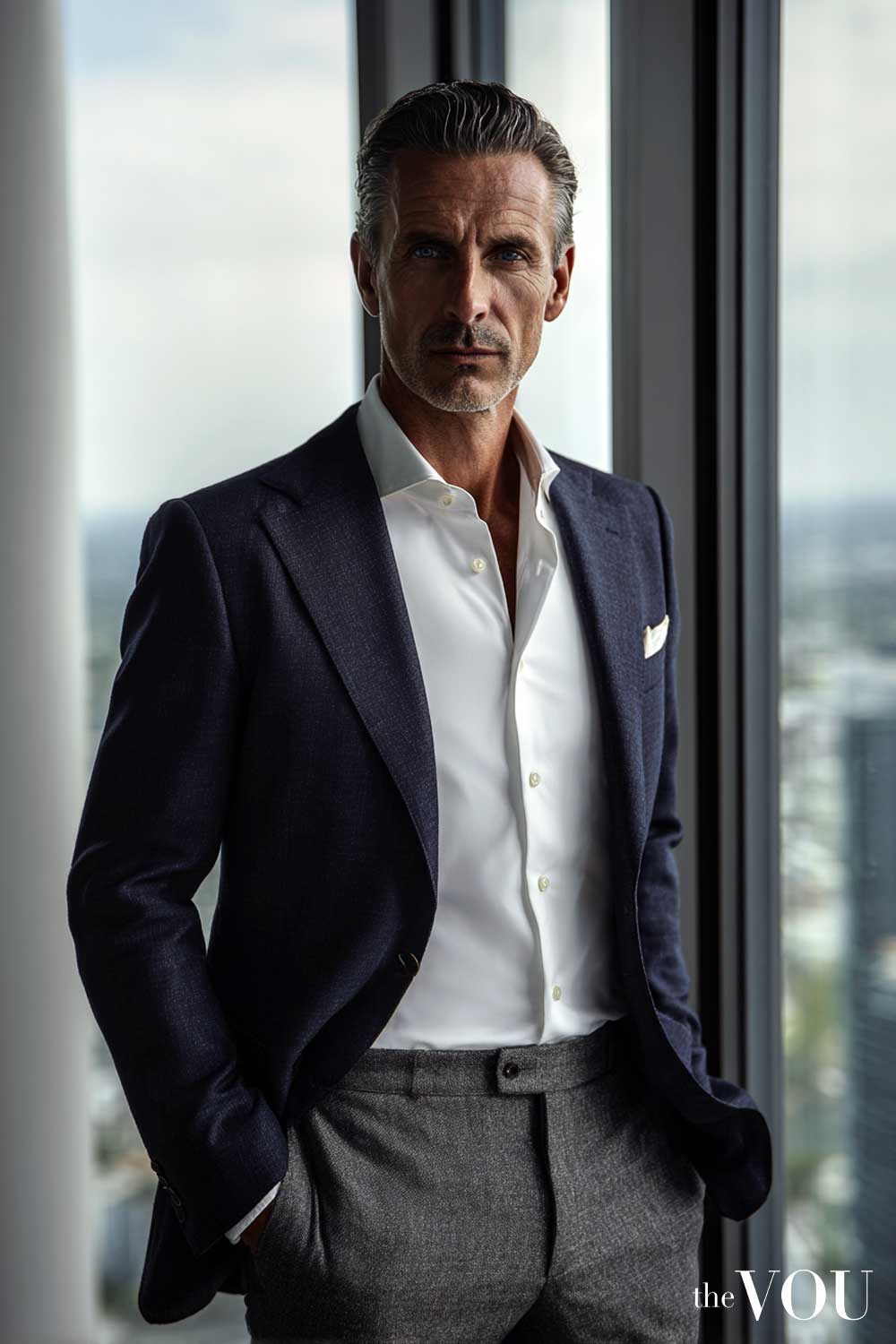
Business casual means tailored but relaxed office clothes, usually chinos or wool trousers, a collared shirt or fine knitwear and leather shoes, and this guide turns that definition into ten worked outfits.
It covers the practical side of the code, such as:
what business casual is, and how it differs from smart casual and weekend wear
the trousers, shirts, knitwear, jackets, shoes and accessories that combine most easily
ten outfit combinations, each with styling notes and suitable occasions
common mistakes, differences between industries and seasonal changes
a phased buying plan and garment care
and many more!
Your employer’s dress policy sets the limits, so use these outfits within whatever it allows.
Key Points
01Business casual leans towards business: start from tailored trousers and a collared shirt, then relax the formality with knitwear or an unstructured jacket.
02Trainers, jeans and short sleeves are allowed in some offices and not others, so your own policy is the deciding rule.
03The quantities and buying stages in this guide are a hypothetical example; your attendance, laundry routine and budget decide what you actually need.
04Care advice in this guide is general; each garment’s care label takes priority.
Business casual can be hard to judge, because it sits between the clarity of a suit and the freedom of weekend clothes.
Our related guides cover common business casual mistakes and how the code can be worn in one European city in our Amsterdam business-casual guide.
Business casual sits in a middle ground where you can look polished or untidy, and the difference usually comes down to a few principles.
The code is not “casual business“: it leans towards business, with casual garments added carefully.
One useful way to picture it is professional clothing with the tie removed and the suit jacket replaced by something less formal.
Smart casual and weekend wear are usually more relaxed again, so check which code your workplace actually uses.
Modern Business Casual Foundation
Before choosing outfits, it helps to know what business casual means in most workplaces today.
The definition has changed over the past decade, influenced by technology-industry norms, hybrid work and a general move towards comfort, and it still varies between employers.
A few principles hold steady across most interpretations.
Principles of Business Casual Style
Fit comes first. An inexpensive shirt that fits you comfortably usually looks better than an expensive one that hangs off your shoulders or pulls across your chest.
Simple alterations, such as shortening sleeves or trousers, can make a big difference to garments you already own.
Choose versatile garments. A smaller number of well-made, easily combined garments often serves better than a large wardrobe of clothes that do not go together.
Cotton, wool and linen are common choices for their comfort and texture, and modern synthetic and blended fabrics can add stretch, easy care and durability, so judge each garment by how it wears for you.
Grooming and maintenance. Clothes should be clean and pressed or steamed, shoes cared for, and hair and facial hair maintained in whatever style you wear.
Business Casual Wardrobe Essentials
These garments form a flexible starting wardrobe for many business-casual offices.
The numbers in brackets are a hypothetical example for someone in the office most days who washes shirts weekly; adjust them to your own week.
Business Casual Trousers (for example, 4 to 6 pairs)
Tailored chinos are the backbone of business-casual dressing.
Navy, grey and stone are easy colours to start with, in a mid-weight cotton that holds a pressed crease.
Leave out overly casual details such as cargo pockets, and choose a cut you find comfortable, with a leg length that sits cleanly on your shoe.
Wool trousers in charcoal or mid-grey make an outfit smarter.
A flat or pleated front and a weight suited to your climate both work; wool trousers bridge the gap between suit trousers and chinos, so you can dress up or down.
Business Casual Shirts (for example, 8 to 12 shirts)
Oxford cloth button-downs (OCBDs) are the workhorses of business casual, and the basketweave texture of Oxford cloth looks interesting while staying professional.
White and light blue are the most versatile colours; pink, lavender and a Bengal stripe add variety as your rotation grows.
Choose a collar that keeps its shape without a tie and a body that lets you move without excess fabric at the waist.
Spread-collar shirts in cotton poplin or twill offer a slightly more formal alternative and sit well under blazers and sports coats.
Plain colours and quiet patterns, such as small checks or fine stripes, keep them versatile, and the spread collar looks clean when worn open.
Chambray shirts are a more casual option that still looks professional.
Chambray is lighter and smoother than denim, and a light-blue or grey chambray shirt can be dressed up with wool trousers and a blazer or kept relaxed with chinos.
Business Casual Knitwear (for example, 4 to 6 jumpers or cardigans)
Merino wool crew-neck jumpers in navy, charcoal, burgundy or forest green are useful for layering.
Fine merino layers neatly under a jacket and is comfortable over a range of temperatures.
The jumper should sit close but not tight, and sleeves that end around the wrist bone let a little shirt cuff show.
V-neck jumpers show more of the shirt and collar and sit neatly under blazers.
Cardigans give a relaxed but professional option, and a navy or charcoal shawl-collar cardigan can work almost like a soft jacket in less formal offices.
Business Casual Blazers and Sports Coats (for example, 3 to 4 jackets)
An unstructured navy blazer is one of the most versatile garments in business casual.
“Unstructured” here means little or no shoulder padding and a light or partial lining, which gives a softer, more relaxed shape; construction details such as canvassing vary by maker.
A mid-weight wool with a little texture, such as hopsack, and patch pockets make the blazer feel less formal, and it works with chinos, wool trousers and, where permitted, dark jeans.
A grey sports coat in a textured wool, such as a small herringbone or birdseye, pairs with navy, brown, olive or burgundy trousers, and the texture stops it looking like a suit jacket without its trousers.
A brown or tobacco jacket adds warmth, in corduroy for autumn and winter or a cotton-linen blend for warmer months, and pairs well with blue shirts and grey or navy trousers.
Business Casual Footwear (for example, 4 to 5 pairs)
Dark-brown leather lace-ups are a dependable base, either Oxford shoes, which have closed lacing, or Derbies, which have open lacing and feel slightly more relaxed.
A cap-toe or plain-toe pair in a burnished finish works with navy, grey, brown and olive trousers.
Loafers provide a more relaxed alternative that suits most business-casual offices.
A penny or tassel loafer in brown or burgundy leather is versatile, and loafers built like dress shoes look smarter than soft driving moccasins.
Monk strap shoes sit between lace-ups and loafers, and a dark-brown double monk adds personality without being flashy.
Chelsea boots are useful in cold or wet weather; a sleek leather pair in brown or black, with a moderate sole and toe, suits business casual.
Business Casual Accessories
Leather belts in dark brown and black with simple buckles cover most outfits, and a belt in a colour that sits comfortably with your shoes looks considered.
Choose a width in proportion to your trouser belt loops and buckle.
A watch is optional; if you wear one, a simple design on a leather strap or metal bracelet suits most offices.
Pocket squares are optional and add polish when you wear a blazer; start with white linen in a simple straight fold.
Ten Business Casual Outfit Ideas for Men
The ten combinations below turn these garments into specific outfits.
They are editorial examples to adapt to your own office.
Business Casual Outfit 1: The Foundation
The outfit: light-blue Oxford button-down shirt, navy chinos, dark-brown leather belt, dark-brown cap-toe Derby shoes, navy merino crew-neck jumper (optional for cooler weather).
Why it works: A light-blue Oxford, navy chinos and brown leather accessories are a useful starting combination where business casual applies. Compare the shirt’s actual shade beside your face and choose the effect you prefer. Adding the navy jumper repeats the trouser colour and leaves less of the lighter shirt visible.
Styling details: Press the shirt, paying attention to the collar, and give the chinos a clean crease if you like a sharper look.
If you roll your sleeves, fold them neatly to just below the elbow.
With the jumper, let the shirt collar sit neatly at the neckline, and keep the shoes clean and polished.
When to wear it: internal meetings, office presentations and business lunches in a business-casual workplace; for a client meeting, check whether the client has asked for something more formal.
Business Casual Outfit 2: The Elevated Essential
The outfit: white Oxford button-down shirt, charcoal wool trousers, black leather belt, black Oxford shoes, charcoal merino V-neck jumper, navy unstructured blazer.
Why it works: The white shirt gives crisp contrast, the charcoal trousers are smarter than chinos and the blazer lifts the whole outfit; the V-neck shows the shirt collar neatly under the jacket.
Styling details: Keep the white shirt clean and free of collar marks, and wear the collar open.
The jumper should sit smoothly under the blazer.
By convention a two-button blazer is fastened on the top button when standing and unfastened when seated.
Trousers that rest on the shoes with a small break or none look tidy, as discussed in our guide to formal attire, and a little shirt cuff showing below the blazer sleeve is a common convention.
When to wear it: more important meetings, client dinners in a business-casual setting, and days that continue into an evening event.
Business Casual Outfit 3: The Textural Play
The outfit: light-blue chambray shirt, stone chinos, brown suede belt, tobacco-brown suede loafers, brown herringbone sports coat.
Why it works: The chambray, herringbone and suede give the outfit texture, and the lighter colours feel approachable while still polished.
Styling details: Press the chambray like a dress shirt, and roll the sleeves neatly if you take off the jacket.
Stone chinos show marks easily, so keep them clean.
Wear no-show socks with the loafers in warm weather, or dress socks in cooler weather, and add a simple watch if you like one.
When to wear it: creative-industry meetings, relaxed Fridays and networking events.
Business Casual Outfit 4: The Monochromatic
The outfit: pale-grey spread-collar shirt, mid-grey wool trousers, grey textured sports coat, black leather belt, black monk strap shoes, burgundy pocket square.
Why it works: Layering different shades of grey gives a modern, tonal look, and the burgundy pocket square adds a small amount of colour.
Styling details: Use the lightest grey for the shirt, a mid-grey for the trousers and a jacket with enough texture to look different from the trousers.
Fold the pocket square simply and keep the burgundy deep rather than bright.
Keep belt and shoes plain and clean.
When to wear it: contemporary offices, design and architecture firms and industry events.
Business Casual Outfit 5: The Pattern Mix
The outfit: white-and-blue Bengal-stripe shirt, navy chinos, burgundy knit tie (optional), navy wool blazer with a subtle windowpane check, brown leather belt, brown brogues.
Why it works: The stripe and the windowpane are different in scale, so they sit together comfortably, and the knit tie adds texture.
Styling details: The key to mixing patterns is varying their scale: a fairly narrow shirt stripe works with a much larger blazer check.
Keep colours within a related family, such as blues, burgundies and browns.
A knit tie usually has a square or pointed end, and the brogues’ decorative punching adds interest without competing with the patterns above.
When to wear it: regular office days and client meetings in less conservative settings.
Business Casual Outfit 6: The Smart Layer
The outfit: white shirt, charcoal wool trousers, forest-green merino V-neck jumper, brown leather belt, dark-brown Chelsea boots, tan trench coat for changeable weather.
Why it works: The layers work together in cool weather, the forest green adds colour that still feels professional, and the trench coat finishes the outfit for the commute.
Styling details: Let the white collar show above the V-neck.
Trousers with little or no break sit cleanly over Chelsea boots.
A trench coat can be belted or worn open, and should leave room for the jumper underneath.
When to wear it: autumn and winter office days, commuting in wet weather and outdoor meetings.
Business Casual Outfit 7: The Relaxed Crossover
The outfit: pink Oxford button-down shirt, olive chinos, brown woven leather belt, brown suede loafers, navy shawl-collar cardigan.
Why it works: This outfit sits at the relaxed end of business casual; the Oxford shirt keeps it professional while the olive chinos and cardigan bring in a weekend feel.
Styling details: A soft, muted pink keeps the shirt understated.
A cardigan with a substantial knit and firm buttons holds its shape like a soft jacket.
Brush suede loafers regularly to keep the nap clean, and wear the outfit without the cardigan in warm weather.
When to wear it: relaxed Fridays, creative offices and internal team meetings, where your policy allows this level of informality.
Business Casual Outfit 8: The Summer Solution
The outfit: white linen-cotton shirt, stone linen trousers, tan woven leather belt, tan suede loafers, light-grey linen-cotton sports coat (optional).
Why it works: Light, open fabrics and pale colours suit hot weather, and the optional jacket lets you dress up for a meeting.
Styling details: Linen creases easily; a linen-cotton blend creases somewhat less, and the exact blend is a matter of preference.
Linen trousers with a little structure hold their shape better, and you can compare current styles in our article on current fashion trends for men.
An unlined or half-lined jacket is cooler.
Wear no-show socks with the loafers and keep the watch, if any, simple.
When to wear it: summer meetings, outdoor business events and warm offices where your policy allows lighter clothing.
Business Casual Outfit 9: The Contemporary Classic
The outfit: lavender spread-collar shirt, mid-grey chinos, brown leather belt, burgundy tassel loafers, navy merino V-neck jumper, grey herringbone sports coat.
Why it works: Classic garments are combined with less usual colours: the lavender shirt and burgundy loafers add personality, and the grey coat over a navy jumper gives tonal layering.
Styling details: Choose a grey jacket that differs from the trousers so the outfit does not look like a mismatched suit.
Polished loafers in a classic style keep the burgundy smart.
When to wear it: standard business-casual offices in spring and summer, and networking events.
Business Casual Outfit 10: The Sophisticated Alternative
The outfit: cream or ecru shirt, navy wool trousers, brown leather belt with a brass buckle, dark-brown wholecut shoes, tobacco-brown corduroy blazer, brown wool tie (optional).
Why it works: Warm browns with navy make a change from grey, and the corduroy adds texture and a heritage look; the tie lifts the outfit for more formal days.
Styling details: Choose a cream shirt in a substantial cotton.
Fine-wale corduroy, with narrow ribs, looks smarter than wide-wale.
Wholecut shoes are cut from one continuous section of leather, which gives a sleek, plain look.
When to wear it: autumn and winter offices, client meetings in traditional settings and business dinners.
Common Business Casual Mistakes (How to Avoid)
These are common pitfalls, and avoiding them makes business casual easier.
The Orphaned Suit Jacket
A smooth worsted suit jacket worn without its trousers often looks like half a suit, because its fabric, buttons and flap pockets were chosen to match.
Blazers and sports coats designed as separates, with more texture, usually work better.
A textured suit jacket can sometimes work on its own, so treat this as a strong convention rather than a ban.
The Overly Casual Shoe
Athletic trainers, canvas plimsolls and beach shoes are too casual for most business-casual offices.
Some relaxed offices accept clean, plain leather trainers; check your policy before wearing them, and keep leather shoes for client meetings unless told otherwise.
The Wrinkled Shirt
Creased shirts undermine an otherwise neat outfit.
Iron, steam or use a laundry service, or choose easy-care shirts, following each shirt’s care label; linen will always crease a little, which is natural for the fabric.
The Poor Fit
Fit usually matters more than brand: a modestly priced shirt that fits well often looks better than an expensive one that does not.
Try clothes on, sit and move in them, and find a tailor for simple alterations.
Trousers that are too long, shirts that are loose in the body and jackets that are too large in the shoulders are the most common fit problems.
The Overuse of Black
Black is a traditional formal colour, and many people find navy, charcoal and grey easier to combine in business-casual outfits.
Black trousers can look like suit trousers without their jacket, so if you wear black, combine it deliberately, for example black trousers with a grey knit and a textured jacket.
The Logo Display
Large logos and prominent designer buckles draw attention away from you.
Business casual looks best when the outfit is quiet, though a small logo on a polo shirt is common and acceptable; see our guide to polo shirts.
The Accessory Overload
A watch, a ring and perhaps cufflinks with double cuffs are usually plenty.
Many bracelets, rings or necklaces at once can look cluttered in a business setting, although religious jewellery is a different matter: employers are generally expected to accommodate it where it does not affect safety or the work, so raise any conflict with your employer.
Industry-Specific Considerations
Business casual varies between sectors and between employers within a sector, so these are tendencies rather than rules.
Finance and Law
Where these sectors use business casual, it often leans conservative: darker colours, traditional patterns, wool trousers, collared shirts and blazers, with chinos in navy or grey and leather Oxfords or loafers.
Technology and Startups
Many technology offices are more relaxed, and chinos with an Oxford shirt and clean trainers, or dark jeans with a blazer and Chelsea boots, are common where permitted.
Relaxed still means clean and considered.
Creative Industries
Marketing, advertising, design and media often allow more personal expression through colour and pattern.
When meeting clients from more conservative sectors, adjust to their expectations.
Consulting
Consultants often adapt to their clients’ environments, so a wardrobe that can move from conservative to contemporary is useful.
A common approach is to match or slightly exceed the client’s level of formality, while following any instructions the client gives.
Business Casual by Season
Spring
Lighter colours such as stone, light grey and pastel shirts, and cotton or cotton-linen fabrics, suit spring.
Lighter chinos and unlined jackets are useful, and loafers with no-show socks work as the weather warms.
Summer
Lightweight, open fabrics such as linen-cotton blends, tropical wools and light cottons help in hot weather, along with lighter colours.
Short-sleeved shirts are accepted in some offices and not others; where allowed, a short-sleeved shirt with a collar looks smarter than a polo.
Autumn
Textured fabrics such as corduroy, flannel and herringbone, heavier knits and richer colours such as burgundy, forest green and tobacco brown suit autumn.
Winter
Layering matters most: heavier wool trousers, substantial knits, jackets and a coat that fits over them.
Warmth depends on the fabric, its weight and how you layer, rather than on price.
A waistcoat or extra knit adds warmth indoors, and your outerwear should look tidy over your office clothes.
Building Your Wardrobe: A Practical Approach
If you are starting from scratch, a phased approach spreads the cost.
The plan below is a hypothetical example; start with what you already own and skip anything you have.
Month 1 to 2: Foundation Garments
Two pairs of navy chinos and one pair of grey chinos
Two white and two light-blue Oxford shirts
One navy merino crew-neck jumper
One pair of dark-brown Derby shoes
One brown leather belt
Month 3 to 4: Building Versatility
One pair of charcoal wool trousers
One navy unstructured blazer
Two more shirts in other colours or patterns
One V-neck jumper
One pair of brown loafers
Month 5 to 6: Adding Personality
One grey or brown sports coat
One pair of olive or stone chinos
One chambray or more casual shirt
One cardigan
Optional accessories such as a watch or pocket squares
This phased approach builds a working wardrobe without a large single outlay, and second-hand shops and sales can stretch the budget further.
Care and Maintenance
Good care helps garments last and look their best, and each garment’s care label is the first guide.
Shirts
Most cotton shirts are washed after each wear; follow the label for temperature and drying.
Rotating shirts gives each one a rest between wears.
Trousers
Chinos and wool trousers often need washing or cleaning less often than shirts; spot clean and air them between wears where the label allows.
Hang trousers by the hem or over a trouser hanger to limit creasing.
Knitwear
Fold knitwear rather than hanging it, so the shoulders do not stretch.
Wash wool knits gently and only as often as they need, following the label, and dry them flat.
A fabric comb or de-piller removes bobbles.
Blazers and Sports Coats
Brush jackets after wearing to remove dust, and steam out creases where the fabric allows.
Dry clean only when needed, and store jackets on shaped hangers that support the shoulders.
Shoes
Shoe trees help leather shoes keep their shape and dry out between wears.
Rotating pairs gives each pair time to dry fully, and regular polishing protects the leather, as our guide to elevating personal style explains.
Well-made shoes can often be resoled, which extends their life considerably.
Final Thoughts
Business casual works best when you know what your workplace expects and have a small set of garments you can combine without thinking.
Start with fit, versatile fabrics and neutral colours, then add colour and texture gradually.
A good tailor and a reliable shoe repairer are useful for keeping clothes in shape.
Adapt the outfits here to your own policy, proportions, colouring, climate and preferences, and keep what works for you.
Mandy Meyer’s focus at The VOU is men’s body-shape styling, garment fit and outfit proportions. Her coverage addresses the practical questions behind a wardrobe choice: how a jacket sits across the shoulders, how trousers fall and how different cuts change the silhouette a wearer wants to create.
Her subject areas include the triangle, inverted triangle, rectangle, oval, trapezoid, hourglass and diamond labels used in body-shape styling. These provide starting references for comparing visible proportions; they do not capture every body or prescribe one correct way to dress. The focus connects those observations with garment shape, construction, length and the relationship between the upper and lower parts of an outfit.
Mandy’s editorial coverage combines visual comparisons with fit checks for comfort and movement. Readers can consider whether a cut gives them the room they need, where clothing pulls or gathers and which changes might support their preferred look. The aim is to make menswear choices more understandable while keeping personal preferences and the wearer’s own styling goals central.