
Start here
What’s This About
A men’s image consultant helps your clothes, grooming and manner suit your role, working through a planned sequence of stages.
The guide walks through the stages of a business styling engagement, such as
a consultation about your work and goals
a review of every suit, shirt and pair of shoes
colour and fit notes for future shopping
a prioritised shopping list and tailoring
a lookbook of complete outfits
and many more!
The aim is a wardrobe system you can keep using on your own.
Key Points
01The first session focuses on your work, goals and dress code rather than on clothes.
02The wardrobe review sorts garments into keep, alter and set aside, with reasons explained.
03A colour palette is a shopping aid, not a fixed fact about you or a list of banned colours.
04A lookbook of checked outfits makes getting dressed for work quicker.
For many men, the term ‘image consultant’ is vague, suggesting little more than ‘fashion’ or ‘personal shopping’.
Fashion and shopping can feel superficial to a man focused on career goals and results, and the hesitation is understandable.
Business image consulting is less about fashion trends and more about dressing appropriately and consistently for your role.
A men’s image consultant is, in essence, an adviser on how you present yourself at work.
The consultant’s job is to help your clothing, grooming and non-verbal communication suit your role, your industry and the direction you want your career to take.
Some capable professionals worry that their appearance sends a different message from the one they intend.
Clothes that are dated, ill-fitting or out of step with a person’s role can distract colleagues and clients, and may lead some to question that person’s attention to detail.
So what does the work involve in practice?
Most business styling follows a planned sequence that moves from your goals to your wardrobe.
Below are the stages a business styling engagement commonly follows; consultants, including The VOU, vary the format, in person or online, and the details.
The Business Styling Process, Step by Step
The work usually happens over several sessions rather than one, moving from analysis to practical changes, with the aim of leaving you with a wardrobe system you can maintain yourself.
1. The Deep-Dive & Personal Brand Discovery
The consultant usually begins by looking at a career rather than a wardrobe.
The first phase is a consultation about your work, your goals and the impression you want to make, rather than about clothes.
The consultant then looks at the following.
- Career Goals. Where is the client right now, and where does he aim to be in 2, 5, and 10 years? (e.g., “I am a Senior Director aiming for a Partner role,” or “I am launching a new consultancy and need to attract high-value clients.”)
- Professional Environment. What is the specific ‘visual code’ of the client’s industry?
The acceptable look for a tech CEO is vastly different from that of a private equity partner or a creative director.
- Audience Perception. Who does the client need to influence? (e.g., board members, junior staff, external clients, investors).
- Brand Keywords. The consultant asks clients to identify their core professional attributes.
Do individuals want to be perceived as ‘authoritative and trustworthy’ or ‘innovative and dynamic’?
Or perhaps ‘approachable and experienced’?
- Current Pain Points. What is not working? (e.g., “I feel I look too young to be taken seriously,” “I waste 20 minutes every morning getting dressed,” “My wardrobe is full of clothes I never wear.”)
From this session, the consultant writes a short brief that sets out the objective of the work and guides later decisions.
2. The Wardrobe Review
The second stage is a review of the whole wardrobe, covering suits, shirts, trousers, shoes, outerwear and accessories.
Each garment is judged against the brief from the first session, not simply sorted to free up space.
Garments are usually sorted into three groups.
- The Foundation holds garments that fit well, are of high quality, and align with the objective in the consultant’s brief.
These are the building blocks.
- The ‘Tailoring’ Pile is for garments with potential.
A suit with a great fabric but a dated fit, or trousers that are too long.
These are salvageable with expert tailoring.
- The ‘Liability’ Pile contains garments that work against the brief because of poor fit, wear or an outdated cut.
Whether you sell, donate or keep them for weekends is your decision.
What makes a garment a ‘liability’?
Examples include square-toed shoes that look dated, a suit jacket whose shoulder pads extend past the natural shoulder, and shirts that are visibly worn at the collar.
Details like these can suggest a lack of care.
The consultant should explain each recommendation, covering fit, proportion and quality, so that you learn the principles and can apply them yourself later.
3. The Technical Blueprint, a Colour & Fit Analysis
With the wardrobe reviewed, the next stage sets guidelines for colour and fit.
Professional Colour Analysis
Many men rely on navy and grey, which remain useful, but shades of navy and grey differ, and some may suit you better than others.
A colour analysis compares groups of colours near your face and organises the results into a palette, often named after a ‘season’ such as Deep Winter or Soft Autumn.
The seasonal name is a way of organising a palette, not a fixed fact about you.
The palette is a shopping aid and a starting point for choosing shirts, ties and knitwear, rather than a list of colours you must wear or avoid.
For example, one man may find that an icy pale blue shirt looks crisp next to his face, while another prefers a warmer, softer blue; comparing the two shirts side by side in the same light tells you more than guessing from a single feature such as vein colour.
Fit & Body Architecture
Fit is one of the most important factors in how tailoring looks.
A modestly priced suit that has been altered to fit well usually looks better than an expensive suit that fits poorly.
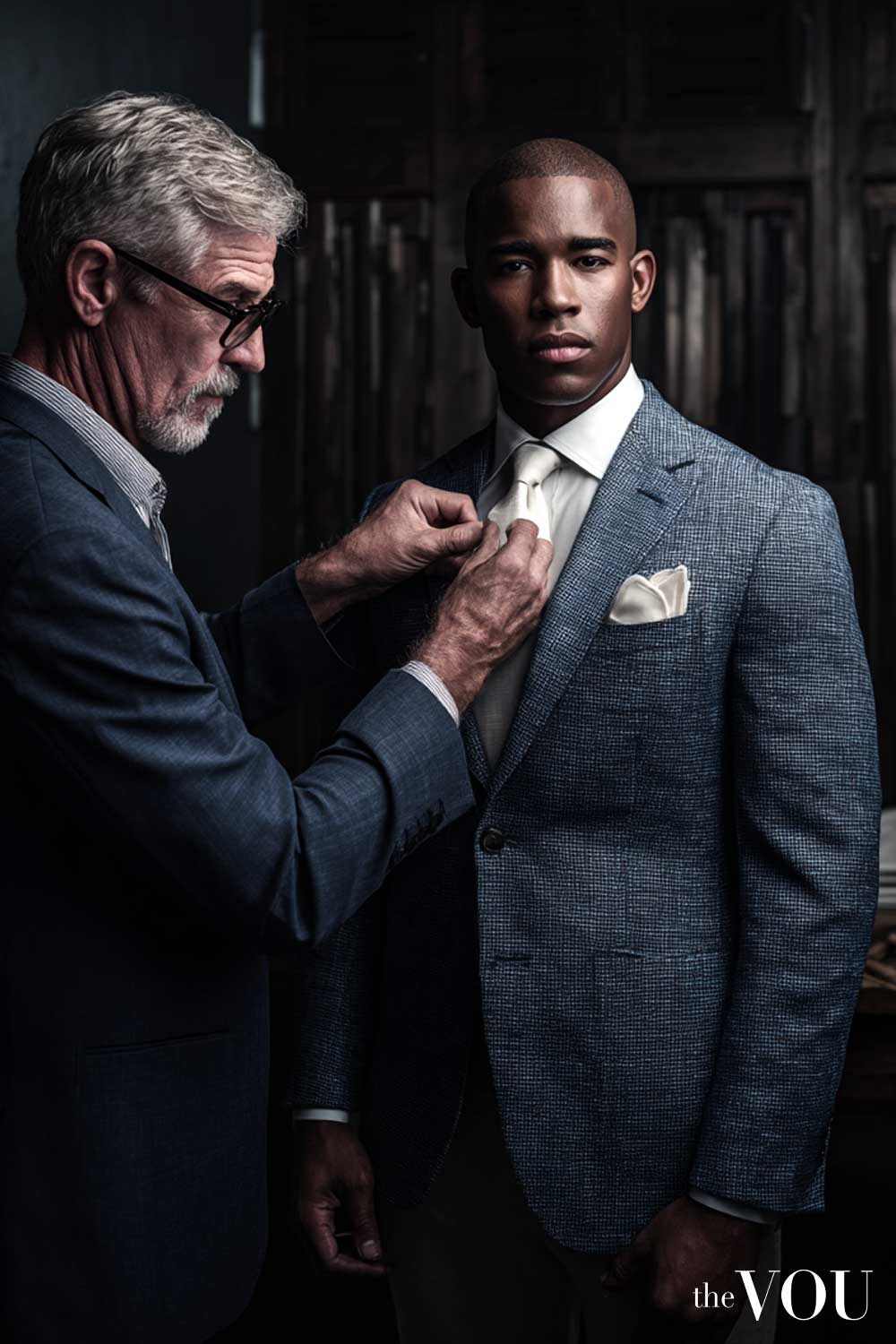
The consultant takes measurements and notes your proportions to suggest suitable cuts and garment lengths.
The notes cover lapel width, jacket length, shoulder construction and trouser break, and become a fit reference for future purchases.
4. Planned Shopping
Based on the brief, the garments you are keeping and the colour and fit notes, the consultant writes a prioritised shopping list.
The list fills the gaps needed for a coordinated ‘capsule wardrobe’.
A business capsule might hold around 20 to 25 garments, for example 2 suits, 3 blazers, 5 pairs of trousers, 8 shirts and 3 pairs of shoes, chosen so that most of them combine to make many different outfits for work.
The consultant usually does this in one of two ways, depending on the client’s preference.
- For the Client (Time-Saving). The consultant pre-selects garments from various retailers for you to try on and approve, which saves you time.
- With the Client (Educational). The consultant shops with the client, teaching him how to shop effectively and showing him how to identify quality, what to look for in a fit, and how to build relationships with a good tailor.
5. Integration, Tailoring & The ‘Lookbook’
In the final step, new purchases are brought together with the ‘Foundation’ garments you kept.
Garments that need alterations go to a tailor, using the fit notes from step 3.
Once alterations are done, a final session puts together complete outfits and photographs each one.
These photographs are compiled into a personalised digital ‘Lookbook’.
The lookbook serves as a reference you can check when getting dressed.
Instead of starting from scratch each morning, you can open the lookbook, pick “Outfit 14” and know the combination has already been checked for fit and colour.
Grooming & Non-Verbal Communication, Beyond the Clothes
The consultant’s work often goes beyond the wardrobe, since a man’s image is a complete package, and the consultant may also give guidance in the areas below.
- Grooming. Recommending the right hairstyle and facial hair (if any) to complement a client’s face shape and industry.
- Poise & Posture. How to carry oneself in a suit.
How to sit, stand, and walk with an air of confidence and authority.
- Digital Presence. Advice on a professional headshot for LinkedIn, so your online profile matches how you now dress for work.
The Result Is a Wardrobe System You Can Maintain
So what does a men’s image consultant do?
In short, the consultant helps close the gap between how you want to come across at work and how your clothes and grooming currently present you.
The useful outcome is not only better clothes but a set of principles, notes and outfits that you can keep using without the consultant.
Want personal help with your work wardrobe?
The VOU offers paid Business Image Consulting services for men, where you can book a consultation.