Start here
What’s This About
A blue suit bought for freedom. A Harlem portrait. A London tailor’s shop. Black dandyism links clothes to the right to choose how the world sees you. Here are the people behind the style, the clothes they wore, and five ways to draw on them today.
Key Points
01The Met traces Black dandyism to the meeting of African and European styles.
02This history has room for neat tailoring, bold colour and casual dress.
03The next five outfits are The VOU’s ideas to try.
04Start with what you own.
Olaudah Equiano bought the suit before he bought his freedom. He was still enslaved. The sailor, who later fought to end slavery, had chosen blue clothes for the dances he hoped to give. “In this expectation I laid out above eight pounds of my money for a suit of super-fine blue cloaths to dance in at my freedom,” he wrote in The Interesting Narrative. His life story came out in 1789.
Freedom was close. As Barnard College professor Monica L. Miller explains in her essay on the suit, Equiano had saved nearly all the money he needed. His freedom seemed certain. He put a copy of the document that freed him in his book. It bears the date 10 July 1766. At the dances he gave as a free man, he recalled, “my Georgia superfine blue cloaths made no indifferent appearance, as I thought.”
More than 250 years later, those words opened Superfine: Tailoring Black Style. This was a 2025 show at New York’s Metropolitan Museum of Art, or the Met. Miller helped lead it as guest curator. Her 2009 book, Slaves to Fashion, inspired the show. She worked with Andrew Bolton, who led the museum’s Costume Institute. The show ran from 10 May to 26 October 2025. Equiano’s suit gives us a place to start: a man choosing clothes for a life that would be his own.
What Black dandyism means
The Met traces Black dandyism to the meeting of African and European styles. The clothes can be precise and neat, or bold and full of flair. Yet the story goes beyond the look. Miller calls it “a sartorial style that asks questions about identity, representation, and mobility”. That is a way of asking who you are, how others see you, and how your place in society can change. A Council of Fashion Designers of America feature sets out the view of fashion historian Jonathan Michael Square. He sees fine dress as a way to challenge racial hierarchies and claim the right to choose for oneself. He also sat on the show’s advisory group.
The name needs care. W. E. B. Du Bois was a scholar who fought for civil rights. People praised his dress, but he did not like being called a Black dandy. Barnard Magazine’s account of Miller’s work explains why. At that time, the name could echo the racist images in blackface shows that he opposed. Here, Black dandyism names a history and a way of dressing. It is not a label for every Black man in a good suit.
The VOU’s guide to dandy style looks at the British and French forms. This story shares some of that tailoring. But Equiano’s suit poses a further question: who gets to choose what a person wears, and what it says about them?
When the clothes were not your choice
In eighteenth-century England, fine clothes could show the wealth of the person who owned an enslaved servant. Miller describes servants known as “luxury slaves”. Their dress was a sign of the owner’s status, rather than clothes for manual work. Fine cloth could also be used as a form of money to buy enslaved people. In that setting, the right to choose the clothes was far from the wearer’s own.
Julius Soubise’s life crossed that divide. Born enslaved in the Caribbean, he was taken to England. In the Duchess of Queensberry’s home, he was “educated in the art of being a gentleman”, as the Met’s guide to the show puts it. Once free, he became known for his own bold take on dandy style. He liked costly flowers grown in hothouses, as well as perfume. The publisher’s account of Miller’s book adds red-heeled shoes with diamond buckles to the picture.
Miller counts Soubise among the first known Black dandies. A 1772 print of him opened the show’s Presence section. But much of this clothing history is lost. Miller explains that few clothes worn or made by enslaved people survive. This holds true for work in homes and fields, in the Americas and Europe. Such clothes were rarely valued or kept. Men are easier to find in the written record. Travel writers wrote about them more, and men were among the first to write their life stories.
Frederick Douglass on taking care with clothes
The writer Frederick Douglass fought to end slavery. He also had firm views on clothes. His tailcoat, top hat and waistcoat from the nineteenth century were in Superfine. Miller counted them among her favourite objects in the show. She told Barnard Magazine that seeing them reach the Costume Institute felt like a privilege.
Douglass’s advice went beyond dressing up. In “There Is Something in Dress”, he criticised the man who showed off his fine clothes. He also criticised the man who took no care over his dress. He argued that the respectability and dignity of Black Americans must be upheld. The piece appeared in Frederick Douglass’ Paper on 25 May 1855. Superfine used it to open its Respectability section. The show presented dress as one way Black leaders could show pride and earn respect.
Harlem, in front of the camera
In Harlem, a New York neighbourhood, photographer James Van Der Zee made a record of how people chose to be seen. He moved there in 1906 and opened a portrait studio in 1916. His subjects came from the growing Black middle class and from the stage. They included entertainer Florence Mills and dancer Bill “Bojangles” Robinson. He took care over more than the clothes. He set up props, retouched prints and added colour by hand. The Smithsonian American Art Museum says his images have “a sense of glamour, sophistication, and prosperity”.
Journalist Robin Givhan sees a familiar care in those clothes. In the Met’s Harlem Is Everywhere talk, she pointed to the men’s “wonderful fedoras”. They “look effortful”, she said, and follow “a certain template”. The dress brought back her own memories of church on Sundays. Her father wore a Borsalino fedora and a cashmere overcoat. To her, these clothes were hallmarks of the Harlem Renaissance. This was a wave of Black art, writing and music in the 1920s and 1930s. Harlem gave it its name, but its reach was wider.
Givhan also recalled the rules Black shoppers faced. Some shops barred them. Others would sell them a hat but would not let them try it on. Those limits form part of the world behind the portraits. The talk’s host, writer and art critic Jessica Lynne, noted that Van Der Zee sometimes asked people in the street to pose. Art historian Bridget R. Cooks used Deborah Willis’s phrase “a studio of transformation” for his rooms. Speaking about portraits of the era more broadly, Cooks noted that not everyone was smiling. She set work by Black artists against racist images in which a smile was part of the uniform.
Four portraits, four ways to dress
Van Der Zee’s own 1918 self-portrait gives us a less formal look. Christie’s writer Camille Okhio describes his white trousers and striped shirt, with the sleeves rolled up. His knitted tie is fixed near the third button. His hat tilts with his head. Okhio thinks the trousers look like linen.
The details in Portrait of a Couple (1924) are more formal. The National Gallery of Art describes the man’s three-piece tuxedo. He holds a bowler hat and a cane in his right hand. There is a ring on each little finger. A chain runs across his waistcoat to the pocket where his thumb is tucked. Each small detail has its place.
The white tuxedo and top hat in On the Town (1929) make a bold pair. The Studio Museum in Harlem describes a backdrop that creates the look of a grand parlour. To the museum, it suggests the man is on his way to a smart banquet or club. The blues singer Gladys Bentley was also known for a white tuxedo and top hat. Miller writes that the tuxedo could suggest queerness and androgyny when worn by women such as Bentley. The same type of suit could carry more than one meaning.
Couple, Harlem (1932) brings a car into the portrait. In the Met talk, Cooks describes the man wearing a full-length raccoon coat. He is in what she calls a very fancy Cadillac. The woman stands elegantly, with brownstones behind them. The picture dates from the Great Depression. Cooks reads the pair’s dress as a way to keep respect and dignity in hard times.
Harlem’s clothes were not all about formal portraits. The show’s Jook section included the zoot suit. Jazz musician Cab Calloway was among the “hepcats” who wore it. Superfine saw its break with standard tailoring as a sign of joy, youth and rule-breaking. The zoot suit has a wider history beyond Harlem. Here, it shows another way that dress could make a person stand out.
The men who made Harlem’s clothes
The people who made the clothes belong in this story, too. Miller names Harlem tailor James McFarland, known as “Gentleman Jim”. He worked on 125th Street in the 1960s and 1970s. His clients included Muhammad Ali, Jackie Robinson and James Brown. Ali’s clothes linked his work as a boxer with his dress outside the ring. Superfine called his Everlast shorts “a nod to the formalism of a tuxedo”. Away from boxing, he liked bespoke suits, made just for him.
Dapper Dan brought printed leather into Harlem’s fashion story. He used the logos of Gucci, Louis Vuitton and Fendi to make bold patterns. His shop opened in 1982, according to Interview’s 2018 talk with him and rapper Nas. Eric B. and Rakim, Big Daddy Kane and LL Cool J were among his regular clients. Superfine credited his clothes, which used or drew on luxury brand names, with helping shape hip-hop style in the 1980s.
Dan kept his printing method close. He told Nas that he had taught himself to print on cloth. He then came up with a chemical for leather that would last. He hid the cans so no one would know which ink he used. Interview also tells of the labels’ lawyers coming to call, after which the shop closed. By the 2018 interview, things had changed with Gucci. The brand had given Dan an uptown atelier, or workshop, and they were working together.
The musicians’ own looks had range, too. The CFDA credits André 3000 and Big Boi of OutKast, along with Pharrell Williams, with challenging rap and hip-hop dress. Its examples include plaid suits, ties in many colours, bold outfits and striking hats. That is a broad set of choices, rather than one fixed way to dress.
Britain: from the Windrush to Savile Row
The links across the Atlantic showed up in Britain, too. Passengers from the Empire Windrush stepped ashore on 22 June 1948. Royal Museums Greenwich records that journey. In her MR PORTER history of Black British menswear, Fedora Abu describes the role of African American performers in Caribbean men’s dress. The passengers’ suits reflected American styles, above all the zoot suit. Trousers had high waists and wide legs. Jackets were long, with broad lapels.
There were skilled makers on the ship as well as smart clothes. Abu records 34 tailors among the passengers. One was Clifford Fullerton, who began work as a tailor in North Kensington. He went on to become the first Black associate member of the City of London Master and Foreman Tailors Society. The story is about the craft of making clothes as well as the men who wore them.
For Wendy Ellison, the change she recalled was colour. She shared her memories of life after the war in Hackney Museum’s account of Windrush fashion. Most men she knew as a child had navy pinstripe suits from when they left military service. Then West Indian friends arrived in “a light blue suit, or a fawn suit, with matching Trilby hats”. The museum also describes Sunday best. These were your smartest clothes for church, often worn with gloves and a hat. Ellison’s memories and Givhan’s give us two accounts of care over clothes, on either side of the Atlantic.
Andrew Ramroop: from tailor to owner
Andrew Ramroop’s story turns from wearing suits to making them. Born in Trinidad, he came to Britain in 1970, aged 17. By 1974, he was working on Savile Row, the London street known for its tailors. He first worked at Huntsman & Son, then joined Maurice Sedwell. That name can cause confusion. It refers both to a tailoring firm and to the tailor who ran it.
When Sedwell retired in 1988, Ramroop bought the firm. He became the first Black person to own a shop on Savile Row. The firm’s own history confirms that milestone. He had gone from working for a Savile Row house to owning one.
Ozwald Boateng: a shop of his own
Designer Ozwald Boateng took a different route: he opened a shop of his own. He was born in London to Ghanaian parents. In 1995, he opened his first retail store on Vigo Street, at the end of Savile Row. His company history dates his first headquarters on Savile Row itself to May 2002. The shop and the headquarters were separate steps.
Boateng’s fabrics also make a link to Ghana. His house’s account of its fabrics calls its Kente pattern a modern take on traditional Ghanaian Kente cloth. Its Adinkra range turns traditional Adinkra symbols into patterns.
Joe and Charlie Casely-Hayford: a family venture
Joe Casely-Hayford was a designer with a tailor’s training. His career took him from a label of his own to a long-established tailoring house, then to a label he shared with his son. He launched his label in 1983. In 2005, he became creative director of Gieves & Hawkes, a British bespoke tailoring house. Then, in 2009, he launched the Casely-Hayford label with his son, designer Charlie Casely-Hayford. The work had become a family venture. Joe died in 2019.
Both father and son were featured in Superfine. Charlie sees more in these clothes than their cut. He told MR PORTER that “Black dandyism is a powerful reclamation of identity, autonomy and self-expression”. For him, the right to choose how you look is part of the point.
Grace Wales Bonner and Foday Dumbuya: clothes from history
British designer Grace Wales Bonner was in the show, too. Her work offers another link between clothes and portraits. For her spring/summer 2022 collection, Volta Jazz, she drew on the work of photographer Sanlé Sory from Burkina Faso. As AnOther reported in 2021, the campaign took its lead from West African studio portraits of the 1970s, above all Sory’s. He shot the country’s young and stylish on black-and-white film in his Bobo-Dioulasso studio. He was also known for his pictures of its nightlife.
Designer Foday Dumbuya brings us back to Equiano. Born in Sierra Leone, he moved to London at 12 and launched Labrum in 2014. London Museum describes migration and movement as themes that run through the brand’s work. The museum holds two pieces inspired by Equiano: a suit and a coat. They come from Labrum’s autumn/winter 2021 St Giles Blackbird collection. More than 250 years after he bought his blue suit, Equiano had become a source for clothes made in London.
Who gets to make the image?
The person who makes a portrait helps shape the record, too. Shantrelle P. Lewis is a scholar, filmmaker and curator. In 2010, she founded the Dandy Lion Project to focus on Black dandyism today. It began as a show in a pop-up gallery in Harlem. It grew into a travelling show and a book, which Aperture published in 2017.
Morehouse and Spelman are two historically Black colleges. When Ralph Lauren worked with them on a 2022 collection, the designers had a link to the schools. They were former students who worked at the brand. The clothes drew on student dress from the 1920s to the 1950s. A wool flannel blazer paid tribute to the Morehouse blazer, traditionally given to students in their first days on campus. The company’s announcement says the campaign was its first with an all-Black cast and creative team. Photographer Nadine Ijewere shot it.
The Met Gala brought the theme to the red carpet on 5 May 2025. This is the Costume Institute’s yearly fundraising event. Its dress code was Tailored for You. Vogue’s May issue gave four of the gala’s co-chairs a cover each: A$AP Rocky, Lewis Hamilton, Colman Domingo and Pharrell Williams. The Fashion Spot named the people who made those images. Tyler Mitchell photographed Rocky, Malick Bodian photographed Hamilton, and Iké Udé photographed Domingo. Henry Taylor painted Williams.
Rocky’s shoot brought Harlem into the issue. Law Roach styled him. He was photographed in and around his home neighbourhood, including the home of poet Langston Hughes, according to The Root. The place links his images to the streets, studios and workrooms in this history.
The clothes in 2025
Boateng made the emerald corduroy suit on Rocky’s cover. It was a double-breasted two-piece. British Vogue called the fit “confidently ample, though far from oversized”. That is a useful point for your own clothes. A suit can have room without being too big.
Asked about the shoot’s best looks, Udé picked out “Mr. Domingo wearing a Dolce & Gabbana pale blue three-piece, with a cane and white gloves”. The Vogue caption names the makers. The jacket, waistcoat and trousers were Dolce & Gabbana Alta Sartoria. Wing & Weft made the gloves, Bailey 1922 the hat, and Bode the shoes. The cane came from Michael German Antiques. This was a portrait outfit. It was not what Domingo wore to the gala.
The gala gave us a different set of looks. 10 Magazine describes Burna Boy in a red single-breasted suit by Boateng. He wore a sherbet yellow shirt beneath a textured leather overcoat. Hamilton wore an all-white Wales Bonner tuxedo, with coattails and a beret. Domingo arrived in a blue robe. Under it was a Valentino look with a sequinned chequerboard blazer and grey tailored trousers. Pearl ear halos and a polka-dot scarf finished the outfit.
Inside Superfine, designer Jacques Agbobly brought a family link to denim. The Brooklyn-based designer’s four-piece denim look was in the Heritage section. It had beads worked into it. The piece “is an homage to his aunts”, Miller explained in Barnard Magazine. The beads referred to the earrings they wore when dressing for church. A small detail could carry the family story.
A style with room for more than suits
This history has room for neat tailoring, bold colour and casual dress. The show’s Cool section included khaki, denim, tracksuits and knitted cardigans. Ellison’s matching suit and hat differ from Rocky’s corduroy or Agbobly’s beads. Each gives us a different way to make clothes feel personal.
There is no single soundtrack for the style, either. Think of Calloway, Dapper Dan’s clients and OutKast. Nor does the car in a portrait become a car every dandy should own. These are people, places and objects in a history. They are not a shopping list for a life.
Related styles have their own names and histories. On the Dandy Lion Project’s site, a passage by Maurice Berger places La Sape in the French-speaking Congo. Its full name is la Société des Ambianceurs et des Personnes Élégantes. Berger describes the swenkas as “the debonair working-class Zulu men of South Africa”. These styles sit close to this story. But they have histories of their own, as does the zoot suit beyond Harlem.
How to wear it now
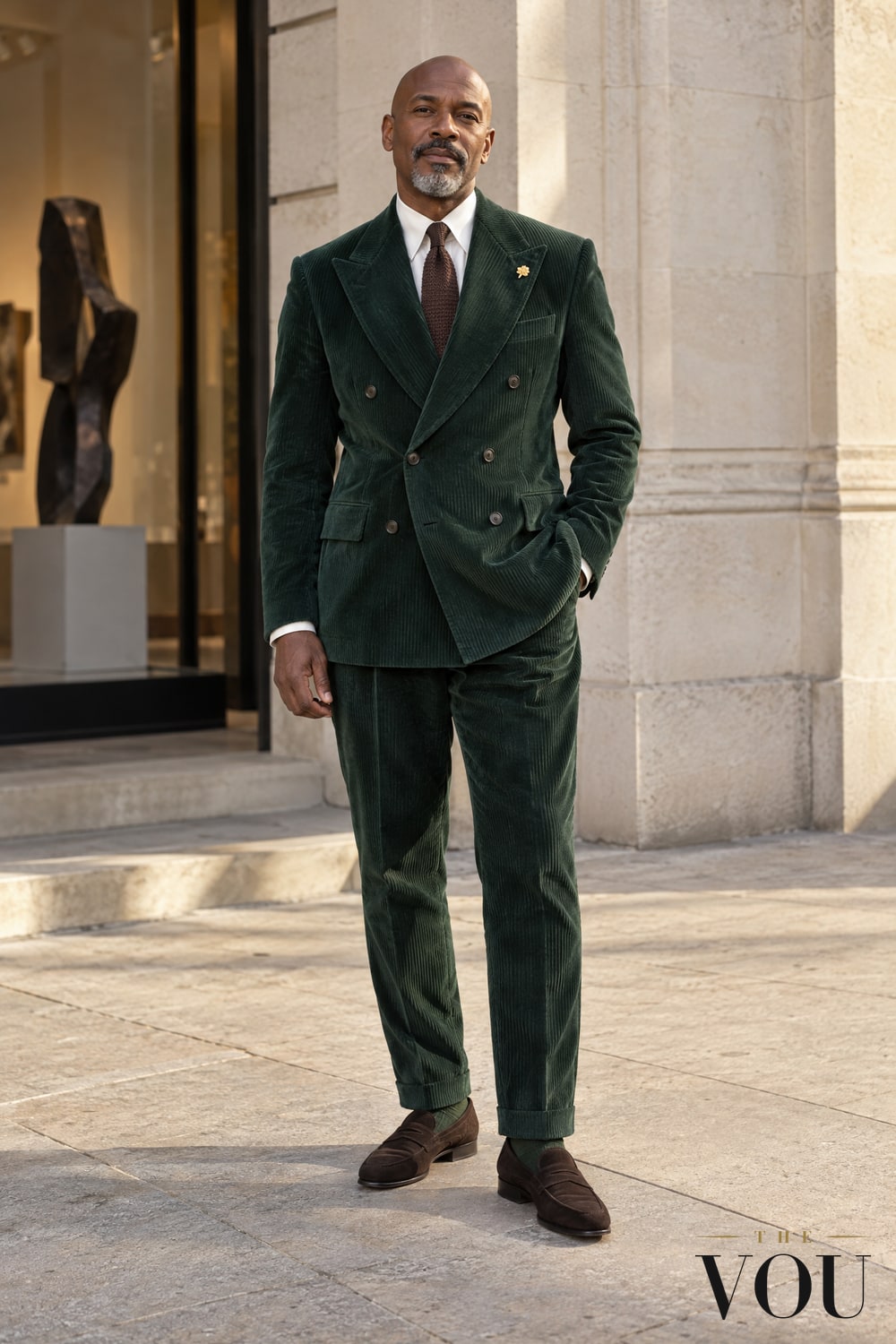
The next five outfits are The VOU’s ideas to try. Each takes one cue from the clothes we have described. You do not need to copy a whole portrait or gala look. Choose what you want to notice first: a jacket’s shape, a fabric or one personal piece. Then build around it. In our green corduroy outfit, an ivory shirt gives the strong colour a quiet partner. The colours are examples, not a test of which shades suit you. The VOU’s seasonal colour quiz and body shape quiz can help you explore shades and clothing proportions.
A starting wardrobe in eight parts
Start with what you own. Use these eight groups as a checklist. You do not need to buy eight new things.
- A navy or charcoal suit with a jacket you can also wear on its own.
- A waistcoat in the suit’s cloth or a quiet contrast, to make a three-piece.
- Two or three shirts in white and pale blue, with point or semi-spread collars.
- Two ties: one knitted and one silk.
- Separate trousers and jeans, such as grey flannel trousers and straight dark indigo denim.
- A navy wool flannel blazer, taking a cue from the Morehouse blazer.
- Two pairs of leather shoes: black Oxfords, and brown suede Derbies or loafers.
- One personal piece. It could be an inherited ring or a pocket square chosen for a memory.
Add clothes for special events as you need them. A fawn or light blue suit can work for a daytime party. A white dinner jacket can suit a warm-weather black-tie event where the host welcomes it. You might also want a suit in a stronger colour. The hat is your choice. So is the long overcoat, unless the weather gives you a reason to own one.
A fawn suit for a daytime party
Ellison’s memory of pale suits and matching hats is the starting point. Try a fawn single-breasted suit in light wool. Add a pale blue shirt, brown knitted tie, brown socks and dark brown suede Derbies. A matching trilby echoes her account. Felt is our choice for the hat, but you can leave it out. If you wear it, take it off when you sit down indoors. Try this for a spring or summer daytime wedding, a christening or a family party.
A charcoal three-piece for dinner or the theatre
The 1924 portrait shows a three-piece tuxedo. Our version is a charcoal three-piece lounge suit for a smart dinner, the theatre or an evening concert. Wear it with a white shirt, burgundy silk tie, black socks and black cap-toe Oxfords. Run a plain watch chain from a waistcoat buttonhole to a pocket. Or choose a ring instead and let that be the detail. This draws on the portrait; it does not copy it. It is not an outfit for an event that asks for black tie.
A white dinner jacket for warm-weather black tie
The white tuxedo in On the Town is the starting image. But check the dress code before you choose this outfit. Debrett’s sets out the basics of black tie. It calls for a dinner jacket with silk peaked lapels or a shawl collar. The black trousers have a single line of braid down each outside leg. A white evening shirt completes that base.
Then comes the question of the white jacket. The Emily Post Institute allows one with the rest of the black-tie outfit in summer, the tropics or on a cruise. Debrett’s gives a different British custom. White dinner jackets were worn in hot climates, but not usually in Britain, even in summer. For a British black-tie event, ask your host before choosing white.
Where white is welcome, wear the jacket with braided black trousers and a white evening shirt. Add studs and cufflinks, a hand-tied black silk bow tie, black silk socks and black patent Oxfords. If you want to cover your waist, choose a black cummerbund or a low-cut evening waistcoat. Wear one, rather than both. The VOU’s black-tie guide goes through the dress code by event. Leave the top hat to the photograph.
A green double-breasted suit for an evening opening
Rocky’s cover is the cue for this suit’s colour and shape. Try a deep green double-breasted suit in corduroy for cooler weather. For a warmer evening, choose light worsted wool. Add an ivory shirt, dark brown knitted tie, dark green socks and dark brown suede loafers. Ask for a roomy cut that still follows your shoulders. Wear it to a gallery opening, an evening show or a dinner where a suit is welcome.
Denim with one personal piece
For a weekend lunch, an exhibition or an informal dinner, start with straight dark indigo jeans. Tuck in a white Oxford-cloth shirt. Add the navy flannel blazer, navy socks and burgundy leather loafers. Leave the tie out. The cue from Agbobly is the personal link, not a need to copy his beads. Choose an inherited ring, a brooch or another piece with a story of your own.
Change the cloth with the season. Try light fabrics and pale suits in summer, then flannel and corduroy in colder weather. Add a coat or hat when the weather or your taste calls for it.
Make the look your own
A gala look can give you ideas without becoming your dinner outfit. Borrow one thing, such as a pale three-piece or a green suit. Give it shirts and shoes you know well. The same approach works with older clothes. Start with a shape, a colour pairing or one detail before trying a full period look.
Before buying another label, try the jacket and trousers you own with the shirt and shoes you plan to wear. An alteration may finish the outfit. Keep an eye on the fit, too. Rocky’s suit was, in British Vogue’s words, “far from oversized”. Buying a larger size is not the same as choosing a roomy cut.
Keep, alter, then buy
Pick the outfit you will wear first. Lay out the jacket, trousers, shirt and shoes. Then ask a tailor to check the fit. Does the waistcoat cover your trouser waistband when you stand and sit? Do the trousers fall neatly over the shoes? Does the jacket follow your waist without pulling? If you order a suit, ask which fittings the price covers. Also ask how much room the suit leaves for changes later.
The tailoring house Henry Poole explains its own bespoke process. It leaves extra cloth, called inlays, at some seams. This allows the suit to be altered later. At the first fitting, its cutter also adjusts the suit to the way the client stands. Those are useful things to ask about when you choose a tailor.
Lapels give you another choice. The Oliver Wicks guide sets out three shapes: the notch, the upward-pointing peak, and the curved shawl used on dinner jackets. For our daytime suit, a notch is an easy place to start. A peak gives the green double-breasted suit a stronger line. Spend on the piece or change that makes your chosen outfit work. The rest can wait until you have somewhere to wear it.
More help from The VOU
To see where this sits among the styles you like, try The VOU’s fashion style quiz or style personality quiz.
For help based on your own tastes and events, The VOU offers a paid Professional Fashion Style Analysis for Men. You first fill in a detailed form about your interests, work and goals. You then get a PDF to download within one week. It lists your top three styles in order of relevance. Each has three outfit ideas. There is also a shopping guide and a week of extended support.