

Start here
What’s This About
A dandy is a man who treats dress, grooming and manner as a deliberate art, and this guide explains where dandyism came from and how to wear a modern dandy look.
It covers the practical side of dandyism, such as
Beau Brummell and the plain, perfectly cut look of Regency London
French dandyism and the writers who defined it
Black dandyism, from minstrel caricature to Yinka Shonibare’s art
the suits, shirts, neckwear and accessories of a modern dandy wardrobe
and many more!
Dandyism is about precision and personality, not about spending the most.
Key Points
01The classic British dandy, Beau Brummell (1778 to 1840), made understatement the point, with a dark coat, clean linen, a careful cravat and immaculate fit.
02Writers such as Thomas Carlyle (Sartor Resartus, 1833 to 1834), Jules Barbey d’Aurevilly (1845) and Charles Baudelaire turned the dandy into a figure for thinking about style and modern life.
03Black dandyism uses sharp tailoring to answer racist caricature, a tension artists such as Yinka Shonibare explore directly.
04A modern dandy look rests on a well-cut suit, a crisp shirt, one expressive neckwear choice and a few small, well-made accessories.
The dandy look for men is an iconic expression of elegance, tradition, heritage, and stylistic sophistication.
Characterised by high-quality garments, a touch of eccentricity, and an obsession with details, the dandy way of dressing showcases a sophisticated man of classic aesthetic.
During Britain’s late 18th and early 19th centuries, men who stood out for their impeccable elegance and refined taste were called ‘dandies.’
What is Dandy?
A dandy is a man who treats his clothes, grooming, manners and conversation as a deliberate art.
A dandy need not be born rich. Many of the best known were self-made men who adopted an aristocratic polish regardless of their background.
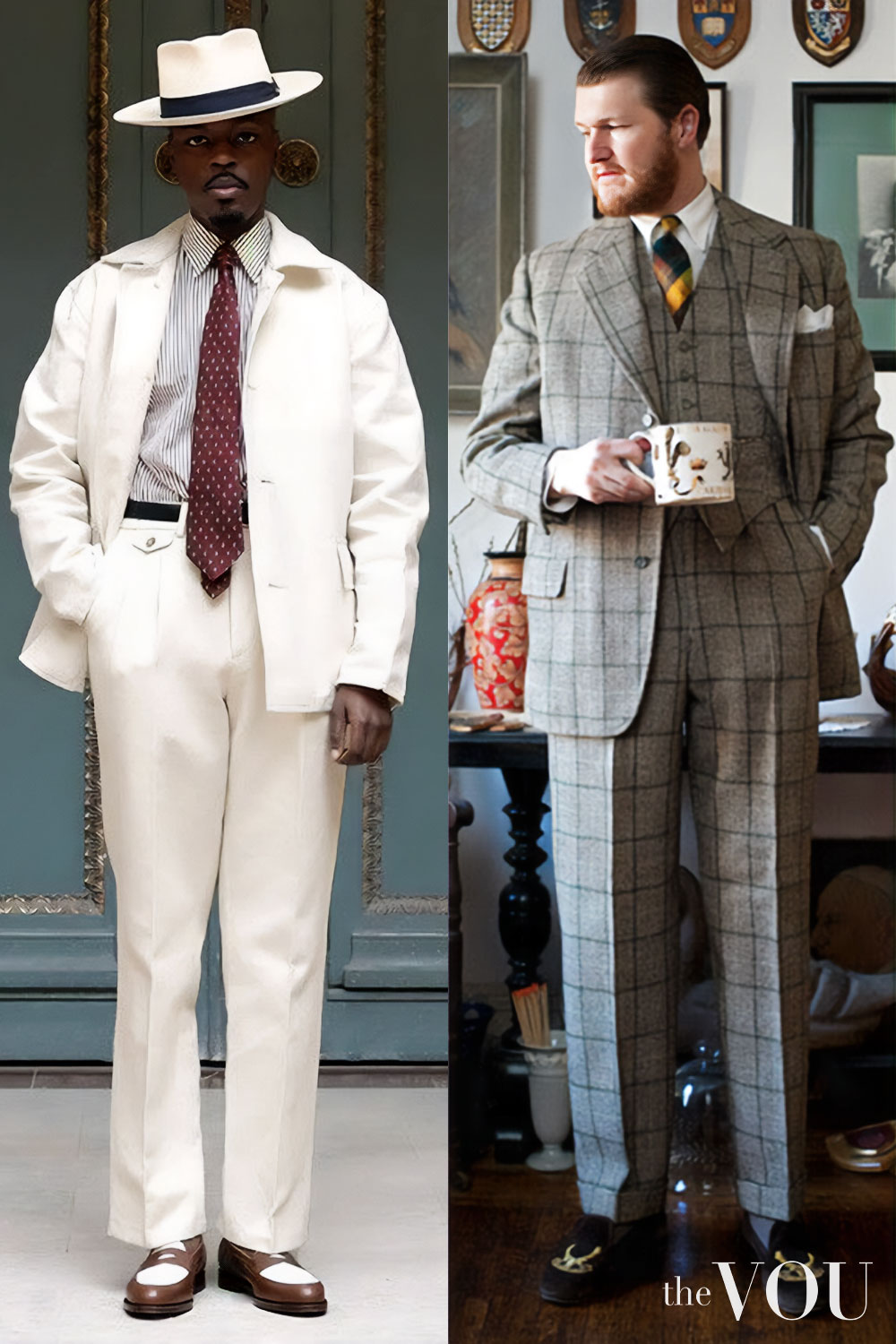
The French poet Charles Baudelaire described dandyism as almost a religion of beauty and a quiet rebuke to the conformity of middle-class men.
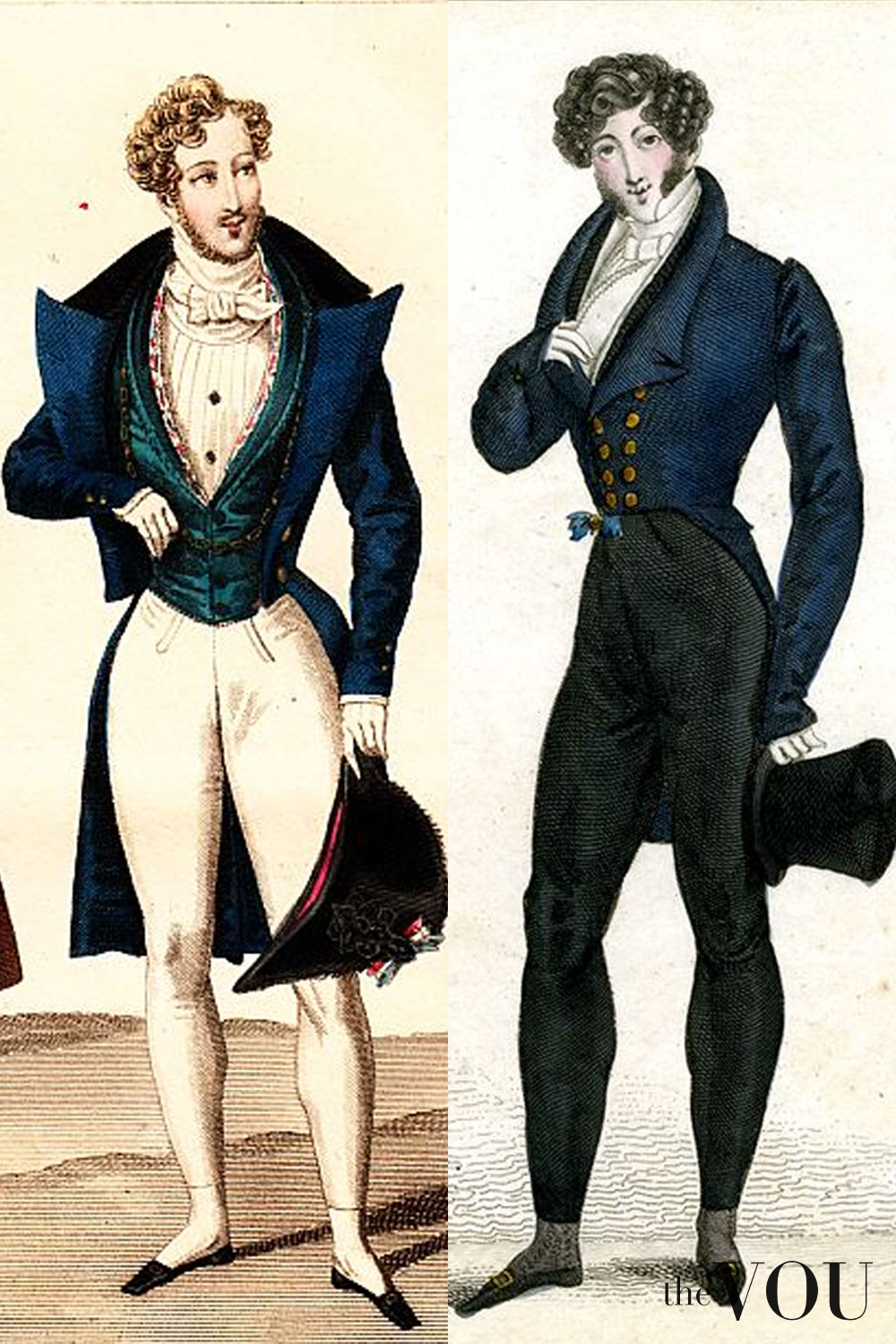
Baudelaire saw it as a discipline close to stoicism rather than a simple love of clothes and luxury.
For his ideal dandy, fine clothes only signalled a superiority of mind.
The Origin of Modern Dandyism
Men who made a show of fashion existed long before the word dandy, as 18th-century London had its macaronis, and Paris its petits-maîtres and, after the Revolution, the showy young Muscadins.
The dandy as we know him appeared in London in the 1790s and early 1800s, at a time of war and revolution, when old aristocratic finery was giving way to plainer clothes.
His answer to that change was not more decoration but more precision.

The dandy needed an audience, because his elegance only counted if it was seen and talked about.
Later figures such as the poet Lord Byron and, in the 1880s and 1890s, Oscar Wilde showed how a writer could also make his own appearance part of his fame.
British Dandyism
Beau Brummell (George Bryan Brummell, 1778 to 1840) is the model British dandy.
He was not an aristocrat, but after Eton, a short spell at Oriel College, Oxford, and the army, his wit and taste made him a close friend of the Prince of Wales, later the Prince Regent and George IV.
His look was famous for what it left out. It came down to a plain dark coat cut to fit perfectly, clean white linen, pale breeches or pantaloons, polished boots and a carefully tied cravat.
He was also known for daily washing and shaving at a time when that was far from universal.
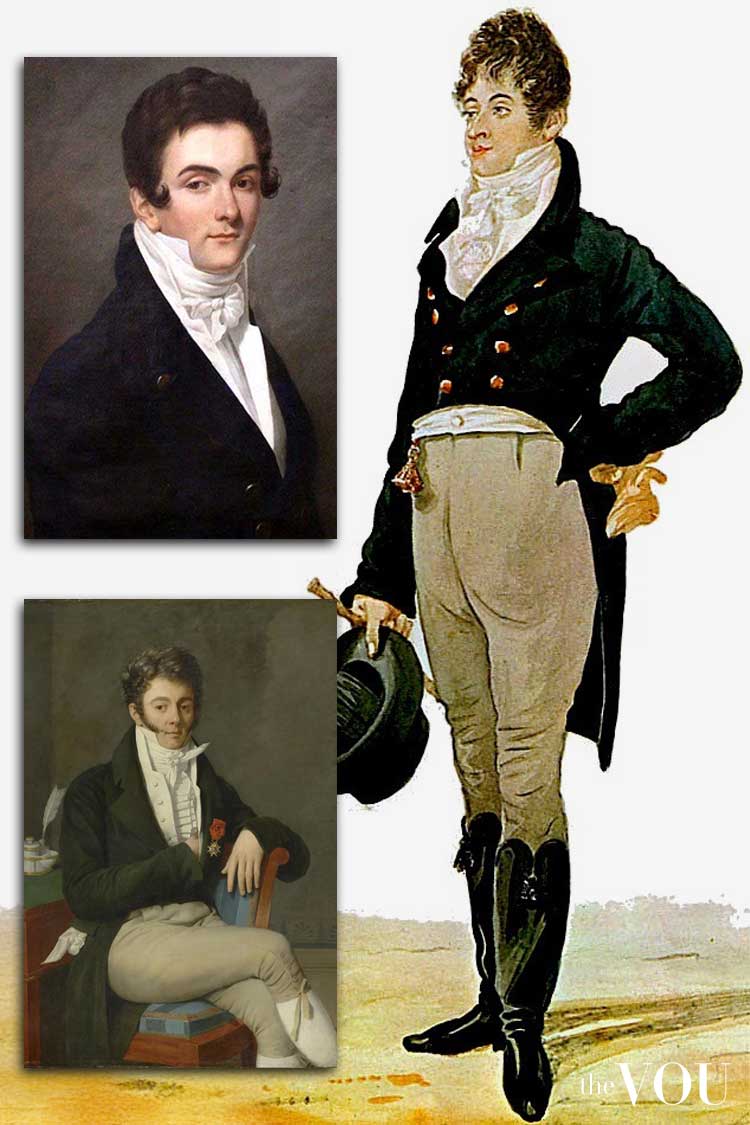
In 1795, Prime Minister William Pitt the Younger introduced a tax on hair powder to help pay for the war with France.
Brummell had already given up powder and wore his hair short in the Roman-inspired “Brutus” cut, which helped make natural hair fashionable.
Brummell also helped move men from knee-breeches to long, close-cut pantaloons, the ancestor of modern trousers.
He inherited a substantial fortune but spent it on gambling and high living.
In 1816, deep in debt, he fled to France, where he lived in poverty and died in an asylum in Caen in 1840.
His fall did not end his influence. The plain, well-cut look he championed spread across Europe and outlived him.
Lord Byron (1788 to 1824) admired Brummell, although his own romantic image, including a famous 1813 portrait of him in Albanian dress, was more flamboyant.
The French-born Count d’Orsay (1801 to 1852) carried a more colourful version of dandyism into London society in the 1830s and 1840s.
In Sartor Resartus (written 1831, published 1833 to 1834), Thomas Carlyle mocked the dandy in a chapter called “The Dandiacal Body”.
“A Dandy is a Clothes-wearing Man, a Man whose trade, office, and existence consists in the wearing of Clothes. Every faculty of his soul, spirit, purse, and person is heroically consecrated to this one object, the wearing of Clothes wisely and well: so that as others dress to live, he lives to dress.”
In return for all this devotion, Carlyle joked, the dandy asks only to be noticed.
As men’s clothing settled into a narrow range of dark, muted colours in the 19th century, the English dandy put his attention into small details, such as the quality of the cloth, the angle of a pocket flap, the exact colour of his gloves and the shine on his boots.
The ideal was to take infinite pains while appearing not to care, an attitude that became part of the image of the well-dressed Englishman.
French Dandyism
In France, showy dress was tangled up with the politics of the Revolution (1789 to 1799).
After the fall of Robespierre in 1794, the young men known as the jeunesse dorée (gilded youth) used conspicuous fashion to set themselves apart from the sans-culottes, the radical working men named for wearing trousers instead of silk knee-breeches.

In the decades after Brummell, English dress and the idea of the dandy became fashionable in Paris.
French writers turned the dandy into a figure of self-invention, a man who shaped his own appearance and personality as deliberately as a work of art, often in open contempt for bourgeois conformity.
Baudelaire, writing in The Painter of Modern Life (1863), put it more admiringly, saying that dandies have
“…no profession other than elegance . . . no other [social] status, but that of cultivating the idea of beauty in their persons. . . . The dandy must aspire to be sublime without interruption; he must live and sleep before a mirror.”
Writers also linked the dandy with the flâneur, the observant stroller of the Paris boulevards.
In his 1845 essay on Brummell, Jules Barbey d’Aurevilly treated him as the man who decided what London society thought fashionable.
By the late 19th century, a dandified, decadent pose was common among writers of the Symbolist and Decadent movements, who treated their own lives as part of their art.
Black Dandyism
Black men have been dandies for as long as there have been dandies, and they have shaped the style.
The scholar Maria Weilandt, in “The Black Dandy and Neo-Victorianism: Re-fashioning a Stereotype”, criticises histories of dandyism that treat it as an almost entirely white story.
It is important to acknowledge Black dandyism as a distinct and highly political effort at challenging stereotypes of race, class, gender, and nationality.
The British-Nigerian artist Yinka Shonibare (b. 1962) restages Victorian dandy imagery to explore Black men’s experience of European society.

His photographic series Dorian Gray (2001) restages Oscar Wilde’s novel The Picture of Dorian Gray (1890), with the artist himself in the title role, raising questions about who is pictured, and who is left out, in images of Victorian Britain.
His Diary of a Victorian Dandy (1998) is a series of photographs showing the dandy at different times of day, played by Shonibare himself and surrounded by white servants and companions; it borrows from William Hogarth’s A Rake’s Progress and challenges conventional images of race, class and British identity.
In Dandy Lion: The Black Dandy and Street Style (Aperture, 2017), the curator Shantrelle P. Lewis writes that “the Black dandy is often making a concerted effort to juxtapose himself against racist stereotyping seen in mass media and popular culture”, and that “for dandies, dress becomes a strategy for negotiating the complexities of Black male identity”.
The dandies photographed for that project favour close tailoring, a deliberate contrast with baggy streetwear.
“Dandy Jim, from Carolina” (also known as “Dandy Jim of Caroline”) is a blackface minstrel song published in New York in 1843.

It tells the story of a character named Dandy Jim, who is depicted as a stylish, flamboyant man “from Carolina”.
The song mocks Dandy Jim’s fine clothes and vanity for a white audience.
The song was written for blackface minstrel shows and published as a “popular Negro melody”; it is an example of the racist caricature that Black dandyism has had to answer, not an example of Black dandyism itself.
Minstrel shows invited white audiences to laugh at the idea of a Black man dressing well and “putting on airs”, a joke that reflected the racism of 19th-century America.
Knowing this history explains why later Black dandies, and artists such as Yinka Shonibare, treat sharp tailoring as a deliberate answer to stereotype.
Modern Dandy, How to Dress Like One
Scroll horizontally to see all columns →
 |
 |
 |
 |
 |
 |
 |
 |
 |
 |
 |
 |
 |
 |
 |
 |
The dandy style is not for everyone, perhaps because it is “the style” par excellence, something you can’t easily build.
Therefore, it is not a good idea to force an outfit that does not reflect your personality.
Dandyism is more than a taste for expensive clothes.
Dandyism is a way of life and has to be found in every detail.
Dandy style is for those who love to express their personality through clothes, attitudes and everyday choices.
And for those of you, dandy inside, here is a little help to become dandy even outside.
Modern Dandy Style Wardrobe Essentials
Nowadays, the dandy look for fashion men is still present even if the style has changed slightly.
Instead of Oscar Wilde’s velvet knee-breeches and sunflower, today’s dandy wears a close-fitting, sharply cut suit. They also wear matching shirts with silk scarves, ties, or bow ties.
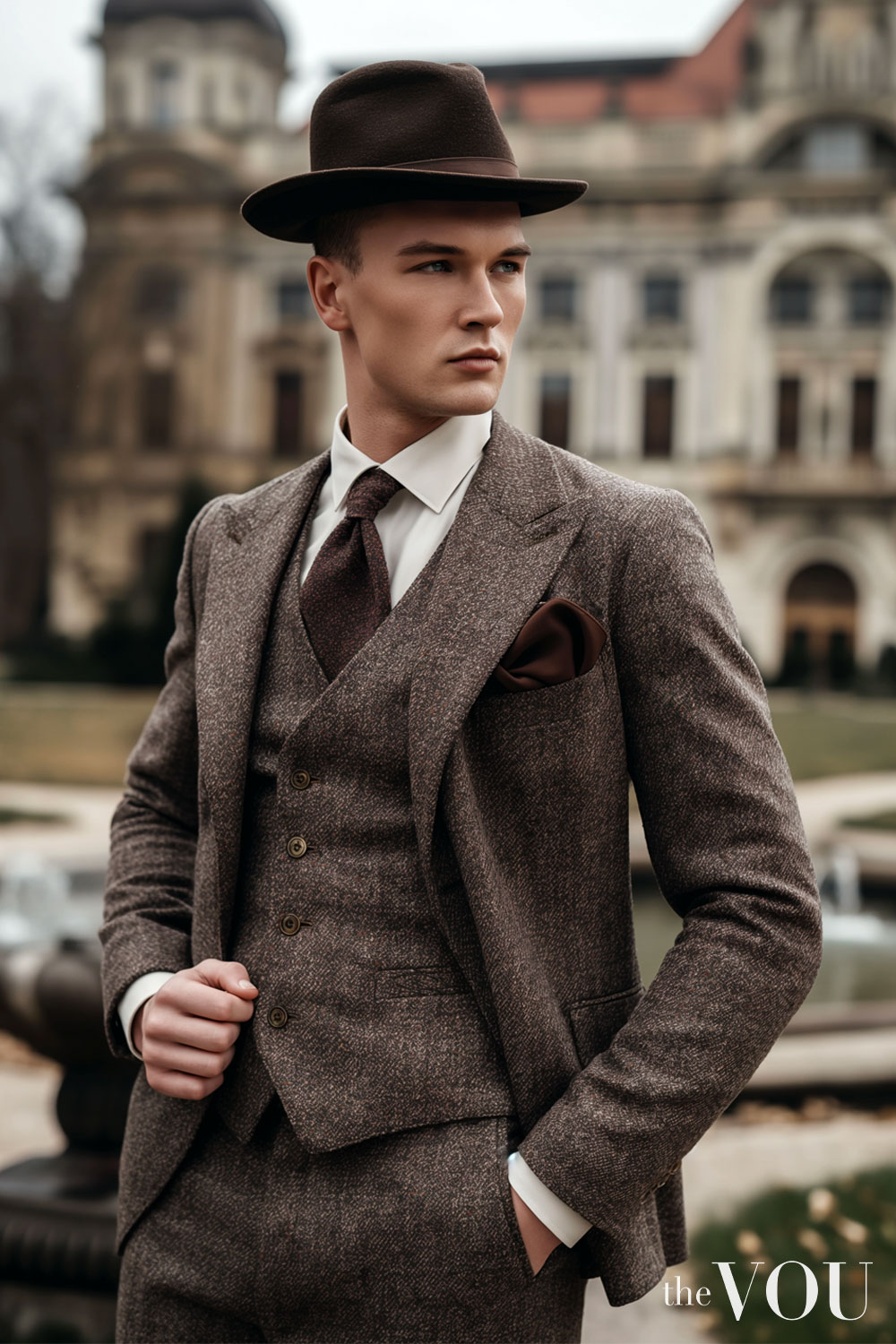
The outfit has to look clean and well-groomed, and a hat suits the look.
The fabrics are noble, such as cashmere and silk, mixed with wool and cotton sateen.
The accessories should be kept simple but still high-quality. The best choices are cufflinks, watches, belts, and bow ties, which are perfect for completing any outfit.
Tailored Suits
Tailored suits are the cornerstone of dandy style. Opt for clothes with impeccable cuts, clean lines, and high-quality fabrics.
Choose classic colours like grey, blue, or black, but don’t hesitate to experiment with unusual details or refined patterns.
A good starting point is a two-button jacket with slim trousers in clean, sober lines. Focus your attention on fabrics.
Wearing checked patterns, stripes, Prince of Wales, and Tartan can obtain a wow effect. If you want to dare, you can add a waistcoat, a direct descendant of the waistcoats of Brummell’s era.
But keep in mind that less is more, even in sartorial style for the new dandy. Before opting for the most eccentric outfit in your wardrobe, always consider the occasion.
Dress Shirts
Shirts with high collars, elegant cuffs, and fine details like mother-of-pearl buttons or understated embroidery are a key feature of the dandy look.
Choose neutral colours or subtle prints to balance sobriety and elegance.
Dress Shoes
Dress shoes are essential for a complete dandy look. Opt for loafers, brogues, Oxfords, or leather dress boots.
Ties and Pocket Squares
Ties are a way to express your personality in a dandy look. Opt for silk neckties, bow ties, ascots, or cravats with subtle prints or signature details like pins or brooches.
Top them off with a matching pocket square for a touch of class.
Hats and Caps
Hats are a signature accessory of the dandy style. To complete your look, choose a quality hat like a fedora, trilby, or felt hat.
Cufflinks
A true gentleman needs cufflinks for his look. They are small but perfect for any event, such as a business lunch or a party.
Fine silver, perhaps set with wood or enamel, looks quietly expensive.
Take the First Step With The VOU’s Styling Quizzes
Start with our quizzes. Take our Face Shape Quiz to check your face shape and get initial styling suggestions.
Then take our Seasonal Colour Analysis Quiz to find your seasonal colours.
Our Body Shape Quiz suggests garment styles to try, and our Fashion Style Quiz helps you explore your personal style.
Transform Your Image with The VOU’s Professional Guidance
If you would like personal help with your whole look after the quizzes, The VOU offers paid styling services.
Our Professional Face Shape Analysis package is a paid consultation; the product page lists what it includes.
Our Complete Image Transformation Package combines the face shape, seasonal colour, body shape and fashion style analyses.