
Start here
What’s This About
Wide spread, cutaway, club, band and moderate button-down collars are the five usually suggested for a long outline with angular jaw corners, and the shirt you actually buy is settled by your neck measurement, the clearance you can see with the collar closed and the knot you like tying.
This guide covers those five collars and the trade-offs a long face with a defined jaw runs into, such as:
The wide spread collar, and choosing a knot by its actual tie space
The cutaway collar, and how it behaves under a narrow lapel
The club collar, and what a collar bar really does to the opening
The band collar, with circumference, height, front and rear shape, and closure to check
The moderate button-down, and its fastened points in open-neck wear
Why collar band height follows your neck, and why a long neck is the case that takes a taller band
and many more!
If your jaw corners read as softly curved rather than angular, the oblong guide covers the same question from that side.
Key Points
01A wider spread sets the points further apart and gives a level line across the throat, showing more shirt and tie either side of the knot, and the cloth sits below the jaw so no collar alters your bones.
02No collar height limit follows from a long face, because band height is set by your neck length and by the clearance you can see on the shirt.
03A collar bar or pin pulls the points together and lifts the knot forward, so a bar tightens the opening and cannot be used to add width.
04No tie knot is compulsory, and a Windsor is one option among several depending on tie thickness and the tie space in front of you.
At a glance
Jump to rectangle or oblong if you are not sure which long-face guide you want.
Jump to long face, short neck, broad jaw for the separate fit checks.
Jump to the five collars for what each shape does in wear.
Jump to related questions for collar height, knots, pins and casual shirts.
Men with a long outline and a defined jaw are usually sent straight to the widest collars available, and this page explains what those collars actually do, as options rather than requirements.
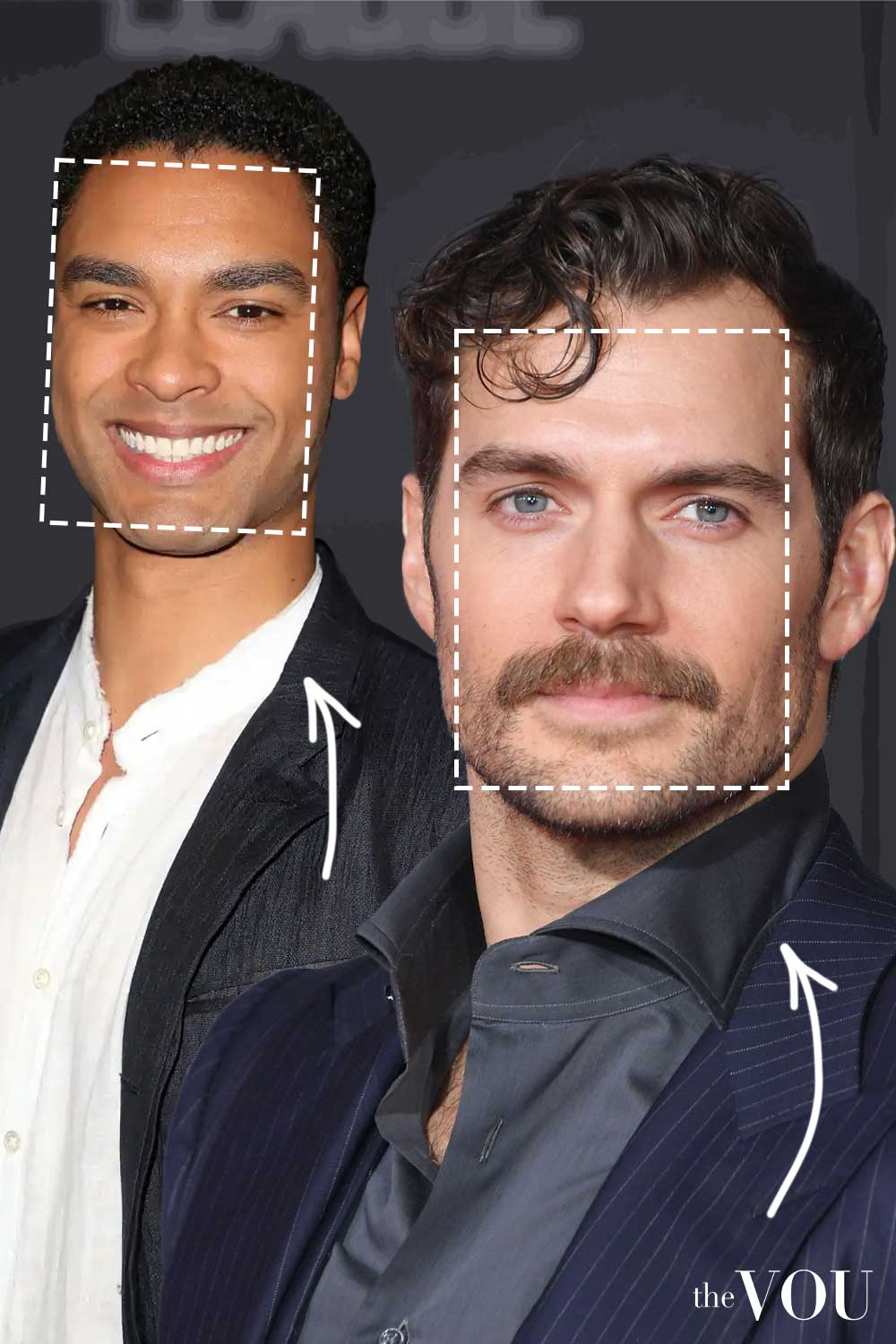
If you are uncertain whether you have a rectangular face, The VOU uses rectangle for a clearly longer outline with broadly similar widths and angular jaw corners, which is a set of relative observations rather than a measurement.
Take our face shape analysis quiz as a starting point, reading the result as our editorial description of your outline rather than a measurement of your bone structure.
Understanding your specific facial structure mainly helps you find the right guide, and the collar and face shape hub sets all nine shortlists side by side.
The shortlist on this page is our editorial suggestion drawn from the styling sources we assessed, rather than a measured record of what readers prefer.
Rectangle Or Oblong: Which Long-Face Guide Is Yours
The VOU keeps two names for long outlines and separates them by the jaw corners: rectangle for angular corners and oblong for softer, rounded corners.
That division is our editorial convention rather than an anatomical boundary, and several other guides put both outlines under one heading, which is worth knowing before you treat either name as a finding about yourself.
The collar question is nearly the same on both pages, so the difference is one of emphasis: this guide gives most of its room to the crisp spread and cutaway collars, for readers who want a crisp collar under a defined jaw, while the oblong guide leans on the softer club and band collars; in short, a crisp finish echoes an angle, while a wider spread changes the direction of the line.
Read whichever matches your corners, then read the other, because nothing in either page is closed to you.
What The Collar Changes On A Long Face With A Defined Jaw
The collar closes at the base of the neck and its points lie on the chest, so no collar shortens a face or broadens a cheekbone, and whatever contrast it creates is a modest perceived effect.
What changes is how much throat is visible between the jaw and the cloth, and whether the line across the throat reads level or narrow, which on a long neck is a noticeable difference and on a short one a small one.
Art of Manliness, reviewing the same advice, calls the visual effect subtle and the rules optional while treating a long face and a long neck as two separate decisions, which is the distinction that makes the rest of this page work.
If you would rather emphasise a defined jaw than counterbalance it, a crisp semi-spread or point collar keeps a narrower, more angular line, if that is the framing you prefer, and choosing to agree with your own outline is a preference rather than an error.
The one rule worth keeping
Measure the neck, check the clearance at the jaw with the collar buttoned, then choose the opening for the tie and the jacket, because a long face on its own dictates no height and no knot.
Long Face, Short Neck, Broad Jaw: The Combination That Breaks The Rule
The standard long-face instruction is to keep the collar band low, and the standard broad-jaw instruction is to buy a crisp, structured collar, and the two can collide on a short neck if a taller structured band catches under the jaw.
Comfortable clearance comes first, so if a band catches, try a lower band in the correct neck size and choose the opening and stiffness you prefer from what remains.
On a long neck the reverse applies, and a taller band covers more throat, which you may find looks more finished under a jacket, even though the face description has not changed at all.
That is why this guide gives no band height figure: one number cannot serve a long face on a short neck and the same face on a long one.
When you do compare band heights, check which end the figure describes, because Proper Cloth’s soft fused English spread specifies front and rear separately and an unlabelled number cannot be compared between shirts.
The Fit Checks Behind Every Choice Here
Check one
Neck circumference
Measure the way your chosen maker instructs, since a collar size can describe either a body measurement or the finished collar and makers differ over how much room to leave under the tape, then follow that maker’s size chart and allowance instruction rather than adding ease of your own on top.
Check two
Comfort and clearance while buttoned
Button the collar, knot the tie, then sit, stand and turn your head fully to each side, watching whether the band catches under the jaw, and treat the one to two finger gap in Proper Cloth’s collar fit guide as a starting point rather than a specification.
Check three
Tie space against your own ties and lapels
Spread is the distance between the bottoms of the collar points and tie space is the distance between the tops of the collar leaves above the top button, which makers specify as two separate measurements.
A wider tie space gives a fuller knot room to sit, a thick tie makes every knot larger, and the collar also has to work with the jacket you own, so try the shirt with your usual tie and lapel before buying two more.
Wide Spread Collar
The wide spread pushes the points well apart while keeping enough point length to sit under a lapel, which makes it a practical middle choice among the broad collars.
What it does: the broad spread gives a level line below the jaw. Worn open, it can expose more throat; buttoned with a tie, compare the shirt and neckwear visible around the knot.
Styling advice: try a Windsor, half-Windsor or four-in-hand against the actual tie space and tie cloth, and look for a cloth with enough body to help the collar hold its spread, since a limp collar loses the line the shape exists for.
Cutaway Collar
The cutaway angles its short points back towards the shoulders, giving the widest opening in a normal shirt range.
What it does: the cutaway has the widest spread in this shortlist. Its separate tie space must still be checked on the actual shirt rather than inferred from that angle.
Styling advice: try a Windsor, half-Windsor or four-in-hand against the actual tie space and tie cloth. The knot need not conceal all the shirt beside it; keep comfortable seating and the appearance you prefer.
Check the collar under your own jacket before committing, because short points set at a wide angle show beyond some narrow lapels and sit neatly under others.
Club Collar
The club collar finishes its short points in a curve, which is the one shape here that contrasts with an angular jaw rather than agreeing with it.
What it does: the curved finish keeps the visible collar compact and reads as a deliberate period choice, and the short points leave a modest opening rather than a wide one.
Styling advice: short rounded points do not determine tie space, so try the knot on the actual shirt. A collar bar draws the points together and lifts the knot forward, closing the opening rather than widening it.
Band Collar
The band collar, also called a mandarin collar, is the collar band on its own with no points sewn to it.
What it does: with no points there is no opening and no tie space, so the collar reads as a plain ring at the base of the neck and the eye has no vertical edges to follow down the chest.
A band collar removes the point and spread choices rather than every dimension, so circumference, the band height and shape at the front and rear, and how the closure sits at the throat all still need checking, and no knot guidance applies to a collar worn without a tie.
Styling advice: worn without a tie, so choose a cloth with body such as oxford or chambray, and treat a band collar shirt as its own wardrobe decision rather than a substitute for a dress shirt.
Moderate Button-Down Collar
The button-down fastens each point to the shirt front, and a moderate spread between the fastenings keeps the opening reasonably broad while the points stay put.
What it does: the fastened points hold their position all day rather than drifting, and the cloth between the fastening and the band lifts into the curve called the roll, which softens the line at the throat.
How much roll appears depends on the collar’s cut and its cloth alongside the stiffening, and Proper Cloth’s account of shirt collar constructions explains why: a heavily fused collar holds a flatter line while an unfused or soft fused collar in a substantial oxford rolls more readily.
Styling advice: because its points stay fastened, this is a dependable choice with the top button open, and a moderate spread rather than a narrow placement keeps it consistent with the rest of this shortlist.
Related Questions
Q. Are narrow point collars a mistake on a long face?
No, and that includes the tab and pin collars, and the higher collar bands, often ruled out for a long face.
A narrow opening keeps the visible line close to the throat, which runs with a long outline rather than against it, and a crisp point collar also agrees with an angular jaw, if that is the framing you prefer.
Proper Cloth’s guide to collars and face shape describes collar style as a matter of preference rather than a fixed rule.
Q. What collar height suits a rectangular outline?
The question has no answer at the level of the face, which is why this guide gives no figure for it.
Band height is set by how much throat you have between jaw and shoulder and by the clearance you can see with the collar closed, so a long neck takes a taller band and a short neck a lower one.
If you compare specifications, note whether the figure quoted is the front or the rear of the band, since makers publish the two separately.
Q. Does a wide spread collar have to be worn with a Windsor?
No, because the knot is decided by the tie space in front of you and by the tie you are tying.
A wide spread does not require a bulky knot or the concealment of all visible shirt. Check the separate tie space and tie thickness, then try the knot you prefer.
Look in the mirror for comfortable seating, undistorted points and the amount of visible shirt you like. Those checks are more useful than a knot rule based on a face label.
Q. What works in casual shirts?
A button-down with a moderate spread is a practical casual choice, because the fastened points keep their shape with the top button open.
A camp collar lies flat and open with a wide, relaxed spread, and a band collar shirt removes the question entirely, both of which are wardrobe decisions rather than face decisions.
A polo with a soft collar covers the same ground in warmer weather, and formality here comes from the cloth rather than the collar name.
Q. Should hair and beard be coordinated with the collar?
They are separate decisions made on different timescales, and the honest version of the usual advice is narrower than it sounds: temple width and crown height are different effects, and what you can achieve depends on your density, texture and growth pattern rather than on a named cut.
A beard changes the jaw outline you see rather than your bone structure, and how you wear a beard does not by itself tell you your shirt size, so recheck the actual fit of the shirt you own with the collar buttoned.
Describe to your barber where you want length and weight, then judge the result dry in a mirror.
Take the First Step With The VOU’s Styling Quizzes
Start your style journey with our resources, beginning with our Face Shape Quiz, which points you to the guide written for your outline and to initial styling guidance.
Then, check your colours with our Seasonal Colour Analysis Quiz.
Check your body shape with our Body Shape Quiz, and your personal style with our Fashion Style Quiz.
Styling Consultations
Choosing a collar well is a small decision inside a larger one, and the larger decision takes in your neck and shoulders, your hair, your beard and the jackets every shirt has to live under.
Our Professional Face Shape Analysis package is a paid consultation; its product page lists what it includes.
Our Complete Image Transformation Package combines the face shape, seasonal colour, body shape and fashion style analyses.
If you would like personal help, you can book a paid consultation.
Our styling services for men are paid consultations; the shop page lists what each one includes.
Mandy Meyer’s focus at The VOU is men’s body-shape styling, garment fit and outfit proportions. Her coverage addresses the practical questions behind a wardrobe choice: how a jacket sits across the shoulders, how trousers fall and how different cuts change the silhouette a wearer wants to create.
Her subject areas include the triangle, inverted triangle, rectangle, oval, trapezoid, hourglass and diamond labels used in body-shape styling. These provide starting references for comparing visible proportions; they do not capture every body or prescribe one correct way to dress. The focus connects those observations with garment shape, construction, length and the relationship between the upper and lower parts of an outfit.
Mandy’s editorial coverage combines visual comparisons with fit checks for comfort and movement. Readers can consider whether a cut gives them the room they need, where clothing pulls or gathers and which changes might support their preferred look. The aim is to make menswear choices more understandable while keeping personal preferences and the wearer’s own styling goals central.