
Start here
What’s This About
Your collar size is set by your neck, the collar band by your neck length and jaw clearance, and the tie knot by the tie space in front of you, after which the shape of the collar is a preference that frames the throat rather than a rule that fixes your face.
This guide sets out the whole decision in order, with the nine VOU outline descriptions and their shortlists, such as
How to measure your neck and judge a collar with the collar buttoned
Collar band height, and why makers quote the front and the rear separately
Collar spread, tie space and how to check a knot against the actual shirt
Stiff fused, soft unfused and soft fused collars, and what each does in wear
The nine outline descriptions used on this site, with the collars usually suggested for each
Collars for business, formal and casual wear, and how each sits under a jacket
and many more!
Read the fit section before the shortlists, because a collar that does not close comfortably will not look considered whatever its shape.
Key Points
01A collar closes at the base of the neck and its points lie on the chest, so no collar alters the width of a forehead, a cheekbone or a jaw, and what it does change is the line at the throat and upper chest.
02Neck circumference, comfortable closure, collar band height and tie space are the four checks that decide a shirt, and every one of them is independent of any face description.
03Collar band height follows neck length and jaw clearance, not a face label, so choose it from the actual shirt rather than a face category.
04Whether a collar echoes your outline or contrasts with it is your choice, the visible difference between two collars on the same man is modest, and stylists disagree about which direction suits which face.
At a glance
Jump to step one, the four fit checks, which decide the shirt before any shape question.
Jump to step two, the nine outlines, for the collars usually suggested for each description.
Jump to step three, construction and proportions, for band height, spread, knots and interlining.
Jump to step four, collars by occasion, and then to related questions.
When choosing a shirt, check collar fit alongside chest and sleeve fit. A shirt that fits elsewhere may still pinch, gape or catch against a jacket lapel.
This guide puts the decision in the order that actually works, starting with the measurements and the comfort checks, moving to construction, and treating the shape of the collar as the last and most personal choice rather than the first and most rule-bound one.
Collar selection is not a scientific method and this guide does not present it as one, because the useful parts are measurable fit and clearly described trade-offs.
What follows is an editorial convention grounded in maker guidance and our own reading of the alternatives, not a validated classification system, and the guides it links to are written the same way.
Step 1. Measure The Neck And Check The Fit
These four checks settle whether a shirt is wearable, and none of them has anything to do with the shape of your face.
Check one
Neck circumference
Run a soft tape around the base of the neck where a collar band actually sits, level all the way round and snug without compressing the skin, with your head upright and facing forward.
Measure the way your chosen maker instructs, since a collar size can describe either a body measurement or the finished collar and makers differ over how much room to leave under the tape, then follow that maker’s size chart and any allowance or shrinkage instruction rather than adding ease of your own on top.
Check two
Comfort with the collar buttoned
Judge the collar the way you will wear the shirt, buttoned to the top and with the tie knotted if a tie belongs to the outfit, then stand, sit and turn your head fully to each side.
Proper Cloth’s collar fit guide offers a one to two finger gap as a practical starting point, which is a maker’s rule of thumb rather than a specification, and the test that settles the shirt is whether you forget the collar is closed.
Check three
Collar band height and jaw clearance
The band is the upright strip the collar is sewn to, and a taller band covers more neck and sits closer to the jaw while a lower band leaves more neck showing and stays clear of the chin.
Choose the band by neck length and by the clearance your jaw needs with the collar closed, which is a mirror check rather than a number to look up.
Check four
Tie space at the throat
Tie space is the distance between the tops of the collar leaves just above the top button, which makers specify separately from spread, and the knot needs to seat in that space without forcing the points out of shape.
The one rule worth keeping
Fit the collar to your neck, set the band by neck length and jaw clearance, match the knot to the tie space, and then choose the shape you like.
Step 2. Identify Your Face Shape, And The Collars Usually Suggested For It
Reading your own outline is useful for navigation, because it points you at the guide written for that description, and understanding your face shape is where that starts.
Stand at a mirror with your head upright, hair moved aside if that is comfortable, in even light, then compare four observations separately, which are the overall length from the central hairline to the bottom of the chin, the width of the forehead above the brows, the widest point across the cheekbones, and the width between the jaw corners.
Record the jaw corners as curved or angular as a separate observation from the widths, because that distinction is what separates several of the nine descriptions below from each other.
For a quick route to the right guide, take our face shape quiz for men, and read the result as our editorial description of your outline rather than a measurement of your anatomy.
There are two honest cautions about the nine names. They preserve the navigation this site has always used rather than claiming nine separate anatomical categories, and no numerical threshold separates any one from its neighbours.
If a covered or receding hairline makes face length hard to judge, leave length out and work from the widths and corners you can see, and if a beard hides your jaw, describe the bearded outline and record the underlying corners as unknown.
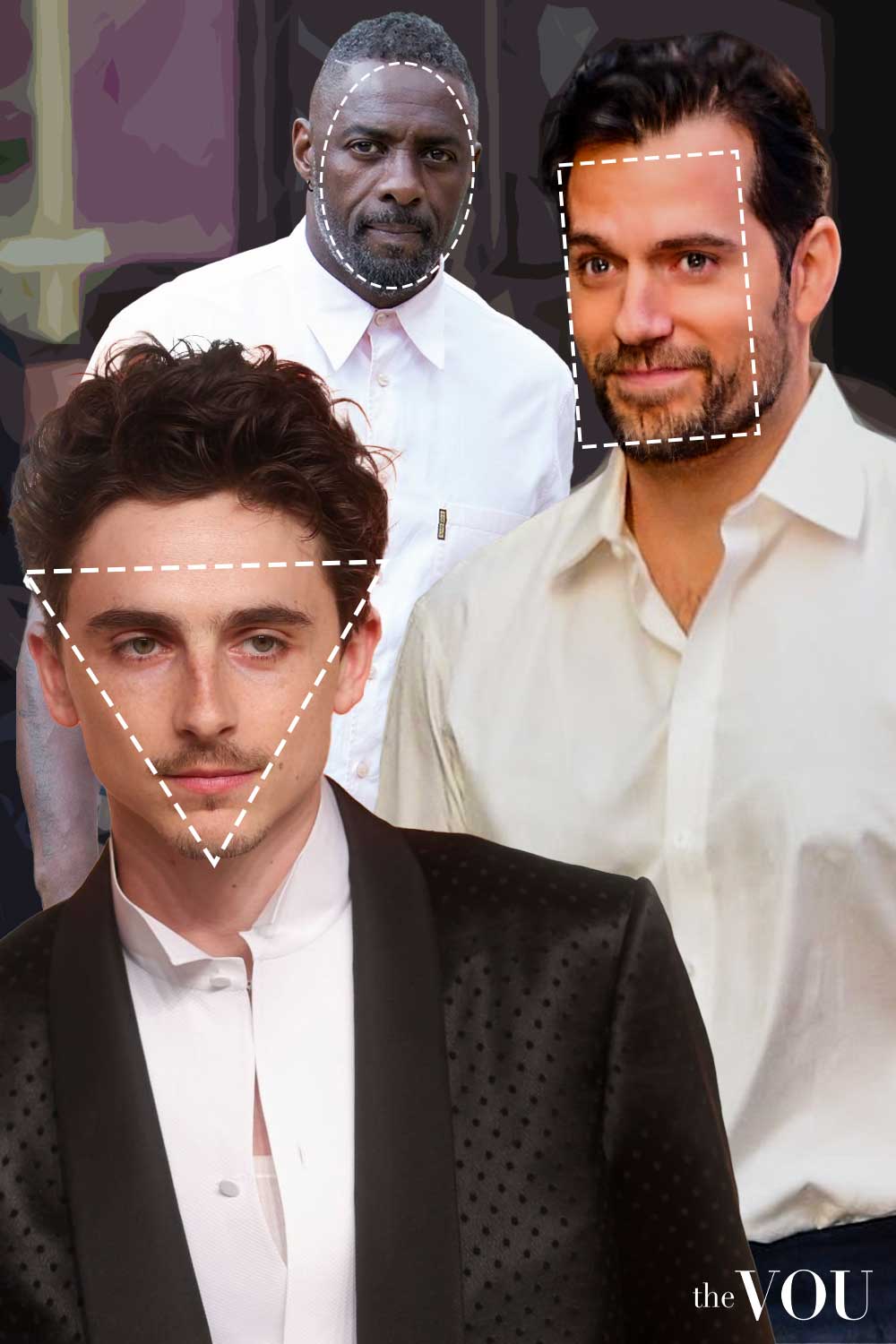
Oval Face Shape

Men with oval faces have an outline described here as longer than wide with a gently curved edge and no strongly dominant upper or lower breadth.
The classic spread gives a broader line below the jaw, the button-down’s fastened points can support a visible roll, and a cutaway sets the points farther apart. With the shirt open that may expose more throat; with it buttoned, compare shirt and tie around the knot. Check tie space separately.
Because nothing here needs counterbalancing, the useful question is which line you prefer and which knots you like tying.
Recommended styles for an oval face include the following.
- Classic Spread Collar
- Button-Down Collar
- Cutaway Collar
- Point Collar
- Club Collar
Read more about the best collar styles for men with Oval face shape.
Round Face Shape
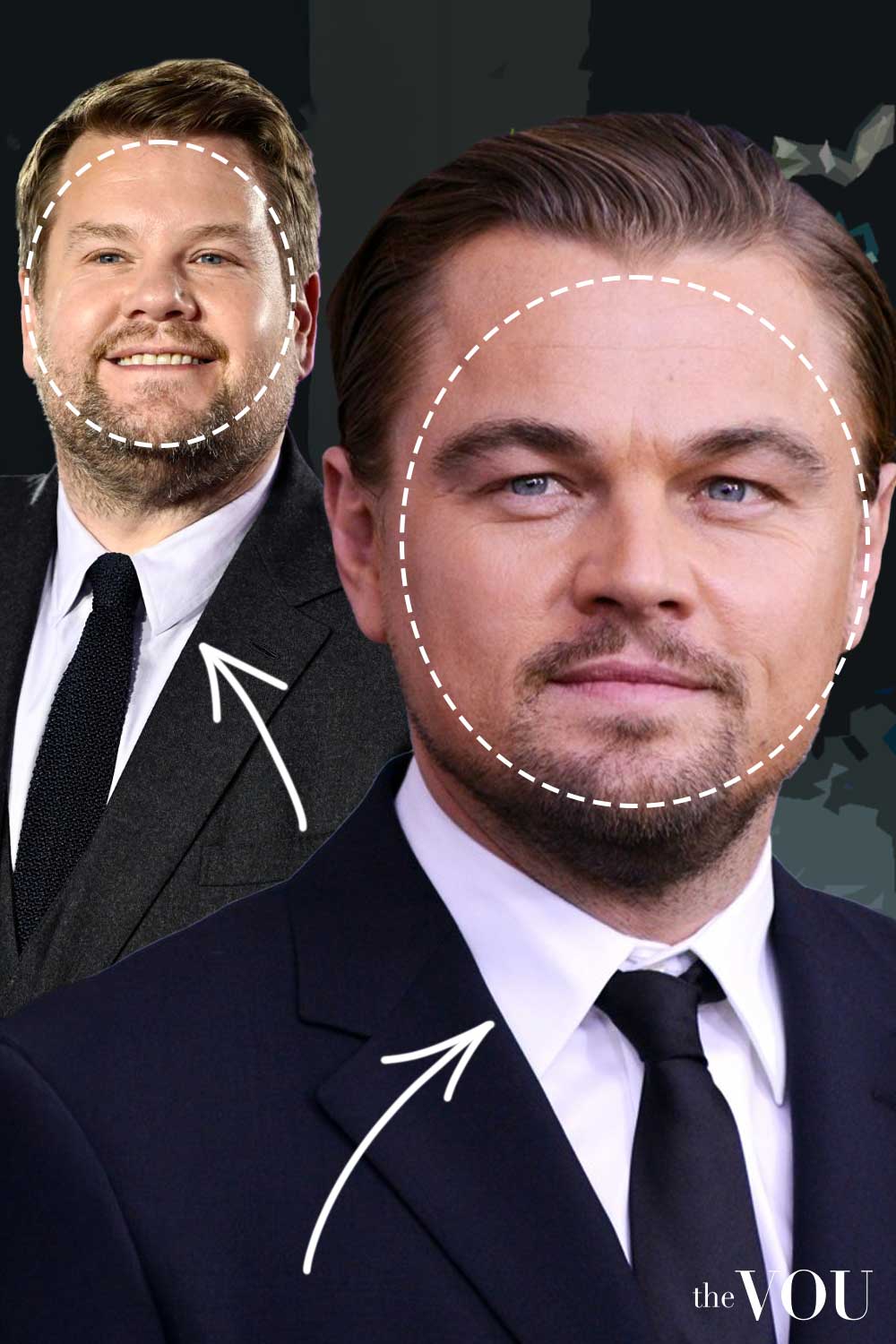
Men with round faces, described here as a relatively compact outline with curved jaw transitions, are usually sent to collars with a narrow opening.
The point and forward point collars keep their edges closer together and can cover more throat when worn open. Pin and tab collars hold the points beneath a tie knot; a button-down’s fastened points can help it sit neatly without a tie, as can other collars depending on their construction.
A wide spread or cutaway is not ruled out, and Proper Cloth explicitly allows a round-faced wearer to choose a cutaway, so treat this list as a starting point rather than a fence.
The recommended styles are listed below.
- Classic Point Collar
- Forward Point Collar
- Button-Down Collar
- Pin Collar
- Tab Collar
Read more about the best collar styles for men with Round face shape.
Square Face Shape

Men with square faces, described here as a compact outline with broadly similar widths and angular jaw corners, are usually offered curved collars as a contrast.
The rounded club collar is the clearest contrast, the button-down with a genuine roll is the everyday version, and the moderate spread and semi-cutaway set their edges at a different angle from the jaw above.
The forward point is on this list for the opposite reason, because a crisp angular collar agrees with a defined jaw, and choosing to echo your own outline is a preference rather than a mistake.
Recommended styles include the collars below.
- Rounded Club Collar
- Moderate Spread Collar
- Button-Down Collar with Soft Roll
- Semi-Cutaway Collar
- Forward Point Collar
Read more about the best collar styles for men with Square face shape.
Rectangular Face Shape
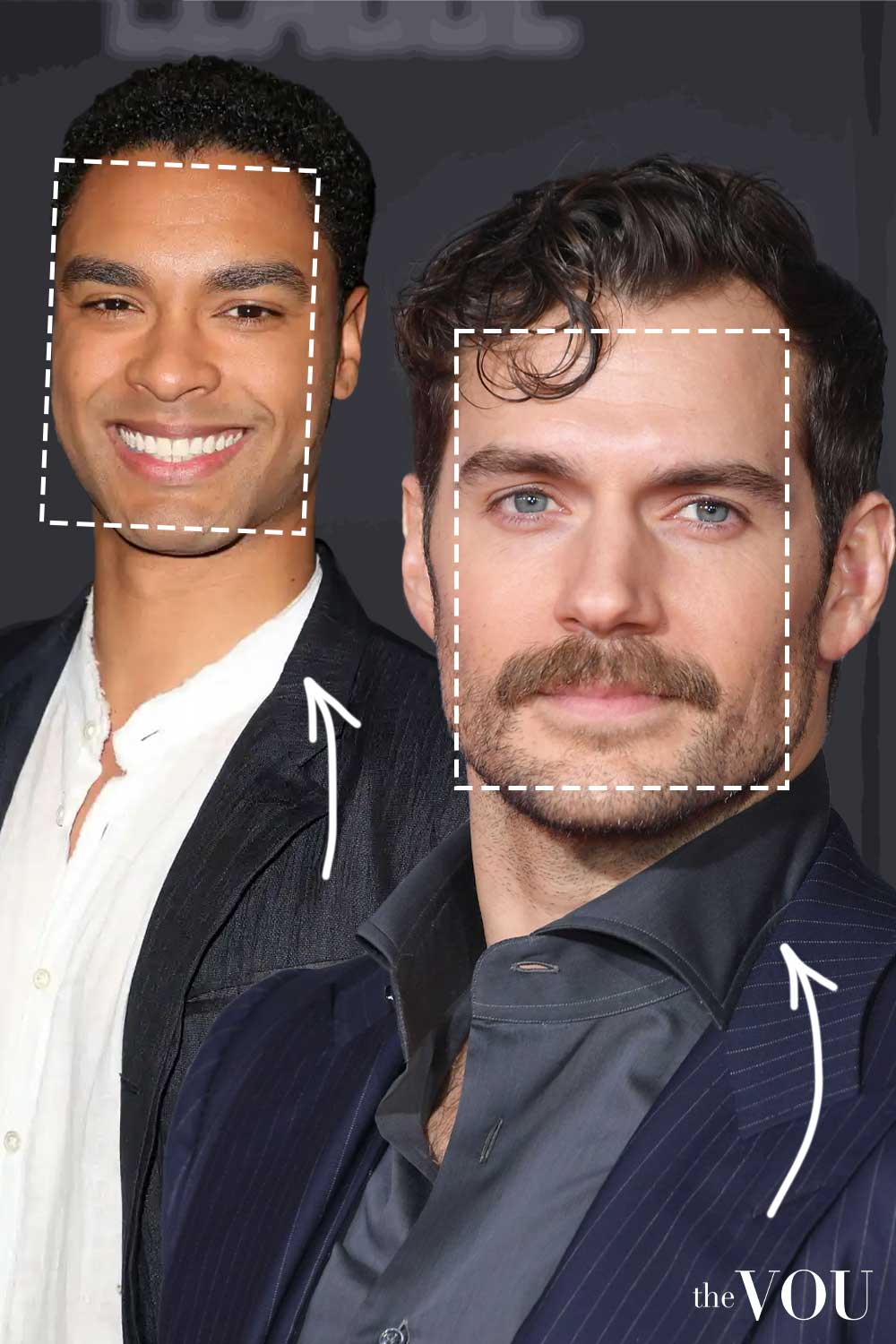
Men with rectangular faces, described here as a clearly longer outline with broadly similar widths and angular jaw corners, are usually offered the widest collars.
The wide spread and cutaway set the points furthest apart and can be chosen in a crisp finish if you want to echo an angular jaw, the club collar contrasts with that jaw instead, and the band collar removes the point and spread choices altogether.
The moderate button-down is the casual choice, and note that a long face tells you nothing about your neck. A short neck under this outline wants a lower band for clearance rather than the tall crisp collar a face-first rule would hand you.
The shortlist of recommended styles follows.
- Wide Spread Collar
- Cutaway Collar
- Club Collar
- Band Collar
- Moderate Button-Down Collar
Read more about the best collar styles for men with Rectangular face shape.
Triangle Face Shape

Men with triangle face shapes, described here as a jaw reading broader than the forehead with the face narrowing from bottom to top, are usually offered a shortlist led by the wider collars.
What those collars do is give a broad, level line at the throat, and no collar or tie knot creates width at the forehead or the temples.
Note also that other systems use triangle for the opposite outline, so a recommendation borrowed elsewhere has to be read by the features described rather than by the name.
Recommended styles for this outline include the following.
- Cutaway Collar
- Wide Spread Collar
- Semi-Spread Collar
- Club Collar
- Band Collar
Read more about the best collar styles for men with Triangle face shape.
Heart Face Shape
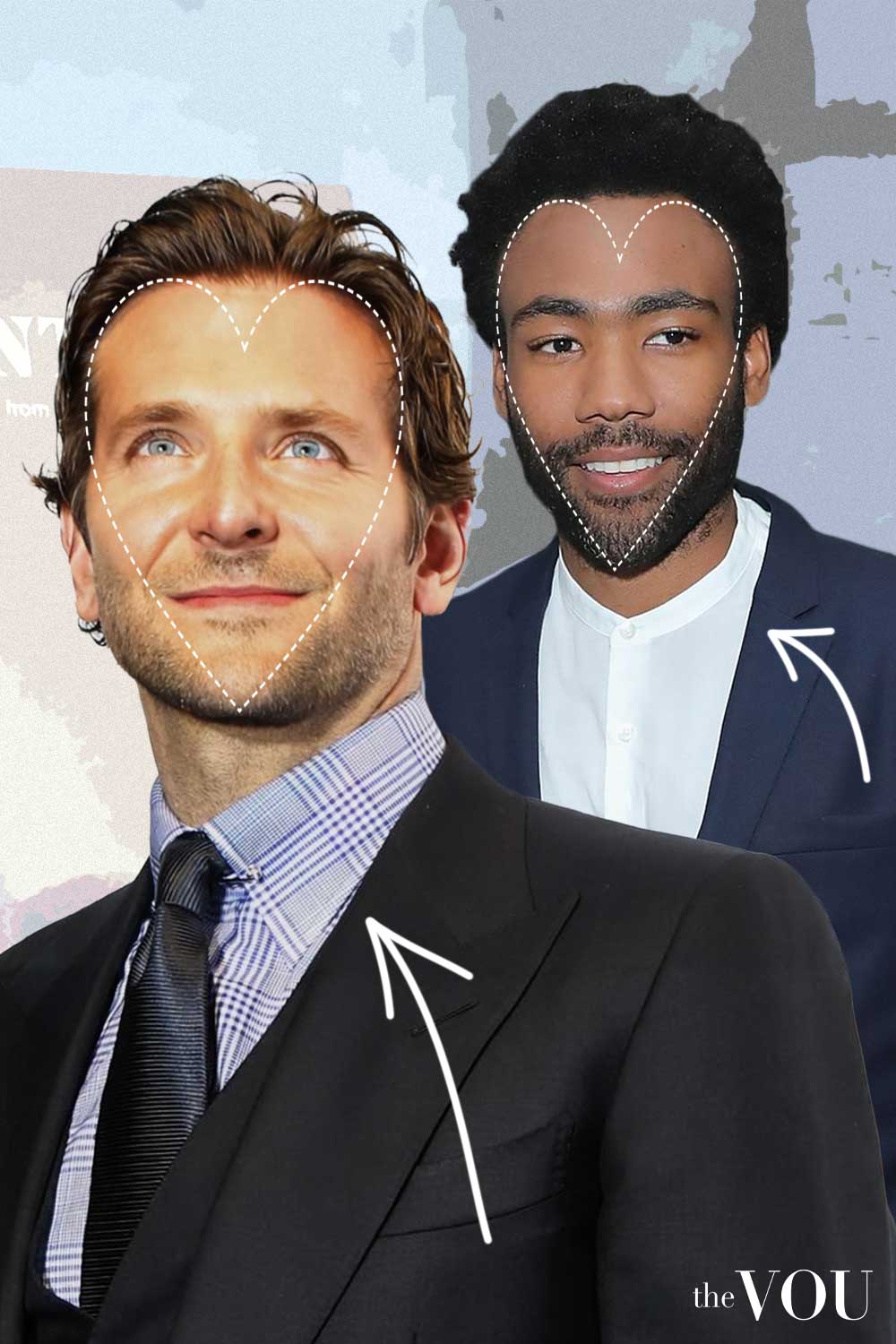
Men with heart face shapes, described here as an upper face reading broader than the jaw with a taper towards the chin, are usually offered collars that make no strong statement in either direction.
The moderate point and semi-spread both leave a middling opening, the button-down adds a soft roll, the band collar is the most neutral of all, and the pin collar holds a narrow opening in place.
Clearance at the front of the collar band is worth checking on the shirt itself, since no face description tells you how close your chin sits to a collar.
Here are the recommended styles.
- Moderate Point Collar
- Button-Down Collar
- Semi-Spread Collar
- Band Collar
- Pin Collar
Read more about the best collar styles for men with Heart face shape.
Diamond Face Shape

Men with diamond face shapes, described here as a cheekbone region reading clearly broader than both the forehead and the jaw, are usually offered a shortlist led by the wider collars.
The spread, semi-spread and cutaway give a progressively broader line at the throat, the button-down covers casual wear, and the club collar is on the list for its distinctive shape rather than for width.
A collar creates no width at the forehead or the chin, and a narrower collar that lets prominent cheekbones lead is a perfectly reasonable alternative.
The collars recommended for a diamond face are listed below.
- Spread Collar
- Semi-Spread Collar
- Cutaway Collar
- Button-Down Collar
- Club Collar
Read more about the best collar styles for men with Diamond face shape.
Oblong Face Shape

Men with oblong faces, described here as a clearly elongated outline with softer rounded corners, get an overlapping shortlist with the rectangular description. Four collars are shared, and this list adds the semi-spread where the rectangular list has the moderate button-down.
Cutaway, semi-spread and wide spread collars give different point directions below the jaw. Worn open, they can expose different amounts of throat; buttoned, compare the shirt and tie around the knot. Club and band collars offer other outlines to try.
The split between oblong and rectangular is our editorial convention based on the jaw corners rather than an anatomical boundary, and several other systems combine the two, so read both guides.
Recommended styles for an oblong face include the following.
- Cutaway Collar
- Semi-Spread Collar
- Wide Spread Collar
- Club Collar
- Band Collar
Read more about the best collar styles for men with Oblong face shape.
Pear Face Shape

Men with pear face shapes, described here as a narrow upper forehead widening through the cheeks to a broader jawline, get the same five collars as the triangle description.
Pear and triangle are two VOU names for one jaw-wide family, separated by how the taper looks, which is our editorial convention rather than a validated distinction, and several other guides treat the two as synonyms.
The collars give a broad line at the throat, and a wider collar under a narrow jacket lapel is one combination worth checking before you buy.
The recommended styles for a pear face are below.
- Cutaway Collar
- Wide Spread Collar
- Club Collar
- Semi-Spread Collar
- Band Collar
Read more about the best collar styles for men with Pear face shape.
Step 3. Understanding Collar Construction and Proportions
Three measurements matter more than the collar’s name. Look at how tall the band is, how wide the opening is, and how the collar is built.
Collar Height

Choose collar band height from the neck coverage you prefer and the clearance you observe on the actual shirt.
A longer neck carries a taller band comfortably, which you may find looks more finished under a jacket, while a shorter neck is happier with a lower band that keeps the cloth clear of the jaw.
Face descriptions are sometimes grouped under taller or lower collars, and this guide does not do that, because the grouping contradicts itself as soon as two men with the same outline have different neck lengths.
The reason is straightforward. Face length and neck length are independent observations, so a long face can sit on a long neck or a short one, and a single band height cannot serve both.
When comparing shirts, one practical note is that makers specify the front and the rear band heights separately, as Proper Cloth’s soft fused English spread does, so a single unlabelled figure cannot be compared between two makers.
Collar Spread and Tie Knots

Spread is the distance between the bottoms of the collar points, and tie space is the distance between the tops of the collar leaves where they meet above the top button, and a maker specifies the two separately rather than deriving one from the other.
Try a Windsor, half-Windsor or four-in-hand according to the actual tie-space specification and your tie’s thickness. Spread and point length do not determine tie space, so the collar name alone cannot settle the knot.
These knots are starting options rather than rules. A smaller knot leaves more shirt visible either side of it, which is a matter of taste, while a knot too large for the tie space forces the points out of shape, which is not.
A thicker tie makes any knot larger, so a four-in-hand in a heavy wool tie can occupy the space a half-Windsor takes in fine silk, which is why the same collar can want different knots on different days.
For a bow tie, check comfortable band fit around the neck separately from appearance. Compare the bow with the collar in a mirror; matching its width to the spread is an optional visual choice.
Collar Structure and Interlining
Interlining is the layer between the outer and inner cloth of the collar, and it is the main reason two collars of the same shape behave differently.
Construction is often presented as a choice between two kinds, fused for crisp and non-fused for soft, and that division is too simple.
Proper Cloth’s account of shirt collar constructions sets out three families instead, namely a stiff fused collar, a soft unfused collar and a soft fused collar, which means whether the interlining is bonded to the cloth does not by itself settle how stiff the finished collar feels.
A stiff fused collar holds a flat, crisp line and shows little roll, which suits a formal shirt worn with a tie and tends to keep its shape through repeated laundering.

Proper Cloth describes its soft non-fused collars as flexible, with lightly supporting sewn interlining. That does not establish a universal roll ranking, because the collar pattern, point length, cloth and interlining work together.

Proper Cloth’s soft fused construction uses a lighter bonded interlining than its stiff fused option. The maker describes a smoother finish than its soft non-fused collars; that is guidance about its own construction, not a general guarantee of greater shape retention.
A button-down’s roll depends on the collar cut, point placement, cloth and interlining together. Compare the actual shirt rather than treating fused or unfused construction as a promise of a particular curve.
Construction is also not assigned by face description, so choose a crisp collar when you want a defined line and a soft one when you want movement, and judge the result on the shirt in front of you rather than from a label.
Step 4. Collar Selection for Different Contexts
Occasion and the jacket you are wearing constrain the collar far more than any face description does, so this section is organised by setting rather than by outline.
Formal Business Settings
For a workplace requiring a suit and tie, try a well-pressed spread, semi-spread or point collar. Check the stated dress code and comfortable knot seating; the knot need not conceal all shirt beside it.
Try spread and point collars under your usual jacket. Compare how their points sit and which framing you like, checking tie space separately from the spread angle.
A cutaway reads as contemporary rather than conservative, so it belongs in offices where that is welcome, and its short, wide-set points may show beyond a narrow lapel, so check it under your own jacket and decide whether you like that.
Any of these suits any of the nine outlines, and the direction you take, echoing your own proportions or contrasting with them, is yours to choose.
Business Casual Environments
The question here is whether the collar still looks deliberate with the top button open, and the button-down answers it well because its fastened points hold their position without a knot behind them.
A semi-spread with some body in the collar often holds up worn open too, a wide cutaway in a soft cloth tends to lose its shape without a knot behind it, and a tab collar is made to fasten behind a knot so it is not intended for open-neck wear.
A band collar shirt is the other reliable choice, since a collar with no points has nothing to sag, and oxford or chambray gives any of these collars the body to stand on its own.
Formal Social Occasions
Evening dress codes carry their own conventions, and the shirt is usually specified more tightly than daywear, so start from what the invitation asks for.
Beyond that, a crisp spread or a cutaway gives a broad line with the knot chosen by the actual tie space, a club collar is the deliberately period choice, and the collar needs enough structure to stay put through a long evening.
None of these is assigned by face description, and choosing between them on the strength of what you enjoy wearing is the honest basis.
Casual Settings
The button-down oxford with a soft or soft fused collar is a flexible casual shirt for many wardrobes, because the roll gives the throat a relaxed line and the fastened points survive a day of movement.
A camp collar lies flat and open with a wide, relaxed spread, which is the casual route to a broad line at the throat, and a band collar shirt removes the collar question altogether.
There is one distinction to be clear about, because the two are often muddled. A point collar and a band collar are different shirts, since a band collar is the band on its own with no points sewn to it.
If you want a narrow line in a casual shirt, choose a soft point collar in a cloth with body, and if you want the clean ring at the base of the neck, choose the band collar, since those are two different shirts.
Industry-Specific Considerations
Conservative offices are often associated with spread and point collars worn with a tie, which is a convention about formality rather than about anyone’s features.
More relaxed workplaces may accept band, club and cutaway collars and open necks more readily, so the constraint there is what the rest of the outfit is doing.
A button-down is an option for a workplace that accepts it, with or without a tie. Follow the actual dress code rather than inferring one from an industry or job title.
Creating a Complete Image
A collar is one decision among several, and the ones next to it matter as much, such as the jacket lapel that covers the points, the knitwear neckline that sits over the collar, your hair, your beard and how much of your throat the whole combination leaves visible.
Check those together rather than in isolation, since a collar that looks right on its own can be swallowed by a crew neck or exposed by a narrow lapel.
A beard changes the jaw outline you see rather than your bone structure, and how you wear it does not by itself tell you your shirt size, so recheck the fit of the shirt you own with the collar buttoned.
Related Questions
Q. Can I wear any collar style regardless of my face shape?
Yes, and this is the plainest answer on the page. No collar is ruled out by any of the nine descriptions, and the shortlists above are our editorial suggestions drawn from the styling sources we assessed.
Proper Cloth’s guide to collars and face shape takes the same position and explicitly allows a round-faced wearer to choose a cutaway, and Art of Manliness calls the visual effect subtle and the rules optional.
A shirt is unsuitable if it closes uncomfortably, its band catches under your jaw or the knot distorts the collar. Check the lapels too; visible shirt beside the knot and visible collar points are appearance choices.
Q. Do stylists agree about which collars suit which faces?
No, and it is worth knowing before you follow any single source, including this one.
The usual advice sends a rounder outline to narrow point collars for a vertical line, while Real Men Real Style’s collar styles guide argues in its own text that a spread collar produces the vertical line instead.
Neither position rests on a measured test, so we record the disagreement rather than settling it, and we put the weight on the fit checks you can verify on your own neck.
Q. How do I match a collar to different types of neckwear?
Coordinate the knot with the tie space rather than with a table of widths, because the tie’s thickness changes the knot’s size and the same collar can take different knots on different days.
A wider tie space gives the Windsor and half-Windsor room, a moderate one suits the half-Windsor, and a narrow one suits the four-in-hand, and these are starting options rather than fixed pairings.
For a bow tie, check neck-band comfort separately from appearance. Compare the bow and collar in the mirror; matching bow width to collar spread is an optional choice.
Q. Does shirt fabric affect which collar I should choose?
Yes, and it matters more than most collar advice admits, because the cloth decides whether a collar can hold its shape.
Oxford, poplin, twill and lighter cloths can behave differently, but fabric name alone does not determine roll or shape retention. Check the collar’s actual pattern and interlining, including how it sits open if you will wear it without a tie.
Read the cloth and the construction together, since a soft cloth with a soft fused collar behaves differently from the same cloth unfused.
Q. How many collar styles should I own?
Fewer than most lists suggest, and chosen by what you actually wear, with a spread or semi-spread for business, a button-down for open-necked wear, and one more for whatever your week demands beyond those two.
A cutaway earns its place if you wear a suit regularly and like a broad line at the throat, a band collar if you wear knitwear over shirts, and a club or pin collar only if you like the look for its own sake.
Buying every shape to cover a face description is the wrong reason, and buying two collars that fit properly beats owning five that pinch.
Q. How do I care for different collar constructions?
Follow the care label on the shirt first, since the maker knows the cloth and the interlining, and treat general advice as secondary to that.
Beyond the label, take removable collar stays out before laundering and put them back when the shirt is clean, dry and ready to wear, hang shirts with the collar unbuttoned and shaped rather than folded, and press the collar from the points inwards to avoid a crease at the fold.
A fused collar can be damaged by heat over time, so keep the iron moderate, and a button-down is usually better lightly pressed than starched flat, since heavy starch can flatten the roll it is bought for.
Take the First Step With The VOU’s Styling Quizzes
Start your style journey with our resources, beginning with our Face Shape Quiz, which points you to the guide written for your outline and to initial styling guidance.
Then, check your colours with our Seasonal Colour Analysis Quiz.
Check your body shape with our Body Shape Quiz, and your personal style with our Fashion Style Quiz.
Styling Consultations
If you would like personal help, you can book a paid consultation.
Our Professional Face Shape Analysis package is a paid consultation; its product page lists what it includes.
Our Complete Image Transformation Package combines the face shape, seasonal colour, body shape and fashion style analyses.
Our styling services for men are paid consultations; the shop page lists what each one includes.