Start here
What’s This About
A vest and a waistcoat are the same tailored garment, with “waistcoat” as the British name and “vest” as the American one, while in Britain a vest also means a sleeveless undershirt.
This guide clears up the names and shows how to wear a waistcoat, such as
Which sleeveless garments are and are not waistcoats
How a waistcoat should fit, and which button to leave undone
Waistcoats with three-piece suits, black tie, white tie and morning dress
Odd waistcoats for smart casual outfits
Wearing a waistcoat without a jacket
and many more!
Fit decides how good a waistcoat looks, so check the length and the armholes before you buy one.
Key Points
01Ask for a waistcoat in Britain and a vest in the US to get the same tailored garment.
02A waistcoat should cover the trouser waistband, which is why braces or side adjusters suit it better than a belt.
03Most single-breasted waistcoats are worn with the bottom button undone.
04Morning dress and white tie require a waistcoat; with a lounge suit or black tie it is optional.
“Vest” and “waistcoat” are two names for the same tailored garment, a sleeveless, close-fitting layer worn over a shirt and often under a jacket.
“Waistcoat” is the usual British word and “vest” the usual American one, and in British English a vest is also a sleeveless undershirt, which is where much of the confusion comes from.
This guide explains the names, how the garment should fit, and how to wear one for formal and casual occasions.
Vest vs waistcoat and what the words mean
Scroll horizontally to see all columns →
| Word | In British English | In American English |
|---|---|---|
| Waistcoat | The tailored sleeveless garment worn over a shirt, alone or with a matching jacket and trousers as a three-piece suit. | Understood, but less common in everyday speech. |
| Vest | A sleeveless undershirt worn next to the skin. | The tailored sleeveless garment, the same as a British waistcoat. |
Merriam-Webster gives “waistcoat” as the chiefly British word for what Americans call a vest.
The other sleeveless garments sometimes called vests are different garments with their own names, such as a knitted sweater vest (a sleeveless jumper or tank top in Britain), a quilted or padded gilet, and a denim or utility vest.
They are casual layers, and none of them replaces a tailored waistcoat where a dress code asks for one.
Where the waistcoat comes from
The waistcoat descends from the long vest that Charles II adopted at the English court in 1666.
Samuel Pepys recorded on 15 October 1666 that “the King begins to put on his vest”, describing it as “a long cassocke close to the body, of black cloth”.
Over the following two centuries the garment became shorter, and by the 19th century the matching jacket, waistcoat and trousers of the three-piece suit had taken shape.
How a waistcoat should fit
A waistcoat should be long enough to cover the trouser waistband, so no shirt shows between the two.
For that reason, trousers that sit at or close to the natural waist suit a waistcoat, and braces or side adjusters are more comfortable under it than a belt.
The front should lie flat without pulling across the buttons, and the armholes should be close enough not to gape but large enough to move freely.
The back is usually a smooth lining fabric with an adjuster strap, so a jacket slides over it easily.
On most single-breasted waistcoats the bottom button is left undone, a convention often credited to Edward VII; some waistcoats are cut with a straight bottom edge and are meant to be fully fastened.
How to wear a waistcoat
With a three-piece suit
A matching waistcoat makes a suit look more formal and gives you a neat outfit even when you take the jacket off.
Wear a grey or navy three-piece wool suit, a light blue shirt with a spread collar, a silk tie tucked under the waistcoat, black leather Oxfords and dark socks.
Our double-breasted suit guide and suit guide cover the rest of the suit.
With morning dress
Morning dress, the formal daytime dress for some weddings and for the Royal Enclosure at Royal Ascot, includes a waistcoat, often grey, buff or another light colour, or matching the coat.
Our morning dress guide covers the full outfit.
With black tie and white tie
With a single-breasted dinner jacket, a low-cut black waistcoat is one traditional way to cover the waist, and a cummerbund is the other; a double-breasted dinner jacket is worn fastened, so it is usually worn without either.
White tie requires a white piqué waistcoat worn under an open black tailcoat.
Our black tie guide and white tie guide explain both dress codes.
An odd waistcoat for smart casual
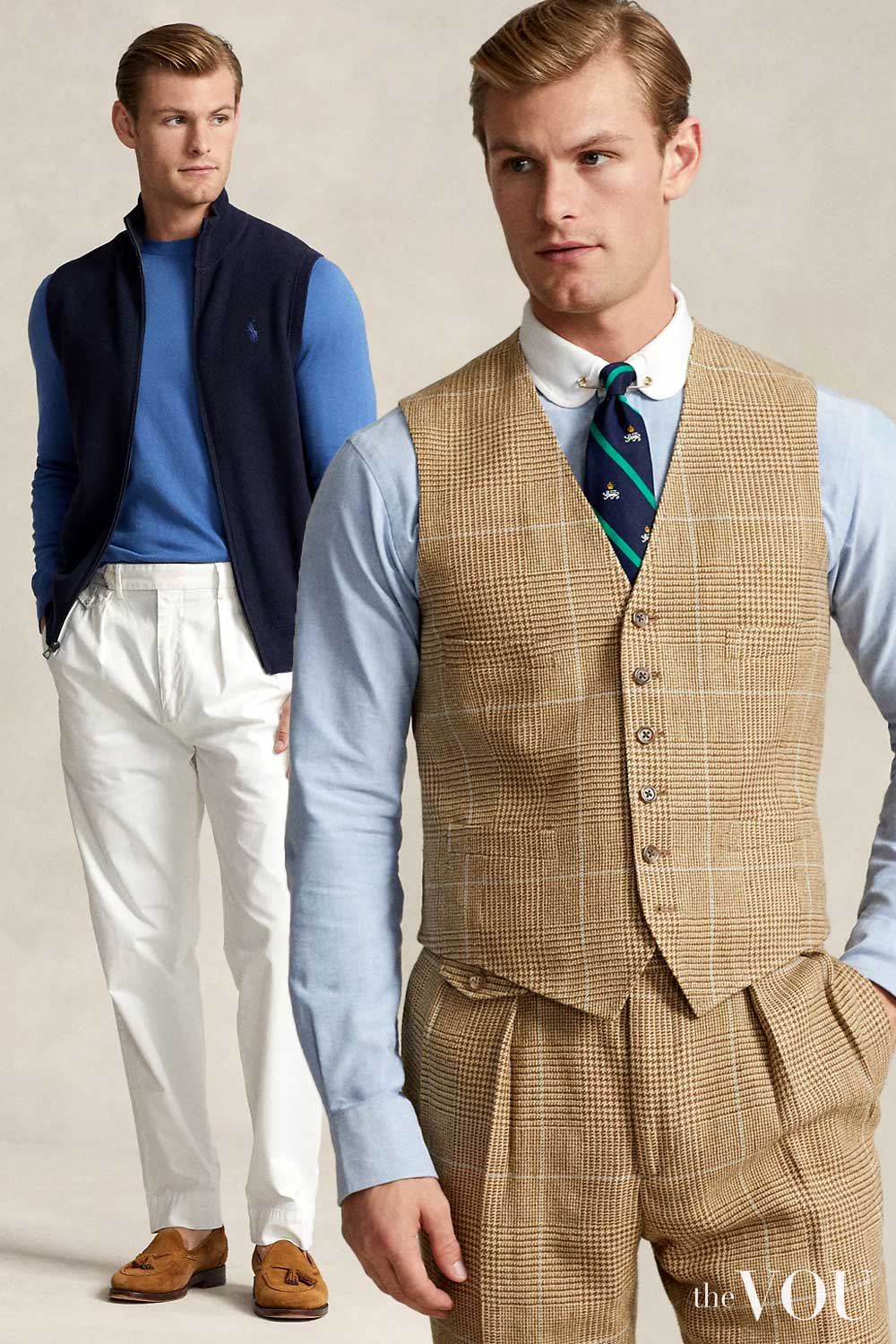
A waistcoat in a cloth that does not match the trousers, such as tweed, flannel, corduroy or linen, gives a relaxed tailored look.
Wear a brown tweed waistcoat, a light blue Oxford shirt, navy flannel or corduroy trousers, a navy or grey jacket and brown suede Chelsea boots.
Without a jacket
A waistcoat worn without a jacket suits warm weather and relaxed events, and a lightweight cloth such as linen or cotton is the most comfortable choice.
Wear a beige or light grey linen waistcoat, a white shirt with the sleeves rolled once, navy linen trousers and tan suede loafers.
Choose a waistcoat that fits closely, because without a jacket the fit is fully on show.
In the country
Tweed waistcoats are a traditional country garment, worn with a tweed jacket or on their own over a checked shirt.
Wear a green or brown tweed waistcoat, a cream or tattersall checked shirt, moleskin or corduroy trousers in olive or brown, and brown leather brogue boots.
Buying a waistcoat
Choose the cloth for how you plan to wear it, with worsted wool to match a suit, tweed or flannel for autumn and winter, and linen or cotton for summer.
Check the length against your own trousers, because a waistcoat that stops above the waistband looks too short.
Look at the buttons, buttonholes and lining seams, which should be firmly sewn, whatever the price or the label.
A tailor can usually adjust the side seams and the back strap, but a waistcoat that is too short is hard to fix.
Waistcoat dos and don’ts
Scroll horizontally to see all columns →
| Do | Don’t |
|---|---|
| Make sure the waistcoat covers your trouser waistband. | Let shirt fabric show between the waistcoat and your trousers. |
| Leave the bottom button undone on most single-breasted waistcoats. | Wear a belt buckle that pushes out under the waistcoat if braces or side adjusters are an option. |
| Tuck your tie under the waistcoat. | Wear a knitted sweater vest where a dress code asks for a waistcoat. |
| Match the cloth to the season. | Wear a heavy tweed waistcoat without a jacket on a hot day. |
Conclusion
The vest and the waistcoat are the same garment with British and American names, so the useful choices are the cloth, the fit and the occasion.
Wear one with a three-piece suit, with morning dress or white tie, or on its own with odd trousers, and make sure it covers your waistband.