
Start here
What’s This About
T-shirts work very well on a slim or narrow build, and getting the shoulder seam, body width and length right matters more than any brand or colour.
This guide covers how to choose and style T-shirts for a slim build, such as
fit checks for the shoulder, chest, sleeve and hem
cotton weight and how it hangs
crew necks, V-necks and other necklines
stripes, colours and layering jackets
and many more!
A slim build is not a problem to correct, so each suggestion is an option for the look you want.
Key Points
01Start with fit, which means a shoulder seam near your shoulder point, a body that skims without clinging and sleeves that sit around mid-bicep.
02A mid-weight cotton usually holds its shape better than a very thin one, but judge the drape rather than a number.
03Crew necks and shallow to medium V-necks both work; a very deep V or wide scoop is a stronger look rather than a mistake.
04Stripes and colours have no guaranteed widening or slimming effect, so pick by preference and compare in a mirror.
If you have a slim or narrow build and wonder whether T-shirts can work for you, the answer is yes; a well-fitting T-shirt is one of the easiest garments to wear on a slim frame.
A slim build is not a problem to correct.
What helps is knowing what to look for in fit, cloth and neckline, and deciding whether you want a T-shirt to add a little visual presence or simply to look clean and neat.
Body-shape guides at The VOU use seven names. Triangle, Inverted Triangle, Rectangle, Trapezoid and Hourglass follow familiar styling usage; Oval and Diamond are described in The VOU’s own words.
A slim build can sit within several of them, so this guide is about build rather than one shape.
Start with Fit, Whether Slim, Regular or Oversized
Fit comes first.
A good everyday fit has the shoulder seam close to your shoulder point, a body that skims your chest and stomach without clinging or pulling, sleeves that end around mid-bicep and a hem that covers your waistband when you raise your arms.
A very tight T-shirt shows every contour, and a very large one can hang away from a slim frame and make the fit look borrowed.
Many slim men prefer a slim or regular cut that follows the body without pressing on it.
Oversized T-shirts are a deliberate silhouette rather than a fitting error.
If you like that look, choose one designed to be oversized, with a dropped shoulder and a length that still sits in proportion to your legs, rather than simply buying a size up.
A slight taper from chest to waist suits many slim builds, as long as the T-shirt still lets you move freely.
Pick Mid-Weight Cotton Over Lightweight or Heavy Fabrics
Very thin jersey tends to cling and show what is underneath, while very heavy cotton stands away from the body and can look boxy on a slim frame.
A mid-weight cotton that holds its shape through the day is the usual compromise.
Some makers state weight in grams per square metre (GSM), but they do not all measure or describe it the same way, so use the number as a rough guide and judge how the T-shirt hangs when you try it on.
Sunspel and James Perse are two makers whose cotton T-shirts are worth comparing for weight and drape.
Crew Necks, V-Necks and Scoop Necks
A crew neck sits close around the base of the neck.
Its rounded edge runs across the top of the chest, which is why many guides suggest it for a slim build; it is also the most versatile neckline under a jacket or overshirt.
A shallow to medium V-neck works on a slim build too, and is a common choice if you want a little more open space below the face.
A very deep V or a wide scoop shows more chest; whether you like that is a matter of style rather than a rule.
Whichever neckline you choose, check that the neckband lies flat and has not stretched; a collapsed neckband is more noticeable than the neckline shape.
A.P.C. and Acne Studios both sell crew-neck T-shirts if you want to compare cuts.
Horizontal and Vertical Stripes
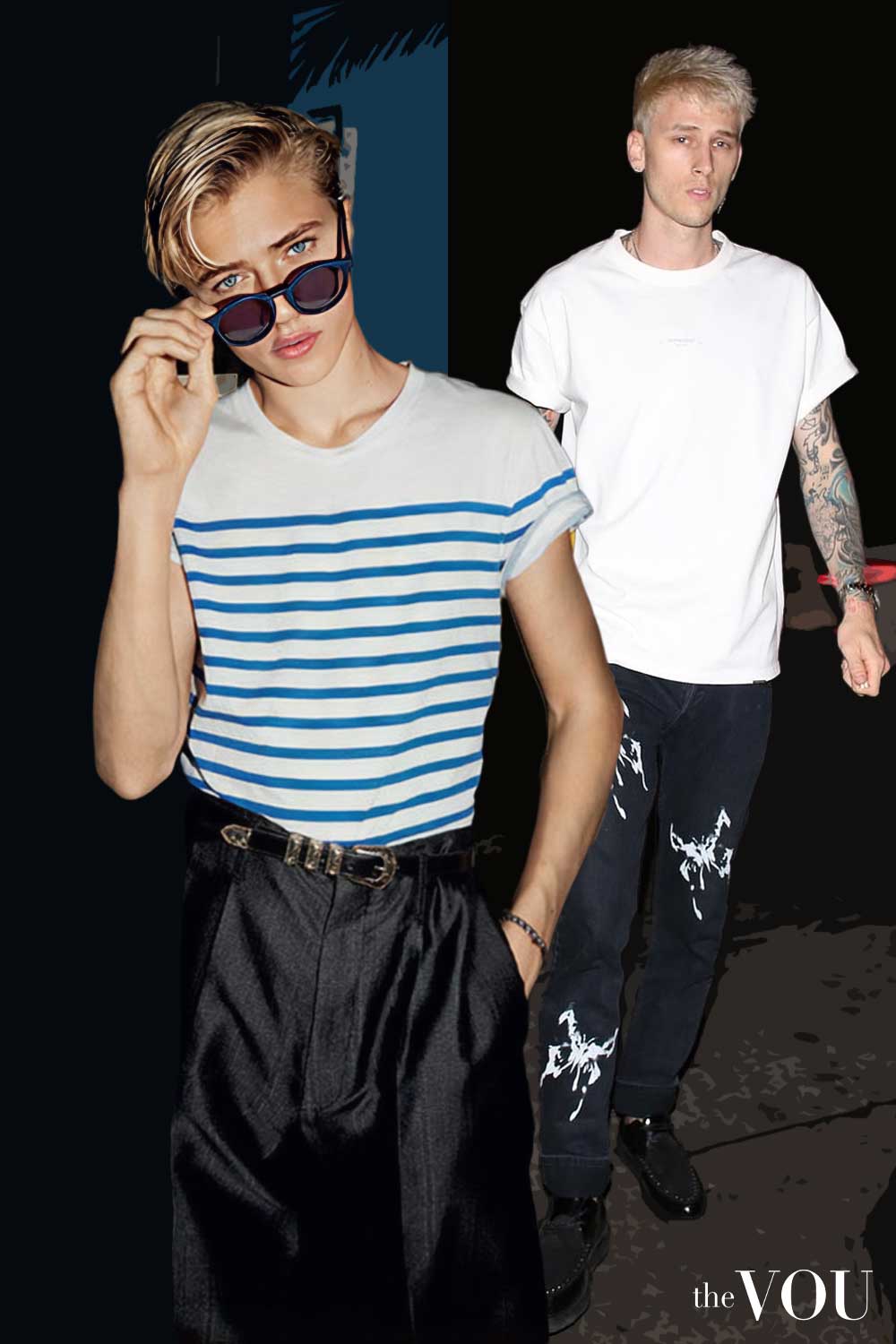
Style guides often say horizontal stripes add width and vertical stripes make you look slimmer.
Studies of stripes have found effects in both directions, and none settles a rule. One research paper is titled “horizontal stripes won’t make you look fatter”, and a 2021 study using photographs of a woman in a striped dress found horizontal stripes looked slightly thinner than plain cloth, so the effect on a man’s T-shirt is not settled either way.
So choose stripes because you like them.
A Breton stripe T-shirt, such as the classic versions from Saint James, is a casual favourite on any build; vertical stripes are just as wearable if you prefer them.
If you want to see the difference for yourself, try a striped and a plain T-shirt in the same size in front of a mirror.
Layer with Light Jackets Rather Than Wearing T-Shirts Alone
Create depth and structure by layering T-shirts under lightweight jackets or overshirts.
In smart-casual or semi-formal settings, a T-shirt usually needs a jacket over it; on its own it reads as casual wear.
A well-fitting denim jacket from Levi’s or a light bomber from A.P.C. adds a layer of structure around the shoulders and chest, which many slim men like; an unstructured blazer over a plain T-shirt does the same for smarter occasions.
Set-In Shoulder Seams or Dropped Shoulders
On a classic T-shirt, the shoulder seam should sit close to your natural shoulder point.
A seam that slips well down your arm on a T-shirt not designed that way is usually a sign the size is too large.
A dropped shoulder, cut deliberately so the seam sits lower on the arm, is a different silhouette, relaxed and softer at the shoulder.
If you want your shoulder line to look as defined as possible, a set-in seam at your shoulder point does that more directly; if you like the relaxed look, a dropped shoulder is a valid choice.
Sunspel and Asket both sell plain T-shirts, so you can compare where the shoulder seam lands on you.
Light, Mid and Dark Colours
Advice on colour for slim men points both ways.
Some guides suggest lighter colours to add visual presence; others suggest mid to dark tones because very pale colours can look washed out.
In a 2021 study using photographs of a woman in a dress, darker versions looked slightly thinner than lighter ones, but that does not mean light colours will make a slim man look broader.
In practice, how a colour sits against your skin, hair and eyes often matters more than its effect on your outline; The VOU’s seasonal colour guides cover that question.
If you want a T-shirt to draw a little attention to your upper body, a lighter or mid tone above darker trousers is the usual suggestion, and a dark T-shirt is equally wearable.
White, light grey, pale blue, navy and charcoal are easy starting points; Handvaerk and Uniqlo U both offer plain T-shirts in these colours.
The Final Word on T-Shirts for Slim Builds
Wearing T-shirts well with a slim build comes down to a few checks rather than avoiding T-shirts altogether.
Focus on fit first, meaning the shoulder seam, the body width, the sleeve and the length.
Then choose a cotton that hangs the way you like, and a neckline, pattern and colour that suit your style.
None of these choices will change your build, and none needs to.
A small set of well-fitting T-shirts in colours you enjoy wearing is a sound base for a casual wardrobe.
Style Like a True Gentleman
Before we say goodbye, fit does most of the work, whether or not you ever work with image consultants.
Professional styling starts with getting the fit right and choosing clothes that suit the occasion; knowing your body shape and seasonal colour palette can make the choosing quicker.
Our guides also cover styling by occasion, location, season and time of day, garments, footwear, accessories and heritage fashion brands.
Take our three quizzes, then book a consultation if you would like personal help.
1. Find Your Body Shape
Different garments suit different silhouettes.
To compare your outline with the seven body shape descriptions, take our body shape quiz for men.
2. Find Your Seasonal Colours
The garments in your outfits come in many colours.
To see which seasonal colour palette may suit you, take our seasonal colour quiz for men.
3. Find Your Fashion Style
To explore your personal fashion style, take our fashion style quiz for men; it suggests styles, outfit ideas and brands to explore.
Book a Consultation with The VOU
For personal help, you can book paid consultations with our image consultants and fashion stylists.
Our styling services for men page lists the paid consultations.
Wearing luxury brands is not enough on its own; how your clothes fit and suit the occasion matters more, and our personal style guide covers the rest.
For more on labels, see our guide to logo-heavy luxury brands and how to wear them.
Contact us if you would like to book a consultation.