

Start here
What’s This About
The main dress shoes are the Oxford, Derby, monk strap, brogue, loafer and wholecut, and the right choice depends on the dress code and the fit.
This guide explains how to choose and wear dress shoes, such as
The difference between Oxfords and Derbies
What a Goodyear welt is and why it allows resoling
How formal each dress shoe type is
Outfit ideas for black tie, business casual and summer weddings
The five pairs to buy first
and many more!
Buy for the occasions you actually dress for, choose shoes that fit, and look after them so they last.
Key Points
01Oxfords have closed lacing and are the most formal lace-up shoe, while Derbies have open lacing and are more versatile.
02Goodyear-welted shoes can be resoled many times, which is why they are often a long-term buy.
03Black Oxfords and dark brown Derbies cover most occasions for a first collection.
04Comfort and fit matter as much as the design; never accept shoes that pinch in the shop.
Dress shoes are the leather shoes you wear with tailoring, from a dinner suit to a blazer and chinos.
Choosing them well comes down to three questions, which are how formal the shoe is, whether it fits, and whether it suits the clothes you actually wear.
This guide explains the main types of dress shoe, how formal each one is, how to wear them, and which pairs to buy first if you are building a small collection.
What are dress shoes?
Dress shoes are leather shoes made to be worn with suits, tailored trousers and formal or smart casual outfits.
Most have a slim leather or thin rubber sole, a low heel and a smooth or lightly textured upper.
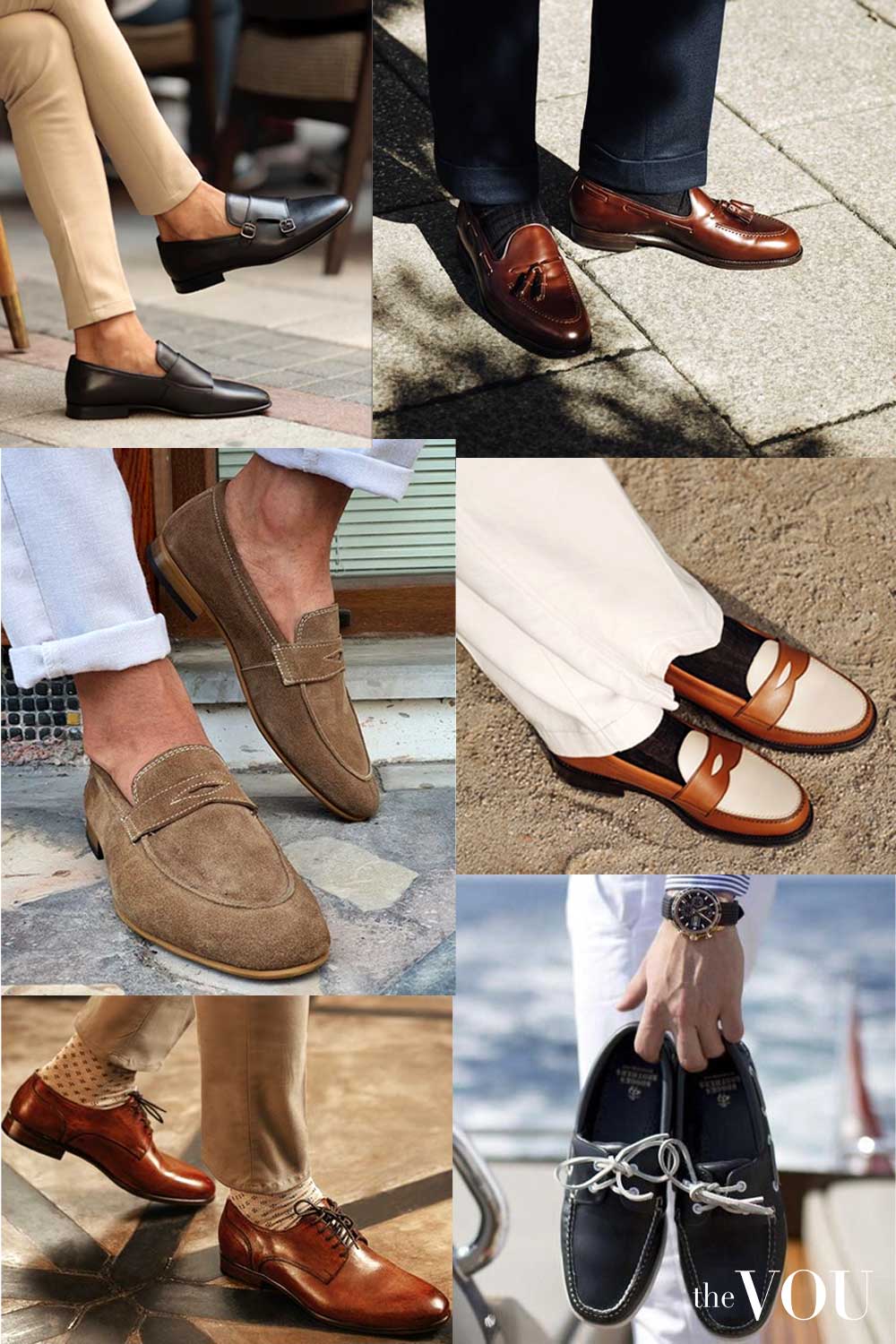
Good dress shoes are usually made of calf leather or suede, with a sole that is stitched rather than only glued.
Comfort and good looks are not a trade-off in a well-fitted pair, so fit matters as much as the design.
The Goodyear welt and how dress shoes are made
Many traditional dress shoes are Goodyear-welted.
A strip of leather, the welt, is stitched to the upper and the insole, and the outsole is then stitched to the welt, with a layer of cork filling the space underneath.
The method is named after Charles Goodyear Jr, who invented the machinery that made it practical.
Because the welt sits between the upper and the sole, a cobbler can replace a worn sole without damaging the upper, so a welted shoe can be resoled many times.
Blake-stitched shoes, common in Italy, have the sole stitched directly to the upper, which makes them lighter and more flexible, and they can also be resoled by a specialist.
Shoes with glued soles are usually cheaper and lighter, but they are harder to repair.
Dress shoe types at a glance
The table below compares the main dress shoe types by their key features and how formal they are, with a less formal alternative for each.
Scroll horizontally to see all columns →
| Dress shoe | Key features | Formality | Less formal alternative |
|---|---|---|---|
| Oxford | Closed lacing, sleek shape | Highest | Derby |
| Wholecut | Upper cut from a single panel of leather | Highest | Plain or cap-toe Oxford |
| Derby | Open lacing, slightly roomier | High to medium | Suede Derby or chukka boot |
| Monk strap | Buckle closure, no laces | High to medium | Loafer |
| Brogue | Decorative perforations | Medium to high | Suede brogue |
| Loafer | Slip-on, no laces | Medium | Driving loafer |
Brogueing is a decoration rather than a shoe of its own, so a brogue can be an Oxford or a Derby; the more perforations, the more casual it looks.
Why the right dress shoes help
Shoes finish an outfit, so a clean, polished pair that suits the dress code makes the rest of your clothes look more considered.
Workplaces and events often have dress codes, and knowing which shoe each one expects saves you from guessing on the day.
Shoes that fit well are more comfortable to wear for a long day, which makes it easier to stand, walk and stop thinking about your feet.
A small collection of well-chosen pairs covers most occasions, from business formal to weekends.
Welted shoes that are looked after and resoled can last for many years, though price on its own does not tell you how well a shoe is made.
Oxford shoes
Scroll horizontally to see all columns →
| Key features | Best for | Formality |
|---|---|---|
| Closed lacing, sleek shape | Formal events, business formal attire | Highest |
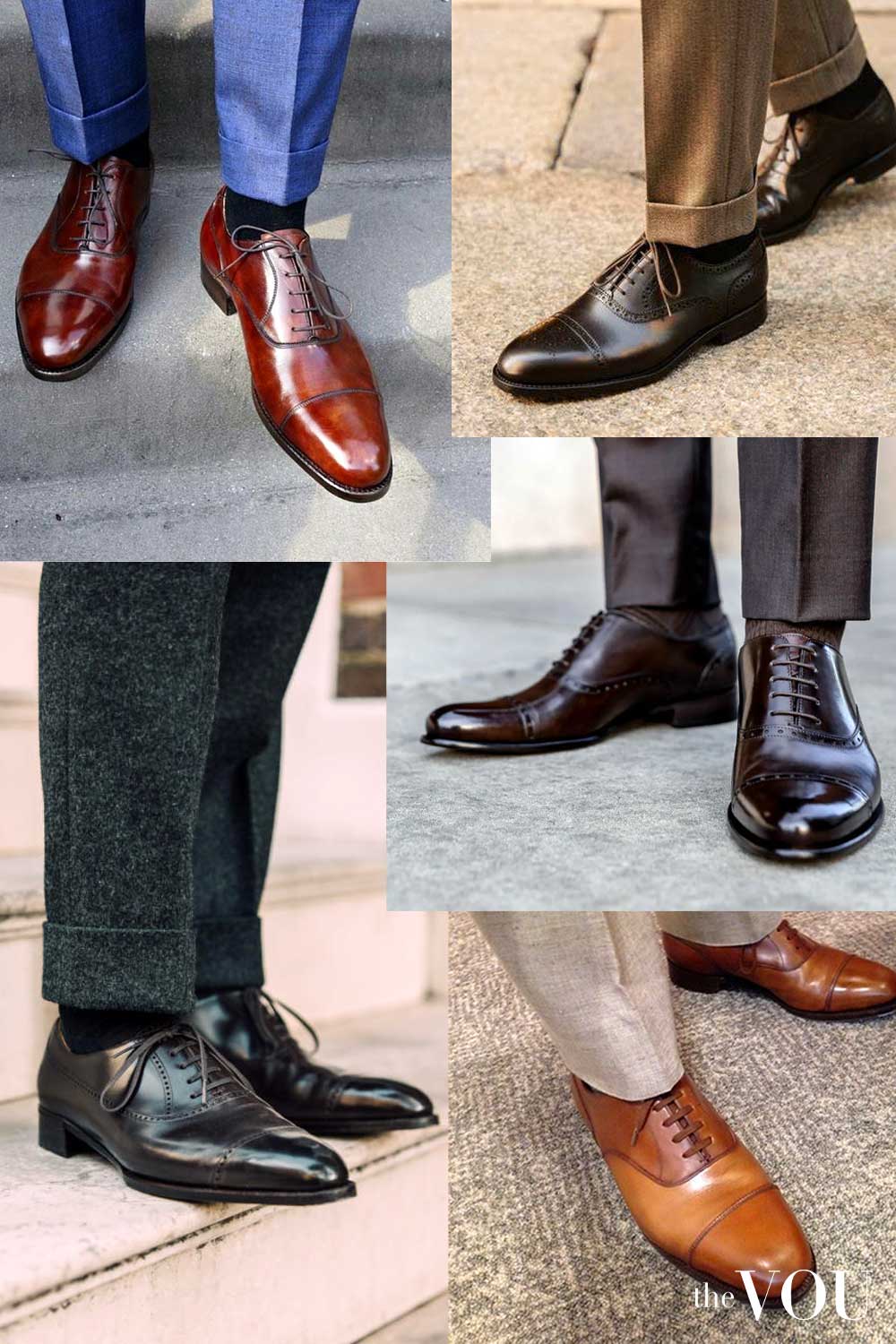
An Oxford has closed lacing, which means the vamp, the front of the shoe, is stitched over the two side panels that carry the eyelets, so the eyelet tabs sit under the vamp and close neatly when laced.
That clean, close shape is why Oxfords are the standard shoe with a dark suit and with black tie.
Our guide to Oxford shoes explains the main Oxford types and how to wear each one.
Oxfords for a formal look
For a black tie charity dinner, start with black Oxfords in highly polished calf leather or patent leather.

Wear them with a black or midnight blue dinner suit with peak or shawl lapels.
The trousers should have little or no break, just touching the top of the shoes.
Choose a white dress shirt with a pleated or marcella bib front and double cuffs.
Finish with plain cufflinks, a black silk bow tie and a white linen pocket square.
Derby shoes
Scroll horizontally to see all columns →
| Key features | Best for | Formality |
|---|---|---|
| Open lacing, slightly more relaxed look | Business casual, smart casual events | High to medium |
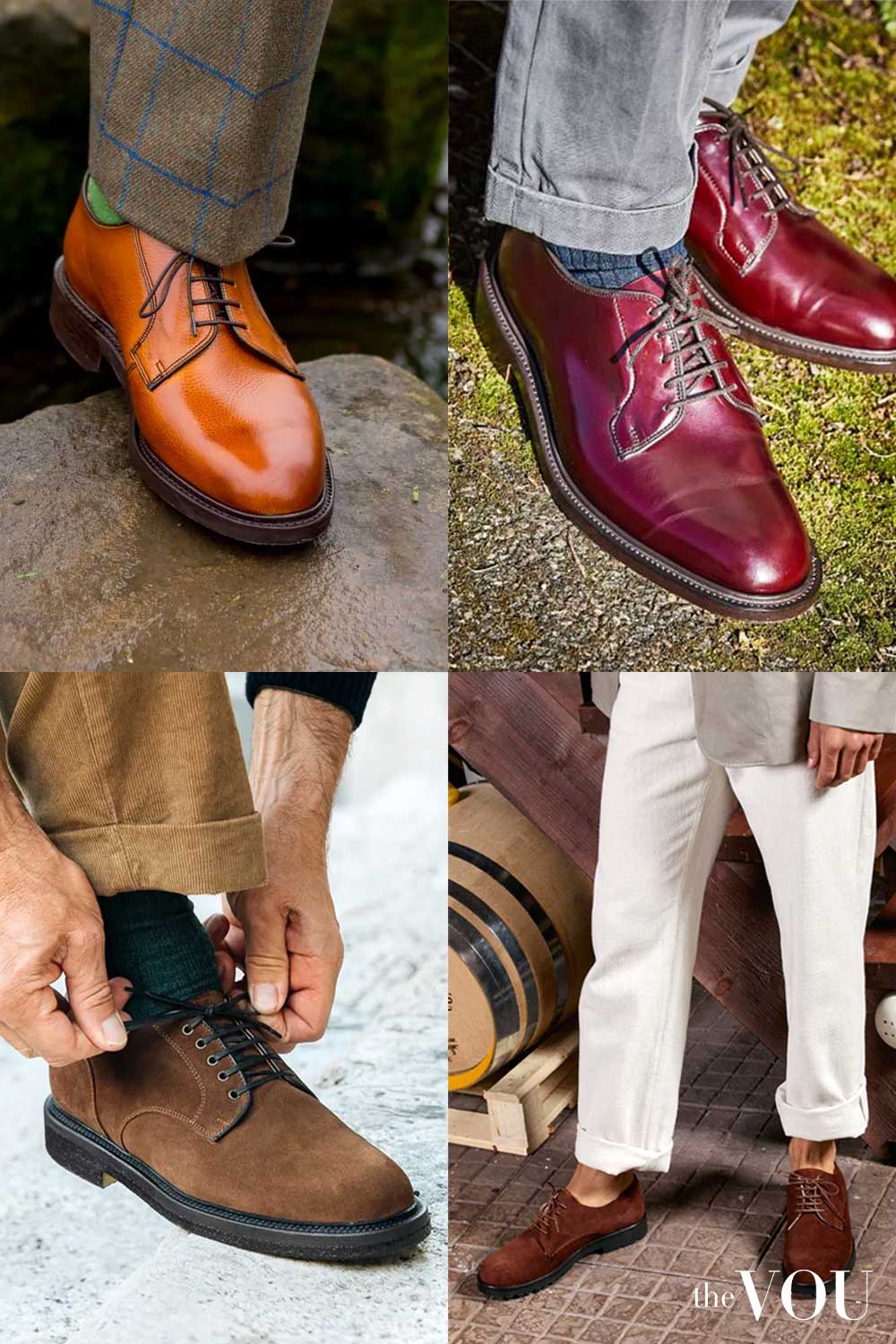
A Derby has open lacing, meaning the side panels carrying the eyelets are stitched on top of the vamp, so the two flaps can open wider.
That makes a Derby easier to fit over a high instep and gives it a slightly more relaxed look than an Oxford.
In the US, a Derby is often called a Blucher; strictly, a Blucher has small eyelet tabs sewn onto a vamp cut as a single panel, but the two names are widely used for the same open-laced shoe.
A plain black Derby can be worn with a suit, and a brown Derby suits business casual and smart casual settings.
Derbies for a business casual look
For a client lunch where you want to look smart but approachable, start with dark brown Derbies in smooth or burnished leather.
Wear them with navy chinos or wool trousers, with a short break or a neat hem.
Add a light blue Oxford cloth button-down shirt with the top button undone.
Layer an unstructured oatmeal blazer on top.
Finish with a brown leather belt close in tone to the shoes and a muted paisley pocket square.
Monk strap shoes
Scroll horizontally to see all columns →
| Key features | Best for | Formality |
|---|---|---|
| No laces, buckle closure | Business attire, smart casual and social events | High to medium |
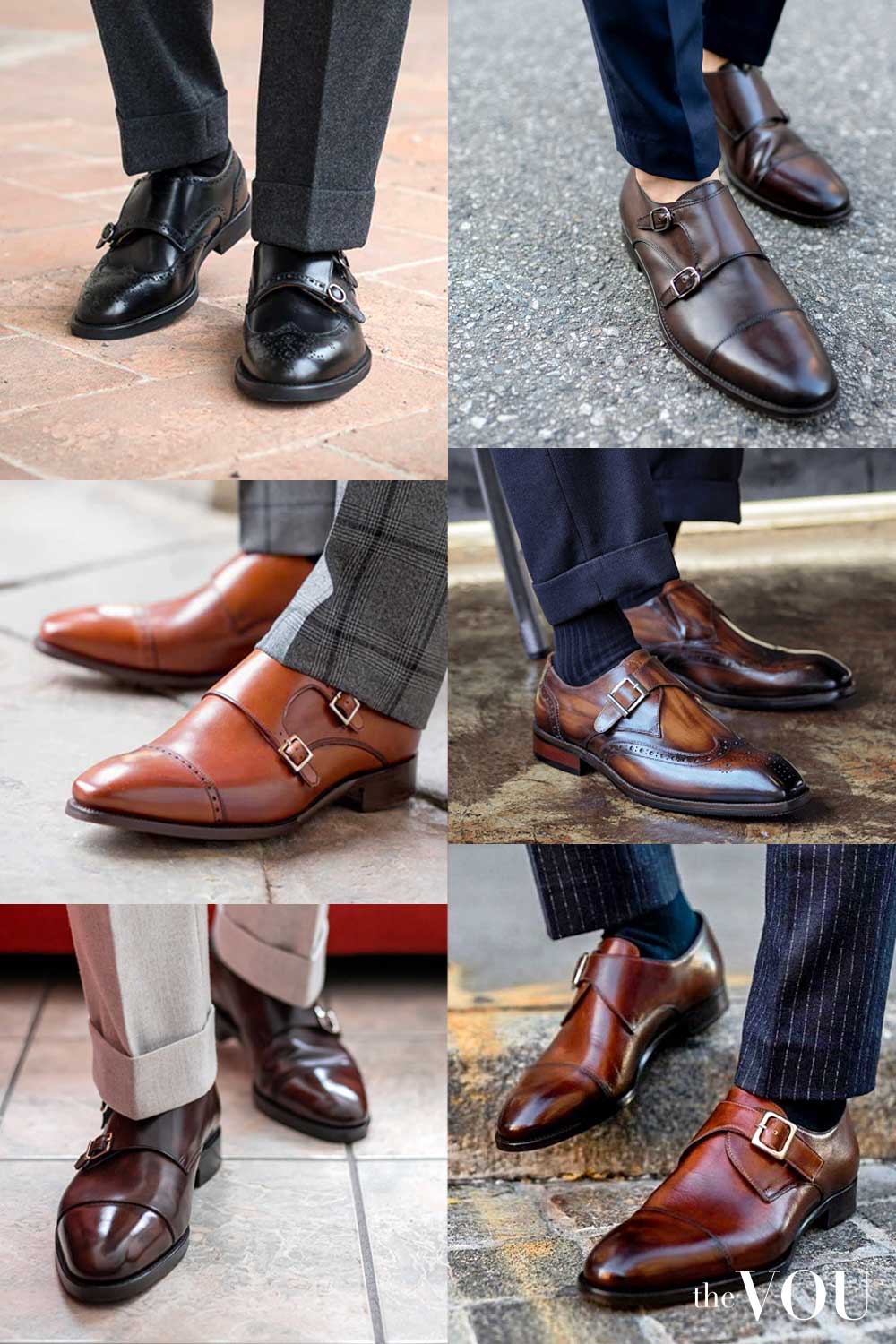
Monk strap shoes close with one or two buckled straps instead of laces.
A black or dark brown single monk with a plain toe is close to an Oxford in formality, while a double monk or a lighter colour looks more relaxed.
Monk straps for a creative look
For a gallery opening, start with burgundy double monk strap shoes in polished leather.
Wear them with charcoal wool trousers with a tapered leg.
Add a white dress shirt and a charcoal waistcoat that matches the trousers.
Layer a softly structured forest green blazer on top.
Skip the tie, add a silk pocket square in burgundy and green, and wear a small vintage-inspired lapel pin if you like.
Brogue shoes

Scroll horizontally to see all columns →
| Key features | Best for | Formality |
|---|---|---|
| Decorative perforations, Oxford or Derby lacing | Business casual, smart casual events, weekends | Medium to high |
Brogues are shoes decorated with rows of small perforations, called brogueing, along the seams and often on the toe.
Their roots are usually traced to country shoes from Scotland and Ireland, which is one reason brogues still look at home with tweed and flannel.
A quarter brogue has perforations only along the toe cap, a semi-brogue adds a pattern on the toe, and a full brogue, or wingtip, has a toe cap shaped like a W that runs along the sides.
Brogues for a smart casual look
For a weekend garden party, start with tan suede wingtip brogues.
Wear them with sage green chinos, hemmed to show a little sock.
Add a white poplin shirt under a cream cable-knit jumper.
Layer a navy wool and linen blazer on top.
Finish with a woven leather belt and a small floral pocket square.
Loafers
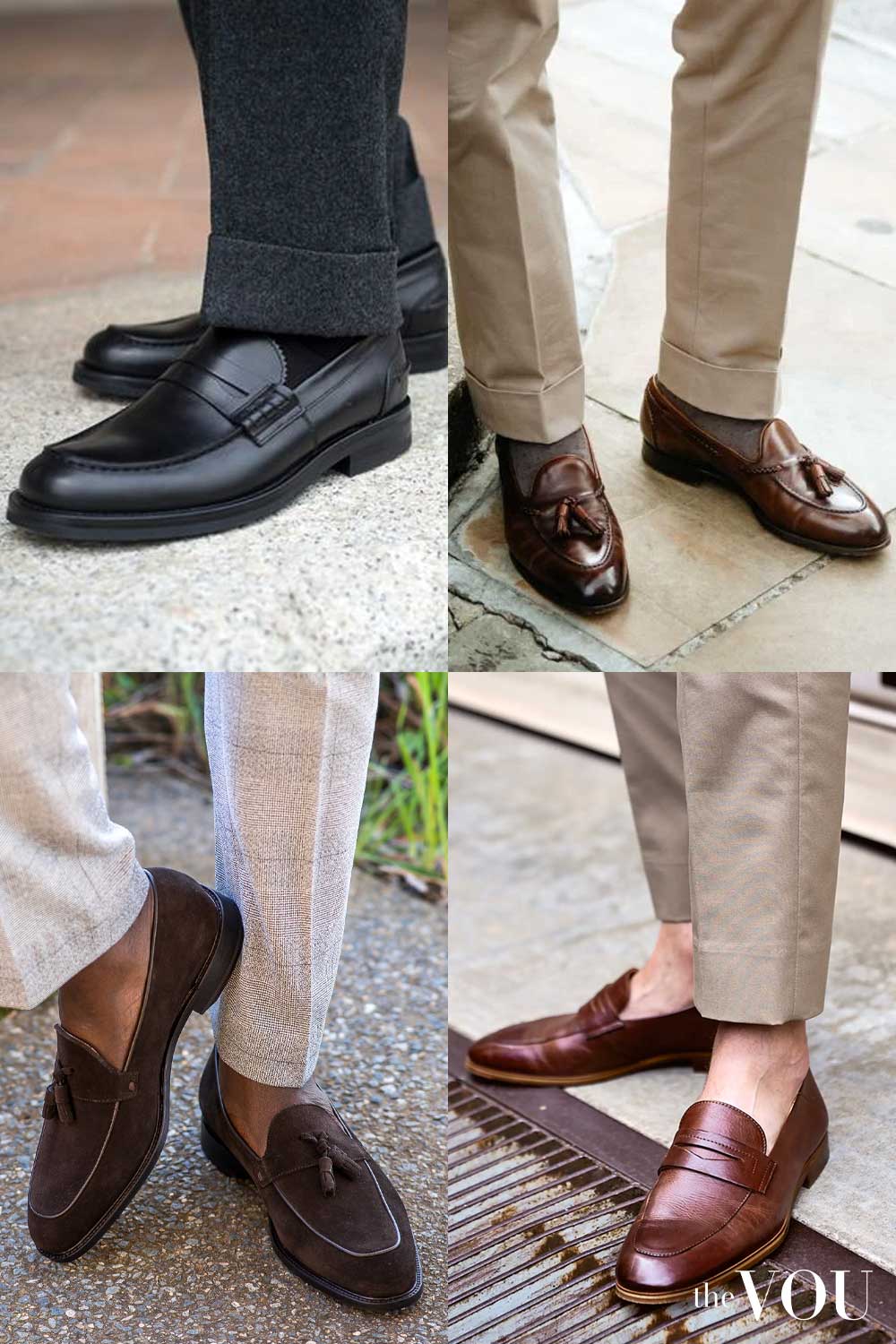
Scroll horizontally to see all columns →
| Key features | Best for | Formality |
|---|---|---|
| Slip-on, no laces, often with a strap, tassels or a metal bit | Business casual, smart casual events, summer suits | Medium |
Loafers are low-cut slip-on shoes with no laces.
Penny, tassel and horsebit loafers are the most common dress styles, and our guide to loafer types explains each one.
Loafers for a summer suit
For a summer wedding with a smart, daytime dress code (not black tie), start with burgundy or dark brown penny loafers in polished leather.
Wear them with a light grey tropical wool suit, with the trousers hemmed to show a little ankle.
Add a pale pink or white shirt.
Choose a light silk tie if the invitation suggests one, or a silk pocket square in burgundy, pink and grey if ties are optional.
Check the invitation first, because a formal or black tie wedding calls for Oxfords instead.
Wholecut shoes
Scroll horizontally to see all columns →
| Key features | Best for | Formality |
|---|---|---|
| Upper cut from a single panel of leather, with only a seam at the heel | Formal events, business formal, evening wear | Highest |
A wholecut has an upper cut from a single panel of leather, so the only visible seam is usually at the back of the heel.
The plain surface shows off the leather and the shape of the last, which makes a wholecut look very sleek and formal.
Wholecuts for a business formal look
For an important board meeting, start with black wholecut shoes polished to a high shine.
Wear them with a charcoal grey three-piece worsted wool suit.
Add a white dress shirt with a spread collar.
Choose a deep burgundy silk tie with a subtle herringbone pattern and a white linen pocket square folded square.
British, Italian and American dress shoes
Shoes from different countries often follow different traditions, though every maker varies.
In Britain, Northampton makers such as Church’s, founded in 1873, are known for Goodyear-welted shoes with rounded toes and sturdy soles, and John Lobb has made bespoke shoes in London since the nineteenth century.
In Italy, many makers favour sleeker shapes, longer toes and lighter construction, often Blake-stitched.
American makers such as Allen Edmonds, founded in Wisconsin in 1922, often sit between the two, with roomier fits and welted soles.
Essential dress shoes to start a collection
You do not need many pairs to cover most occasions; start with the shoes that match the clothes and dress codes you meet most often.
Scroll horizontally to see all columns →
| Shoe type | Colour | Why start here | Occasions |
|---|---|---|---|
| Oxford | Black | Covers the most formal dress codes | Formal events, business formal, interviews |
| Derby | Dark brown | Works with suits and with chinos | Business casual, smart casual |
| Brogue | Tan or mid-brown | Adds texture for less formal outfits | Smart casual, weekends |
| Loafer | Burgundy or dark brown | Easy slip-on for warm weather and casual offices | Business casual, summer events |
| Monk strap | Brown | A laceless alternative to the Derby | Business casual, social events |
Black Oxfords
Black Oxfords are the safest first pair if you wear suits or attend formal events, because they suit interviews, funerals, weddings and black tie.
Choose a plain or cap-toe design with little decoration so they work across all of those occasions.
Dark brown Derbies
Dark brown Derbies cover the widest range of everyday outfits.
They are smart enough for most business settings and relaxed enough for chinos and a jumper.
Tan brogues
Tan or mid-brown brogues add texture and colour to smart casual outfits, especially in spring and summer.
They go well with navy and mid-grey suits worn in a relaxed way, and with chinos.
Burgundy loafers
Burgundy loafers are comfortable for warm weather and casual offices.
They suit chinos and a blazer, and they also work with dark jeans; our guide to dress shoes with jeans shows how.
Brown monk straps
Brown monk straps are a laceless alternative to the Derby for business casual and social events.
Single and double strap versions are both easy to wear; the double strap is a little more noticeable.
Later additions
Once the basics are covered, you might add
Patent leather Oxfords for black tie, or velvet slippers for relaxed black tie evenings, especially at home
Suede loafers for summer weekends
Wholecuts for formal business settings
Two-tone spectator shoes for a vintage-inspired summer look
Dress shoe do’s and don’ts
Scroll horizontally to see all columns →
| Do | Don’t |
|---|---|
| Wear a belt close in colour to your shoes | Wear thick athletic socks with dress shoes |
| Hem trousers so they sit neatly on the shoe | Leave shoes scuffed or unpolished |
| Rotate your shoes and use cedar shoe trees | Wear the same leather pair every day |
| Choose the shoe for the dress code | Ignore the dress code on the invitation |
| Buy for fit and construction, not price alone | Accept shoes that pinch in the shop |
| Check laces, heels and soles regularly | Wear patent evening shoes with casual clothes |
| Choose materials for the season | Wear formal Oxfords with shorts or sportswear |
Wear a belt close in colour to your shoes
A belt in the same colour family as your shoes makes an outfit look consistent.
The match does not need to be exact. A dark brown belt with dark brown shoes or a black belt with black shoes is enough.
Hem trousers to the right length
The break is the fold where your trouser leg meets the shoe.
A slight break or no break keeps a clean line and shows the shoe, while a deep break bunches fabric over it; which you choose is a matter of taste, as long as the hem sits neatly.
Rotate your shoes
Leather absorbs moisture from your feet, so giving a pair a day’s rest with cedar shoe trees helps it dry and keep its shape.
Having two or three pairs you can alternate makes each one last longer.
Wear dress socks
Thick athletic socks look bulky with slim leather shoes.
Thin wool or cotton socks that match your trousers continue the line of the leg, and a subtle pattern is fine with less formal outfits.
Final thoughts
Start with the dress codes you meet most often, buy shoes that fit, and look after them so they last.
A black Oxford and a dark brown Derby cover most needs, and loafers, brogues and monk straps add variety as your wardrobe grows.
Sources
Tricker’s, Goodyear welting (construction, resoling, Charles Goodyear Jr).
E.J. Daniels, The Derby Shoe and Blucher Guide, Gentleman’s Gazette, 2014, updated 2023 (Oxford, Derby and Blucher lacing).
Church’s, Wikipedia (founded 1873, Northampton).