
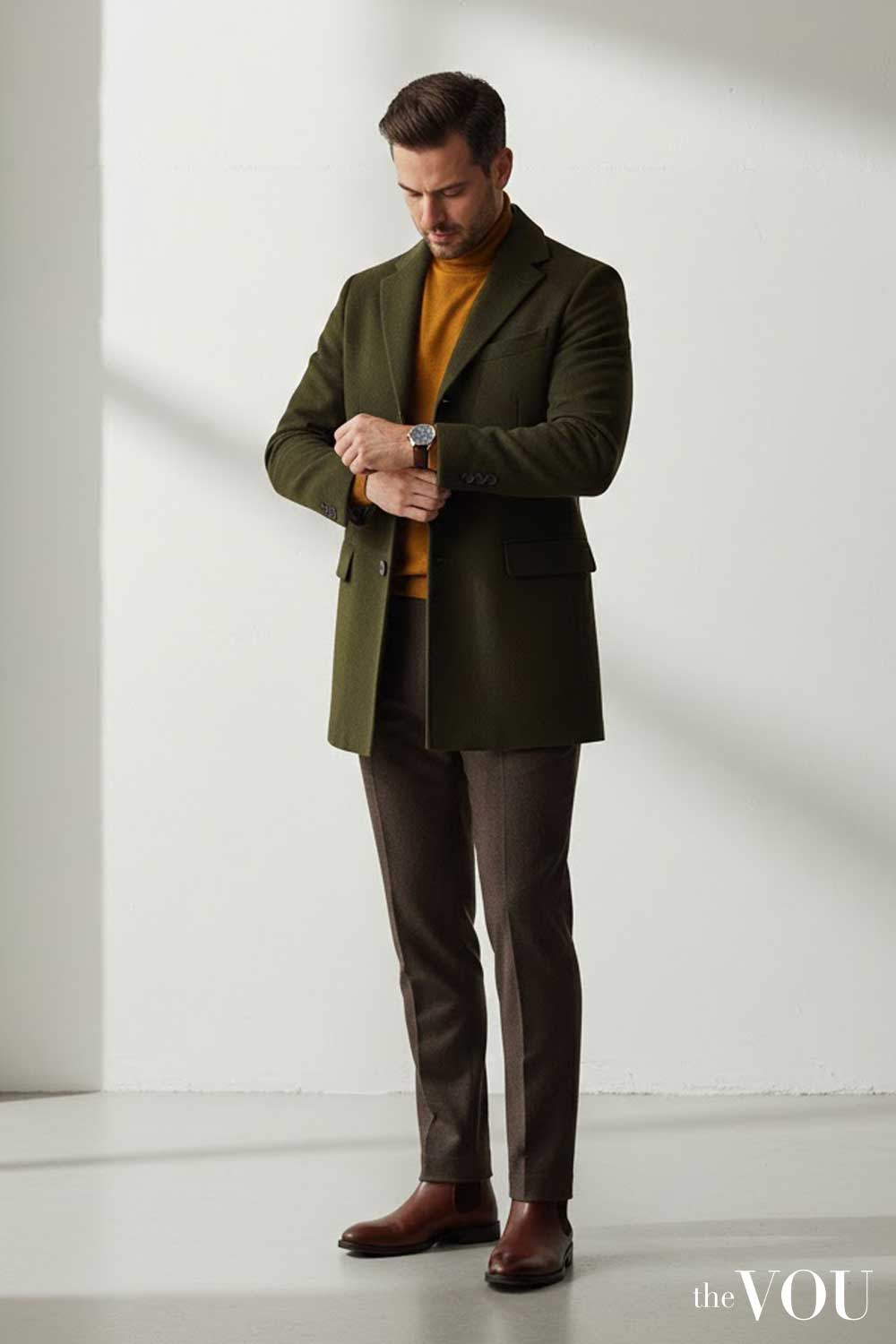
Understanding your personal colour palette is not a matter of fleeting fashion; it is a fundamental principle of strategic self-presentation.
For the discerning man, mastering colour is an instrument of influence, ensuring every garment you acquire is an asset that enhances your natural advantages.
This guide provides a definitive methodology for identifying your colour season, enabling you to build a wardrobe that is not only cohesive but engineered for maximum impact.
What Is Colour Season Analysis?
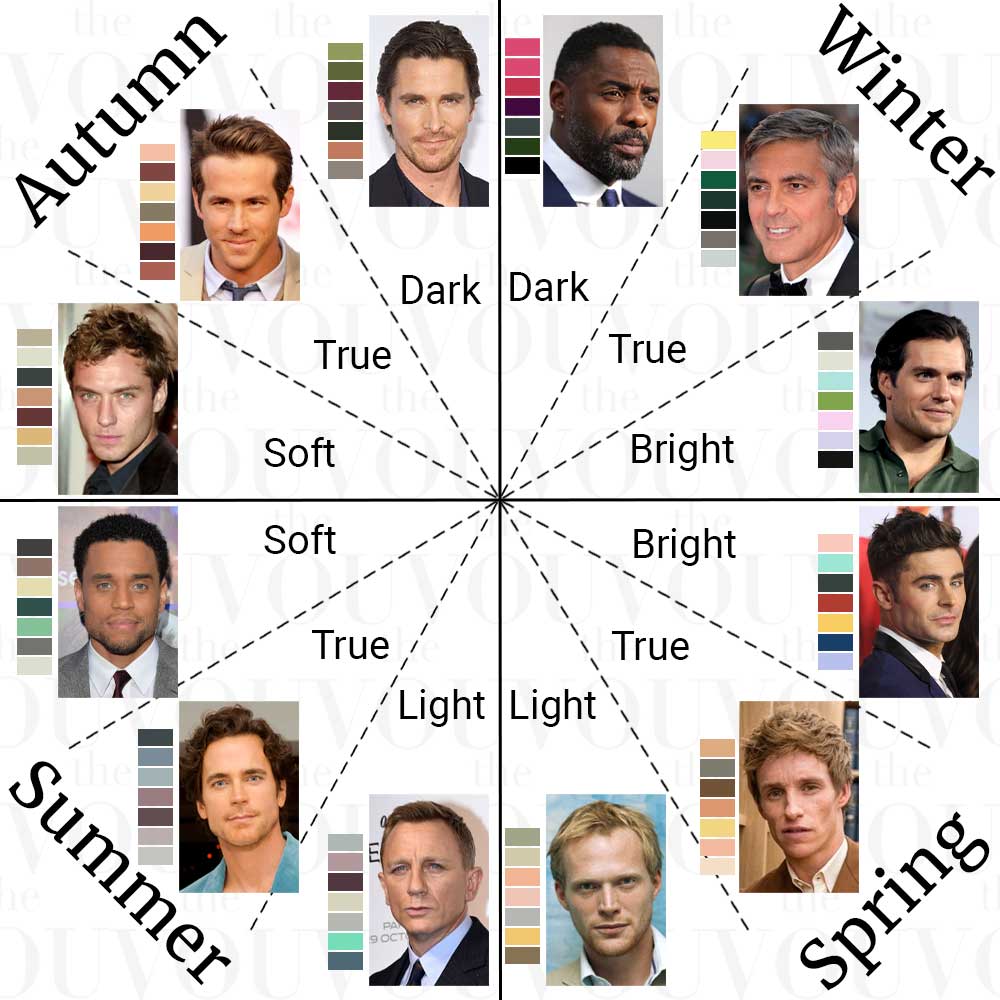
Colour season analysis is a system that categorises individual colouring into one of four distinct seasons; Winter, Spring, Summer, or Autumn.
The objective is to identify a palette of colours that harmonises perfectly with your natural skin tone, eye colour, and hair colour.
Operating within your correct seasonal palette ensures you look healthier, more vital, and more commanding. It eliminates sartorial guesswork, streamlines purchasing decisions, and guarantees a return on your wardrobe investments.
It is the foundational step toward achieving an effortless and powerful personal aesthetic.
The Four Colour Seasons Explained
Each of the four seasons possesses a unique set of characteristics defined by three variables; undertone (cool or warm), value (light or dark), and chroma (clear or muted).
Winter
The Winter palette is defined by its cool, deep, and clear characteristics. It commands attention through sharp, high contrast.
Men with this colouring typically exhibit a striking contrast between their skin, hair, and eyes. Skin may be fair, olive, or dark, but it always possesses cool blue or pink undertones. Hair is usually dark brown or black, whilst eyes are deep brown, black, or a piercing shade of blue or green.
Your optimal colours are bold and saturated. Prioritise true black, pure white, and rich jewel tones; sapphire blue, emerald green, and ruby red. Avoid muted, earthy colours, as they will diminish your natural intensity.
Spring
The Spring palette is characterised by warmth, light, and clarity. It projects energy and vibrancy.
This season features low contrast between features, all unified by a warm undertone. Skin will have golden or peachy undertones. Hair is typically lighter; ranging from blonde to light brown, often with natural golden or red highlights. Eyes are light and clear; blue, green, or light brown.
Your wardrobe should reflect this natural warmth. Embrace clear, bright colours; coral, turquoise, warm greens, and ivory. Steer clear of dark, heavy colours that will overpower your complexion.
Summer
The Summer palette is cool, light, and soft. It conveys an air of refined, understated elegance.
Summer colouring is marked by a low-contrast, cool-toned harmony. The skin has subtle pink or blue undertones and is often fair. Hair is typically ash blonde or ash brown, entirely devoid of red or gold. Eyes are soft and cool; blue, grey, green, or a muted shade of brown.
Your power lies in subtlety. Build your wardrobe around soft, muted colours; dusty rose, sky blue, lavender, and cool greys. You must avoid harsh, overly saturated colours, particularly black, which will appear severe against your softer colouring.
Autumn
The Autumn palette is defined by its warm, deep, and muted qualities. It communicates substance and sophistication.
Autumn men have a rich, warm, and earthy appearance. The skin has distinct golden undertones. Hair is imbued with warmth; from auburn and warm brown to dark golden blonde. Eyes are typically brown, hazel, or a warm olive green.
Your palette is drawn from the natural world. Invest in rich, earthy tones; mustard yellow, terracotta, olive green, and deep coffee browns. Cool, icy colours and stark blacks or whites are your primary adversaries; they will make you appear drained and unwell.
How to Determine Your Colour Season
Follow this three-step diagnostic process to ascertain your correct season with precision. This requires objective observation in natural daylight, free from artificial lighting.
Assess Your Skin’s Undertone
Your skin’s undertone is the constant, underlying colour that never changes. It is either cool (blue-based) or warm (yellow-based). Use these two tests to identify yours.
First, the Vein Test. Examine the veins on the inside of your wrist. If they appear distinctly blue or purple, your undertone is cool (Winter or Summer). If they appear greenish, your undertone is warm (Spring or Autumn).
Next, the White Paper Test. Hold a sheet of pure white paper next to your face. If your skin appears pinkish or rosy in comparison, you are cool-toned. If it takes on a yellowish or golden cast, you are warm-toned.
Analyse Your Natural Hair and Eye Colour
Your hair and eye colour provide the next layer of data, primarily related to contrast and value.
High contrast between dark hair, light skin, and bright eyes is the hallmark of a Winter.
Low contrast, defined by light, ashy hair and soft, cool eyes, indicates a Summer.
Low contrast with warm, golden or red-toned hair and light, clear eyes points to a Spring.
A deep, rich harmony of warm-toned hair and eyes signifies an Autumn.
The Drape Test
This is the definitive confirmation. The drape test reveals how different colours interact with your complexion.
Acquire fabric swatches or use existing garments in a range of colours, specifically comparing warm and cool versions; gold vs. silver, rich brown vs. black, orange vs. hot pink.
Sit before a mirror in good, natural light. Hold each colour up to your face, directly under your chin.
Observe the effects meticulously. The correct colours will make your skin appear even and bright, your eyes will look clearer, and your features will appear defined. The wrong colours will cast unflattering shadows, highlight blemishes, and create a sallow, drained appearance.
The results will be unequivocal and will confirm your season.
Why Finding Your Colour Season Matters
Identifying your colour season is a strategic imperative, not a stylistic indulgence. The benefits are tangible and immediate.
It provides an immediate enhancement of your appearance. Wearing the correct colours projects health, vitality, and authority, giving you a competitive edge before you have spoken a word.
It engineers efficiency. Shopping becomes a targeted mission, not a speculative exercise. You know precisely which colours to seek and which to ignore, saving invaluable time and eliminating decision fatigue.
It protects your investments. Every piece of clothing becomes a high-performing asset that works in your favour. This eliminates costly purchasing errors and builds a wardrobe where every single item is effective.
Ultimately, it cultivates an unshakable, effortless confidence. Knowing that your appearance is optimised provides a foundation of self-assurance that permeates every personal and professional interaction.
Aidan Russell’s focus at The VOU is men’s face-shape styling, facial proportions and the way accessories frame the face. His coverage addresses a common starting question: how do you choose glasses, hats or necklines when standard face-shape advice does not quite describe your features?
His subject areas include comparing visible face length and width, recognising mixed features and understanding how frame size, brim shape and neckline placement change an overall look. Rather than making a shape label the final decision, this coverage connects proportions with the effect a reader wants, whether that means adding definition, softening an outline or drawing attention to particular features.
Aidan’s editorial focus also links facial styling with the rest of a man’s wardrobe. The aim is to make comparisons easier when trying on accessories or planning an outfit, while allowing for comfort, fit and personal preference. Readers looking for a starting point in face-shape styling can use this coverage to identify options worth trying, without being confined to one prescribed look.
Mandy Meyer’s focus at The VOU is men’s body-shape styling, garment fit and outfit proportions. Her coverage addresses the practical questions behind a wardrobe choice: how a jacket sits across the shoulders, how trousers fall and how different cuts change the silhouette a wearer wants to create.
Her subject areas include the triangle, inverted triangle, rectangle, oval, trapezoid, hourglass and diamond labels used in body-shape styling. These provide starting references for comparing visible proportions; they do not capture every body or prescribe one correct way to dress. The focus connects those observations with garment shape, construction, length and the relationship between the upper and lower parts of an outfit.
Mandy’s editorial coverage combines visual comparisons with fit checks for comfort and movement. Readers can consider whether a cut gives them the room they need, where clothing pulls or gathers and which changes might support their preferred look. The aim is to make menswear choices more understandable while keeping personal preferences and the wearer’s own styling goals central.
Sara Law’s focus at The VOU is men’s capsule wardrobes, outfit formulas and wardrobe curation. Her coverage addresses readers who want to get more useful combinations from their clothes, particularly across everyday and business-casual settings.
Her subject areas include coordinating shirts, trousers, knitwear, jackets and footwear, identifying gaps and understanding why certain combinations work together. This focus starts with the wearer’s routine and preferences rather than a fixed number of garments. A capsule wardrobe should reflect the situations a man needs to dress for, including the level of formality and the practical demands of his day.
Sara’s editorial coverage gives readers a way to organise existing pieces before deciding what to add. Outfit formulas provide repeatable starting points that can be adjusted through colour, texture, proportions and accessories. The aim is to reduce the difficulty of getting dressed while preserving variety, helping men build a wardrobe that feels connected without making every outfit look the same.