
Start here
What’s This About
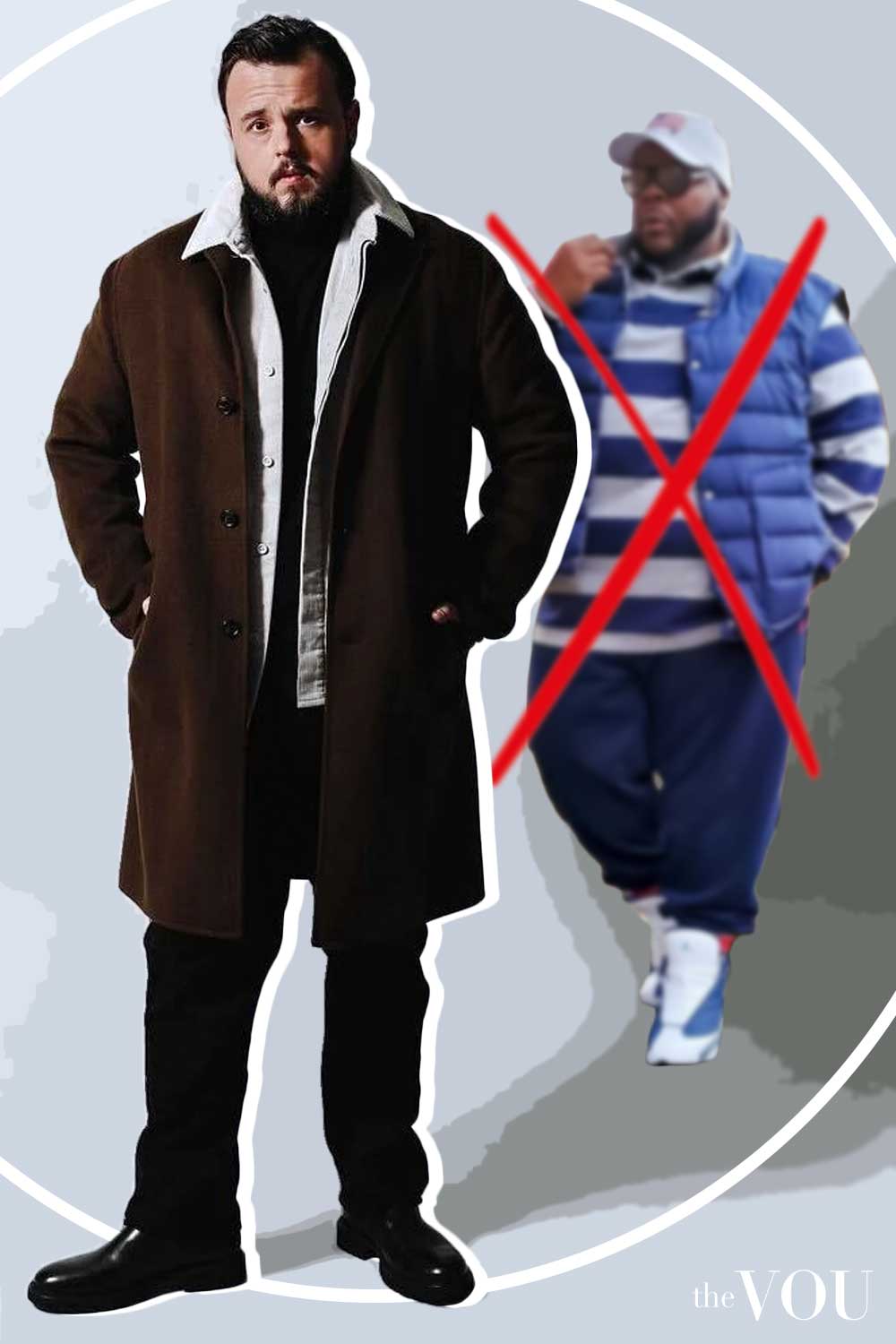
Common styling mistakes on an apple (Oval) outline include clothes that pull across the middle, waistbands that slip below the stomach and details that stop in a line across it.
This guide goes through each mistake and what to try instead, such as:
shirts and jackets that pull or cling at the middle
low waistbands, and how to check a rise standing and seated
jacket structure, button stance and pocket placement
belts, collars, layers and trouser length
and many more!
Every fix is an option to compare in the mirror, and fit always comes first.
Key Points
01Fit comes first: shirt buttons and jacket fastenings should close without pulling, standing and seated.
02Where a waistband feels secure matters more than a rise label, because makers measure and name rise differently.
03Stripes, colour and jacket structure have no guaranteed slimming effect; treat them as choices you compare on your own body.
04If your middle stands out more sharply between a narrower chest and hips, the Diamond description may fit too, and the same fit checks apply.
An apple body shape, which The VOU calls Oval, describes a rounded, fuller middle with more general fullness through the torso.
It is a styling description of how the outline looks, not a measurement, and it says nothing about health or fitness.
Triangle, Inverted Triangle, Rectangle, Trapezoid and Hourglass follow familiar styling usage; Oval and Diamond are described in The VOU’s own words.
We use Diamond for an outline where the middle stands out more distinctly between a narrower chest and hips; if that sounds closer to you, the fit advice below still applies.
Below are common styling mistakes on a fuller middle, each with what to try instead.
None of them is a rule, and whether you want a more even outline or simply more comfort is your choice.
Overly Fitted Clothes
When clothes fit too tightly around the midsection, the fabric creates visible pull lines and wrinkles that draw attention to the very areas you might prefer to downplay.
Tight garments also restrict movement, affecting both comfort and confidence.
Instead, choose garments with enough room to skim your body without clinging.
A quick check in the fitting room: shirt buttons should fasten with no pulling or gaps between them, and a jacket should fasten without an X-shaped crease spreading from the button.
Then sit down and reach forward; if the shirt strains at the buttons or the jacket pulls, try the next size or a fuller cut.
Look for shirts with a little room through the middle and jackets that hang cleanly from the shoulders.
A good fit lets you move comfortably while the cloth falls without clinging.
Many shirt makers sell more than one cut: Eton offers Classic, Contemporary and Slim fits, and Stenströms offers Classic, Fitted Body and Slimline, so compare the fuller cut with your usual one rather than simply sizing up.
Horizontal Stripe Patterns
Many style guides warn that horizontal stripes make a frame look wider.
Studies of stripes have found effects in both directions and none that settles a rule: one research paper is titled “horizontal stripes won’t make you look fatter”, and a 2021 study using photographs of a female model in striped dresses found horizontal stripes looked slightly thinner than plain cloth.
Those studies used particular images and bodies, so the honest answer is that the effect depends on the stripe, the garment and the person wearing it.
If you prefer the eye to travel up and down rather than across, vertical stripes, solid colours or small-scale patterns are the usual alternatives.
Try a horizontal stripe and a vertical one in front of a mirror rather than ruling either out.
Proper Cloth and Charles Tyrwhitt both sell shirts in a range of stripe widths and colours, which makes side-by-side comparison easy.
Low-Rise Trousers
Low-rise trousers are cut to sit lower on the hips, and on a fuller middle the waistband can end up under the stomach, where many men find it rolls over, slips or needs hitching up through the day.
If that happens to you, try trousers with a higher rise so the waistband sits higher and more securely.
Your natural waist and the fullest point of your abdomen can be in different places, and the navel is not a fixed waist line, so the useful question is where the waistband feels secure and comfortable on you.
Rise labels such as mid or high vary between makers, so check where the waistband actually sits standing and seated, and compare the rise measurement on the maker’s size chart where one is given.
A higher waistband can also give a longer, unbroken line from waist to shoe, which some men prefer; compare both versions in a mirror.
Berg & Berg and Anglo-Italian are two makers of tailored trousers to try; check each model’s rise before you buy.
Unstructured Jackets
A completely unstructured jacket has little internal support, so on a fuller middle the front can fall onto the stomach and follow its curve.
Some men like that relaxed look.
If you would rather have a cleaner line from shoulder to hem, try a jacket with light shoulder padding and enough internal structure to stop the front collapsing.
A little waist shaping can work too, as long as the jacket still fastens without pulling; shaping that strains across the stomach does the opposite of what you want.
Suitsupply and Ring Jacket both make softer-shouldered tailoring, so try a few constructions side by side and see which hangs best on you.
Belt Issues
A wide or strongly contrasting belt draws a horizontal line at the waistband, and an ornate buckle adds a focal point in the same place.
If you would rather not draw attention to the middle, a narrower dress belt in a colour close to your trousers is the quieter choice.
For tailored trousers, side adjusters or braces avoid a belt altogether, and braces can also help when a waistband tends to slip below the stomach.
Meermin and Charles Tyrwhitt both sell leather belts in classic colours.
Buttoning Mistakes
The fastening button (the top button on a two-button jacket, the middle one on a three-button jacket) sets where the jacket closes.
If it closes high on a fuller middle, the front can pull or open below the button and the lapels end in a short V.
Rather than following a fixed landmark, check how the button falls on you: the jacket should fasten without strain, the front should hang flat below the button, and the fastening point usually sits near the jacket’s own waist shaping.
A slightly lower button stance shows a longer V of shirt and tie, which many men with a fuller middle prefer; compare two jackets in a mirror before deciding.
Spier & Mackay and Cavour are among the makers selling two-button jackets you can compare.
Pocket Mistakes
Pockets that sit across the fullest point of your middle can gape open, and a phone, wallet and keys inside them add visible bulges.
On trousers, frogmouth pockets (also called cross or western pockets) open across the front a little below the waistband; some tailors suggest them for men whose side pockets flare open.
On jackets, notice whether the hip pockets land on the widest point of the stomach, and compare with a jacket whose pockets fall a little differently.
Keep your phone, wallet and keys in a briefcase or an inside jacket pocket where you can.
For casual wear, a cross-body bag or a slim cardholder instead of a thick wallet keeps the pockets flat.
Drake’s and Private White V.C. both make casual jackets worth trying on with this in mind.
Fabric and Material Issues
Very heavy or bulky cloth adds volume, while very light cloth can cling to the middle.
A mid-weight cloth with enough body to hang rather than cling is the usual compromise.
Makers quote weight in different units, so judge a suit or shirt by how the cloth falls when you try it on rather than by a number alone.
Cloth with some stretch and recovery, such as high-twist wool or cotton with a small proportion of elastane, can add comfort when you sit.
Stoffa and Luca Faloni are two brands whose cloths are worth comparing for weight and drape.
Collar Mistakes
A very small, narrow collar can look out of scale if your face, neck or torso is broad, while a very wide spread shows more of the collar band across the neck.
A medium spread is a common middle choice.
Judge the collar points by how they sit with your jacket lapels and your face rather than by a set length.
Button-down collars are a casual choice with a soft roll; whether that roll suits you is a matter of taste, so wear one if you like it.
Eton and Harvie & Hudson both offer shirts in several collar styles, so you can compare spreads directly.
Layering Errors
When several layers end at the same height, that edge can read as a line across the middle, which some men would rather avoid.
Staggered lengths give a less abrupt edge.
In tailoring, the waistcoat should cover the trouser waistband and the jacket should cover the waistcoat.
In casual layering, an open overshirt or cardigan that ends a little below a T-shirt or knitted polo works the same way.
Anglo-Italian and Berg & Berg both sell tailoring that can be worn in layers like this.
Trouser Mistakes
How much the trouser hem folds where it meets the shoe (the break) is a length choice.
A deep break, with cloth gathering at the ankle, adds weight at the bottom of the leg; a hem that grazes the shoe with no break gives a cleaner, shorter look.
Neither is wrong, but each changes the line from waist to shoe.
A slight break, with the front just resting on the shoe and the back reaching towards the heel, is a common middle choice, though tailors describe these conventions differently.
Compare the actual trousers with the shoes you will wear them with.
Tailored trousers from makers such as Rota and Incotex can be hemmed by a tailor to the length you choose.
Putting the Fixes Together
None of these mistakes is about changing your body; each one is about choosing garments that fit the body you have and give the outline you want.
When you try on a new shirt, jacket or pair of trousers, start with fit: does it fasten without pulling, does the waistband stay put standing and seated, and does the jacket hang cleanly from the shoulders?
Next, decide on the silhouette you like, then check the proportions of each garment: the rise, the jacket length and button stance, the collar and the trouser length.
Patterns, colours and jacket structure come last.
Their effect depends on the whole outfit, so compare options in a mirror rather than following a blanket rule.
Clothes that fit and feel comfortable are easy to forget about once you are wearing them, and that ease is what most people notice.
Style Like a True Gentleman
Before we say goodbye, fit does most of the work, whether or not you ever work with image consultants.
Professional styling starts with getting the fit right and choosing clothes that suit the occasion; knowing your body shape and seasonal colour palette can make the choosing quicker.
Our guides also cover styling by occasion, location, season and time of day, garments, footwear, accessories and heritage fashion brands.
Take our three quizzes, then book a consultation if you would like personal help:
1. Find Your Body Shape
Different garments suit different silhouettes.
To compare your outline with the seven body shape descriptions, take our body shape quiz for men.
2. Find Your Seasonal Colours
The garments in your outfits come in many colours.
To see which seasonal colour palette may suit you, take our seasonal colour quiz for men.
3. Find Your Fashion Style
To explore your personal fashion style, take our fashion style quiz for men; it suggests styles, outfit ideas and brands to explore.
Book a Consultation with The VOU
For personal help, you can book paid consultations with our image consultants and fashion stylists.
Our styling services for men page lists the paid consultations.
Wearing luxury brands is not enough on its own; how your clothes fit and suit the occasion matters more, and our personal style guide covers the rest.
For more on labels, see our guide to logo-heavy luxury brands and how to wear them.
Contact us if you would like to book a consultation.