Start here
What’s This About:
A V-neck suits a slim or narrow build when it fits well at the shoulders and body and its depth, knit and colour give the look you want.
This guide sets out six practical choices, such as:
– how deep the V should sit for the effect you want
– fine-gauge versus mid-weight and textured knits
– the fit at the shoulder seam, chest and hem
– layering under a jacket and choosing a shirt collar
and many more!
A slim build is not a problem to fix, so each choice is an option to compare in the mirror, not a rule.
Key Points:
01Fit comes first: the shoulder seam sits where the style intends, the body neither clings nor billows, and the hem stays put when you raise your arms.
02A shallow to medium V keeps more knit across the chest; a deeper V shows more shirt or skin and gives a longer, narrower opening.
03Mid-weight and textured knits add more body than very fine knits, which are better suited to layering under a jacket.
04Horizontal stripes, spread collars and lighter colours are often suggested for more width, but none has a guaranteed optical effect.
A V-neck jumper is one of the easiest knits to wear over a shirt or under a jacket, and it suits a slim or narrow build as well as any other.
How it looks on you depends on the depth of the V, the weight and texture of the knit, the fit and what you wear with it.
A slim build is not something to disguise, and no knit is guaranteed to make you look broader.
The six choices below explain what each option tends to do, so you can pick the effect you want.
1. Choose the Depth of the V for the Effect You Want
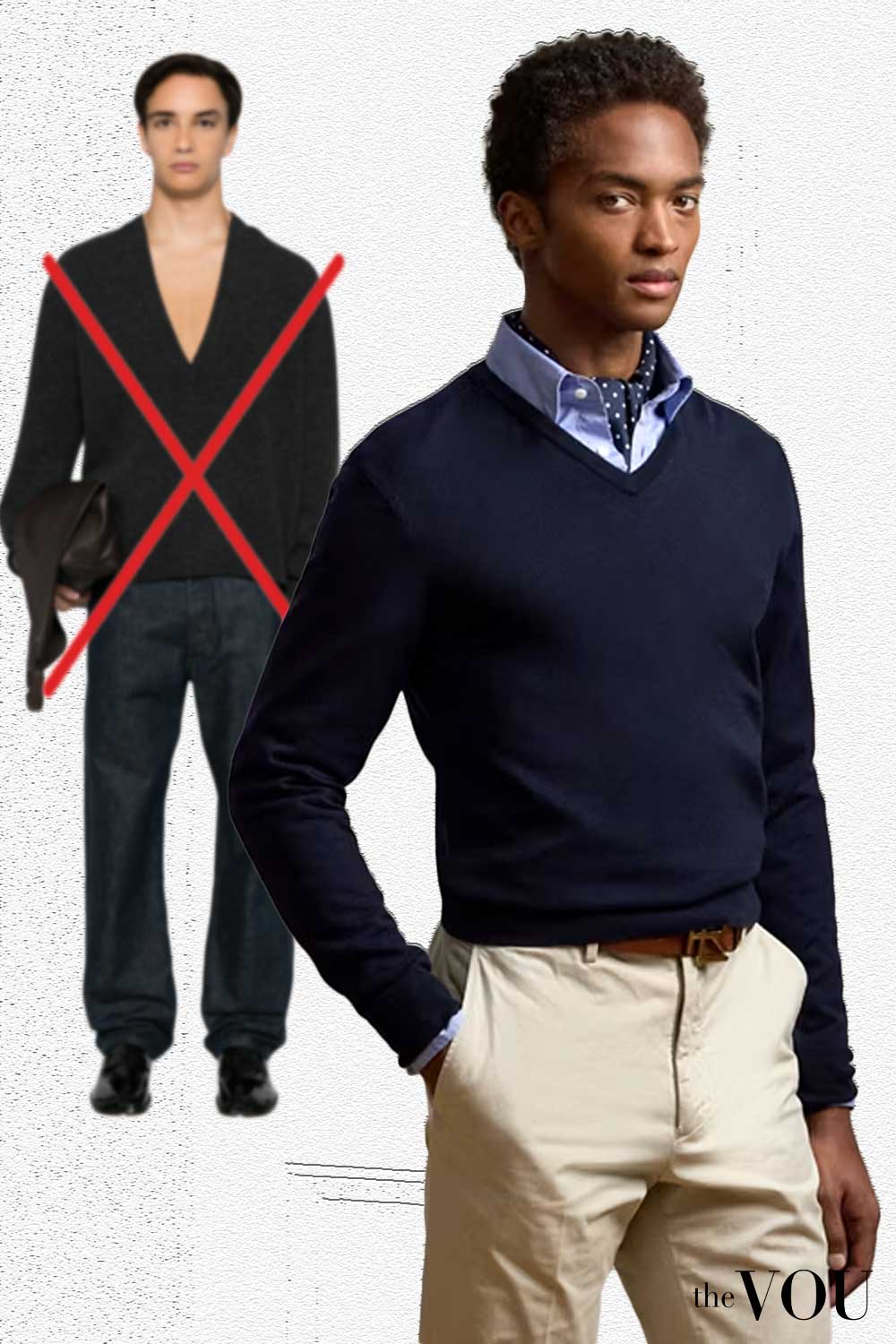
A shallow to medium V-neck, one that opens just enough to show a shirt collar and the knot of a tie, keeps more knit across the chest.
A shallower V is often suggested for a slim build because its wider angle is meant to lead the eye towards the shoulders rather than down the centre of the body.
A deep V shows more shirt or skin and makes a longer, narrower opening.
It draws the eye down the centre of the chest, so if you want more emphasis on width, a shallower V is the usual suggestion; if you like a longer line, or you wear the V-neck open over a T-shirt, a deeper V is a legitimate choice.
Other guides on The VOU suggest a deeper V for readers with a fuller middle for that same lengthening reason.
There is no correct depth in inches.
Try the V-neck on over the shirt you plan to wear and check where the opening sits in a mirror.
2. Consider Knit Weight and Texture
Mid-weight knits in merino wool, lambswool or a firm cotton have more body than very fine knits.
They hold their own shape instead of following every contour, which many slim men prefer when the V-neck is worn on its own.
Very fine knits are the other option.
John Smedley’s Sea Island cotton knits, for example, are made at 30 gauge, a fine and smooth knit that is light rather than heavy.
A fine knit sits flat under a jacket and suits warm offices; if it clings when worn alone, a mid-weight knit is the alternative.
Textured knits such as cable, rib or a chunky lambswool add surface interest and some bulk.
Wear them if you like a fuller look through the chest, and check that the extra bulk does not make the sleeves or body too wide.
3. Wear a Fit That Skims, or Go Oversized on Purpose
Look for a V-neck that skims the body: it sits close without pulling across the chest, does not cling at the waist and does not ride up when you raise your arms.
The sleeves should reach the wrist bone without bunching.
On a classic knit with set-in sleeves, the shoulder seam usually sits at the edge of your shoulder.
A dropped shoulder is a deliberate relaxed style rather than a fault, so decide which look you want before judging the fit.
A very tight knit shows the outline underneath, and a very loose one can look borrowed.
If you like a relaxed, oversized look, choose it on purpose and keep the trousers and shoes in proportion.
Knitwear is harder to alter than a shirt, so it is worth trying on several sizes and makers.
4. Layer Under a Jacket
A fine or mid-weight V-neck under a blazer or sports jacket adds a layer of colour and texture between the shirt and the jacket.
A jacket with some shoulder structure is meant to add definition at the shoulders, and a softer jacket gives a more relaxed line; both work with a V-neck.
Keep the V-neck thin enough for the jacket to button without strain and for the sleeves to move freely.
Chunky knits are better worn on their own or under a coat with room for them.
5. Choose a Shirt Collar That Sits Well Inside the V
A spread or cutaway collar opens outward towards the shoulders, which many people find adds a little width at the top of the outfit, and its points tuck neatly under the edges of the V.
A button-down collar also works well under a V-neck and stays in place without a tie.
Band collars and collarless shirts give a cleaner, more casual neckline.
They are a matter of style rather than something a slim build needs to avoid.
Check that the collar points sit under the edges of the V rather than poking over the knit.
6. Choose Pattern and Colour by the Look You Want
Horizontal stripes are often suggested for adding width across the chest.
Studies of striped clothing have found effects in both directions, and some found horizontal stripes made the wearer look thinner rather than wider; none settles a rule, so wear stripes because you like them rather than as a fix.
Vertical stripes and patterned knits such as Missoni’s zigzags are equally open to you.
Solid colours are the most versatile.
Mid and dark tones such as navy, grey and bottle green pair easily with most shirts and trousers; lighter colours such as cream, pale grey or light blue bring more attention to the upper body, which some slim men prefer.
Both approaches work, and our other guides for slim builds discuss lighter shades in more detail.
Textured knits add interest in a plain colour if you prefer not to wear pattern.
The Final Verdict
A V-neck suits a slim or narrow build when it fits well and its depth, knit and colour give the look you want.
Start with the fit at the shoulder, body and hem, then choose a shallower or deeper V, a fine or mid-weight knit and the shirt you will wear underneath.
None of these choices is compulsory; compare them in a mirror and keep what you like wearing.
Style Like a True Gentleman
Before we say goodbye, fit does most of the work, whether or not you ever work with image consultants.
Professional styling starts with getting the fit right and choosing clothes that suit the occasion; knowing your body shape and seasonal colour palette can make the choosing quicker.
Our guides also cover styling by occasion, location, season and time of day, garments, footwear, accessories and heritage fashion brands.
Take our three free quizzes, then book a consultation if you would like personal help:
1. Find Your Body Shape
Different garments suit different silhouettes.
To compare your outline with the seven body shape descriptions, take our free body shape quiz for men.
2. Find Your Seasonal Colours
The garments in your outfits come in many colours.
To see which seasonal colour palette may suit you, take our free seasonal colour quiz for men.
3. Find Your Fashion Style
To explore your personal fashion style, take our free fashion style quiz for men; it suggests styles, outfit ideas and brands to explore.
Book a Consultation with The VOU
For personal help, you can book paid consultations with our image consultants and fashion stylists.
Our styling services for men page lists the paid consultations.
Wearing luxury brands is not enough on its own; how your clothes fit and suit the occasion matters more, and our personal style guide covers the rest.
For more on labels, see our guide to logo-heavy luxury brands and how to wear them.
Contact us if you would like to book a consultation.
Mandy Meyer’s focus at The VOU is men’s body-shape styling, garment fit and outfit proportions. Her coverage addresses the practical questions behind a wardrobe choice: how a jacket sits across the shoulders, how trousers fall and how different cuts change the silhouette a wearer wants to create.
Her subject areas include the triangle, inverted triangle, rectangle, oval, trapezoid, hourglass and diamond labels used in body-shape styling. These provide starting references for comparing visible proportions; they do not capture every body or prescribe one correct way to dress. The focus connects those observations with garment shape, construction, length and the relationship between the upper and lower parts of an outfit.
Mandy’s editorial coverage combines visual comparisons with fit checks for comfort and movement. Readers can consider whether a cut gives them the room they need, where clothing pulls or gathers and which changes might support their preferred look. The aim is to make menswear choices more understandable while keeping personal preferences and the wearer’s own styling goals central.