

Start here
What’s This About
This guide explains how The VOU describes an oval face and uses ten celebrities often cited as examples to show hair, beard and accessory choices you can adapt.
It covers the decisions that change the result, such as
How to check whether the oval description fits you
Where to place height, width and layers in a haircut
Beard side fullness versus chin length
Glasses and hats chosen for fit first
and many more!
We also cover upkeep, work and weekend styling, and what to do when your observations are mixed.
Key Points
01The face looks longer than it is wide, with a gently curved outline; no fixed ratio makes a face oval.
02Oval faces are often called versatile, but that is a styling convention, not a scientific finding or an ideal.
03Your hair density, texture, curl, hairline and preferences decide more than the label.
04If your observations are mixed, record what you can see and compare neighbouring guides.
Understanding Oval Face Shapes
Understanding your face shape can help you describe what you see in the mirror and choose a haircut, beard or pair of glasses with a clearer goal in mind.
The oval face shape is one of the descriptions The VOU uses, and a few visible observations help you decide whether it fits.
Oval Face Characteristics
The VOU describes an oval face as longer than it is wide, with a gently curved outline and no strongly dominant upper or lower breadth.
Viewed from the front, the face looks longer than it is wide, but no fixed ratio makes a face oval and there is no numerical border with the oblong description.
The outline is often compared to an egg; it does not need to be symmetrical, and few faces are perfectly symmetrical.

The cheekbones may look slightly broader than the forehead and jaw, with gentle curves rather than sharp angles; if the cheekbones look clearly broader than both, the diamond description may fit better.
Looking straight ahead, neither the forehead nor the jaw is clearly the broadest level of the face.
A side view can help you plan styling, but a frontal outline description says nothing reliable about your profile, nose, chin projection or bone structure.
How to Identify an Oval Face Shape
To see whether the oval description fits, look in a mirror with your head upright, facing straight ahead in even light, and move hair aside if you are comfortable doing so, then compare the observations below.
1. Length Compared With Width. Compare the distance from your hairline to your chin with the widest span across your face. In the oval description the face looks clearly longer than it is wide; if it looks very long, compare the oblong description too, and if your hairline is receding or hidden, treat length as uncertain rather than guessing.
2. Cheekbone Position. Your cheekbones may be slightly the broadest level of your face, with a gentle rather than dramatic difference and soft curves running to the jaw and forehead.
3. Outline Curves. Notice whether the outline runs from forehead to cheekbones to jaw in a smooth curve; clearly angular jaw corners point more towards the square or rectangle descriptions.
4. Mixed Observations. If your observations do not all point the same way, or a beard hides your jaw, that is normal. Record what you can see, leave the rest as unknown, and compare neighbouring guides rather than forcing one label.
Why Oval Faces Are Considered Versatile
Oval faces are often described as versatile, because no single level of the face is especially broad.
That is a styling convention rather than a scientific finding, and it does not make the oval an ideal that other face shapes should copy.
Your hair density, texture, curl, hairline and preferences still decide which styles work for you.
Before exploring the celebrity examples, if you would like a starting point, take our face shape quiz for men.
It can help you check your face shape and gives styling ideas to try alongside your own mirror observations.
Celebrity Examples of Oval Face Shapes
The ten celebrities below are often cited as examples of an oval face shape; each entry describes visible styling you can adapt, not a measurement of their faces.
The face-shape label is a common description, not a verified fact about the person.
1. Michael Jordan

Michael Jordan, pictured above, is often cited as an example of an oval face shape.
He is best known for a closely shaved head, often worn with a neatly trimmed moustache and goatee.
There are a few ideas you can take from this look.
A closely shaved head shows your whole outline as it is; no face needs hair to correct it, so this is a matter of preference and of how comfortable you are with your head shape.
A neat moustache and goatee add a little length and focus at the chin without adding width at the sides.
Keeping facial hair off the cheeks keeps the lower outline narrow; letting the sides fill in adds width, if your growth allows.
2. Ryan Gosling
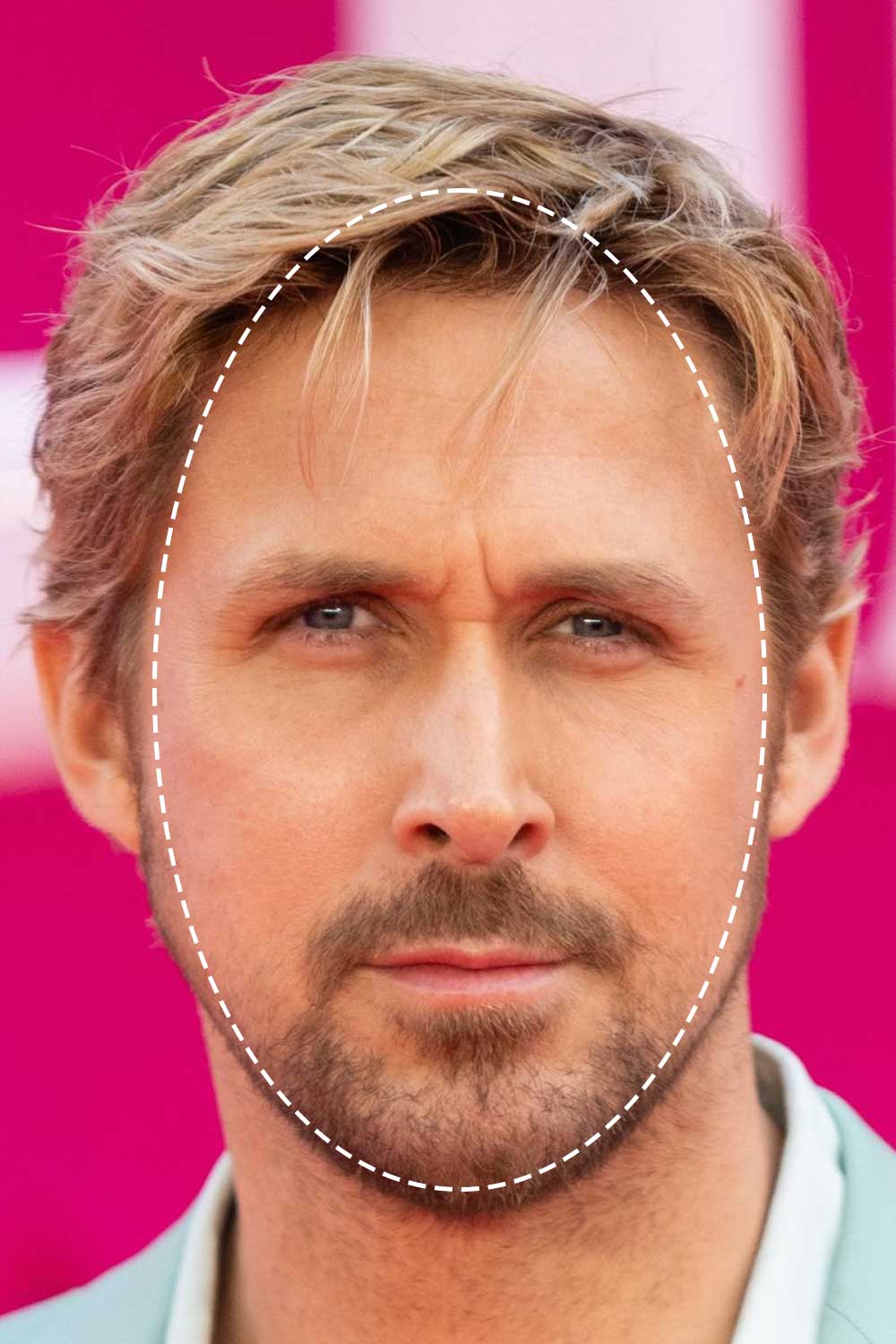
Ryan Gosling, pictured above, is often cited as an example of an oval face shape, and is often photographed with medium-length, textured hair.
You can take several ideas from his looks.
Medium-length hair with textured layers on top adds movement; more height on top makes the outline read longer, so keep the top flatter if you do not want that effect.
A side parting placed slightly off-centre adds a little asymmetry; where it sits naturally depends on your growth direction and any cowlick.
Short facial hair adds texture without changing the outline much.
3. Jake Gyllenhaal
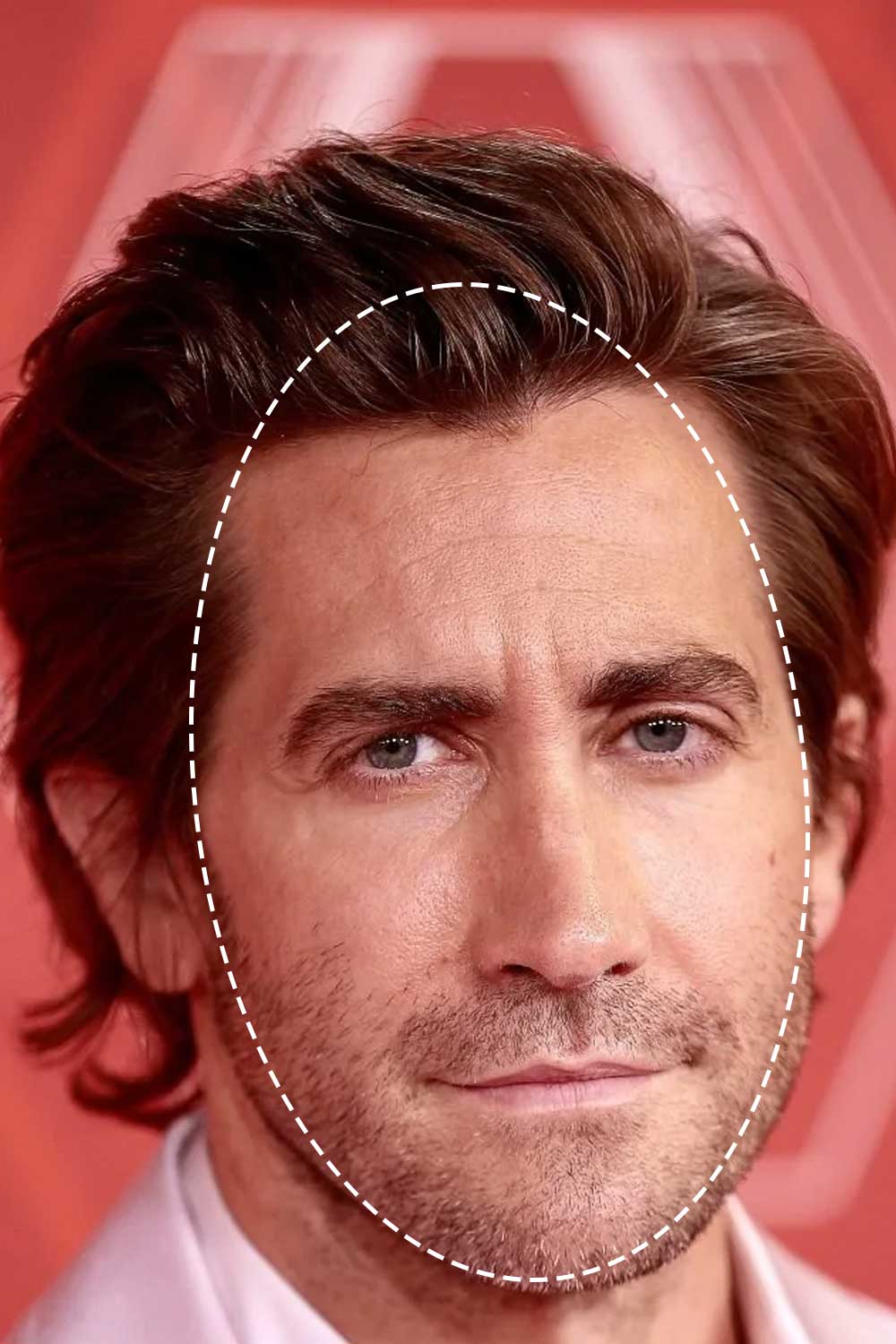
Jake Gyllenhaal, pictured above, is often cited as an example of an oval face shape, and has worn both short and longer hair as well as beards of different lengths.
His looks offer ideas you can take.
In longer hair, layers that start around cheekbone level add movement at the sides, while layers placed higher add more volume near the temples.
A beard fuller at the chin and tapered along the cheeks adds a little length; full sides add width instead, and both are choices.
Large changes in hair and beard, as his film roles show, alter the overall look far more than any face label predicts.
4. Idris Elba

Idris Elba, pictured above, is often cited as an example of an oval face shape, and is often photographed with a very short haircut and a beard.
A very short cut with a beard is a low-effort pairing that works across many outlines.
A buzz cut with a gradual fade at the sides gives a smooth transition from scalp to hair; agree the clipper lengths with your barber for your hair rather than copying a guard number.
A fuller beard kept at an even length all round adds weight at the jaw and chin; choose the length by your growth coverage and the look you want.
5. John Legend

John Legend, pictured above, is often cited as an example of an oval face shape, and is often photographed with short hair and a neat goatee or short beard.
A short, tidy cut with neat facial hair is a polished option that suits a wide range of outlines.
A medium fade that begins around temple level gives a gradual transition from the sides to the top.
A short goatee adds definition and a little length at the chin without adding width; there is no single optimal length, so trim to suit the density of your growth.
6. Chris Evans

Chris Evans, pictured above, is often cited as an example of an oval face shape, and is often photographed with a short pompadour or swept-back style and a short beard.
A modern pompadour keeps length on top with tapered sides, which adds height at the front and crown.
Height at the front makes the outline read longer, so keep the volume modest if you do not want that effect; how much height your hair holds depends on its density and texture.
A short beard kept slightly shorter on the cheeks than at the chin adds a little length at the chin; ask your barber to blend the change gradually rather than to fixed clipper settings.
7. Chris Pratt
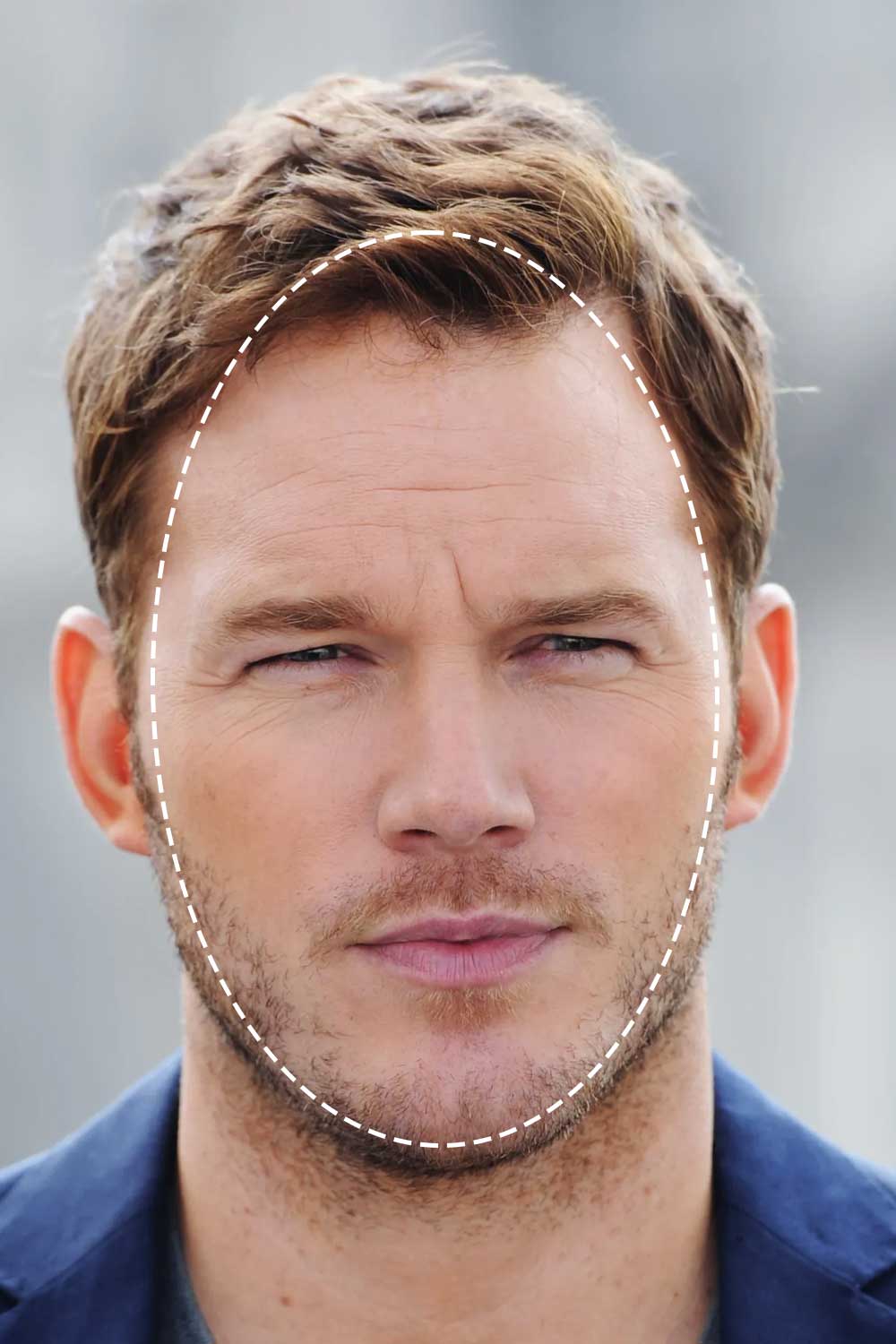
Chris Pratt, pictured above, is often cited as an example of an oval face shape.
He is often photographed with short, textured hair and, at times, short facial hair.
Short layers cut to fall around brow level add texture on top and can sit forward as a light fringe, which shows less of the forehead.
Short facial hair kept at an even length adds definition at the jaw without changing the outline much.
8. Dev Patel

Dev Patel, pictured above, is often cited as an example of an oval face shape, and has worn both short hair and longer curls.
His curls show how natural texture changes what a cut does. Curl adds volume at the sides, and shrinkage means curly hair sits shorter dry than when it is cut wet.
Short and longer styles can both work; the choice depends on your hair and the upkeep you want.
Collar-length curls with layers starting around cheekbone level place movement and width at the sides of the face.
If you want less width at the sides, ask for more weight removed there or keep the length shorter.
A full beard tapered slightly along the cheeks keeps the side outline neat while adding weight at the jaw, within the limits of your growth coverage.
9. Justin Bieber

Justin Bieber, pictured above, is often cited as an example of an oval face shape, and has changed his haircut and hair colour many times.
His frequent changes are a reminder that no single cut is fixed by your face shape.
A textured crop of fairly even length all over keeps the outline close to the head with a little movement on top.
Ask your barber for the length your hair needs to hold texture rather than a fixed number, because density and wave change the result.
Light stubble adds subtle definition without adding length or width.
Hair colour is a separate choice from face shape; bold colour changes depend on your skin tone, upkeep and hair condition rather than your outline.
10. Cole Sprouse

Cole Sprouse, pictured above, is often cited as an example of an oval face shape, and is often photographed with wavy hair and no beard.
The label is a common description; neither our face shape quiz nor a photograph can confirm it as a fact about him.
Wavy hair with textured layers adds movement and some volume on top.
Longer length on top lets waves form; how much you need depends on your wave pattern, so ask your barber to check the shape once your hair is dry and styled.
A clean-shaven face leaves the whole outline visible, which is as valid a choice as wearing a beard.
Styling Guide for Oval Faces
Oval faces are often described as versatile, but your hair and preferences matter more than the label.
The notes below cover hair, beard, upkeep and accessories, building on the celebrity examples.
Haircut Principles for Oval Faces
Start by choosing your goal, whether that is to keep the outline as it is, add height, add width at the sides, or simply wear a style you like.
When choosing a haircut, consider the following points.
There is no ideal ratio between top and side length. A fade or buzz cut with very short sides works as well as a longer, even cut, depending on the look you want.
Tell your barber where you want length, height, weight and movement, and mention your hair density, texture, curl, growth direction and hairline, because the same cut sits very differently on fine straight hair and on dense coily hair.
The approaches below are grouped by length.
Short Styles. Tapered sides give a softer transition than a sharp, high-contrast cut; both are valid, and Chris Evans’s modern cut and Idris Elba’s fade are two examples. Short, sharp edges need more frequent barber visits to stay crisp.
Medium Lengths. Where the layers start decides where movement and width sit, so layers around cheekbone level add movement at the sides, while higher layers add volume near the temples. Ryan Gosling’s textured cuts are one example.
Longer Styles. Longer hair that falls flat beside the face makes the outline read longer, while texture and movement add width; Dev Patel’s curls are one example. Check the result dry-styled in the mirror, from the front and both sides.
Facial Hair Guidelines
For facial hair, describe side fullness, chin length, cheek line and neckline separately, because each changes a different area of the outline, and your growth coverage sets what is achievable.
Beard Length. Different lengths work; here is a rough guide to the effect.
Short beards and stubble define the jaw without changing the outline much
Medium beards add texture and some weight at the jaw and chin
Fuller beards add width at the sides unless the sides are tapered, and length at the chin if it is left longer
Styling Approach
Soft, natural lines look gentler and sharp lines look more defined; choose by the look you want
Blending the moustache, cheeks and chin gradually avoids patchy-looking changes in length
Tapering from shorter cheeks to a longer chin adds length; keeping the sides full adds width instead
Grooming and Maintenance for Men with Oval Faces
How often you need upkeep depends on how fast your hair grows and how sharp you want the edges, not on your face shape. A routine might include the following.
Barber visits often enough to keep the perimeter (fade, taper or neckline) looking the way you like
Regular beard trims at home or at the barber to keep your chosen length and shape
Tidying the cheek line and neckline as they grow out
Ideal Accessories for Oval Faces
Choose accessories for fit and comfort first; shape is then a matter of taste.
Eyewear
Frame shape is an aesthetic choice, but fit comes first.
The overall frame width should suit the width of your head so the arms do not press or slip, and the bridge should sit comfortably on your nose
Oversized frames are a style statement; if you like them, check they stay put and the lenses sit correctly in front of your eyes, and ask an optician about prescription needs
Both angular and curved frames work; choose based on your personal style
Additional Accessories
Choose tie width to suit your lapels and collar, and scarves for the outfit and weather; face length does not set either
For hats, measure your head circumference and follow the maker’s size guide first; brim width and crown height are then style choices
Glasses, hats and collars frame the face, but none of them changes its underlying shape
Final Styling Considerations
A face-shape description can be a useful starting point, but personal style and comfort should guide your final decisions. A few further considerations follow.
Working with Your Natural Features
You can choose to show or soften any feature; neither is more correct. Consider how your hairline, cheekbones, jaw and hair texture work together.
For example, if you like your cheekbones and want them visible, choose styles that leave the sides of the face open rather than covering them.
A side-swept style is one option; hair that falls over the cheekbones is equally valid if you prefer a softer look.
Seasonal Styling Adaptations
Your preferences can change with the seasons too.
During summer months, shorter styles can help maintain a clean look while managing heat and humidity.
In winter, some people prefer slightly longer styles for warmth and a softer finish.
Professional vs. Casual Styling
Most cuts can be styled more neatly for work and more loosely at weekends.
Here are some ideas.
Professional settings
Keep lines clean and transitions subtle
Keep facial hair neatly trimmed, for example a tidy goatee like the one John Legend is often photographed with
Choose classic hairstyles that are easy to keep neat
Choose traditional frame and collar shapes if your workplace is formal
Casual settings
Experiment with more textured or relaxed styles
Try different facial hair lengths while maintaining clean transitions
Consider more contemporary accessory shapes
Play with different hair products to create varying effects
Age-Appropriate Styling
Your style can change with each life stage, and so can your hair, since density, hairline and colour often change over time.
Michael Jordan’s closely shaved head is one example of a look that stays simple over many years.
Adapt your cut to the hair you have now and the image you want, rather than to a fixed rule.
Maintaining Your Style
Any look needs some upkeep and an occasional rethink. A routine might include the steps below.
Weekly Maintenance
Regular facial hair trimming to maintain your chosen length
Product application assessment to ensure you’re using appropriate amounts
Quick style adjustments to keep your look fresh
Regular Check-ins
A haircut or trim when the perimeter starts to look untidy, which may be more or less often than monthly
Evaluation of how your style is working with your lifestyle
Assessment of whether your current products are still serving your needs
Seasonal Reviews
Consider if your style needs adjustment for the coming season
Evaluate if your current look still aligns with your goals
Plan any significant style changes you’d like to make
Finding Your Style
Remember that the most important factor is finding a style that makes you feel confident and comfortable.
Use the guidelines and examples we’ve discussed as a foundation, but don’t be afraid to adapt them to suit your personal preferences and lifestyle needs.
Experiment with different styles while keeping the basic principles in mind. Document what works well for you and what doesn’t.
Consider how different styling choices make you feel and how they fit into your daily routine.
The goal is to develop a style that looks good and feels authentic to you.
Conclusion, Mastering Your Oval Face Shape Style
Understanding and working with your oval face shape opens up a world of styling possibilities.
Throughout this guide, we’ve described the oval face as longer than it is wide with a gently curved outline, without any fixed ratio, and looked at how hair, beard and accessories change the overall effect.
What the Oval Description Is, and Is Not
The oval description is an editorial convention, not a scientific classification, and no study cited here validates ideal proportions or styling rules for it.
In The VOU’s description, the cheekbones may sit slightly broader than the forehead and jaw, with a smooth outline and no sharp corners.
Because no level of the face is especially broad, many styles are said to suit it, but your hair and preferences decide more than the label.
Learning from Celebrity Examples
The ten celebrities often cited as examples of an oval face shape show a wide range of looks.
From Michael Jordan’s closely shaved head to Dev Patel’s textured length, each shows a different way to wear hair and facial hair.
Rather than copying a look exactly, adapt it to your hair density, texture, curl and hairline.
Practical Application of Styling Principles
The styling notes in this guide are options, not rules.
Where you place length, height and width in your hair, how you shape the sides and chin of a beard, and how well your accessories fit matter more than any ratio.
Knowing what each choice does helps you decide what you want to try.
Beyond the Basics
Perhaps most importantly, we’ve learned that having an oval face shape isn’t about following a rigid set of rules.
Instead, it is a starting description for personal expression.
Whether you prefer classic looks like Idris Elba’s or frequent changes like Justin Bieber’s, you can choose by preference.
Moving Forward with Confidence
As you try new looks, remember that the goal is a style you like, not perfection.
Your style should reflect your identity.
Use the principles and examples we’ve discussed as guidelines rather than strict rules, and don’t be afraid to adapt them to suit your preferences and lifestyle.
Regular upkeep and an occasional rethink keep any look working for you.
Whether you’re choosing a new haircut, experimenting with facial hair, or selecting accessories, use your mirror observations as a guide and your preferences as the deciding factor.
The key to success lies in balancing these fundamental principles with your preferences and lifestyle needs.
If your features look mixed, or a beard or hairline hides your jaw or forehead, compare neighbouring face-shape guides rather than forcing a single label.
Final Takeaway
An oval outline suits many hairstyles, but your hair type, upkeep and preferences decide which ones work for you. Choose your goal first, adapt the cut to your hair, and check the result dry-styled in the mirror.
Style Like A True Gentleman
Before you go, here is a simple order to follow, whether you work alone or with an image consultant.
Professional styling usually starts with knowing your body shape and seasonal colour palette, which help you choose well-fitting clothes in colours that suit your skin, eyes and hair.
Then you can plan outfits for each occasion, location, season and time of day, with garments, footwear, and accessories from heritage fashion brands that fit the way you want to look.
Take our three quizzes below, then book a paid consultation if you would like personal help.
1. Find Your Body Shape
Different garments flatter different silhouettes, so knowing your body shape is a useful first step.
To check your body shape, take our body shape quiz for men.
Next, take the second quiz to check your colour palette.
2. Find Your Seasonal Colours
Remember, the garments that compose your outfits come in various colours, and it helps to choose shades that suit your natural colouring.
To do that, find your seasonal colour palette by taking our seasonal colour quiz for men.
3. Find Your Fashion Style
Once you know your body shape and colour palette, the next step is to find your personal fashion style.
You can start with our fashion style quiz for men; it gives style suggestions, outfit ideas, relevant fashion brands, and much more.
Professional Image Consultancy with The VOU
If you would like personal help, you can book a paid consultation with our expert image consultants and fashion stylists.
Our styling services for men are paid consultations; the shop page lists what each one includes.
Remember, wearing luxury brands isn’t enough (see logo-heavy luxury brands and how to wear them); it also helps to know your body shape, colour palette, and ideal personal style, and then to dress by occasion, location, season, and time of day.
Contact us if you would like to book a paid consultation.