Start here
What’s This About
Neapolitan style is soft tailoring from Naples, built on a light jacket with a natural shirt shoulder, little padding and minimal lining.
This guide explains the style’s origins and how to choose and wear each garment, such as
The spalla camicia shoulder and gathered sleevehead
The barchetta chest pocket and rounded patch pockets
Hand-finished shirts with soft collars
Trim trousers with turn-ups and little break
Office, smart-casual and summer outfits
and many more!
Start with one soft navy or grey jacket and wear it with trousers you already own.
Key Points
01The modern Neapolitan jacket is traced to the 1930s and London House, opened by Gennaro Rubinacci in 1932.
02Its defining details are a natural shoulder, a high armhole and soft, lightly lined construction.
03Fit decides how the jacket looks on you, more than body shape, age or price.
04A soft jacket is versatile, but black tie still calls for a dinner suit.
Neapolitan style is the soft, lightweight way of tailoring and dressing that developed in Naples, built around a jacket with a natural shoulder, little padding and minimal lining.
It feels closer to a shirt than to a stiff, structured jacket, which is why many men find it comfortable in warm weather and for long days.
This guide explains where the style comes from, what to look for in the jacket, shirt, trousers and shoes, and how to wear it for different occasions.
Where Neapolitan tailoring comes from
Naples has a long tailoring tradition, and the city was the capital of the Kingdom of the Two Sicilies until Italian unification in 1861.
The modern Neapolitan jacket is usually traced to the 1930s.
In 1932 Gennaro Rubinacci opened a tailoring house in Naples called London House, named in homage to London’s standing in men’s tailoring.
His cutter Vincenzo Attolini made unstructured, unlined and unpadded jackets, inspired by the English drape cut but far softer, according to a 2024 history in The Rake.
Compared with most Savile Row and Milanese jackets, Neapolitan tailoring keeps the jacket light and close to the body’s natural shape.
Many tailors and makers carry the tradition on today, including Rubinacci, the Solito and Panico workshops, Kiton (founded in 1968) and Isaia.
In 2016 the Victoria and Albert Museum in London added Rubinacci suits to its permanent collection, the first Neapolitan tailoring to enter it.
The Neapolitan jacket
The jacket is the heart of the style, and these are the details that set it apart.
At the shoulder, the spalla camicia, or shirt shoulder, has little or no padding, and the sleeve is sewn in the way a shirt sleeve is.
For the sleevehead, a larger sleeve is set into a smaller armhole and the extra cloth is left as small gathers, often called grinze, which give the shoulder its rippled look.
The armhole is cut high and snug, which lets you raise your arm without the whole jacket lifting.
The canvas is soft and the lining is minimal, so the jacket is light.
The chest pocket is the barchetta, a curved breast pocket shaped like a small boat.
The hip pockets are rounded patch pockets, which make the jacket look more relaxed.
The buttons form a three-roll-two front, where the top button rolls into the lapel and the middle button is fastened.
Not every Neapolitan jacket has every detail, and each tailor has a house style, so treat this list as a guide rather than a checklist.
Shirts
Neapolitan and other Italian handmade shirts are known for hand-finished sleeves, where extra fullness in the armhole is controlled by hand stitching.
Some makers leave small pleats or gathers at the top of the armhole, and some attach the collar in the round so it curves naturally around the neck.
Soft collars and fine cottons in white, pale blue and blue stripes are easy shirts to wear with a Neapolitan jacket.
Trousers
Neapolitan-style trousers are usually trim through the leg, often with a pleat and turn-ups, and cut to fall with little or no break on the shoe.
A higher rise sits well with a short, soft jacket.
Belt loops or side adjusters are a matter of preference; both are common in tailored trousers.
Shoes
Shoes are not made by the tailor, but lighter styles suit the look.
Suede loafers, tassel loafers and brown oxfords or derbies all sit well with soft tailoring.
For a dark suit at a formal event, choose dark brown or black oxfords.
Neapolitan tailoring and sprezzatura
Sprezzatura, a word from Baldassare Castiglione’s 1528 Book of the Courtier, describes making something difficult look effortless.
Soft Neapolitan tailoring is often linked with this idea, because the gathered sleevehead and light construction look relaxed even when the jacket is carefully made.
You can add a little of that ease with a soft-folded pocket square or a knitted tie, but the effect comes from fit and comfort rather than from studied untidiness.
Neapolitan style by occasion
A Neapolitan jacket is versatile, but the occasion still decides how formal the rest of the outfit should be.
For the office, wear a navy or grey Neapolitan suit in a light wool, a white or pale blue shirt, a dark silk or knitted tie and dark brown oxfords.
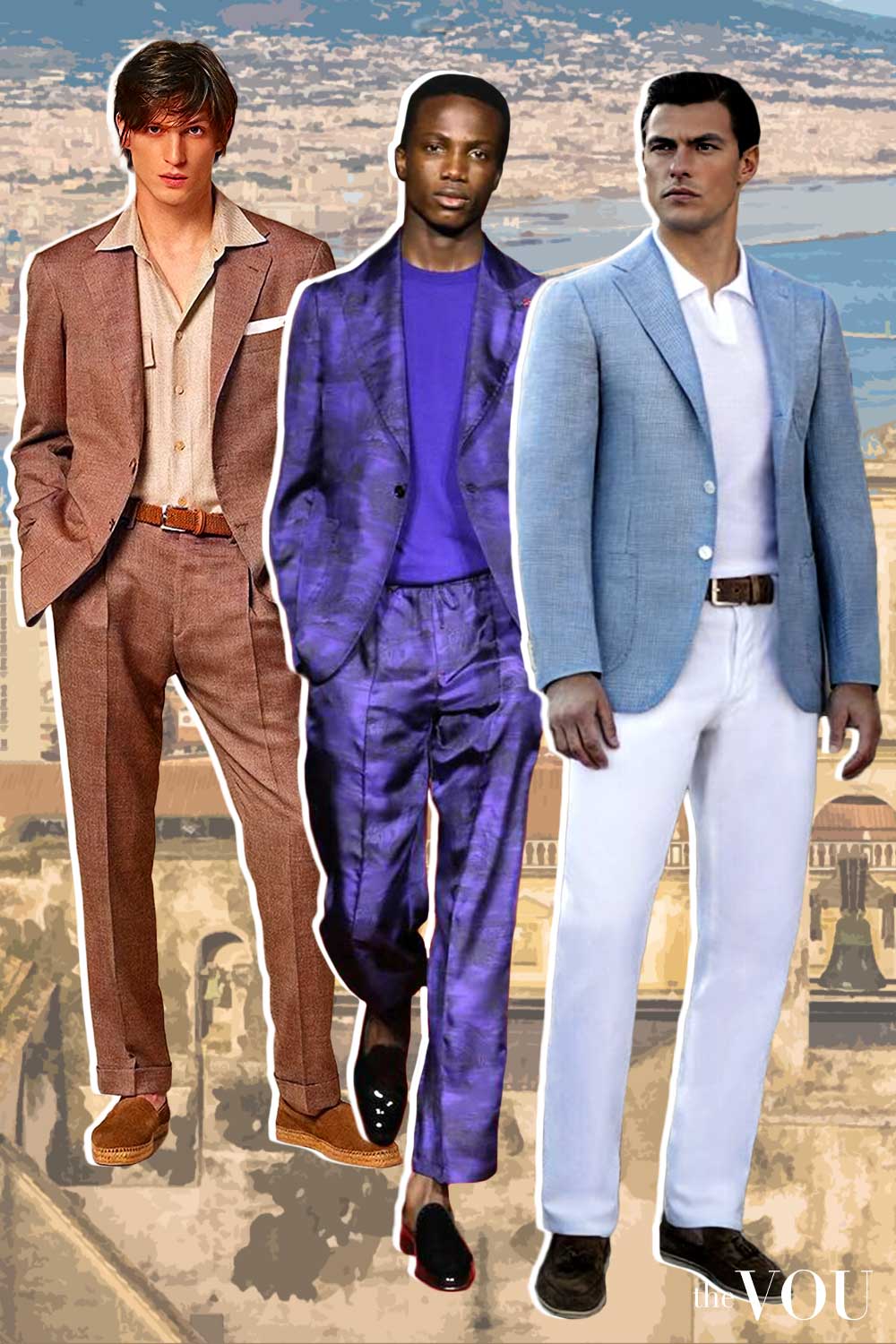
For smart casual, wear a soft jacket in brown or green wool or a linen blend, a blue Oxford or chambray shirt with no tie, grey or cream trousers and suede loafers.
On a summer weekend, wear an unlined linen or cotton jacket, a knitted polo shirt, light chinos or linen trousers and suede loafers without visible socks.
For black tie, a Neapolitan tailor can make a dinner suit, but a soft jacket in ordinary suiting does not replace one.
Fit, build and age
Soft Neapolitan construction suits many men, but how it looks on you depends on fit rather than on a rule about body shape or age.
Because there is little padding, the jacket follows your own shoulder line, so it shows your natural shape rather than building it up.
If you prefer a more defined shoulder, a structured or roped shoulder may suit you better, and that is a matter of taste.
Check that the jacket lies smoothly across the back, that the collar hugs your shirt collar and that the sleeves show a little shirt cuff.
Making the style your own
The Neapolitan look gives you room for personal choices, such as a wider or narrower lapel, a bold lining, a favourite colour of tie or a pocket square you always wear.
A good tailor will adjust house details to suit you, and a ready-to-wear soft jacket from a smaller brand can give much the same feel.
Price is not the measure of a good soft jacket; fit, comfort and how often you wear it are.
Neapolitan style today
As many workplaces have relaxed their dress codes, the soft jacket has become a practical middle ground between a suit and casual wear.
It is light enough for travel and long days, and smart enough for most offices and dinners.
Start with one navy or grey soft jacket that you can wear with trousers you already own, then add a matching suit if you find you reach for it often.
Next steps with The VOU
If you would like help applying these ideas to your own wardrobe, take our three quizzes, then book a consultation if you want personal help.
You can read about dressing for your body shape and your seasonal colour palette, and how to combine garments, footwear and accessories.
A label alone does not make an outfit work, as our articles on heritage fashion brands and Old Money style discuss.
1. Check your body shape
To check your body shape, take our body shape quiz for men.
2. Find your seasonal colours
To find your seasonal colours, take our seasonal colour quiz for men.
3. Take the fashion style quiz
Take the fashion style quiz for men to see which personal fashion styles match your taste, with outfit ideas for each.
None of the quizzes is needed to wear the outfits in this guide.
Book a consultation
For personal help, you can book one of our paid consultations with The VOU’s image consultants and fashion stylists.
You can also contact us with any questions.