

Start here
What’s This About
In menswear, WASP style is an informal name for the traditional American East Coast wardrobe of Oxford shirts, navy blazers, chinos, Shetland jumpers, tweed and loafers.
This guide explains where the clothes came from and how to wear them today, such as
What the WASP label means and why this guide is about clothes, not people
How Brooks Brothers and J. Press shaped the wardrobe
The core shirts, trousers, knitwear and jackets
Classic shoes, repp ties and belts
Four complete outfits from weekend to formal day wear
and many more!
The garments are available at many prices, so start with what you own and add one at a time.
Key Points
01WASP is an ethno-religious label, and the clothes it describes say nothing about the wearer’s background.
02The wardrobe overlaps closely with Ivy League and preppy style.
03Brands are examples; fit, durability and repair matter more than labels.
04British regimental stripes and American repp stripes traditionally run in opposite directions.
What “WASP style” means
WASP style is an informal name for the traditional American East Coast way of dressing in Oxford button-down shirts, navy blazers, chinos, Shetland jumpers, tweed jackets and loafers, worn until they look comfortably used.
The look is often caricatured with popped collars, pink trousers and boat shoes, but the everyday wardrobe is plainer than that.
WASP is an acronym for White Anglo-Saxon Protestant, a label for Americans of mainly British or Northern European ancestry and Protestant background, and dictionaries note that it is sometimes disparaging.
Merriam-Webster dates the term to 1948, and the sociologist E. Digby Baltzell made it widely known through his 1964 book The Protestant Establishment.
In menswear the phrase is used loosely for a clothing tradition, and this guide is about the clothes, not about people.
Anyone can wear these garments, and they say nothing about a person’s ancestry, religion, income or upbringing.
The tradition overlaps heavily with preppy style and Ivy League style, and in practice the three labels describe much the same wardrobe.
The difference is mostly one of emphasis, as the WASP label tends to mean the quieter, older version of the look, with fewer bright colours and logos.
This guide covers where the clothes came from, the core wardrobe, four complete outfits and how to wear the look today.
Where the clothes came from
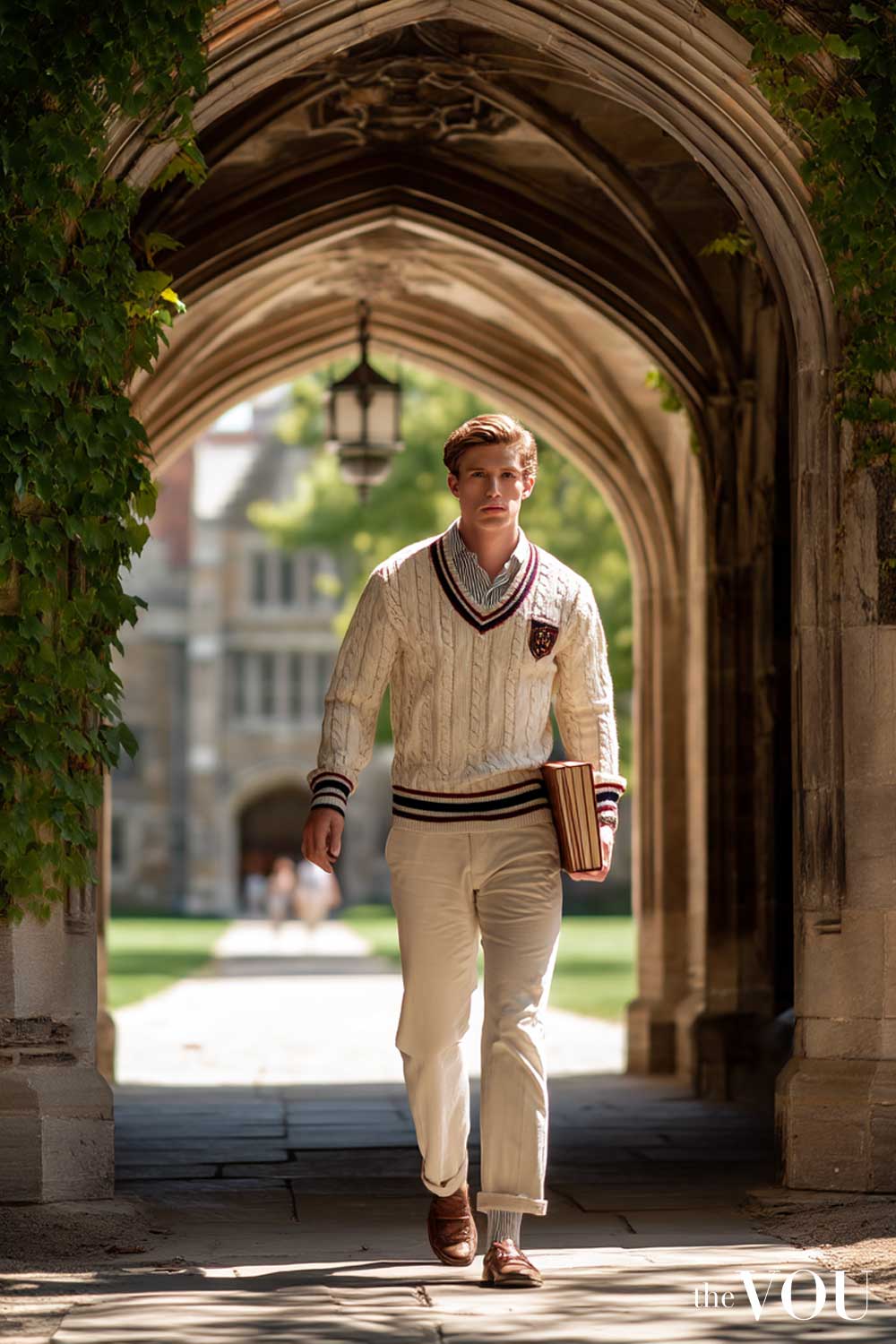
Campus clothes and British sporting dress
From the early 20th century, students at north-eastern American universities adopted British country and sporting clothes, such as tweed jackets, cricket jumpers and soft-collared shirts.
The clothes were practical and hard-wearing, which suited sports such as rowing, tennis and sailing.
The look is now often labelled Old Money style and contrasted with New Money style, but both are modern style labels that describe clothes, not the wearer’s background.
Brooks Brothers and J. Press
Brooks Brothers in New York and J. Press, founded at Yale in New Haven in 1902, were the two shops that did much to define the wardrobe.
Brooks Brothers says that John E. Brooks noticed English polo players with buttoned-down collars in 1896, and the company introduced its button-down collar shirt around 1900; this became the Oxford cloth button-down (OCBD) at the centre of the look.
Both shops sold the sack suit, a jacket with a natural shoulder and a straight body without front darts, which became the standard American campus and business suit.
After the Second World War the same clothes spread from campuses into offices and suburbs.
Bright colours and The Official Preppy Handbook
Brighter leisure clothes grew alongside the plain wardrobe. Madras jackets were popular in resorts such as Palm Beach from the 1930s, and in the 1950s Brooks Brothers sold blazers and trousers in strong colours.
Nantucket Reds, the faded brick-red canvas trousers, were introduced in the 1960s by Murray’s Toggery Shop on Nantucket, and our guide to Nantucket red trousers explains their history.
The Official Preppy Handbook, a satirical guide edited by Lisa Birnbach and published in 1980, listed these clothes with tongue-in-cheek rules and helped make the look widely known.
How the look is worn
The look depends less on any single garment than on how the clothes are worn.
Clothes are allowed to look used, so a soft, slightly creased Oxford shirt is normal, and a waxed jacket with scuffs and repairs is kept rather than replaced.
Quality and repair count for more than quantity, so one well-made tweed jacket worn for years fits the spirit better than several short-lived ones.
Fit is relaxed rather than tight, and nothing in the outfit is meant to draw attention on its own.
The core wardrobe
These are the garments most often associated with the look; brands are examples, not requirements, and similar clothes are made at many prices.
Shirts, trousers and the blazer
For an Oxford cloth button-down shirt, choose a medium-weight Oxford cloth and a soft, unlined collar that rolls; white, solid blue and blue-and-white university stripe are the usual colours.
Chinos are flat-front or single-pleated, with a straight or gently tapered leg, in khaki, stone or navy.
Wool trousers come in mid-grey flannel for cooler months, or a grey worsted for a smoother, lighter cloth.
The summer cloths are blue-and-white seersucker, and linen in white, oyster or natural beige.
Navy blazer. The traditional version is single-breasted with a natural shoulder, a three-roll-two front, a centre vent and often patch pockets, with brass or dark horn buttons.
Knitwear and outerwear
A Shetland jumper is a crew-neck in Shetland wool, in navy, green, heather grey or burgundy; J. Press sells a heavily brushed version it calls the Shaggy Dog.
The cricket or tennis jumper is a cream cable-knit V-neck with coloured stripes at the neck, cuffs and hem, like the one in the photograph above.
A waxed cotton jacket is a common choice for rain; Barbour’s Bedale (introduced in 1980 as a short riding jacket) and Beaufort (introduced in 1983) are two well-known models, usually in olive or navy.
Among Harrington jackets, Baracuta’s G9, which the company dates to 1937, is lined in Fraser tartan and is the best-known version, in tan or navy.
For an overcoat, pick a single-breasted wool overcoat such as a Chesterfield, or a camel polo coat, in navy, grey or camel.
Tailoring and cloth
Tailoring is conservative, with the soft sack suit as the traditional shape and sport coats in a few classic cloths.
Tweed is one of those cloths, and Harris Tweed is a protected name for tweed hand-woven in the Outer Hebrides of Scotland, often in herringbone, barleycorn or gun club check.
Madras is a light, hand-woven cotton check from India, known for colours that bleed when washed, used for summer jackets and shirts.
Glen check is a woollen check, also called Prince of Wales check, usually in grey or brown, for suits and sport coats.
Shoes
Traditional shoes are plain, sturdy and often Goodyear-welted so they can be resoled.
Penny loafers are the classic casual shoe, in burgundy or dark brown like the Weejun, which G.H. Bass introduced in 1936.
Tassel loafers are a dressier loafer; Alden’s tassel loafers in dark burgundy shell cordovan, which Alden calls Color 8, are a well-known example.
Boat shoes are brown leather deck shoes with white soles for summer.
A longwing brogue is a brogue whose wingtip runs right around to the heel, usually brown or burgundy.
Saddle shoes, a two-tone oxford usually white with a black or brown saddle, are now worn mostly as a retro choice.
For boots, wear rubber-bottomed duck boots, such as L.L.Bean’s, for rain and mud, and suede chukka boots for smarter wear.
Accessories
Accessories are kept simple so they suit the clothes rather than dominate them.
Striped silk repp ties are the classic choice; British regimental stripes traditionally run from the wearer’s left shoulder down to the right hip, and American repp ties traditionally run the other way.
Some British stripe colours belong to particular regiments, schools or clubs, so it is worth choosing a pattern that is not an existing club tie if that matters to you.
Other ties include navy or black silk knit ties, ancient madder silk ties with a soft, chalky finish, and wool challis ties with small motifs.
Wear a plain watch on a leather, grosgrain or striped fabric strap; the brand matters far less than a clean, simple dial.
The belt can be a slim leather belt in brown or black, a woven surcingle belt with leather tabs, or a ribbon belt with a small motif.
Four outfit ideas
Outfit 1 for a casual weekend
Wear stone chinos, a blue Oxford button-down with the top button undone, a navy or green Shetland crew-neck and burgundy penny loafers, with a navy and red surcingle belt.
Outfit 2 for business casual
Wear mid-grey wool flannel trousers with a crease, a white Oxford button-down, a navy three-roll-two blazer with brass buttons, a navy and gold striped repp tie and dark burgundy tassel loafers.
Outfit 3 for a summer evening
Wear Nantucket Reds or other faded red canvas trousers, a light blue linen shirt with the sleeves rolled once, a madras jacket if you want more colour, brown leather boat shoes and a ribbon belt.
Outfit 4 for formal day wear
Wear a charcoal or navy worsted sack suit, a white shirt with a straight point collar and barrel or double cuffs, a black silk knit or navy grenadine tie, polished black cap-toe oxfords such as Allen Edmonds or Crockett & Jones, and a white linen pocket square in a straight fold.
A button-down collar is usually kept for odd jackets and blazers rather than dark suits, though the rule is often relaxed.
The look today
A modern fit
Modern versions of the look keep the same garments with a slightly trimmer cut than the full traditional sack suit, while still avoiding a tight fit; our guide to suit cuts for an oval body shape shows how cut changes the line of a jacket.
A tweed jacket with dark, undistressed jeans and brown boots, or a Harrington jacket over a grey T-shirt and chinos, are easy everyday versions.
The current interest in plain, logo-free clothing, often called quiet luxury, overlaps with the look because both favour simple garments and little branding.
Buying second-hand
Because the garments change slowly, second-hand and vintage shops are a good source of Oxford shirts, tweed jackets, Shetland jumpers and blazers.
Buying fewer, longer-lasting clothes and repairing them is also a practical alternative to fast fashion.
Summary
WASP style, in menswear terms, is the plain, worn-in version of the American Ivy and preppy wardrobe of Oxford shirts, chinos, navy blazers, Shetland jumpers, tweed and loafers.
Start with the garments you already own, add one at a time, and choose them for fit and durability rather than for any label.