
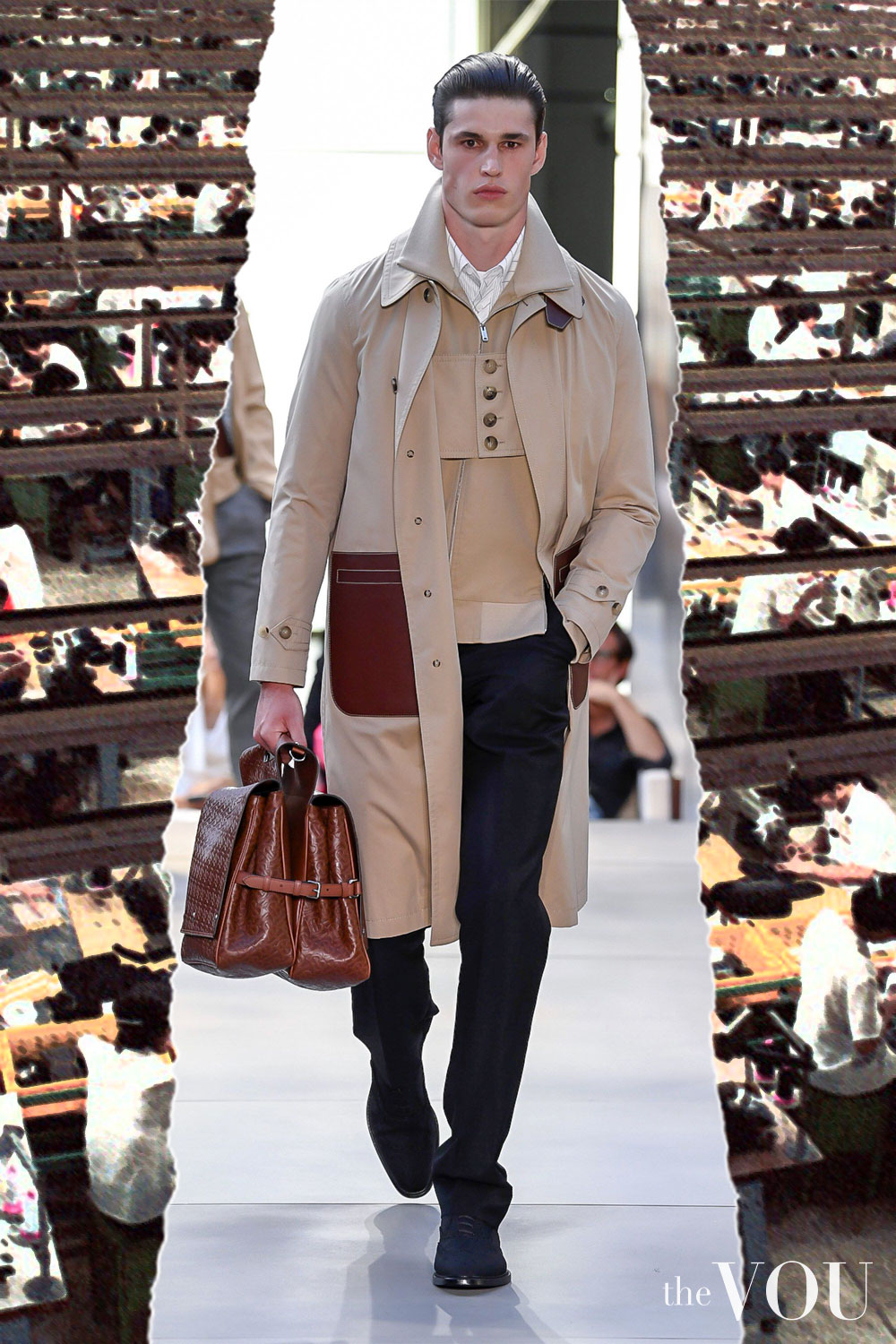
What is Ready-to-wear?
Ready-to-wear (Pret-a-Porter in French) refers to clothing and accessories made en-mass by machines in standard sizes and available for purchase as they are, without the need for custom tailoring.
Intended for the mass market, Ready-to-wear clothing, footwear, and accessories are functional, affordable, and easy to procure.
However, despite being mass-produced in factories, there are Ready-to-wear garments with a level of detail that rivals custom-made and bespoke fashion creations.
A Brief History of Ready-to-Wear
Ready-to-wear in fashion manufacturing emerged during the 19th century with the advent of the Industrial Revolution.
During that time, fashion factories with sewing machines and mass production methods became the norm, taking over local artisans and handcrafted apparel.
The ‘machine-made’ approach democratised the fashion industry, making clothing, footwear, and accessories accessible to consumers worldwide at meagre costs. [1]
Democratisation of Luxury
After the global expansion of the luxury goods market in the 80s, in a process called “democratising the concept of luxury,” high-end designers and luxury houses started to create diffusion lines to reach a wider audience.
The diffusion lines are Ready-to-wear copies inspired by high-end brands and their exquisite collections but machine-made from cheaper materials. [2]
The Advent of Fast Fashion
Fast fashion is a streamlined and more automatised version of the Ready-to-wear business model called ‘quick response.’
The fast fashion business model of manufacturing and retailing clothing emerged in the US in the late 1990s and early 21st century.
To date, fast fashion remains one of the most successful and profitable production-consumption models in the fashion industry. [3]
Ready-to-wear Examples
Example 1: The Trench Coat
Burberry’s trench coat is a classic example of an early timeless creation that, under technological advancements and global demand, has become a machine-made Ready-to-wear piece. [4]
Example 3: Denim Jeans
Levi’s denim jeans are another excellent example of a functional garment that has evolved to Ready-to-wear status under global market demand as a modern and stylish dressing option. [5]
Who Designs Ready-to-wear?
Designers in the Ready-to-wear sector range from well-known fashion houses like Chanel and Dolce & Gabbana to mainstream retail brands like Zara and H&M.
Even high-end designer brands like Ralph Lauren, Gucci, and Versace straddle high-end and affordable Ready-to-wear markets. [6]
The Benefits of The Ready-to-wear Model
1. Versatile and Affordable
Ready-to-wear clothes, footwear, and accessories cater to various consumer bodies with unique tastes and lifestyles.
Whether work attire, sportswear, or casual clothing, Ready-to-wear fashion is inclusive, diverse, and affordable for everyone. [7]
2. Profitable
Compared to custom-made fashion, a costly approach to fashion creation, Ready-to-wear is a revenue-generating machine.
The global Ready-to-wear market was valued at approximately $1.3 trillion in 2020 and continues to grow steadily. [8]
3. Fast Manufacturing
The Ready-to-wear model of manufacturing affordable and trendy clothes, footwear, and accessories at breakneck speeds has been adopted and perfected by fashion giants like Zara and H&M.
However, the Ready-to-wear system is also at the core of the fast-fashion manufacturing approach and growing concerns about sustainability and ethical practices. [9]
4. Standard Sizing
Unlike bespoke garments tailored to client’s needs, specifications, and body types, Ready-to-wear clothes are created in industry-standard sizes.
The ‘one-size-fits-all’ standardisation ensures fashion clothes, footwear, and accessories fit several buyers’ segments, thus lowering returns. [10]
Ready-to-wear vs. Haute Couture
There are five main differences between Ready-to-wear (Pret-a-Porter) and Haute Couture, as explained below:
1. Production Method
Ready-to-wear is produced en-mass by machines, while haute couture is handcrafted by expert artisans.
2. Price Point
Haute couture is exceptionally expensive, whereas Ready-to-wear has a broad price range at a much lower price point.
3. Exclusivity
Haute couture creations are highly exclusive, while Ready-to-wear is accessible to the general public.
4. Customisation
Haute couture offers customisation, whereas Ready-to-wear is standardised.
5. Timeframe
Haute couture requires months for a single piece of clothing, while Ready-to-wear clothes are available immediately.
Who Wears Ready-to-wear?
From professionals donning tailored suits to teenagers embracing modern streetwear, the ready-to-wear market caters to everyone, irrespective of age, gender, or economic status.
However, while Ready-to-wear encompasses all fashion styles for all demographics, genuine luxury fashion buyers avoid Ready-to-wear products and associated brands. [11]
Top 5 Largest Ready-to-wear Companies
1. Inditex
Inditex is the parent company of fast-fashion giant Zara and the largest Ready-to-wear manufacturer in the fashion industry.
2. LVMH
Louis Vuitton Moët Hennessy owns several Ready-to-wear brands.
3. Fast Retailing
FR is the corporate umbrella under which Uniqlo operates.
4. H&M Group
Hennes & Mauritz AB is a Ready-to-wear giant that owns fast-fashion brands like H&M, COS, and Monki.
5. Gap Inc.
Gap Inc. encompasses the Gap clothing brand, Old Navy, and Banana Republic.
Key Takeaway
The historical roots of Ready-to-wear and its evolution represent the fashion industry’s response to changing times and shifting paradigms.
At the confluence of art and commerce, modern Ready-to-wear fashion influences stylistic attitudes and creates cultural and societal shifts.
Professional Styling Advice
Are you looking to improve your fashion style and unsure where to start? Check out The VOU’s personalised styling packages based on your current way of dressing, preferred outfits, colours, aesthetics, age, gender, body shape, location, and event you seek to attend.
Your dedicated stylist will meticulously select essential garments, footwear, and accessories to craft a wardrobe that complements and enhances your style.
Bibliography
[1] Entwistle, J., (2023). The fashioned body: Fashion, dress and modern social theory. Cambridge: Polity, p. 46.
[2] Thomas, (2007). Deluxe: How Luxury Lost Its Luster, p. 141.
[3] Bhardwaj, V., and Fairhurst, A. (2010). Fast fashion: response to changes in the fashion industry. The international review of retail, distribution and consumer research, 20(1), 165-173.
[4] McDowell, C., (2010). Christopher Bailey: Burberry’s golden boy. The Times.
[5] Sullivan, J., (2007). Jeans: A cultural history of an American icon. New York: Gotham Books, p. 67.
[6] Gross, M., (2018). Genuine authentic: The real life of Ralph Lauren. New York: William Morrow, an imprint of HarperCollins Publishers, p. 81.
[7] Welters, L. and Lillethun, A., (2022). The fashion reader. London: Bloomsbury Visual Arts, p. 220.
[8] Statista (2021). Global Apparel Market Report.
[9] Cline, (2013). Overdressed: The shockingly high cost of cheap fashion. New York: Penguin Putnam, p. 68.
[10] Ashdown, S.P., (2007). Sizing in clothing: Developing effective sizing systems for ready-to-wear clothing. Cambridge, England: Published by Woodhead Pub. Ltd. in association with the Textile Institute, p. 32.
[11] Crane, D., (2009). Fashion and its social agendas class, gender and identity in clothing. Johanneshov: TPB, p. 94.
Raf Adams’s focus at The VOU is luxury menswear, brand analysis and quiet-luxury styling. His coverage addresses men who want to understand the difference between a recognisable label, a documented garment feature and a buying choice that makes sense for their wardrobe.
His subject areas include materials, construction details, brand positioning and the understated clothing references associated with quiet luxury. This focus examines what can be established from product information and what remains a matter of appearance or preference. Price and reputation provide context, but neither replaces attention to fit, intended use and the details of the item being considered.
Raf’s editorial coverage connects those comparisons with complete outfits and repeat wear. Readers exploring premium clothing can consider how a purchase works with existing pieces, which features matter to them and whether a less conspicuous look suits their needs. The aim is to make luxury menswear easier to assess without turning a brand name into a promise of quality or personal style.
Mandy Meyer’s focus at The VOU is men’s body-shape styling, garment fit and outfit proportions. Her coverage addresses the practical questions behind a wardrobe choice: how a jacket sits across the shoulders, how trousers fall and how different cuts change the silhouette a wearer wants to create.
Her subject areas include the triangle, inverted triangle, rectangle, oval, trapezoid, hourglass and diamond labels used in body-shape styling. These provide starting references for comparing visible proportions; they do not capture every body or prescribe one correct way to dress. The focus connects those observations with garment shape, construction, length and the relationship between the upper and lower parts of an outfit.
Mandy’s editorial coverage combines visual comparisons with fit checks for comfort and movement. Readers can consider whether a cut gives them the room they need, where clothing pulls or gathers and which changes might support their preferred look. The aim is to make menswear choices more understandable while keeping personal preferences and the wearer’s own styling goals central.
Lawrence Anderson’s focus at The VOU is old-money style, British heritage menswear and the wider strategy behind a man’s wardrobe. His coverage addresses readers who want a composed, consistent style but need practical guidance on where to begin, what to keep and which pieces deserve a place in their wardrobe.
His subject areas connect classic tailoring, knitwear, footwear and accessories with the proportions and formality of a complete outfit. British countryside clothing, preppy dressing and Ivy-inspired references provide context for understanding different versions of the look. The emphasis is on recognising the relevant details and adapting them to the wearer’s life, rather than treating an aesthetic as a requirement to buy particular labels.
Lawrence’s editorial coverage brings wardrobe planning back to the reader’s needs: everyday clothing, professional presentation, occasion dressing and a workable budget. It considers existing pieces, outfit coordination and repeat use, giving men a basis for building personal style over time. A coherent wardrobe should reflect the person wearing it and the situations they actually need to dress for.