
Start here
What’s This About
If you want a round outline to look longer or more defined, keep the sides of the beard shorter and put length or crisp edges at the chin; if you like a softer, fuller look, that is equally open to you.
This guide covers the choices that shape the result, such as
How a Balbo with an extended goatee keeps the cheeks clear
Where an angular full beard and a short box beard add definition
How a tapered beard grades from shorter cheeks to a longer chin
What brushing a beard downward can and cannot change
and many more!
We also cover the growth each style needs and what to tell your barber.
Key Points
01Shorter sides and extra chin length add apparent length, and crisp edges along the jaw add definition; both are optional goals, not corrections.
02Full cheeks are not the same as a round outline, so judge the jaw corners and the overall proportions, not fullness alone.
03Brushing arranges the length you have; it does not change the direction your hair grows from or add coverage.
04A rounder, fuller beard is also a valid choice if you prefer to echo your curves.
Round face shapes, as The VOU uses the term, describe a relatively compact outline, similar in length and width, with curved rather than angular jaw corners.
Full cheeks on their own do not settle the description, because fullness and bone shape are separate observations.
If you are not sure which description fits, our face shape quiz is a useful starting point, though it is a guide rather than a measurement.
The styles below keep the sides shorter and concentrate length or definition at the chin and jaw, which is the route to take if you want a round outline to look longer or more defined.
Before You Choose, Check What Your Beard Can Do
Let your beard grow for a few weeks without shaping it, then look at it dry and brushed, in even light, from straight in front and from each side.
Chin and upper lip. Most styles here rely on the chin, so check how densely your chin and upper lip grow and whether your moustache joins the chin at the corners of your mouth.
Cheeks. Patchy cheeks are less of a problem with a round outline, because several of these styles keep the cheeks short or shaved.
Texture and curl. Curly or coarse hair stands away from the face and adds width at the sides; straight or wavy hair lies flatter and falls downward more easily.
Upkeep. Shaved borders and sharp angles need attention every day or two; a tapered or downward-styled beard can go longer between trims.
1. Balbo Beard With Extended Goatee
A Balbo combines a moustache, usually separate from the beard below it, with a chin beard that extends along the jaw, while the cheeks and sideburns are shaved.
This Balbo variation leaves the most length at the chin, so the outline stays narrow at the sides and longer at the centre.
Leonardo DiCaprio, pictured below, wears a goatee-centred beard with added chin length.
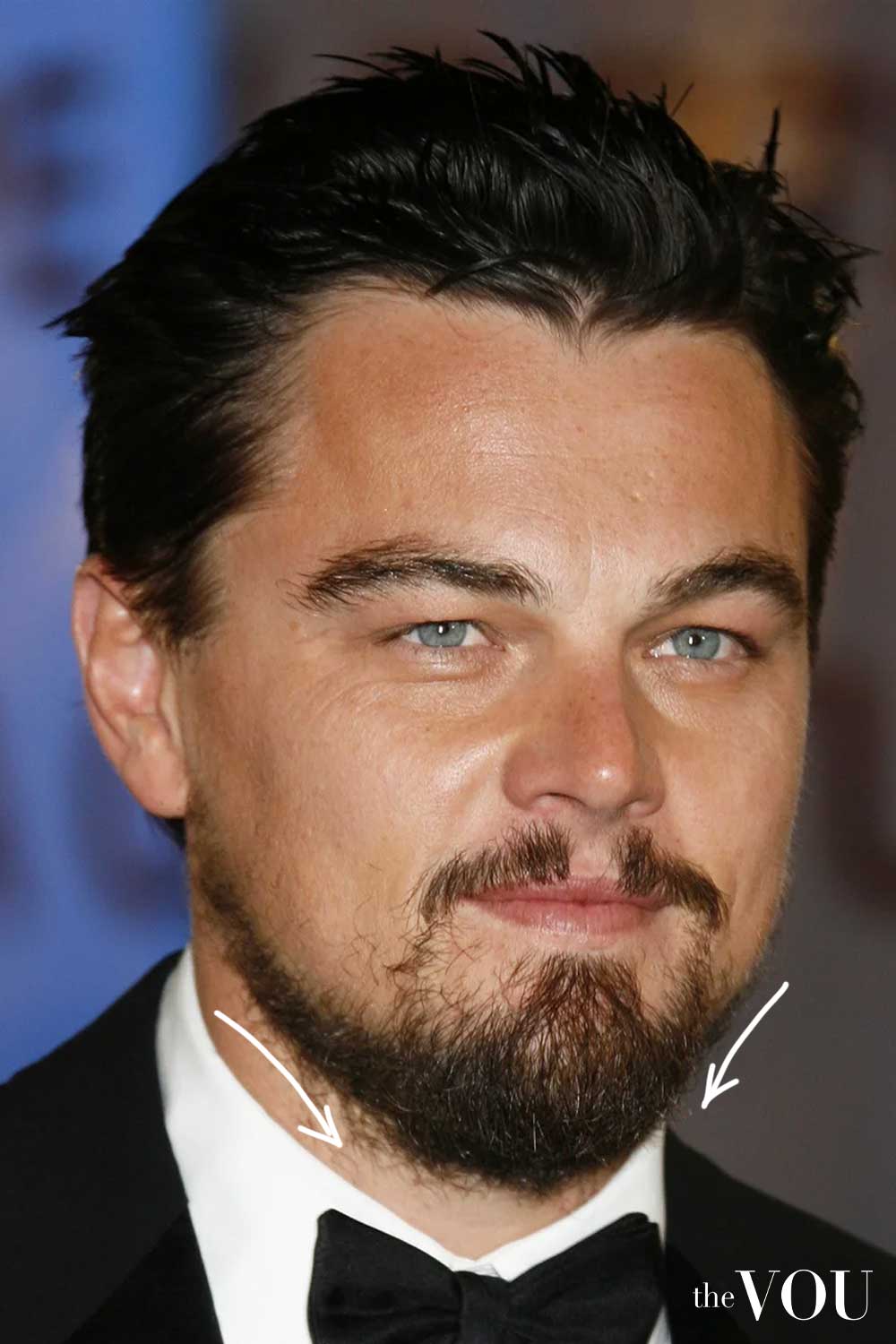
Why it works. Clear cheeks reduce width at the sides, and a longer chin draws the eye downward, adding apparent length to the lower face.
For coverage, a Balbo needs solid growth on the upper lip, under the lower lip, across the chin and along the lower jaw where the extensions sit; the cheeks can be sparse, which makes the Balbo a useful choice when cheek growth is patchy.
If your growth joins the moustache to the chin at the corners of your mouth, you can keep that connection and wear a connected extended goatee instead.
Maintenance. Keep the chin a little longer than the jaw extensions, shave the cheeks and the gap around the moustache often, and check symmetry with your mouth relaxed.
Ask your barber for “Balbo shape: moustache separate, chin beard carried a little along the jaw, cheeks and sideburns clean, and the most length at the chin.”
2. Angular Full Beard
The angular full beard covers the cheeks and jaw but is shaped with straighter lines and defined corners rather than following the face’s curves.
Aaron Paul, pictured below, wears a well-kept full beard with defined edges.

It works because a straight cheek line and squared-off corners at the jaw add definition that contrasts with a curved outline.
Keeping the sides shorter than the chin stops the full beard adding width at the cheeks.
Coverage check. Angles need dense growth at the corners being shaped; where growth thins along the jaw, the angle will look softer than intended.
For maintenance, keep the sides short with a guard, leave the chin longer, and refresh the cheek line and the corners regularly, because the angles soften as the beard grows.
Ask your barber for “Full beard, sides kept tight, more length at the chin, a straight, defined cheek line and squared corners at the jaw.”
3. Tapered Beard
The tapered beard grows gradually longer from the cheeks down to the chin, with a smooth change in length.
Usher, pictured below, wears a neatly tapered beard.
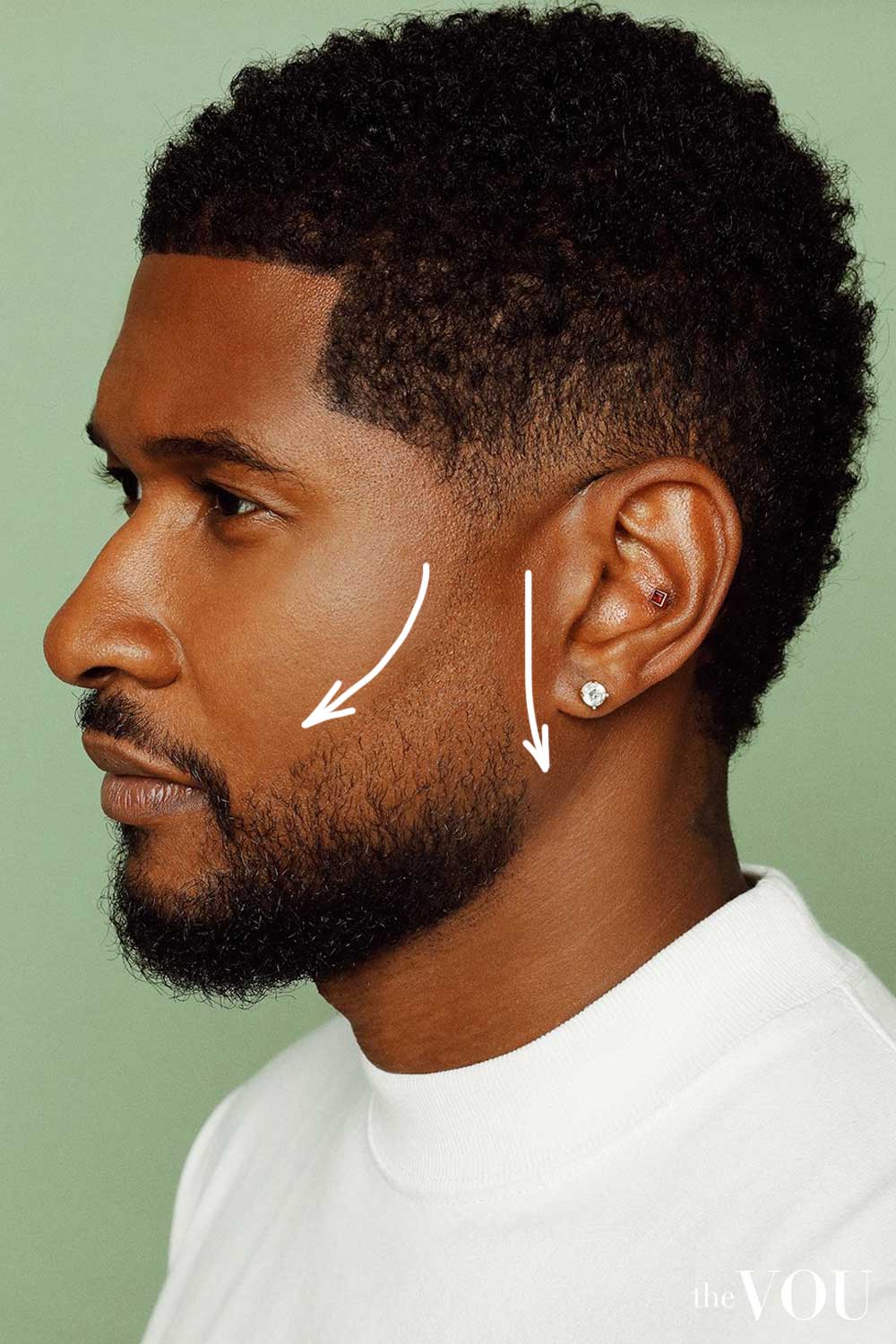
Why it works. Shorter cheeks keep the sides close to the face, and the longer chin adds apparent length to the lower outline.
How long the chin goes is a preference. A gentle taper adds a little length, and a stronger taper adds more.
Coverage check. A taper needs enough cheek growth to start from; on sparse cheeks, the barber can begin the taper lower on the jaw.
Maintenance. Use progressively longer guards from the cheeks to the chin, blending each step so no line shows.
Ask your barber, “Taper it from short on the cheeks to longer at the chin, with a smooth blend and a clean neckline.”
4. Short Box Beard with Length
The short box beard with length keeps the sides short and neatly edged and lets the chin grow a little longer.
James Corden, pictured below, wears a short, structured beard.

It works because the defined edges add structure along the jaw, and the extra chin length adds some apparent length without a long beard.
For coverage, boxed edges need reasonably dense growth along the cheek line and the jaw; a softer cheek line suits lighter growth.
For maintenance, keep the sides short with a guard, leave the chin a step longer and blend it, and keep the edges and neckline sharp.
A common starting point is a neckline about one to two finger widths above the Adam’s apple, curving back towards the angle of the jaw below the ears; check it with your head level rather than tilted back, and adjust it for your beard length and your own neck. A line set with the chin tilted up can end up too high and shorten the beard’s outline from the side.
Ask your barber for “Short boxed sides with clean edges, a little extra length at the chin, and the neckline checked with my head level.”
5. Downward-Styled Beard
The downward-styled beard is a medium beard brushed and shaped so its length falls towards the chin rather than outward at the sides.
Brushing and shaping arrange the length you already have; neither changes the direction your hair grows from the skin, and neither adds coverage.
John Bradley, pictured below, wears a fuller beard with its length falling downward.
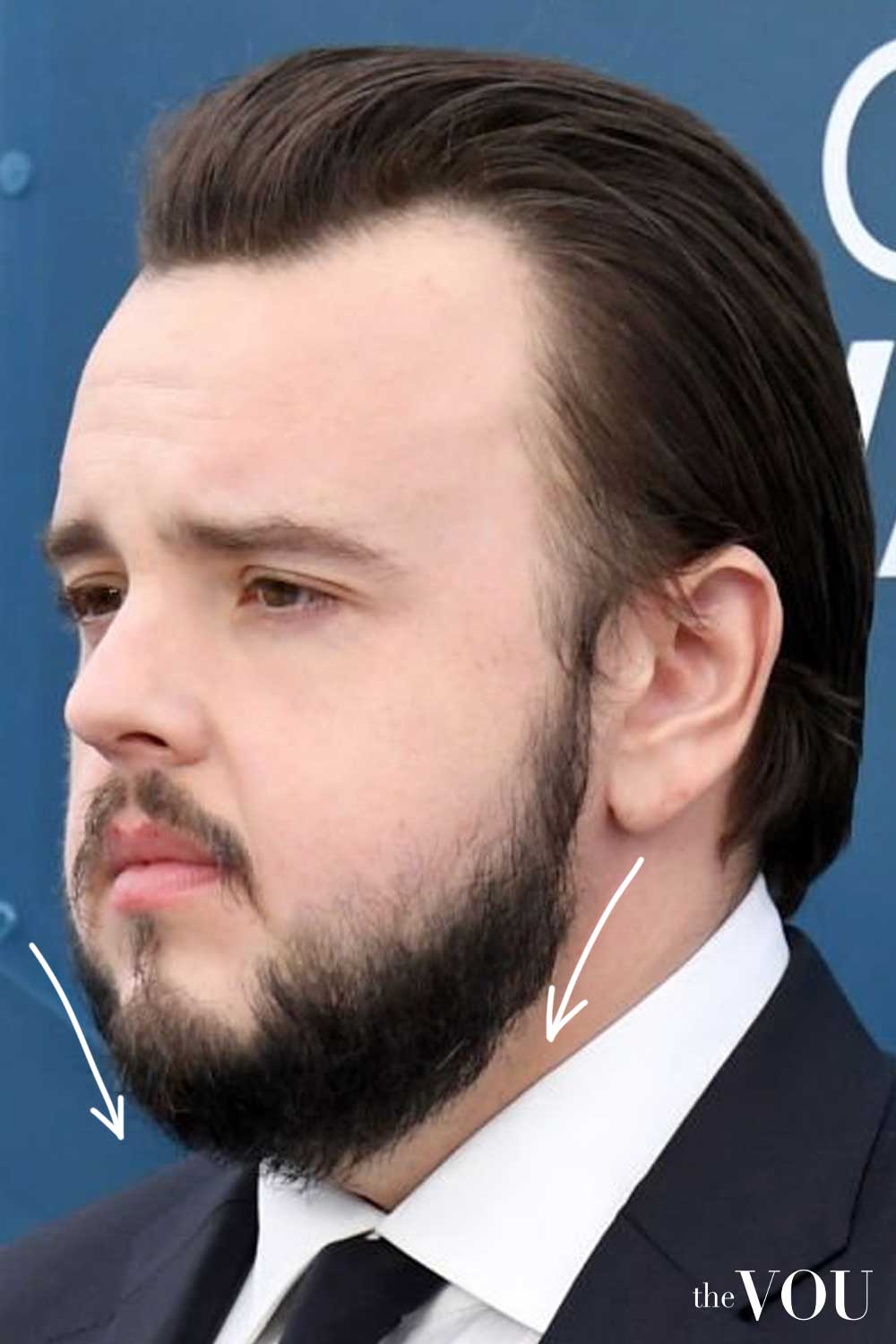
Why it works. Length that falls down rather than out keeps the sides slimmer and puts the visual weight lower, which adds apparent length.
Texture check. Straight or wavy beards lie downward more easily; curly or coarse beards tend to stand out, so they usually need the sides kept shorter to sit close.
Maintenance. Brush the beard downward while it is damp, let it dry in place, and keep the sides shorter than the chin.
Ask your barber, “Keep the sides shorter so the beard doesn’t push out, leave the length at the chin, and shape it to fall downward.”
If Your Beard Hides Your Jaw or Your Face Is Hard to Read
If you already wear a full beard, the jaw corners and chin outline underneath may be hidden, and the beard itself can make the face look rounder.
You do not need to shave to use this guide. Describe the outline your beard makes now, and record the jaw shape underneath as unknown.
An older clean-shaven photograph taken straight on, from a little further back with your head level, can help, but it is optional; a close-up selfie can make the lower face look wider.
A receding or indistinct hairline makes face length harder to judge, so compare the widths and the jaw corners you can see clearly.
If your face is compact but your jaw corners look angular rather than curved, our square face beard guide may be the closer match.
Our guide to reading your own face shape explains the landmarks in more detail.
Conclusion
With a round outline, shorter sides and more length or definition at the chin are the main levers if you want a longer or more defined look.
A softer, fuller beard that echoes your curves is equally valid; the choice is about the look you want, not a correction.
Start a little longer than you think you want, look at the shape dry from the front and the side, and take length away gradually.
Use our face shape quiz to compare descriptions, and tell your barber where you want the length to sit.
For every face shape in one place, see our guide to choosing a beard by face shape.
Take the First Step With The VOU’s Styling Quizzes
Start your style journey with our resources. First, take our Face Shape Quiz for a starting point on your face shape and initial styling guidance.
Then, check your colours with our Seasonal Colour Analysis Quiz.
Check your body shape with our Body Shape Quiz, and your personal style with our Fashion Style Quiz.
Styling Consultations
Before you go, a note on where this guide fits in a wider styling plan.
Face shape is one input among several. At The VOU, we look at it alongside your colouring, body shape and personal style.
Our Professional Face Shape Analysis package is a paid consultation; its product page lists what it includes.
Our Complete Image Transformation Package combines the face shape, seasonal colour, body shape and fashion style analyses.
If you would like personal help, you can book a paid consultation.
Our styling services for men are paid consultations; the shop page lists what each one includes.