Start here
What’s This About
Upgrading your style usually means making the clothes you already own fit, combine and last better, then adding new garments only where a real gap remains.
This guide covers the practical upgrades, such as
Checking fit in the complete outfit and knowing what a tailor can realistically change
Judging fabric and construction on the actual garment rather than the price tag
Building versatile combinations around the colours you enjoy
Refining accessories, grooming and garment care
Updating casual clothes to suit your life without age rules
and many more!
If you are starting from scratch rather than refining a wardrobe, begin with our broader personal style guide instead.
Key Points
01Fit is a strong first priority, but a deliberately roomy or relaxed silhouette is a choice, not a mistake.
02Alterations work best for small reductions such as hems, sleeves and waist suppression; shoulder width is rarely worth changing and a jacket cannot usually be lengthened.
03Quality depends on the specific garment, its construction and its care, not on a fibre name or a price alone.
04Try one change at a time in a low-stakes setting and keep the changes you want to repeat.
Developing a personal style you are happy with is not an innate talent but a skill you can practise.
For most men, upgrading means refining what is already in the wardrobe so that outfits feel more comfortable, more deliberate and more like the person wearing them.
Many men feel unsure where to start, perhaps believing they lack a “natural eye” for clothes.
This guide sets out a structured approach, built on widely used menswear conventions, that you can adapt to your budget, your work and your taste.
Whether you have a full wardrobe that rarely works together or a few favourite outfits you want to build on, the sections below follow a sensible order, with fit first, then quality, versatility, details, casual wear and gradual experiments.
If you have no clear direction yet, our guide on how to develop your personal style covers the earlier discovery stage.
I. Mastering Fit, the Starting Point for Better Style
Fit is one of the most useful places to start, because a garment that fits well is easier to wear, easier to combine and usually looks more considered.
Clothes that pull, sag or restrict movement are uncomfortable whatever they cost, and fixing a fit problem can be cheaper than replacing the garment.
Fit and silhouette are separate questions. Fit is whether a garment works on your body, while silhouette is the overall shape you choose, from close-cut to deliberately relaxed.
Distinguish Excess Fabric From a Relaxed Silhouette
Many men buy a size up for comfort and end up with fabric that bunches, drags or hides the garment’s intended shape.
A roomy shirt, an extended shoulder or a wide trouser leg can be a deliberate style, and more fabric does not automatically mean poor fit.
Check whether the garment does what it was designed to do. A relaxed jacket should still sit cleanly at the collar, and wide trousers should still have a waist that stays put and a hem that clears the floor.
Understand Key Fit Points
A few checkpoints are widely used for tailored clothing.
- A jacket’s shoulder seam usually ends close to where your shoulder ends, without a dent below the seam or a ridge of fabric beyond it; soft or extended shoulders are a deliberate variation.
- Shirt cuffs commonly end around the wrist bone or the base of the thumb, and many men like a little shirt cuff showing below a jacket sleeve, although tailors disagree on how much and some prefer none.
- Tailored trousers often sit higher than jeans, at the natural waist or just below it, and the break over the shoe is a preference ranging from none to a full break.
Treat the checkpoints as conventions to compare against, not exact measurements; our men’s fit guide explains each check in more detail.
Use Tailoring Where It Helps
Ready-to-wear clothing fits some bodies closely and others less well, so a small alteration can be worthwhile.
Adjustments to sleeve length, trouser hems, trouser tapering or taking in the waist of a shirt or jacket are routine for most tailors and can change how a garment looks and feels.
Larger changes are limited, because shoulder width is generally not worth altering, a jacket cannot usually be lengthened, and there is often little spare fabric to let a ready-to-wear garment out.
Bring the garment, the layers and the shoes you intend to wear, describe the problem and ask the tailor what is feasible and what it will cost before you commit; the same applies to charity-shop or vintage finds.
If a garment needs major reshaping, a different cut or size is usually the better route; see our beginner’s guide to what tailoring involves for background.
Know Your Measurements
Keep a note of your neck, chest, waist, inseam and sleeve measurements on your phone, taken the same way each time.
When shopping online, check whether a brand’s chart describes body measurements or the garment’s own dimensions, and compare like with like.
Measuring a garment that already fits you well, laid flat, is often the most reliable way to compare against a seller’s garment measurements.
II. Adopt an Investment Mindset, Prioritising Quality and Longevity
Upgrading your style often involves buying fewer garments and choosing each one more carefully.
The principle of “buy less, but better” is useful when better means a garment you will wear often, can maintain and can afford.
Judge Materials on the Actual Garment
High-quality cottons, such as those used in an Oxford cloth button-down shirt, wools such as merino, cashmere for jumpers, linen for summer trousers, sturdy denim and full-grain leather for shoes are long-standing choices for good reason, since many men find them comfortable and durable when well made.
A fibre name or a price does not guarantee quality on its own, so read the composition and care label, inspect the seams and fastenings, and consider how the cloth feels and moves.
Synthetic and blended fabrics also have roles, for example in rainwear, travel clothing and stretch trousers, so judge each garment against how you will use it.
Build Around Staples You Will Actually Wear
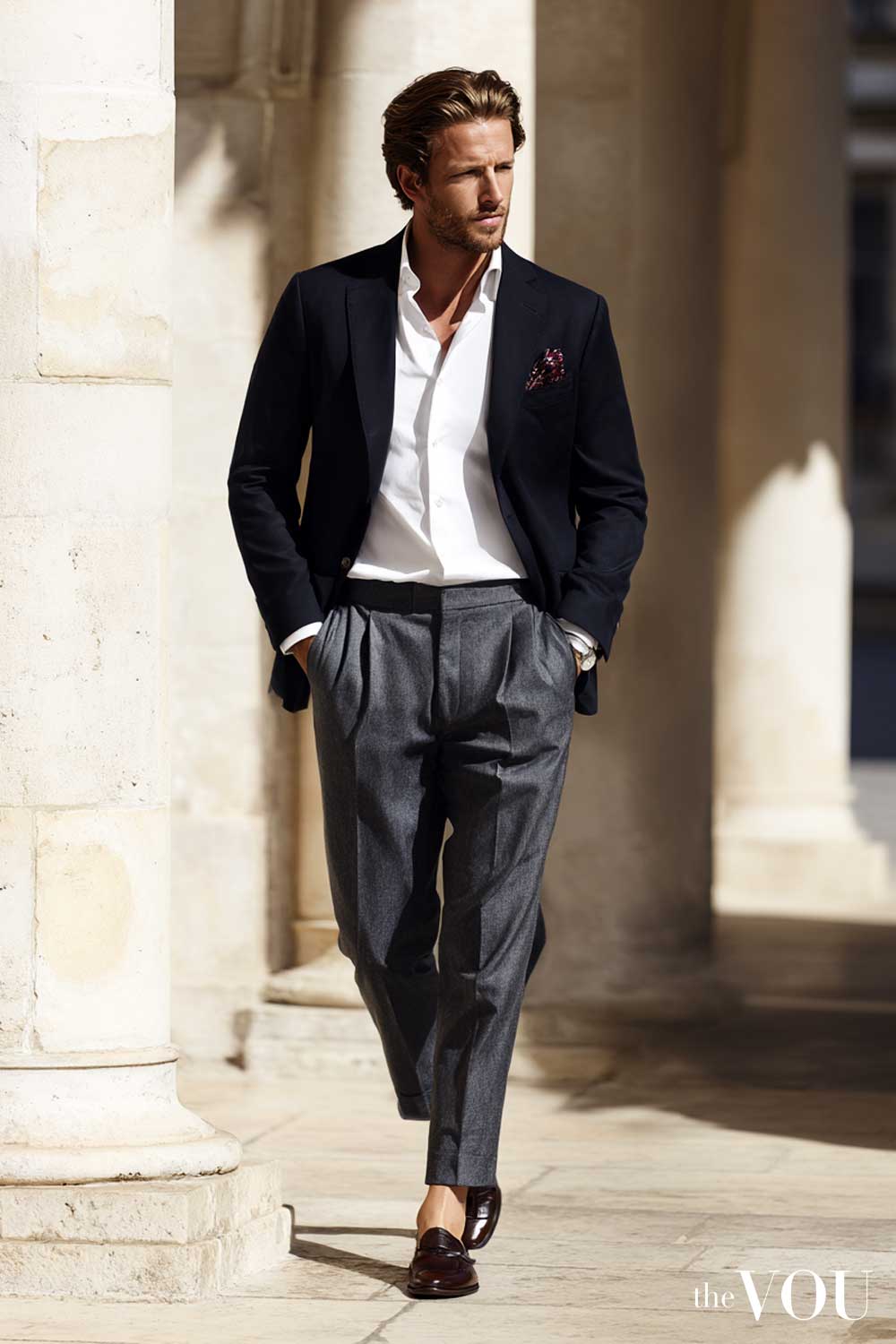
Many men build the core of a wardrobe from versatile classics such as a white dress shirt, dark raw denim jeans, a navy blazer, grey flannel or wool trousers, minimalist leather trainers and Goodyear-welted dress shoes.
Those classics are a common starting list, not a compulsory one; your own favourite garments in current rotation are a better guide to your core style preferences.
If you rarely wear tailoring, for example, a well-made overshirt or a good knit may earn its place more readily than a blazer.
Understand Value Versus Price
Higher prices sometimes reflect better materials and construction, and a well-made garment that you wear often can offer good cost-per-wear value over time.
Price alone does not prove quality, though, and a moderately priced garment that fits and suits your routine may serve you better than an expensive one that stays in the wardrobe.
Handling premium garments in shops, even outside your budget, can help you learn what good fabric and finishing feel like, which makes comparisons at every price easier.
Look for Durability
Well-made footwear such as chukka boots, well-constructed outerwear and classic accessories such as a watch can last many years if chosen carefully and maintained properly.
Check construction details you can see, such as stitching, resoleable soles and reinforced stress points, rather than relying on a label’s reputation.
III. Build a Versatile Core Wardrobe
A functional wardrobe lets you mix and match easily, creating different outfits from a well-chosen selection of garments.
Use Neutral Colours as a Base, If You Like Them
Navy, grey, white, black, beige or khaki, olive and brown combine easily, which is why many wardrobes are built around them.
If you want to compare how different shades look near your face, a core colour palette from seasonal colour analysis is one optional framework.
There is no required ratio of neutrals to bright colours or patterns; if you love colour, build combinations around the colours you wear most and check how much of each appears in a complete outfit.
Select Versatile Garments
Choose garments that move between levels of formality.
A navy unstructured blazer can work for a smart-casual office and for weekend plans.
Dark-wash jeans can be worn with a T-shirt or dressed up with a sport coat.
Minimalist trainers suit casual outfits and can also pair with tailored trousers, including versatile chinos, where the dress code allows.
Plan for Your Lifestyle
Your wardrobe should reflect your daily activities and work requirements.
A man working in a formal corporate environment needs different core garments from a creative entrepreneur working from home, and someone who cycles to work needs different layers from someone who drives.
If you enjoy tailoring but cycle, consider trousers with some stretch, a softly constructed jacket that packs easily, or changing into your tailored clothes at work.
Prioritise garments you will genuinely wear often, and keep occasional formalwear if you need it, even if most days are casual.
IV. Refine the Details with Accessories, Grooming and Care
A polished appearance extends beyond the main garments, and small details can be inexpensive upgrades.
Choose Accessories Deliberately
Accessories add personality and work best when chosen on purpose.
Many men like to coordinate leathers, such as belt, shoes and watch strap, and metals, such as buckle, watch and cufflinks; a deliberate contrast is also a valid choice.
One or two points of interest are often easier to wear than many competing accessories, but there is no fixed count; compare the complete outfit.
Useful accessories include a watch you enjoy wearing, a few versatile ties, subtle pocket squares, well-chosen eyewear and simple cufflinks if you wear double-cuff shirts.
Prioritise Grooming
Grooming supports any outfit.
Keep a haircut you can maintain, keep facial hair shaped as you intend, and look after skin, teeth, hands and nails in a routine that suits you.
Maintain the Clothes You Own
Proper care helps good clothes last.
Follow the care label, use sturdy hangers with shaped shoulders for jackets, and use shoe trees for leather shoes to help them keep their shape between wears.
Press or steam garments where the care label allows, and deal with loose buttons, small tears and worn heels promptly.
Well-maintained clothes look better and usually last longer.
V. Update Casual Wear to Suit Your Life
Casual clothes are often a simple place to start, and the aim is a casual wardrobe that suits your current routine rather than a list of garments banned at a certain age.
Review Casual Staples Honestly
Age does not require you to discard graphic T-shirts, caps, trainers or distinctive clothing.
Instead, ask whether a garment still interests you, still fits, is in good condition and suits the situations you wear it to.
Worn-out trainers, stretched T-shirts and badly fitting cargo shorts are easy candidates for replacement because their condition or fit has gone, not because of the wearer’s age.
If you want a quieter look, try swapping one graphic T-shirt for a plain one; if you love the graphic, build the rest of the outfit around it with clean jeans and a plain overshirt.
A cap suits plenty of casual settings and sits less comfortably with tailoring, so match it to the outfit and the occasion.
Upgrade Casual Basics
Good-quality plain T-shirts, polos and henleys in colours you enjoy are versatile foundations.
Clean dark jeans, well-fitting chinos or tailored chino shorts in warm weather pair easily with them, as do minimalist leather trainers, loafers or desert boots.
Refine Your Outerwear
A small selection of good outerwear, such as a classic denim jacket, a Harrington jacket, a field coat, a trench coat or a bomber jacket, can elevate casual looks quickly.
Choose a Bag That Suits Your Day
Choose a bag for what you carry and how you travel.
A leather briefcase, messenger bag or tote can suit tailored clothing, while a well-made, simple backpack is a practical choice for cycling, commuting on foot or carrying a laptop.
VI. Cultivate Your Personal Style and Confidence
Developing style involves learning what you enjoy wearing, and many men find that dressing in clothes they like makes them feel more at ease.
For a full step-by-step discovery method, see our guide on developing your personal style; the tips below focus on refining a wardrobe you already have.
Identify Inspiration
Observe the style of men you admire, such as your personal style icons, whether they are actors, public figures or colleagues.
Analyse what specifically appeals to you, whether the fit, the colour palette or the overall look.
Use those observations as a guide, not a prescription to copy, and check them against your own routine and budget.
Understand Yourself
Reflect on how you want to feel in your clothes and how you would like to come across.
Combine those preferences with practical needs such as your work dress code, climate and commute; a uniform or dress code you must follow is not evidence of your preferred style.
Experiment Gradually
Step outside your comfort zone in small steps.
Use the “swap trick”. Replace one familiar garment in a reliable outfit with something slightly bolder, for example a patterned or coloured shirt in place of a plain one.
“Break In” New Styles
Wear a new outfit or garment for a low-stakes occasion, such as running errands, before wearing it to an important event.
A trial run builds familiarity and shows you practical issues, such as a collar that rubs or shoes that pinch, before they matter.
Recognise Style as a Skill
Dressing well is learned through practice and attention.
Treat getting dressed as a chance to notice what works, and follow sources whose advice explains its reasons rather than issuing rules.
Wear What Makes You Feel Good
Ultimately, the goal is to wear clothes that feel right to you.
Own your choices, and remember that comfort and enjoyment are legitimate reasons to wear a garment.
VII. Put It Into Practice
Upgrading your style works best as a series of small, deliberate actions.
Seek Expert Guidance If You Want It
Some men find a professional helpful, particularly for a specific fit, wardrobe or occasion problem.
A stylist can give personalised advice based on your goals and budget; ask about the scope, total cost and deliverables before booking.
Classic menswear books and well-referenced blogs are also useful, especially when they explain the reasoning behind their advice.
Shop Smart
Know your measurements and use the “pull three” trick when trying clothes on, which means taking your usual size, one size up and one size down to compare quickly.
Trying neighbouring sizes helps with size labels but cannot fix an unsuitable cut, so try a different cut if none of the three works.
Focus on fit and quality within your budget, and do not buy anything you do not love just because it is on sale.
Review Your Wardrobe Regularly
Review your wardrobe from time to time and be honest about what you actually wear.
Sort garments into those that are damaged, no longer fit, are seasonal, are for occasional use or are simply unfamiliar, because each group needs a different response.
Repair, alteration or a new combination may rescue a garment, so set uncertain garments aside for a while before deciding to donate, sell or recycle them.
Have Fun
Style takes some effort, but there is no need to get bogged down in rigid rules or forum debates.
The aim is to make getting dressed easier and more enjoyable, not more stressful.
Conclusion
Upgrading your style is an achievable goal built on a few principles applied consistently.
Check fit in complete outfits, judge quality garment by garment, build versatile combinations around colours you enjoy, look after the clothes you own and experiment one change at a time.
The aim is a wardrobe that works harder for your actual life and feels more like you, whatever look you choose.
Frequently Asked Questions
Q. What is the most important factor in dressing better?
Fit is one of the most useful starting points, because clothes that fit your body and the silhouette you want are more comfortable and easier to combine.
Fit is not the only factor, though; colour, condition and suitability for the occasion matter too.
Q. Should I follow fashion trends?
Use a trend if you like it and can make it work in your life, often through one garment or accessory at a time.
You can also ignore trends; neither choice determines whether your style is good.
Q. How much should I spend on clothes?
Spend what your budget comfortably allows, prioritising garments you will wear often, such as shoes, outerwear and versatile trousers or jackets.
Compare the actual garment’s materials, construction and fit rather than assuming price guarantees quality.
Q. How do I find my personal style?
Start by noticing the outfits you already enjoy wearing and the people whose style you admire, then try one detail at a time with clothes you own.
Our guide on developing your personal style covers the process step by step.