

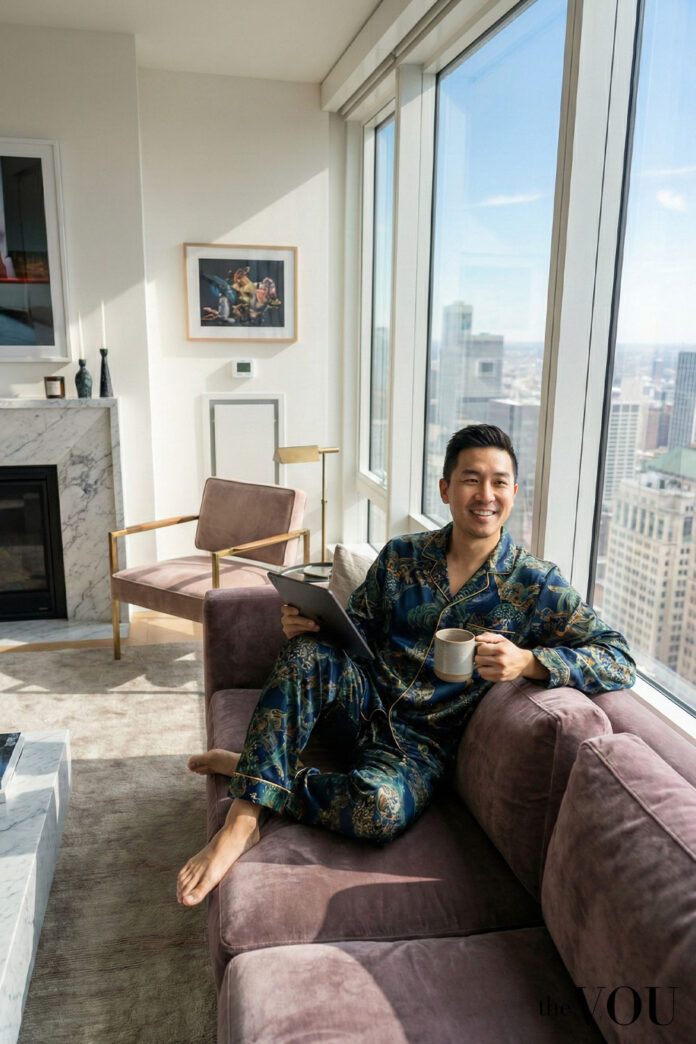
In my years as a stylist, I have noticed a peculiar paradox in the modern man’s wardrobe.
I see clients who will obsess over the Super number of their wool suit (Super 120s vs. 150s), debate the merits of Egyptian versus Pima cotton for their dress shirts, and spend hundreds on Goodyear-welted shoes.
They understand that during the day, high-quality materials equal high performance and confidence.
Yet, a strange phenomenon occurs the moment the sun goes down. These same men, who wouldn’t dream of wearing a cheap, scratchy polyester shirt to a board meeting, will happily climb into bed wearing an old, faded gym t-shirt or bargain-bin synthetic shorts.
It is time to close that gap. We spend approximately one-third of our lives in bed. From a stylist’s perspective, sleepwear is not an afterthought but most important outfit you will wear all day because it dictates your recovery.
If you are looking for comfortable men’s pyjamas, you need to look past the pattern and focus on the physics of the fibre.
This is your definitive guide to upgrading your sleep game, bridging the gap between sartorial style and sleep science.
Sleep Physiology – Your Gym Shirt is Failing You
To understand why fabric choice is a medical necessity rather than a luxury, we have to look at “Sleep Architecture.”
When you enter the deep stages of REM sleep, your body undergoes a process called thermoregulation.
To fall asleep and stay asleep, your core body temperature needs to drop by approximately 1 to 2 degrees Fahrenheit (approx. 1°C). According to data from the National Sleep Foundation, this temperature drop is a crucial biological signal to your brain that it is time to rest.
The Science of “Thermal Effusivity”
Here is a fact most people don’t know: Not all fabrics feel “cold” or “warm” based on their actual temperature. It depends on a metric called Thermal Effusivity.
A study published in Nature and Science of Sleep highlights that thermal effusivity measures a material’s ability to exchange heat with your skin.
- Low Effusivity
Materials like foam or polyester feel warm instantly because they trap your heat. - High Effusivity
Materials like stone, or in the textile world, bamboo and linen, feel cool to the touch because they instantly draw heat away from the body.
If your sleepwear for men has low effusivity (like that old cotton tee or polyester shorts), it acts as an insulator. It fights against your body’s natural need to cool down.
This leads to “micro-wakeups”—tiny interruptions in your sleep cycle caused by overheating.
You might not remember them, but they prevent you from completing deep sleep cycles, leaving you groggy and unrefreshed the next morning.
The Psychology – Enclothed Cognition
Beyond the biology, there is the psychology. There is a fascinating concept in behavioral science called “Enclothed Cognition.”
Writing in the Journal of Experimental Social Psychology, researchers found that the clothes you wear systematically influence your psychological processes.
If you wear a doctor’s coat, your attention span increases. If you wear a gym kit, your motivation to move spikes.
When you wear an old t-shirt to bed—the same one you might wear to mow the lawn or paint the garage—your brain struggles to distinguish between “work mode” and “rest mode.”
Putting on a dedicated set of modern pyjamas for men sends a subconscious signal to your brain: The day is done. It is time to shut down.
Ritualising your sleepwear is one of the most effective ways to treat insomnia caused by stress.
Fabric Hierarchy – The Good, The Bad, and The Breathable
As a stylist, I categorise sleepwear fabrics into three distinct tiers. Understanding this hierarchy is the first step to finding comfortable pyjamas for men that actually function.
Tier 3. The Villain (Synthetics)
Avoid polyester, nylon, and acrylic at all costs. These are essentially plastic polymers. While durable, they are hydrophobic—they repel water rather than absorb it.
When you sweat at night (and everyone loses water weight while sleeping), synthetics trap that moisture against your skin.
This creates a humid microclimate that breeds bacteria and causes skin irritation. The Sleep Foundation specifically advises against synthetic fibers for this exact reason. If the tag says “100% Polyester,” put it back on the rack.
Tier 2. The Old Guard (Cotton)
Cotton is the standard for a reason. It is breathable and soft. However, it has a fatal flaw for hot sleepers: Moisture Retention.
Cotton is highly absorbent, but it dries very slowly. If you sweat during the night, cotton gets heavy, damp, and clings to the body.
This dampness can eventually cool you down too much by 3:00 AM, causing a “cold sweat” wake-up.
Tier 1. The Modern Heroes (Bamboo and Linen)
This is where the industry has evolved. We are now seeing modern pyjamas for men utilising performance natural fibers.
- Bamboo Lyocell
This is the gold standard for hot sleepers. Bamboo fibre has a unique cross-section filled with micro-gaps, giving it superior ventilation.Comparative analyses in the Textile Research Journal confirm that bamboo wicks moisture away three times faster than cotton.Furthermore, bamboo contains a natural bio-agent sometimes referred to as “kun,” which makes the fabric naturally antibacterial and hypoallergenic. - Flax Linen
The king of airflow. Linen fibres are thicker and stiffer than cotton, which prevents the fabric from clinging to your skin.This creates a layer of air between you and the fabric, allowing for maximum convection cooling.
Bridging Sleep Fashion and Sustainability
In my search for brands that understand this technical side of comfort, I’ve found that modern and comfortable men’s pyjamas are surprisingly hard to find.
Most fashion brands treat sleepwear as an aesthetic afterthought, while tech brands make you look like you’re running a marathon.
This is where brands like Koala, Sleeping Duck, and even Emma, really impressed me. You likely know them for their mattresses, which means their entry into apparel comes from a “sleep-first” perspective, not just a fashion one.
In their men’s collection, Koala and Sleeping Duck use 100% Organic Bamboo Lyocell and 100% Organic Flax Linen.
What stands out to me as a stylist is the hand-feel (the tactile quality) of their bamboo. It uses a sateen weave, which gives it a silk-like fluidity without the slipperiness of actual silk, crucial for reducing friction against your bedsheets as you toss and turn.
They have also solved the “style” problem as Koala and Sleeping Duck’s silhouettes are tailored but relaxed, avoiding the messy, baggy look of traditional sleepwear.
They look dignified enough to answer the door for a delivery, but perform like high-end athletic gear while you sleep.
Stylist’s Checklist for Best Men’s Pyjamas
When you are shopping for pyjamas for men, comfort comes down to the details. Here is my checklist for a perfect fit:
- The Waistband: Look for a “fabric-encased” elastic waistband. Cheap pyjamas use exposed elastic, which can dig into the skin and cause itching. Brands like Koala and Sleeping Duck wrap the elastic in soft bamboo, so only the fabric touches your skin.
- Tagless Design: There is nothing worse than a scratchy label on the back of your neck. High-end sleepwear will print care instructions directly on the fabric.
- Flat-Felled Seams: Check the inside of the garment. Bulky seams can cause pressure points when you lie on them. You want seams that lie flat.
- The “Proprioception” Fit: Your sleepwear should never be tight. Tight clothing restricts lymphatic drainage and blood flow. You want a “relaxed fit” that glides over the body, allowing for full freedom of movement.
Care Guide
High-quality fabrics like Bamboo and Linen require slightly more attention than old gym shorts, but the payoff is longevity.
- Wash Cold: Heat breaks down natural fibers. Always wash bamboo and linen in cold water (30°C or below).
- Skip the Softener: This is vital. Commercial fabric softeners coat fibers with a waxy residue to make them feel slick. This residue clogs the micro-gaps in bamboo and linen, destroying their moisture-wicking abilities. Bamboo is naturally soft; it doesn’t need chemical help.
- Line Dry is Best: If you must use a dryer, use the lowest heat setting (delicate). High heat can cause shrinkage in natural fibers.
The Verdict
We live in a high-stress, high-performance world. The hours you spend sleeping are the only time your body has to repair your muscles, consolidate your memories, and reset your hormone levels.
Wearing a restricted, heat-trapping garment is a disservice to that recovery process. Researchers at the University of Sydney found that natural fibers significantly improve sleep onset latency compared to common synthetics.
By choosing modern pyjamas for men made from premium bamboo or linen, like the collection from Sleeping Duck or Koala, you aren’t just buying clothes. You are investing in faster sleep onset, deeper rest, and better skin health.
Throw out the promotional t-shirts. Retire the worn-out boxers. Upgrade to sleepwear that respects the biology of your body. Because true style doesn’t stop when you close your eyes.
Hailing from Miami Beach, Sean Flynn is a NY-based celebrity professional hairstylist specializing in classic haircuts for men but in custom colors. Drawing on a lifetime of hair salon moments of combining fashion, art, and style, Sean is often featured in prestigious styling magazines, including GQ, Forbes, New York Times, and of course, The VOU.