
Start here
What’s This About
Khakis are casual cotton twill trousers named after khaki, the light yellowish brown of their traditional colour.
This guide explains how to choose and wear khaki trousers, such as:
What khaki means as a colour, a cloth and a pair of trousers
How khakis compare with chinos and why shops use both words
Which shoes, shirts and jackets go with khakis
How to dress khakis up for business casual offices
Where khaki uniforms and the word itself come from
and many more!
Choose the cut and colour you like; the fit at the waist and seat matters more than the label.
Key Points
01Khaki is first a colour, and khakis are casual trousers usually made in it.
02Many shops use khakis and chinos for the same trousers.
03Brown leather and suede shoes are the easiest partners for khakis.
04Wear a blazer or sports coat, rather than a suit jacket, to dress khakis up.
Khaki trousers, usually called khakis, are casual cotton twill trousers in khaki, the light yellowish brown that gives them their name.
They sit between jeans and dress trousers in formality, so they work for weekends, smart casual events and many business casual offices.
This guide explains what khakis are, how they compare with chinos, what to wear with them and where the colour and the name come from.
What are khaki pants?
Strictly, khaki is a colour: dictionaries define it as a light yellowish brown, and also as cloth of that colour and garments made from it.
In everyday American English, “khakis” usually means casual cotton twill trousers, most often in khaki or tan, though the word is also used for other colours.
Most khakis have a mid rise, a flat or pleated front, slanted side pockets and back pockets.
Choose a fit that sits comfortably at the waist and moves easily through the seat and thigh, with a straight or gently tapered leg in the width you prefer.
Cargo pockets give a more utilitarian look, so plain-front pockets are the easier choice if you want to wear khakis with a blazer.
The traditional cloth is a hard-wearing cotton twill, which breathes well and holds a crease.
Many modern khakis add a small amount of elastane for stretch, and some use treated fabrics that resist stains or creases; all-cotton versions soften with wear.
Hem the trousers so they just touch the top of your shoes or break slightly over them, or roll or cuff them for a more casual summer look.
Khakis vs chinos
The two words overlap, and many shops use them for the same trousers.
Chino is the name of a cotton twill cloth, and chinos are trousers made from it in many colours, including khaki.
Khaki is first a colour, so khakis are, in the narrow sense, trousers in that colour.
Where retailers and style writers do draw a line, khakis usually mean a slightly heavier, more relaxed trouser, sometimes pleated and often in tan, while chinos mean a lighter, cleaner, flat-front trouser in a wider range of colours.
That distinction is a shop convention rather than a fixed definition, so check the cloth weight, cut and finish of the pair in front of you; our chinos guide covers the cloth and the cut in more detail.
Khakis are a staple of smart casual and business casual dress codes in many workplaces, and a practical alternative to jeans.
What to wear with khaki pants
Khakis go with most shoes, though running and gym trainers look out of place with smarter khakis.
Medium and dark brown leather dress shoes, Derby shoes, loafers and Chelsea boots are the easiest partners.
For casual settings, canvas trainers, boat shoes, chukka boots and leather boots all work.
Brown leather and suede suit the warm colour of khaki especially well.
Black shoes are not wrong, but they contrast more sharply; if you wear them, a mid tan or darker khaki balances them better than a pale shade.
Casual khaki pants styling tips
Here are easy outfit ideas for wearing khakis casually.
Khakis for casual wear
Casual khakis come in tan, stone, olive, grey, brown, navy, black and cream, in flat-front and pleated styles.
Cotton twill is the most common cloth, and linen and cotton-linen versions are cooler in summer.
Good khakis are hard-wearing, and many resist creasing well.
What to wear with casual khaki pants
Khakis belong to the classic preppy style, so a button-down shirt is a natural partner.
Wear: a blue Oxford button-down shirt, khaki trousers, a brown leather belt and brown leather loafers for a casual Friday.
At weekends, try an untucked chambray shirt or a brightly coloured Oxford shirt, with sleeves rolled and the trousers cuffed.
A polo shirt is another classic partner; tuck it in for the office and leave it out at the weekend.
Khakis also work with crew-neck jumpers and henleys in cooler weather.
To mix preppy and streetwear influences, wear khakis with a plain hoodie or a crisp white T-shirt and clean canvas trainers.
If your workplace calls for more formal clothes, khakis are a comfortable option for evenings and weekends.
Wear: a navy blazer with khaki trousers, a white Oxford shirt or a polo shirt, and brown loafers for a relaxed dinner or a country club lunch.
How to dress up khaki pants
Khakis can look smart enough for business casual offices and relaxed daytime events, such as a casual autumn wedding where the invitation allows it.
For smarter occasions, choose a pair cut more like tailored trousers, with a smooth flat front, slanted side pockets and a crease.
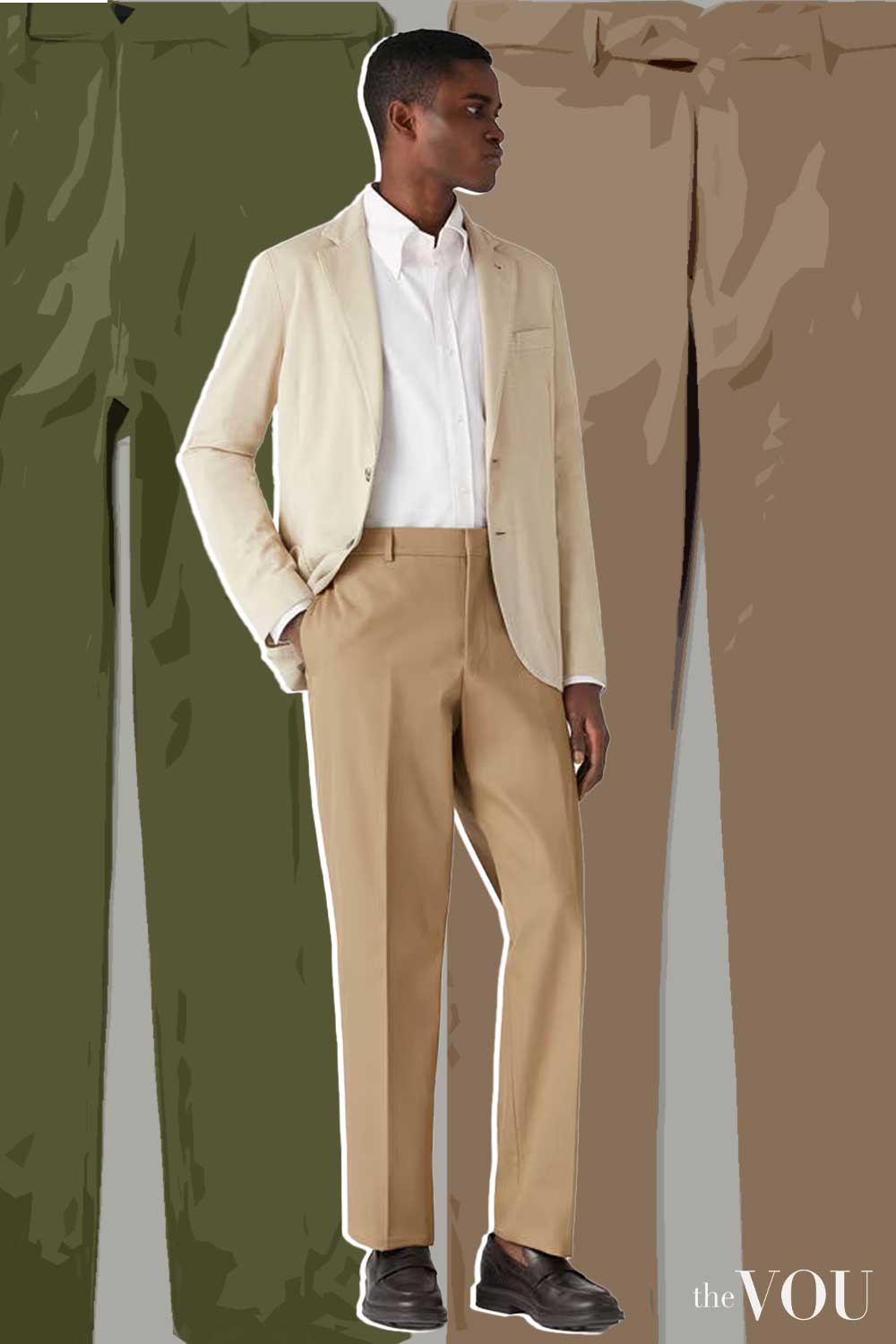
Add a blazer or sports coat rather than a suit jacket: a jacket from a smooth worsted suit can look as if it has lost its trousers, while blazers and sports coats are made to be worn with odd trousers.
Jackets in cotton, linen, tweed or hopsack sit well with the texture of cotton twill.
Wear: a navy hopsack blazer, a crisp white or light blue shirt tucked in, a knitted tie, khaki trousers with a crease, a brown leather belt and brown loafers.
Khaki pants in business settings
Khakis are common in business casual offices, in technology firms and in many retail and service uniforms.
They are hard-wearing and look neater than jeans, so they suit jobs that mix office time with practical work.
Check your workplace dress code: some offices that allow khakis still expect a collared shirt, and some client-facing roles expect tailored trousers instead.
Khaki pants history
Khaki began as a colour of military uniform in British India.
The Corps of Guides, a frontier unit raised in December 1846 and commanded by Harry Lumsden, was given a khaki uniform in 1848.
The cloth was a cotton or linen twill in a dull, dust-coloured shade, cooler and less conspicuous than the uniforms worn before.
Other units in India followed, and khaki became the usual field dress there.
From India to Abyssinia
British troops first wore khaki uniforms officially during the 1868 expedition to Abyssinia, when Indian Army troops joined the campaign.
How khakis got their name
The word khaki comes from Hindi and Urdu khaki, meaning dust-coloured, from the Persian khak, meaning dust or soil.
The name fits: white and bright uniforms showed dirt quickly in dusty climates, while khaki stayed looking cleaner for longer and was harder to see at a distance.
The Boer War and the khaki election
Khaki became standard for British troops during the Second Boer War of 1899 to 1902, and soldiers were nicknamed khakis.
The 1900 United Kingdom general election, held while the war was going on, became known as the khaki election, a term later used for any election called to make the most of wartime popularity.
Khakis in the US Army
The United States Army adopted khaki uniforms in 1898, during the Spanish-American War, in place of its traditional blue.
Khaki and olive drab uniforms were worn widely through the First and Second World Wars.
After the Second World War, cotton twill trousers became popular as civilian casual clothes, and khakis became everyday wear for weekends, college campuses and casual offices.
The related word chino was first recorded in 1943 for the cotton twill cloth used in these trousers.
Today khakis and chinos are worn widely by men and women.
Key takeaways
Khakis are casual cotton twill trousers, named after their traditional dust-coloured shade.
They suit relaxed outfits with polo shirts and T-shirts and smarter outfits with an Oxford shirt and a blazer.
Choose a fit you are comfortable in, pair them with brown leather or suede shoes, and you have one of the most useful trousers in a casual wardrobe.
Sources
Merriam-Webster, khakis and chino (definitions; chino first known use 1943).
Online Etymology Dictionary, khaki.
Khaki and Chino cloth, Wikipedia.
Mandy Meyer’s focus at The VOU is men’s body-shape styling, garment fit and outfit proportions. Her coverage addresses the practical questions behind a wardrobe choice: how a jacket sits across the shoulders, how trousers fall and how different cuts change the silhouette a wearer wants to create.
Her subject areas include the triangle, inverted triangle, rectangle, oval, trapezoid, hourglass and diamond labels used in body-shape styling. These provide starting references for comparing visible proportions; they do not capture every body or prescribe one correct way to dress. The focus connects those observations with garment shape, construction, length and the relationship between the upper and lower parts of an outfit.
Mandy’s editorial coverage combines visual comparisons with fit checks for comfort and movement. Readers can consider whether a cut gives them the room they need, where clothing pulls or gathers and which changes might support their preferred look. The aim is to make menswear choices more understandable while keeping personal preferences and the wearer’s own styling goals central.