
Start here
What’s This About
Brooks Brothers offers its suits, shirts and chinos in three main fits, and the fit changes how a garment is cut around a size rather than which size you are.
This guide explains how to read the brand’s fit names and size charts, such as:
what Traditional, Classic or Regular, and Slim change in suits, sport coats, shirts and chinos
which size guide to open, and why it varies by product
how jacket length bands and shirt sleeve options work
where to start when your chest, middle or seat decides the size
and many more!
Brand pages change, so the details here are dated to when they were read and worth checking against the product in front of you.
Key Points
01Take your own measurements to the chart, then choose the fit for the room you want.
02The middle fit is called Classic on the suit and sport coat guides and Regular on the shirt and chino guides.
03Open the size guide linked from the product page itself, because which guide a product uses varies.
04Fit names describe how a garment is cut, not who should wear it; the fit is settled on your body.
Founded in 1818, Brooks Brothers describes itself as America’s oldest clothing retailer, and it has a long history in American menswear.
For over two centuries, the brand has been associated with classic American style.
Its clothes are often associated with classic, old-money style.
This article is about the brand’s fit names and size charts: what each fit changes, which chart to read, and how to choose between them.
If you would also like to think about colour or your own proportions, we have quizzes for both, though neither is needed for anything below.
Brooks Brothers Fit Names and Sizes
One point to know before you start: the brand publishes two sets of size guides at once, and they use different words for the fits.
Read on 21 and 22 September 2026 on the United States site, one set names the fits descriptively:
- Suits: Slim Fit, “the most modern fit: Trim and polished with a sartorial sensibility”, cut closer to the chest and body with a higher armhole; Classic Fit, “our most popular suit fit: polished and tailored, with a comfortable ease”; and Traditional Fit, “our most relaxed suit fit”, the most generous through chest, body and sleeves.
- Sport coats and blazers: the same three names on their own guide, with charts headed Size, Garment Shoulder and Jacket Length rather than the suit chart’s chest and waist columns, so check that one when the jacket is bought on its own.
- Dress shirts: Slim Fit, “cut closest to the chest and body” with higher armholes; Regular Fit, “average fit across chest, body and sleeves”; and Traditional Fit, “more relaxed through body and sleeves”. Big and Tall is offered alongside them.
- Chinos and casual trousers: Slim Fit, more fitted through hip and seat with a tapered thigh and leg opening; Regular Fit, flat front and straight through hip and thigh; and Traditional Fit, the most relaxed through hip and seat.
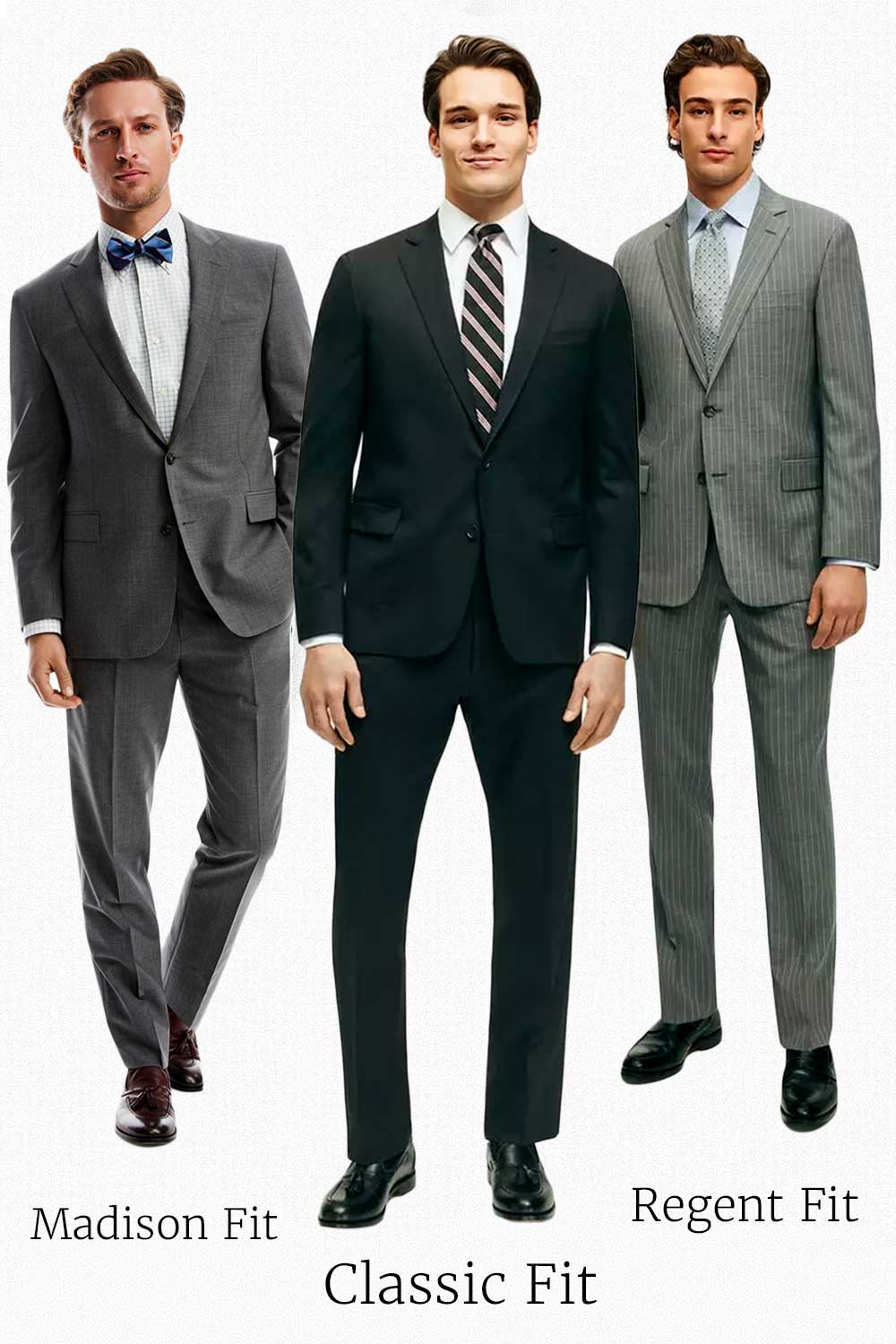
The other set pairs a descriptive label with a house name, and it was reachable on the same days. For suits it lists Milano, Regent and Madison, and for shirts it pairs Extra Slim with Soho, Slim with Milano, Regular with Regent, Relaxed with Madison and Extra Relaxed with Traditional.
Casual trousers also appear under house names on some product listings.
Nothing on either set of pages says which came first, so this guide does not treat one as newer than the other; both were published when they were read, and you will meet the house names on the brand’s own pages and on resale listings.
Worth noticing too that the middle fit is not called the same everywhere: Classic on the suits and sport coats guides, Regular on the shirts and chinos guides.
Either way, the fit description printed beside the garment you are looking at is what to go by rather than the name itself.
The guides read for this article are here: suits, sport coats and blazers, dress shirts and chinos.
Which of them a given product sends you to varies by product rather than by category alone, so open the size guide linked from the page of the garment you are actually looking at.
A guide listing a fit is not a promise that every size in it is in stock today.
Male Body Types
Before delving into the sizes and fits of specific Brooks Brothers garments, it helps to know that the fit advice below is organised by the area that decides your size rather than by shape name.
For reference, the shapes from The VOU’s seven body shapes most often mentioned with fit are:
- Inverted Triangle: the shoulder and upper-torso outline looks noticeably broader than the hips.
- Triangle: the lower torso and hip outline looks broader than the shoulders.
- Rectangle: little visible taper through the shoulders, torso and hips.
- Oval: in The VOU’s usage, a rounded fuller-middle outline, with the fullness spread fairly generally through the torso.
A shape name is a rough starting point at most: the fit names below describe how a garment is cut, not who should wear it, and which size you need is settled by putting the garment on and checking the shoulder, the fastened chest and the seat, as our fitting guide explains.
If unsure what’s yours, take our quick male body shape/type quiz.
Brooks Brothers Fit for Suits, Sport Coats and Blazers
Suits and sport coats are sized separately by the brand, so treat them separately.
A suit is sold as a jacket and trousers together; a sport coat or blazer is bought on its own and has its own size guide.
When read in September 2026, both offered the same three fits, and the fit changes how the garment is cut around a given size rather than which size you are.
1. Traditional Fit
The most relaxed of the three, described as “more generous, yet still polished and refined” and the most relaxed across chest, body and sleeves.
It is the one to try first if you want room through the chest and middle.
In the suit trousers it is also the most relaxed through hip and seat.
Starting point for: anyone who wants room through the chest and middle, and a relaxed trouser through the seat and thigh
2. Classic Fit
The brand’s most popular suit fit, “polished and tailored, with a comfortable ease”, with an average cut across chest, body and sleeves, and flat-front trousers cut straight through the hip and thigh.
It is a reasonable first try if you are unsure where to start.
Starting point for: anyone unsure where to begin, or who wants neither extra room nor a close cut
3. Slim Fit
The closest cut of the three, “trim and polished”, cut closer to the chest and body with a higher armhole, and trousers tapered through the thigh and leg.
A higher armhole lets the jacket move with your arm, but the whole garment is cut with less room, so check the fastened chest and the seat before deciding.
Starting point for: anyone who wants a close cut and has the room through chest and seat to carry it
Choosing the size, and the length
The suit chart lists Size, Chest, Waist, Garment Shoulder and Jacket Length, and offers Short, Regular, Long and Extra Long, tied to height ranges running from up to 5 feet 9 inches to 6 feet 4 inches and above.
The sport coat chart lists Size, Garment Shoulder and Jacket Length, with standard sizes 34 to 54 and a Big and Tall range from 46 to 60.
It also gives sleeve guidance by height range rather than as a single measurement, so check the current guide for the adjustment that applies to your length band.
Take your own chest measurement to the chart, pick the length band that matches your height, then choose the fit for the room you want.
The brand’s own suit buying guide, read on 21 September 2026, gives its measuring instructions, including measuring the chest “around the fullest part of the chest, directly under the armpit” and the sleeve “with arm relaxed, measure from shoulder seam (where jacket sleeve meets body) to wrist bone”.
Brooks Brothers Fit for Dress Shirts
Dress shirts are sized by neck and sleeve, and the fit is chosen separately.
1. Traditional Fit
The roomiest of the three, “our most relaxed fit, Traditional is generous while still retaining every ounce of polished style”, more relaxed through body and sleeves.
Starting point for: anyone who wants room through the chest and middle, or who finds closer shirts pull when reaching forward
2. Regular Fit
Described as “our most democratic fit … the workhorse of a tailored clothing wardrobe”, with an average fit across chest, body and sleeves.
On one product page read on 22 September 2026, the brand calls it “our standard, best-selling fit, designed for a wide range of body types”.
Starting point for: anyone who wants neither extra room nor a close cut
3. Slim Fit
“Our most modern fit”, cut closest to the chest and body, with higher armholes.
Starting point for: anyone who wants a close cut and can still fasten the collar and chest comfortably
Neck, sleeve and the chart
The dress-shirt guide read for this article lists Chest, Waist, Neck Size, Garment Chest, Garment Waist and Garment Shoulder.
It does not give sleeve lengths.
Sleeve length is chosen on the product page instead, as a separate option beside the neck size.
On a non-iron pinpoint Oxford dress shirt read on 22 September 2026, the fit was offered as Regular or Traditional, the neck sizes ran from 15 to 18 and a half, and the sleeve lengths were offered as 32, 33, 34, 35 and 36; a Big and Tall shirt read the same day offered necks from 16 to 22 with sleeves in paired ranges, 32/33, 34/35, 36/37 and 38/39, and sent its reader to a different size guide again.
The dress-shirt guide adds that shirts with sleeves of 37 inches or more carry extra body length.
So take your neck measurement and your sleeve length to the product page, pick from the options that shirt actually offers, and then check the result on your wrist: the cuff should sit at the wrist bone, and a little of it should show beyond a jacket sleeve.
Our fitting guide covers how much is a matter of preference.
Brooks Brothers Fit for Trousers and Chinos
Suit trousers come with the suit and follow the suit chart.
Chinos and casual trousers have their own guide, which lists Size, Garment Waist, Garment Seat and Leg Opening, with an alpha-size conversion from XS to XXL and a Big and Tall section, in inches and centimetres.
It gives no rise figure, so judge the rise on the garment, as our trouser guide explains.
1. Traditional Fit
“More relaxed and generous, Traditional fit is comfortable yet polished and flattering”, and the most relaxed through hip and seat.
Starting point for: anyone who needs room through the seat and thigh, which is the usual reason standard trousers feel tight while the waist fits
2. Regular Fit
“Regular fit is our most democratic casual pant fit: polished and tailored, with a comfortable ease”, flat front and straight through hip and thigh.
Starting point for: anyone who wants neither extra room nor a narrow leg
3. Slim Fit
“Our most modern casual pant fit”, more fitted through hip and seat with a tapered thigh and leg opening.
Starting point for: anyone who wants a narrow leg and has room to spare through the seat and thigh
Brooks Brothers Sizing for Other Garments
Beyond suits, shirts and trousers, the brand also sells accessories and other garments.
How those are sized is not settled by the fit names above, so read the size guide linked from the product page rather than carrying a suit or shirt fit name across to them.
Ties
Tie widths vary between products, so check the width given for the tie you are looking at and match it to the width of your jacket’s lapels rather than to a fit name, with a narrower tie for a narrower lapel.
Knitwear, outerwear and shoes
This is where a single rule would mislead.
Read on 22 September 2026, the separate sweater and outerwear size guides are alpha-size charts, XS to XXL with neck, chest and waist columns and no fit names on them, and the shoe guide is a conversion chart between USA, EU, UK and Japan sizes with nothing about widths.
The products themselves are not all sized that way: a merino quarter-zip sweater offered XS to XXL and sent its reader to the brand’s general clothing guide, while an 1818 wool topcoat on the same day was sized by chest, 38 to 48, with a separate choice of Short, Regular or Long, and linked to that same general guide rather than to the outerwear chart.
So open the guide linked from the particular sweater, coat or shoe, and take its own measurements; whether it runs generously or close is a question for that product page.
Brooks Brothers Sizing Guide
Here’s how to use the official charts, category by category, without doing arithmetic on your own measurements.
Suits, Sport Coats and Blazers
Scroll horizontally to see all columns →
| Fit | What changes |
|---|---|
| Traditional | The most room across chest, body and sleeves, and the most relaxed suit trouser through hip and seat |
| Classic | The average cut across chest, body and sleeves, with a flat-front trouser straight through hip and thigh |
| Slim | Closest to the chest and body, with a higher armhole and a tapered trouser |
Take your own chest measurement to the chart and pick the length band that matches your height, then choose the fit for the room you want.
The fit changes how the garment is cut around a size; it is not an instruction to buy a size other than your chest.
Sport coats and blazers use the same three names on their own chart, so check that one when the garment is bought separately from trousers.
Trousers and Chinos
Scroll horizontally to see all columns →
| Fit | What changes |
|---|---|
| Traditional, Regular and Slim | Seat, thigh and leg opening, and how close the trouser sits through the hip; the waist size you choose from the chart does not change with the fit |
The chinos chart lists Size, Garment Waist, Garment Seat and Leg Opening.
Buy for the seat and thigh, because the waist is usually the easier alteration, and ask what the particular pair carries in the seam before assuming it can be let out.
Sleeve Length
For shirts, take the sleeve length offered on the product page, as described above; the size chart does not carry one.
For a jacket, the brand’s own instruction is to “measure from shoulder seam (where jacket sleeve meets body) to wrist bone”, with the arm relaxed.
Then check it on yourself: a little shirt cuff should show beyond the jacket sleeve, and how much is a preference our fitting guide sets out.
Trouser Length
The break is a choice rather than a property of the fit: no break, a slight break or a full break are all normal, and the shoes you wear change how each one looks.
Decide it in the shoes you will wear with the trousers and have the hem set to it.
Where to Start, by What Needs Room
Fit names describe how a garment is cut, not who should wear it, so this table starts from the area of your body that usually decides the size rather than from a shape label.
Scroll horizontally to see all columns →
| What usually decides your size | Suits and sport coats | Shirts | Chinos |
|---|---|---|---|
| Chest and shoulders, with room to spare at the waist | Classic, or Slim if you want it close | Regular, or Slim if you want it close | Whichever suits the seat and thigh; the chest does not decide this |
| A fuller middle | Traditional | Traditional | Traditional |
| Seat and thighs, with a smaller waist | Classic or Traditional | Not the deciding factor for a shirt | Traditional, then have the waist taken in |
| Nothing in particular stands out | Classic | Regular | Regular |
If your build is mixed, one fit name across a whole wardrobe may not be the answer.
Broad shoulders with heavy thighs, or a fuller middle with a slim seat, can mean a different fit in each category, and buying for the area that is hardest to alter, then having the easier area adjusted, is the usual way round.
These are starting points, not verdicts: two men with the same measurements can want different results from the same garment, and the fit is settled on your body.
Styling Beyond Brooks Brothers Brand
Buying the right size is only one step in dressing well.
Beyond sizing, what makes a garment work is whether it suits the occasion and sits well with the rest of what you own.
None of what follows is required to buy a shirt that fits.
If you would like to go further than sizing, knowing your proportions and the colours you like is a useful next step.
Find Your Body Shape
The fit names above describe how a garment is cut rather than who should wear it, but knowing your own proportions is still a useful way to narrow a rail down.
Our body shape quiz for men is one way to do it.
Find Your Seasonal Colours
Brooks Brothers offers a wide range of colours, and you may prefer some near your face more than others.
Our seasonal colour framework divides each of the four seasons into three sub-seasons, and working out which of those colours you like near your face is one way to narrow a rail down.
You can try it with our seasonal colour quiz for men.
Then, learn how to dress by occasion, location, season, and even time of the day.
Dress for the Occasion
Choosing garments for the occasion, season and location, and mixing Brooks Brothers with other brands, is a separate skill from sizing.
Casual weekends and formal events call for different choices.
Get Styling Advice
For personal help, The VOU offers a paid fashion style analysis for men; its page sets out what it covers.
None of it is needed to buy a garment that fits.
Owning a particular brand is not what makes an outfit work: fit, the occasion and how the garments go together matter more.