

Start here
What’s This About
This gallery uses ten celebrities often cited as examples of a heart face shape to show what different hair and beard choices do to an outline broader across the upper face than at the jaw.
The guide covers choices you can adapt, such as:
Width at the temples versus height at the crown
Layers placed lower to keep volume off the forehead
Beards fuller at the chin and jaw than on the cheeks
Glasses chosen for fit, with a heavier lower rim if you want one
and many more!
We also cover natural curls, product choice and how to check the cut once it is dry.
Key Points
01The VOU describes a heart face as broader across the upper face than at the jaw, tapering towards the chin; a widow’s peak is not required.
02If you want to offset a broader forehead, add width at the temples and keep crown height modest.
03A beard fuller at the chin and jaw than on the cheeks adds weight to the lower face, if your growth allows.
04Keeping your outline as it is remains equally valid.
Understanding your face shape can help you describe what you see in the mirror and choose a haircut, beard or pair of glasses with a clearer goal in mind.
The heart face shape features an upper face broader than the jaw, tapering towards the chin; a widow’s peak is a hairline observation that some people with this outline have, not a requirement.
It is a description, not a diagnosis: if your cheekbones look clearly broader than your forehead, the diamond description may fit better, many faces mix features, and a beard or hairline can hide the jaw or forehead, in which case it is fine to record that observation as unknown.
No styling is required: you can offset the broader upper face, echo it, or simply wear what you like.
Before we start, if you would like a starting point, take our quick and face shape quiz for men to check your face shape and get styling ideas to try.
1. Bradley Cooper

Bradley Cooper, pictured above, is often cited as an example of a heart face shape, and is often photographed with medium-length hair and a short beard.
A medium-length cut with layers that add volume at the temples softens a broader forehead; ask your barber for the top length your hair needs to hold that shape rather than a fixed number.
A beard kept fuller through the chin and jaw and tapered neatly along the cheeks adds weight to the lower face.
Subtle volume at the sides with modest height on top keeps attention away from forehead width, if that is the effect you want.
Leaving the chin a little longer than the cheeks adds length and weight at the chin; choose the lengths by your growth coverage and the look you want rather than copying fixed settings.
2. Nick Jonas

Nick Jonas, pictured above, is often cited as an example of a heart face shape, and is often photographed with short, textured hair and short facial hair.
Textured layers that start around eye level add movement at the sides and draw less attention to forehead width.
Short facial hair kept at an even length adds definition at the chin without looking heavy; choose the length that suits your growth.
As general advice: a light texturising product gives separated, piece-y texture while keeping natural movement.
Going clean-shaven leaves the whole outline visible, which is as valid a choice as wearing a beard.
3. Donald Glover

Donald Glover, pictured above, is often cited as an example of a heart face shape, and is often photographed with his natural curls and a beard.
A beard fuller through the chin and jaw adds weight to a narrower lower face, if that is your goal and your growth allows.
Natural curl shaped to add width at temple level with modest height on top offsets a broader forehead; remember that shrinkage means curls sit shorter dry than when cut.
Defining your natural texture rather than straightening it keeps upkeep lower and the shape more predictable.
Keeping the cheek line clean while leaving more density at the chin puts the weight low on the face.
4. Jesse Williams

Jesse Williams, pictured above, is often cited as an example of a heart face shape, and is often photographed with a close-cropped cut and short beard.
A close crop with a gradual taper gives clean lines with very little upkeep at home, though the taper needs regular barber visits to stay sharp.
A short beard that defines the jaw adds a little width and weight at the chin; trim to the length that suits your growth rather than a fixed number.
A neat cheek line and neckline are what make a short beard look deliberate.
A lineup that follows your natural hairline looks softer than one cut to sharp angles; ask your barber not to push the hairline back.
5. Chris Hemsworth
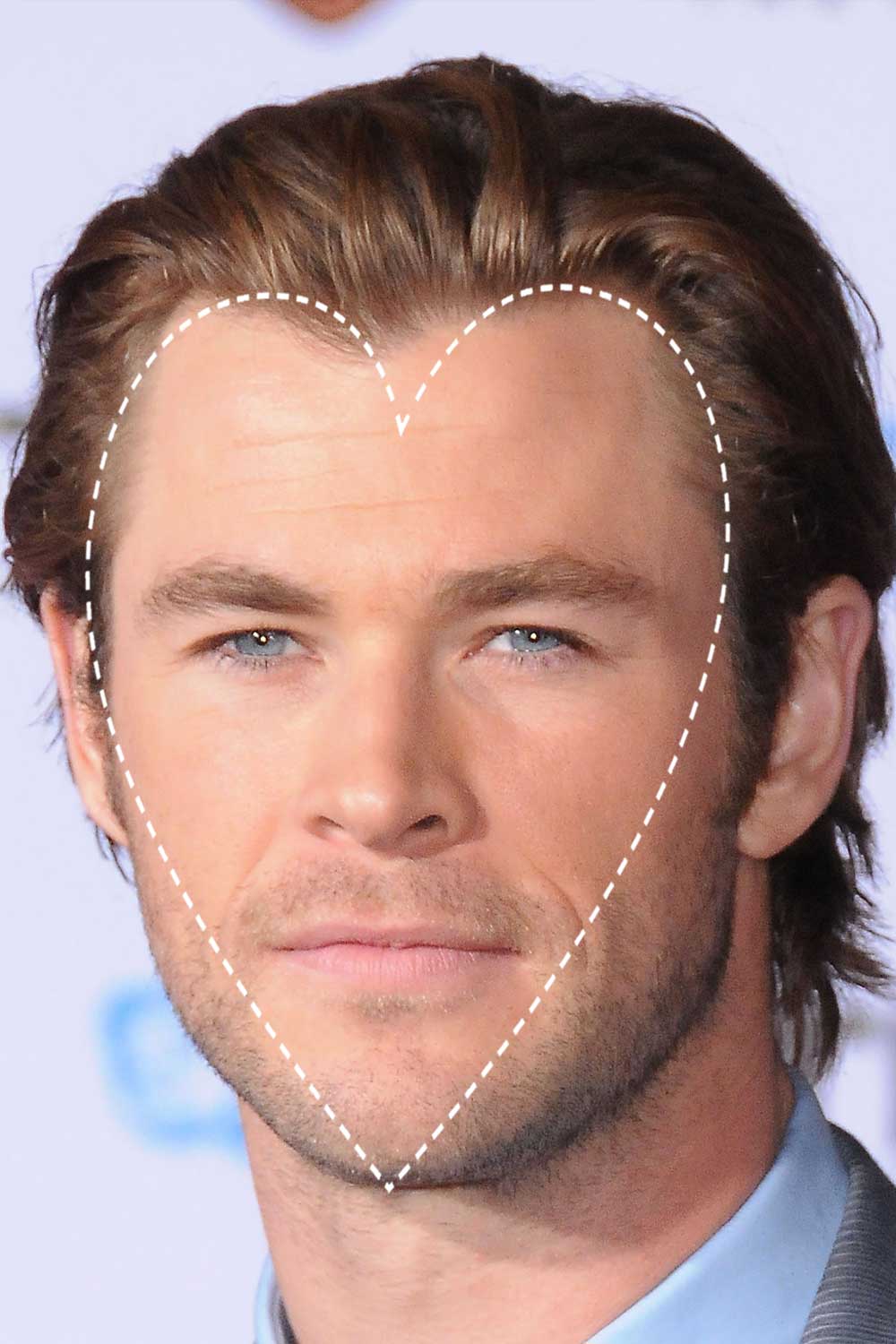
Chris Hemsworth, pictured above, is often cited as an example of a heart face shape, and has worn both long hair, as in his Thor roles, and shorter cuts.
In longer hair, layers that start below cheekbone level add movement lower down without adding width at the forehead.
A beard fuller through the chin and jaw adds weight to the lower face, if that is your aim.
Texture and movement with modest crown volume keep the emphasis lower on the head.
A mid-length cut with textured layers on top gives natural movement; the right top length depends on your hair, not a fixed number.
6. Henry Golding
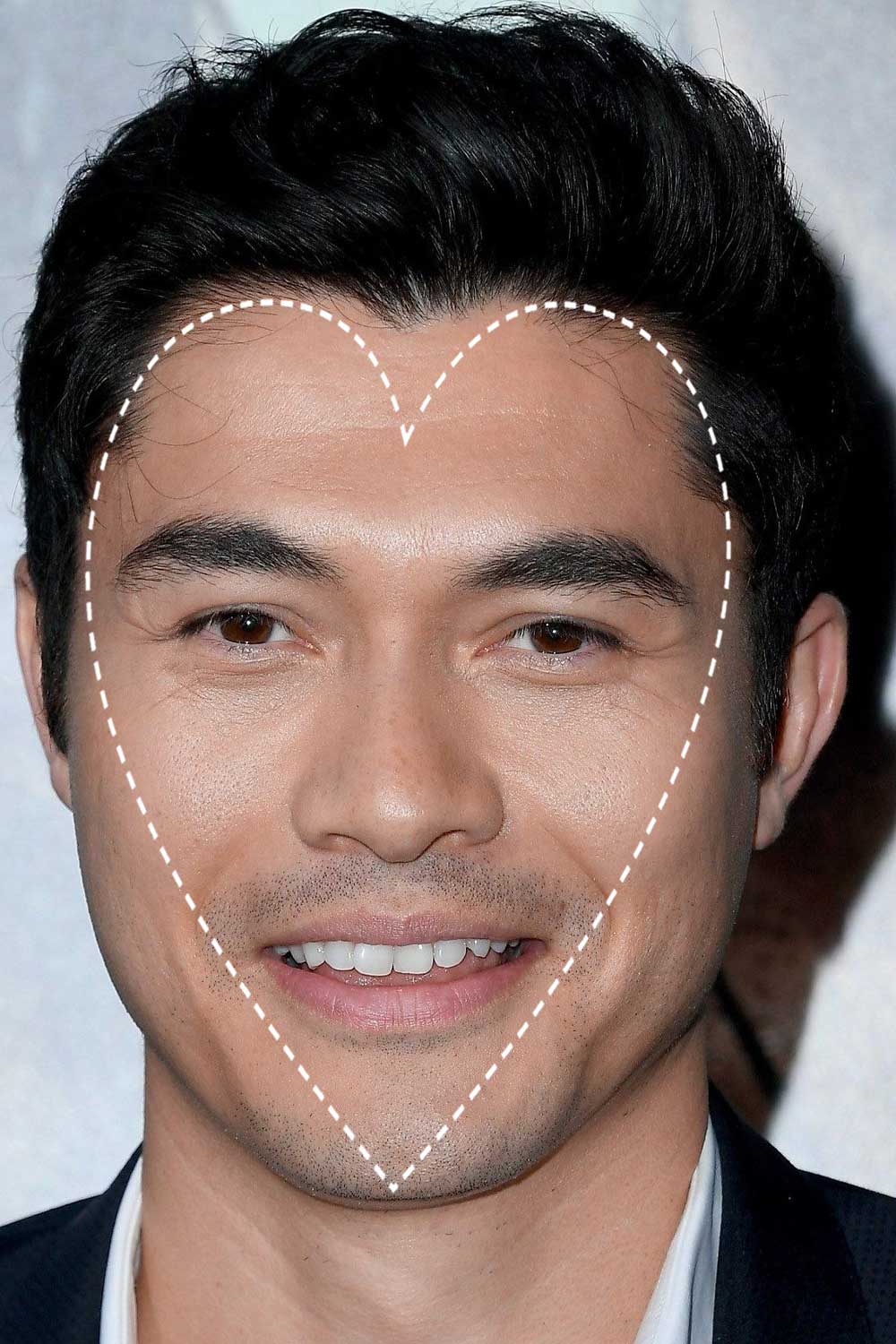
Henry Golding, pictured above, is often cited as an example of a heart face shape, and is often photographed with a neat, classic cut.
A cut that keeps some volume through the sides and modest height at the crown adds width at the temples rather than length.
Light, even stubble defines the jaw without heavy lines.
As general advice: a medium-hold product keeps a classic cut in place while still allowing some movement.
Clean-shaven, the outline stays fully visible; hair cannot add width at the jaw itself, but longer hair or a beard can add visual weight lower on the face if you want it.
7. Chris Pine

Chris Pine, pictured above, is often cited as an example of a heart face shape, and has worn a range of hair lengths and beards.
A cut with some length on top and layers for movement, but little volume at the front, keeps attention away from the forehead.
A beard fuller through the chin and jaw with clean cheek lines puts weight low on the face.
Subtle texture with clean edges is an easy, polished option.
As general advice: lightweight products give definition without making hair look heavy.
8. Ncuti Gatwa

Ncuti Gatwa, pictured above, is often cited as an example of a heart face shape, and is often photographed with his natural texture.
Natural texture shaped to give width at the temples with moderate height on top offsets a broader forehead, if that is your aim.
Layering cut to suit your curl pattern spreads volume more evenly; a barber experienced with your texture can shape it dry so shrinkage is accounted for.
Defined edges with natural texture give a sharp, finished shape.
A clean-shaven face leaves the whole outline visible, which is as valid a choice as a beard.
9. Ethan Hawke

Ethan Hawke, pictured above, is often cited as an example of a heart face shape, and his looks have changed over the years.
Medium-length layers give natural movement while keeping volume away from the forehead.
A beard fuller at the chin adds length and weight to the lower face, if that is your goal.
Working with natural texture rather than against it keeps styling quicker.
Letting grey grow in naturally is a colour choice, separate from face shape, and adds variation through the hair.
10. Daniel Craig

Daniel Craig, pictured above, is often cited as an example of a heart face shape, and is often photographed with a short, tapered cut.
A short tapered cut gives clean lines and keeps width down at the forehead.
He has been seen both clean-shaven and with stubble; stubble adds a little definition at the chin.
A short, classic cut is easy to keep polished for formal occasions.
As general advice: matte products give definition without shine, if you prefer a natural finish.
Styling Guide for Heart Faces
Start by choosing your goal: offset the broader upper face, echo it, or simply wear a style you like; none of these is required.
If you want to offset the forehead, add width at the temples and keep crown height modest; crown height and temple width are different effects. Tell your barber where you want length, height, weight and movement, and mention your hair density, texture, curl, growth direction and hairline, because the same cut sits very differently on fine straight hair and on dense coily hair.
For a beard, describe side fullness, chin length, cheek line and neckline separately: fuller sides add width to the lower face, a longer chin adds length, and your growth coverage sets what is achievable.
Choose products for the texture and hold you want, and check the result dry-styled in the mirror, from the front and both sides, before deciding whether to keep it.
Accessory Selection for Heart Faces
Choose glasses for fit first: frame width, bridge and arms should sit comfortably and stay put, and an optician can check lens needs. Glasses sit around the eyes and cannot widen the jaw, but frames with a heavier lower rim or a little extra width at the bottom can draw the eye lower, if that is the effect you want.
Sunglasses can range from angular to rounded; check the frame width suits your head and the lenses give the UV protection you need.
Neckwear such as ties and scarves can draw the eye downward if you want that, but choose them for the outfit and occasion first.
Final Considerations
A heart-shaped outline works with a wide range of looks, as these ten examples show.
How often you need a trim depends on how fast your hair grows, the cut and how sharp you want the edges, not on your face shape.
If your features look mixed, or a beard or hairline hides your jaw or forehead, compare neighbouring face-shape guides rather than forcing a single label.
Knowing what each hair and beard choice does helps you decide which effect you actually want.
Style Like A True Gentleman
Before you go, here is a simple order to follow, whether you work alone or with an image consultant.
Professional styling usually starts with knowing your body shape and seasonal colour palette, which help you choose well-fitting clothes in colours that suit your skin, eyes and hair.
Then you can plan outfits for each occasion, location, season and time of day, with garments, footwear, and accessories from heritage fashion brands that fit the way you want to look.
Take our three quizzes below, then book a paid consultation if you would like personal help:
1. Find Your Body Shape
Different garments flatter different silhouettes, so knowing your body shape is a useful first step.
To check your body shape, take our body shape quiz for men.
Next, take the second quiz to check your colour palette.
2. Find Your Seasonal Colours
Remember, the garments that compose your outfits come in various colours, and it helps to choose shades that suit your natural colouring.
To do that, find your seasonal colour palette by taking our seasonal colour quiz for men.
3. Find Your Fashion Style
Once you know your body shape and colour palette, the next step is to find your personal fashion style.
You can start with our fashion style quiz for men; it gives style suggestions, outfit ideas, relevant fashion brands, and much more.
Professional Image Consultancy with The VOU
If you would like personal help, you can book a paid consultation with our expert image consultants and fashion stylists.
Our styling services for men are paid consultations; the shop page lists what each one includes.
Remember, wearing luxury brands isn’t enough (see logo-heavy luxury brands and how to wear them); it also helps to know your body shape, colour palette, and ideal personal style, and then to dress by occasion, location, season, and time of day.
Contact us if you would like to book a paid consultation.