
Start here
What’s This About
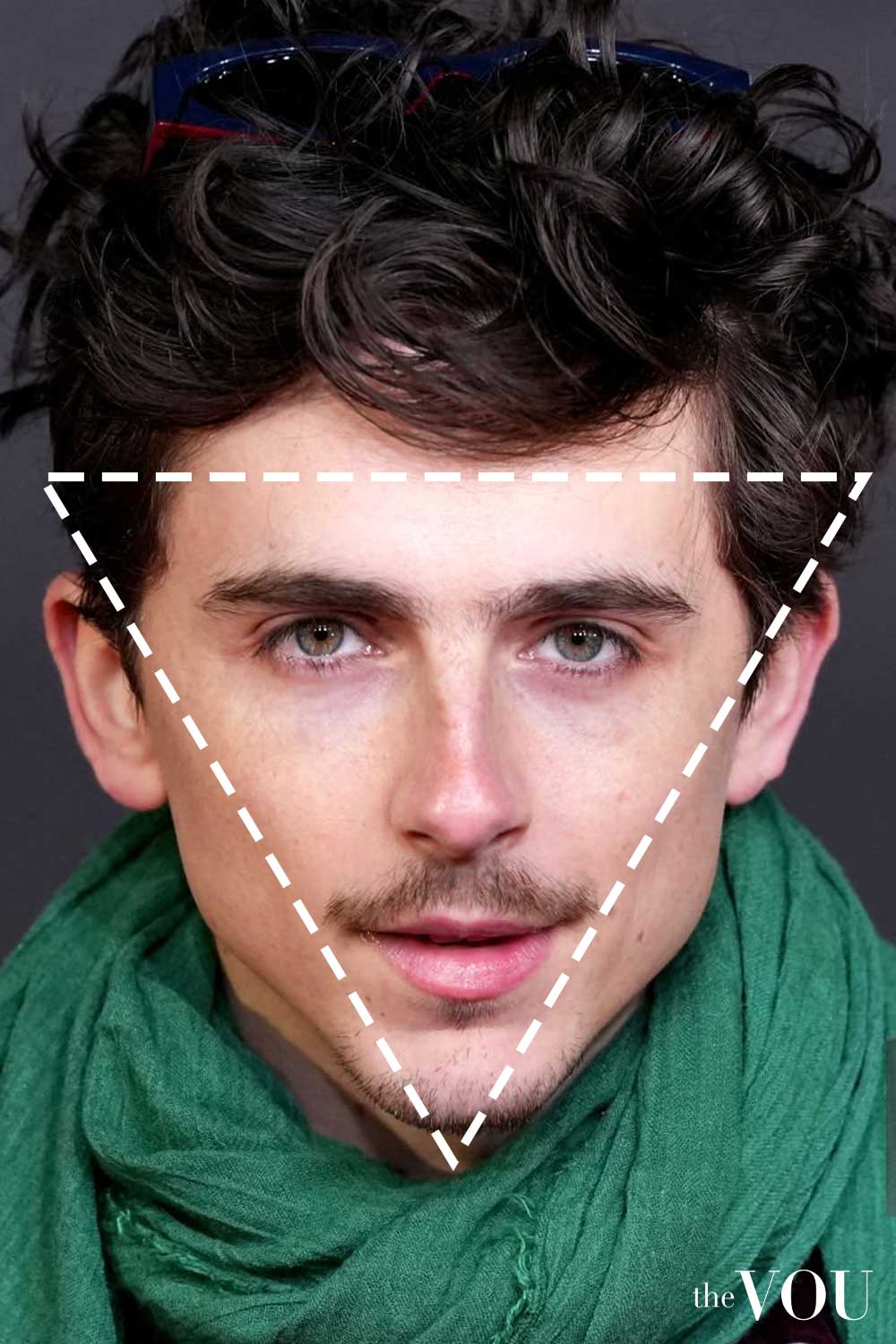
Your face reads as triangular when the span between your jaw corners is the widest of your three widths and your forehead is the narrowest, so the outline broadens as it drops.
This is the name with the worst vocabulary problem of the nine, so the guide deals with that first, such as:
why pear describes the same face and why both words are kept on this site
why some publications use triangle for the opposite outline, and how to translate their advice safely
how to judge jaw width when a beard is covering the corners
where hair volume goes if you want the top of your face to carry more width
and many more!
Everything here runs on the order of three widths you can see for yourself.
Key Points
01One observation makes this reading: your jaw is the widest of your three widths. Everything else on this page follows from that single comparison.
02Triangle and pear describe the same jaw-wide family. Compare the widths you can see without requiring the jaw to exceed the forehead by a fixed amount.
03Check the label on any advice you borrow from elsewhere. Several publications use triangle for a face wide at the brow and narrow at the chin, which is the opposite outline, so a recommendation written under that meaning will push you in the wrong direction.
04Width at the temples is what narrows the gap between your forehead and your jaw, while height at the crown lengthens the outline without adding width at the top, so name the place you want the weight rather than asking for volume in general.
Finding your face shape shouldn’t require complex measurements or scientific tools.
Four observations in a mirror carry this guide, and the sections that follow say where each observation runs out before working from your own answers.
How to See Whether Your Face Reads as Triangular
Set up once
Stand square to a mirror in even light, chin level, expression relaxed, head upright and facing straight ahead.
Push your hair back off your forehead, and take that step seriously here, because this reading depends on your forehead being the narrowest of your three widths and hair falling at the temples will produce that result on any face.
Stay with the same front-on view, since what you are comparing is three widths on one plane.
The Four Observations, In Order
Observation one
Put the three widths in order
Compare your forehead above the eyebrows, the widest region of your cheekbones, and the span between the corners of your jaw, then rank the three.
A triangular reading puts the jaw first and the forehead last, with the cheekbones somewhere between; no other observation on this page can substitute for that ranking.
Observation two
Measure the jaw across, not the chin
Jaw width means the straight span between the two corners at the back of your jaw, below and slightly forward of your ears.
The narrow bottom end of your chin is a different observation entirely, so a man with a wide jaw and a tapered chin still ranks as jaw-widest, and confusing the two is the commonest way readers end up in the wrong guide.
Observation three
Does the jaw turn a corner or curve?
Run a finger from below your ear along the jaw towards your chin and notice whether the line changes direction at a definite corner.
Angularity is a separate observation from width, so a wide jaw can be either cornered or softly curved, and knowing which yours is changes the beard advice further down without changing the name.
Observation four
How long is the face overall?
Compare the drop from the hairline you can see at the centre of your forehead down to your chin against the widest span across your cheekbones.
Length does not decide this reading either way, and the reason to note it is practical: a jaw-wide face that is also long takes different hair advice from a jaw-wide face that is compact.
Keep the four answers, because the styling notes below work from your ranking, your corner and your length rather than from a category.
What the Front View Cannot Settle
The four observations describe an outline seen from the front, and the description ends there.
A jaw that is broad from the front does not necessarily project further forward than your cheekbones or brow. Front-on width and forward projection are different observations; one cannot establish the other.
A triangular label also says nothing about how close together your eyes sit, how your brow or nose is built, or where your ears are set. Observe those features separately if they matter to a styling choice.
Take a side view if you want one and describe it separately, because a barber does use the profile when deciding where a beard neckline goes under a broad jaw.
When You Cannot See the Landmarks
A beard is the obstacle that matters most here, because the jaw is the whole of this reading and a beard sits directly on it.
A full beard left wide at the sides will make almost any jaw the widest span on your face, so if you are bearded, rank the bearded outline as one answer and record the jaw underneath as unknown rather than counting the beard as bone.
A clear straight-on photograph from before the beard is the practical way round this, and nothing here asks you to shave to find out.
Hair at the temples is the mirror-image problem, since it narrows the forehead you are trying to rank, which is why pushing your hair back matters more on this reading than on any other.
If your hairline has receded, note that a higher hairline does not narrow the bone of your forehead: it moves the point your length runs from, so mark the length uncertain and rank the forehead by the breadth you can see above your eyebrows.
If you work from a photograph rather than a mirror, keep it straight on with the lens level with your eyes, take it from farther back where practical, and hold the same head position when you compare two shots. In a 2023 study of twelve subjects photographed at several distances, using a specified phone and camera, the closest shots changed the measured proportions of the midface. A casual photograph is not precise evidence for a classification, so read what you see in one as a description rather than a result.
Triangle, Pear and the Naming Problem
Face-shape names come from barbering and grooming writing rather than from one agreed standard, and this name has collected more conflicting uses than any of the others, so read this section before you borrow advice from anywhere else.
Triangle vs Pear
Pear and triangle describe the same jaw-wide family, and this site keeps both words because readers arrive searching for one or the other.
The quiz treats triangle and pear as one result, and some guides separate them by how sharply the face tapers, so you are welcome to use that distinction if it matches what you see.
If your jaw is the widest of your three widths, the pear guide and this one are written for you, and the advice in both runs the same way.
Triangle vs Heart and Inverted Triangle
Check the features a source describes before following advice labelled triangle: the same word can refer to opposite outlines.
On this site, triangle means jaw-widest and heart, also called inverted triangle, means brow-widest with a taper towards the chin, so the two names sit at opposite ends of the same comparison.
Other publications reverse the vocabulary and use triangle for the brow-widest outline, which means a recommendation you find under the word triangle elsewhere may have been written to add width at your jaw rather than at your forehead.
The safe habit is to read the features rather than the label: check which width the writer says is greatest, and only then decide whether the advice applies to you.
Triangle vs Diamond
Diamond faces put the cheekbones at the top of the ranking, with the forehead and the jaw both narrower than the middle.
Observation one settles the comparison: jaw first is here, cheekbones first is there, and a pointed chin belongs to neither on its own.
Triangle vs Square
Square faces hold all three widths level, so the jaw is broad without being broader than the forehead.
Both readings can share a strong angular corner, which is why ranking the widths matters more than judging the corner when you are choosing between the two guides.
Triangle vs Rectangle and Oval
Rectangle faces keep the three widths level on a long outline, and oval faces put the cheekbones slightly ahead on a gently curved one.
Neither carries the downward broadening this reading is named for, so if your jaw does not win the ranking, one of those two guides is the better fit.
Triangle vs Round
Round faces are compact with curved jaw transitions and no width clearly in the lead.
Full cheeks or jowls low on the face can make a jaw look broader, so if your lower face is full the ranking is less certain; record it that way rather than trying to work out what the width is made of.
If Your Features Are Mixed
A jaw that is broadest with cheekbones almost as broad is a common reading, and it sits between this guide and the square one without being a failure of either.
Describe the ranking you actually saw: jaw widest, cheekbones close behind, forehead clearly narrowest, corner soft rather than sharp, face longer than compact.
That sentence is more use in a barber’s chair than any single name, and no confidence percentage attaches to it.
Decide What You Want Before You Decide What to Wear
Settle this first
Decide whether you want more width high on your face or you are happy with the jaw leading, because a strong lower face is a look many men choose on purpose rather than a fault to be balanced out.
Advice for this outline almost always aims to add width at the top, and that aim is one preference among several.
You can reduce the contrast, which means volume at the crown and the temples in the hair and as little bulk as possible on the jaw.
You can leave the contrast alone, which means short sides and a beard line that follows your jaw, and the jaw stays the widest span in your outline.
You can also change the apparent length instead, since height on top reads longer and side fullness reads wider whichever width leads.
Hair: Width at the Temples Is the Useful Control
The haircuts collected for triangular faces mostly work by putting visible weight high on the head, and it is worth knowing which place on your head each one uses.
Width at the temples is what narrows the gap between your forehead and your jaw, while height at the crown lengthens the outline rather than adding width at the top, so those two are separate requests and only one of them addresses the ranking you read.
A workable brief for reducing the contrast sounds like this: leave length and weight through the temples rather than tapering them tight, keep some texture on top so the hair holds its shape out to the sides, and avoid taking the sides down close above the ear.
Very short sides do the opposite by leaving your jaw as the widest span in the outline, which is the right cut if you have decided you like the contrast.
Then check what your own hair will actually do, because that is what decides which of these you can keep.
What follows are tendencies rather than rules, because density, curl pattern, length and growth direction all pull separately and your own combination decides the result. Fine or low-density hair usually needs the cut, and often some drying, to hold height or width, and it tends to lose a shape sooner through the day. Dense hair generally holds a shape more readily and can need weight removed so it does not read wider than you wanted. Curly and coily hair often carries width with less work and shrinks as it dries, so agree the finished shape dry rather than wet. Growth direction at your hairline can defeat a fringe or a parting whatever your texture.
Ask what the cut looks like on the third morning after a normal wash, and dry it once yourself in the mirror before you settle on it.
Beard: Keeping Bulk Off the Widest Span
A beard sits on the jaw, which is the widest span in your outline, so the beard styles collected for triangular faces matter more here than any other section on this page.
Work through four decisions: how long the chin is left, how full the sides are kept, how high the cheek line runs, and where the neckline sits.
Side fullness is the decision that adds width exactly where your face is already widest, so if you are reducing the contrast, that is the one to keep short. If your face is also long, keep the two goals apart: to take bulk off a wide jaw without adding apparent length, hold the beard short along the sides and keep the chin contour close rather than adding length at the chin, and put any width you want into the hair at the temples instead. More length at the chin is a separate preference, and it lengthens the lower face whether or not you wanted that.
A cheek line taken higher up the face moves the visible weight of the beard upward, which is a neat way to get some fullness without putting it on the jaw corners.
Stubble with a defined edge gives you a clean jaw line with no bulk at all, and a graduated beard kept shortest at the cheek and slightly longer at the chin moves weight away from the corners.
Your growth coverage decides what is available: patchy cheeks cannot hold a high clean cheek line, and a sparse chin will not carry the length you are moving there.
A fade in a beard means a graduated transition with no visible step, which is separate from how long the chin is left, so ask for the two separately; set the neckline in the mirror with your barber rather than by a finger-width rule, because no face shape fixes where it belongs.
Glasses: Preference and Fit Are Two Questions
Frames sit across the upper half of your face, which is the narrower half on this reading, so a frame with visible weight along its top edge draws attention to the part of your face you may want noticed.
A browline frame and a classic aviator both do that. Neither changes the width of your jaw, which sits well below where a frame rests, so the effect is a matter of where the eye is drawn.
Fit decides whether you keep wearing them, and fit is a different question from shape: overall width that leaves your temples alone, a bridge that sits without pinching or sliding, and arms that hold at your ears without digging in.
The three numbers printed inside an arm are the lens width, the bridge width and the temple length, all in millimetres. They describe the frame rather than your face, and they do not add up to the overall outside width of the frame front, because rims and endpieces vary, so use them to compare frames you have tried rather than as a fit guarantee.
Leave the prescription and the lenses to an optician, and check the protection rating on sunglasses separately from how they look.
Collars: Spread, Point Length and Comfort
A collar sits below your jaw and cannot narrow it, though a moderate spread with a longer point keeps the line under your chin more vertical, which is the effect to ask for if you are playing the jaw down.
A very wide spread opens the line horizontally right where your face is widest, so leave it out if that is the reading you are trying to soften, and wear it if you are not.
Band height and neck comfort matter more than either, because a collar that grips gets opened by lunchtime, and the knot needs room for whichever tie you own.
For casual shirts and knitwear, the occasion and the jacket over the shirt decide more than your outline does.
Frequently Asked Questions About Triangle Face Shapes
Q. Is a triangle face the same as a pear face?
On this site, yes. Both names describe a face whose jaw is the widest of its three widths, and the quiz treats them as one result. Some guides separate them by how sharply the face tapers, which is a description you can use if it fits, and the advice in the two guides runs the same way.
Q. Why does other advice for triangle faces contradict this guide?
Because several publications use triangle for the opposite outline, broad at the brow and narrow at the chin, which this site calls heart or inverted triangle. Advice written under that meaning aims to add width low on the face, and applying it here would add bulk exactly where your face is already widest. Check which width the writer says is greatest before you follow anything.
Q. How do I balance a strong jaw?
Width at the temples in the hair is the main control, because it narrows the gap between your forehead and your jaw. Keeping a beard short along the sides stops facial hair widening the jaw further, a higher cheek line lifts the visible weight of the beard, and a frame with weight along its top edge draws the eye upward. Crown height lengthens the face rather than adding width at the top, so on its own it does not address the ranking.
Q. Are there beard styles I should not wear?
Nothing is ruled out. What is worth knowing is the direction each choice pushes: fullness at the sides widens the jaw, length at the chin lengthens the lower face, and a squared bottom edge emphasises the corners. If you want the jaw played down, keep the sides short and put any length at the chin; if you like the jaw as it is, a full beard is a fair choice.
Q. Can I keep my hair very short?
Yes, and short sides leave the jaw as the widest span in your outline, which is the effect if you want it. If you would rather reduce the contrast while keeping the hair short, ask for the sides to be left a grade or two longer through the temples than at the back.
Q. Does a face shape change over the years?
How it reads changes. Cheek and jowl fullness rises and falls with weight and with age, and fullness low on the face can make the jaw read broader, so the ranking you read today may not be the one you read in five years. This guide describes the appearance rather than its cause.
Still Not Sure?
The face shape quiz on this site works by comparison rather than by measurement.
The quiz treats triangle and pear as one result, as this guide does.
Treat the result as a starting description, and if it disagrees with your own ranking of the three widths, trust the mirror.
Expert Style Guidance
Knowing which of your widths leads is the starting point for the haircut and beard conversations that follow.
Our Professional Face Shape Analysis package is a paid consultation; its product page lists what it includes.
Our Complete Image Transformation Package combines the face shape, seasonal colour, body shape and fashion style analyses.
Mandy Meyer’s focus at The VOU is men’s body-shape styling, garment fit and outfit proportions. Her coverage addresses the practical questions behind a wardrobe choice: how a jacket sits across the shoulders, how trousers fall and how different cuts change the silhouette a wearer wants to create.
Her subject areas include the triangle, inverted triangle, rectangle, oval, trapezoid, hourglass and diamond labels used in body-shape styling. These provide starting references for comparing visible proportions; they do not capture every body or prescribe one correct way to dress. The focus connects those observations with garment shape, construction, length and the relationship between the upper and lower parts of an outfit.
Mandy’s editorial coverage combines visual comparisons with fit checks for comfort and movement. Readers can consider whether a cut gives them the room they need, where clothing pulls or gathers and which changes might support their preferred look. The aim is to make menswear choices more understandable while keeping personal preferences and the wearer’s own styling goals central.