Start here
What’s This About
If your jaw is broader than your forehead and you would rather not add more width there, shorter sides, a chin-centred shape or neat stubble give definition without bulk; a fuller beard along the jaw is still your choice if you like it.
This guide covers the choices that shape the result, such as
How minimal stubble and defined stubble add texture without bulk
Where a graduated short beard keeps its length
What a chin-focused goatee needs from your moustache and chin growth
Why fuller sideburns and upper cheeks depend on growth you already have
and many more!
We also explain how this guide relates to our pear guide, and what to do when a beard hides your jaw.
Key Points
01The VOU uses triangle and pear for one overlapping family of jaw-wide outlines, so our pear beard guide covers the same lower-wide shape.
02Some other guides use “triangle” for the opposite outline, a broad forehead and a narrow chin; go by the features described, not the label.
03Keeping the beard shorter at the jaw corners avoids adding width there; fullness higher up is possible only where your sideburns and upper cheeks already grow.
04Stubble changes texture and edge contrast rather than the length or width of your outline.
A triangle face, as The VOU uses the term, has a jaw that is broader than the forehead, with the outline widening towards the lower face.
The VOU also uses the name pear for the same jaw-wide family; whether the widening looks gradual or abrupt is a descriptive nuance rather than a separate category, so our pear face beard guide is worth reading alongside this one.
Other style guides sometimes use “triangle” for the opposite outline, a broad forehead tapering to a narrow chin; if that describes you, our heart face beard guide is the closer match.
If you are not sure which description fits, our face shape quiz is a useful starting point, though it is a guide rather than a measurement.
The five styles below share one optional goal, which is adding definition without adding more width at the jaw corners.
Before You Choose, Check What Your Beard Can Do
Let your beard grow for a few weeks without shaping it, then look at it dry and brushed, in even light, from straight in front and from each side.
Sideburns and upper cheeks. Check how densely these areas grow, because any style that keeps more fullness higher on the face depends on them.
Chin and upper lip. Check whether your moustache joins your chin at the corners of your mouth, which decides whether a connected goatee is possible.
Texture and curl. Curly or coarse hair stands out and adds width at the jaw sooner than straight hair, so a tighter jaw length may suit it.
Upkeep. Stubble and shaved borders need attention every day or two; a short graduated beard can go a little longer between trims.
Neckline. A common starting point is a neckline about one to two finger widths above the Adam’s apple, curving back towards the angle of the jaw below the ears; check it with your head level rather than tilted back, and adjust it for your beard length and your own neck.
A beard can only use the hair that grows. Trimming moves the visual weight by shortening some areas, but it cannot add hair at the temples or anywhere growth does not reach.
1. Minimal Stubble with Defined Lines
Minimal stubble is a very short, even growth with a neatly defined cheek line and neckline.
Tom Cruise, pictured below, wears short, neat stubble.
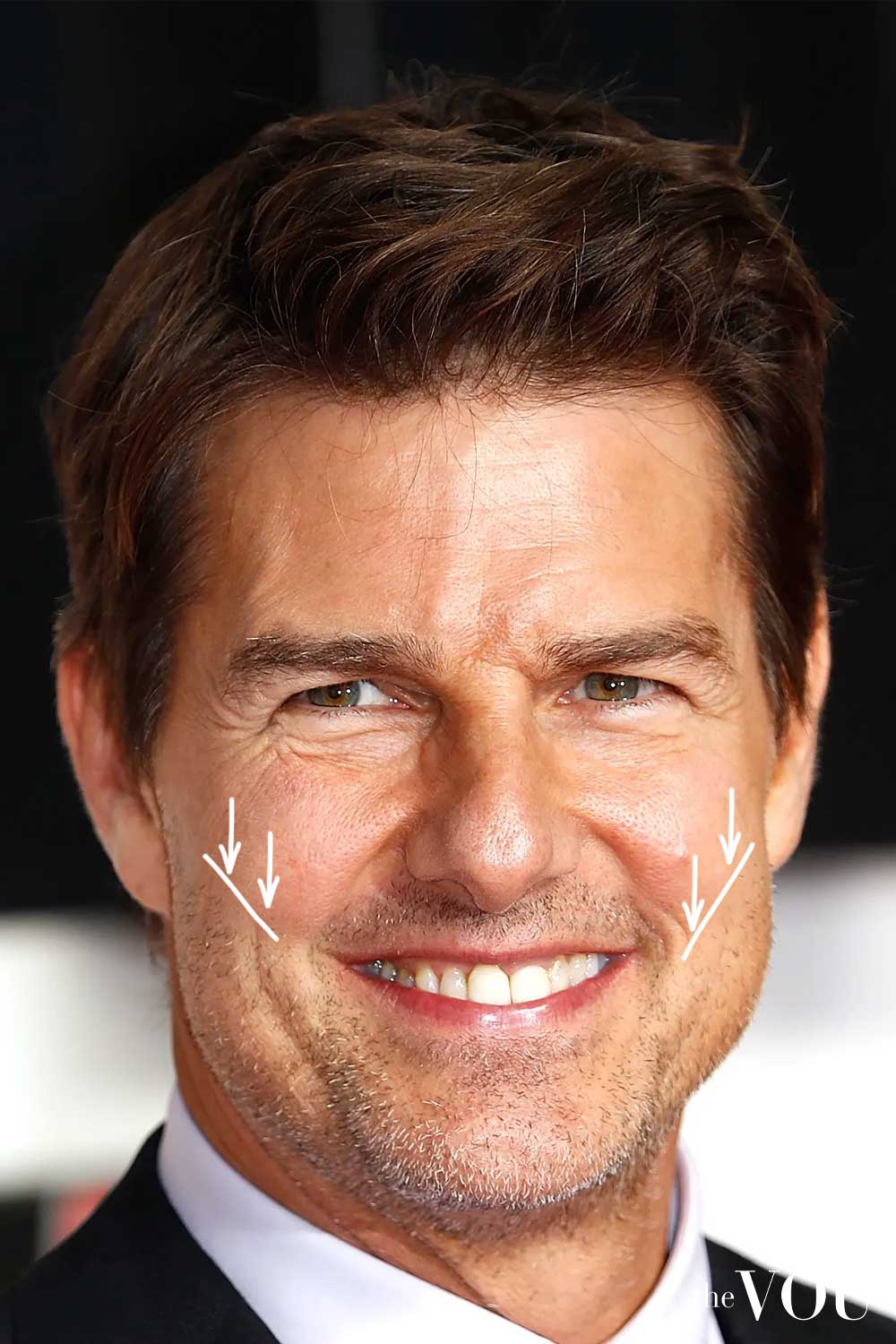
Why it works. At this length the beard adds texture and a clean edge but almost no bulk, so it does not add width at the jaw.
The defined lines give the lower face a tidy border without making it look broader.
Coverage check. Very short stubble is forgiving of uneven growth, though large sparse patches still show.
Maintenance. Trim with the same short guard every couple of days, or as often as your growth needs, and edge the cheek line and neckline lightly so they look neat rather than drawn on.
Ask your barber for “Very short, even stubble, a clean, natural cheek line and a tidy neckline, with nothing bulky at the jaw.”
2. Graduated Short Beard
The graduated short beard keeps a little more length on the upper cheeks and sideburns and a shorter length at the jaw corners.
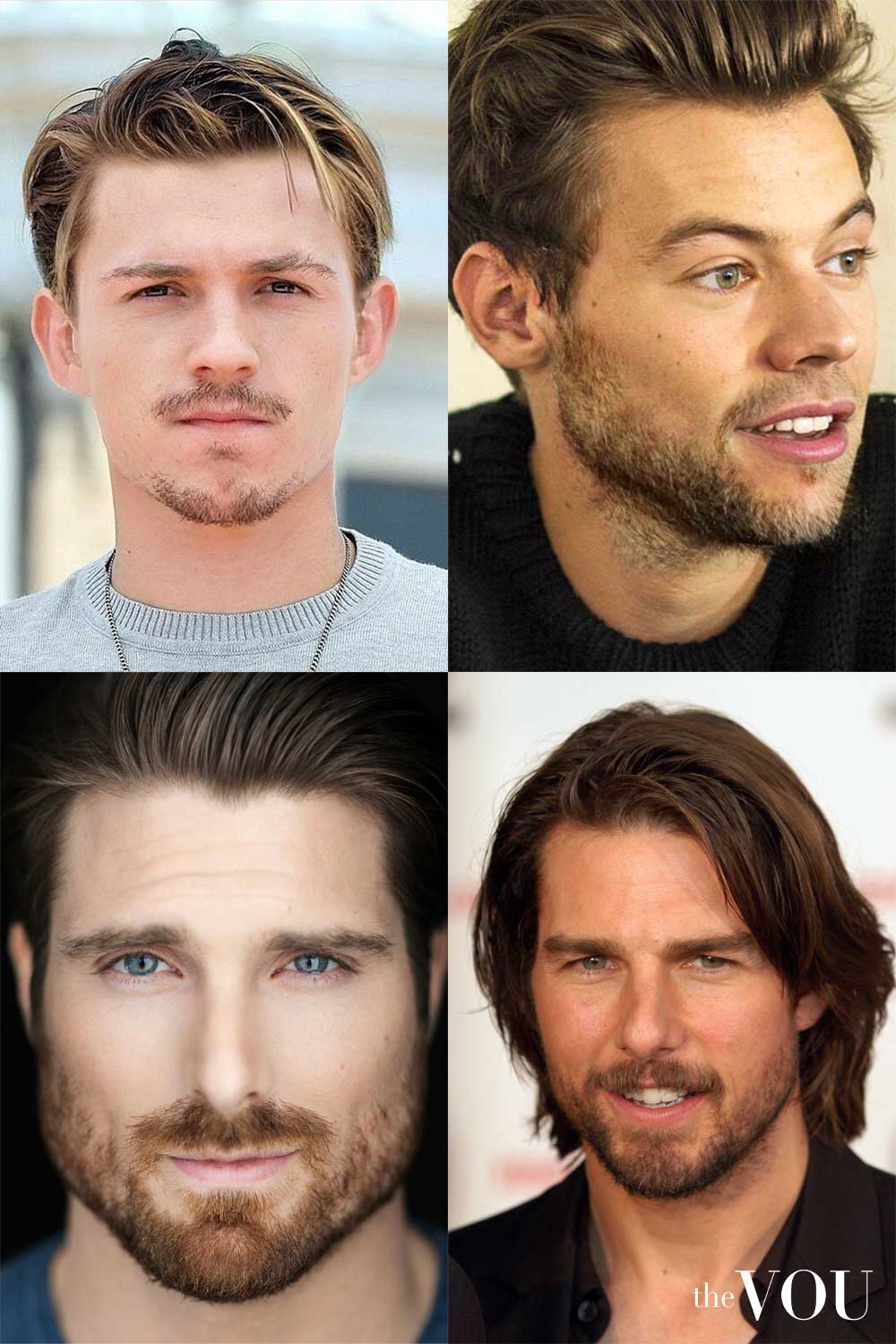
Taylor Zakhar Perez, pictured below, wears a short, graduated beard.

Why it works. Slightly fuller growth higher on the face and shorter growth at the jaw corners moves the visual weight upward instead of adding to the jaw’s width.
Coverage check. The graduation works only if your upper cheeks and sideburns grow densely enough to carry the extra length; if they are sparse, keep the whole beard short and even instead.
Maintenance. Use a slightly longer guard on the upper cheeks and a shorter one at the jaw corners, blend the change, and trim weekly or as your growth needs.
Ask your barber for “Short beard, a little fuller on the upper cheeks and sideburns, tighter at the jaw corners, with a smooth blend between them.”
3. Chin-Focused Goatee
The chin-focused goatee keeps facial hair on the chin, often joined to a moustache, with the cheeks and the sides of the jaw shaved.
Tom Holland, pictured below, wears a neat, chin-centred goatee.

Why it works. Shaved sides add no width at the jaw, and the chin beard puts the visual focus at the centre; a slightly longer chin adds some apparent length.
Coverage check. A goatee needs solid growth on the chin and, if connected, at the corners of the mouth; if the corners are sparse, wear the moustache and chin beard separately.
Maintenance. Shave the sides often, usually every day or two, so the border stays crisp, and keep the moustache trimmed above the lip.
Ask your barber for a “Goatee on the chin, cheeks and jaw sides clean, a little length at the chin, and a neat border.”
4. Upper-Cheek and Sideburn Focus
This style keeps fuller sideburns and upper-cheek growth with a shorter, tighter beard along the jaw, so the beard’s fullest point sits higher on the face.
Jonah Hill, pictured below, wears his beard fuller higher on the face.

Why it works. Fullness higher on the sides with a tighter jaw moves the outline’s widest point upward rather than adding to the jaw.
Coverage check. The upper-cheek and sideburn focus is only possible where your sideburns and upper cheeks already grow densely; a beard cannot add hair at the temples or anywhere growth does not reach.
If your upper cheeks are sparse, a similar effect can come from your haircut instead, with a little more fullness at the sides of the head above the ears.
Maintenance. Keep the upper cheeks and sideburns slightly longer, blend down to a shorter length at the jaw corners, and reshape every couple of weeks or as your growth needs.
Ask your barber. “Keep fullness at my sideburns and upper cheeks, take the jaw corners shorter, and blend it so there’s no step.”
5. Defined Stubble with Clean Edges
Defined stubble is a short, even stubble with deliberately crisp cheek lines and neckline.
Harry Styles, pictured below, wears short, defined stubble.

Why it works. Uniform stubble adds very little height or width to the outline; its effect comes from texture and the contrast of clean edges, which keep the jaw area neat.
The difference from minimal stubble is mainly length and edging. Defined stubble is a touch longer, with sharper lines.
Maintenance. Trim with the same guard every few days and refresh the edges as they blur.
Ask your barber for “Even stubble, a little longer than a shadow, with crisp cheek lines and a clean neckline.”
If Your Beard Hides Your Jaw or Your Hairline Is Unclear
If you already wear a full beard, it may hide how broad your jaw really is, and the beard’s own width can make the lower face look broader than the jaw underneath.
You do not need to shave to use this guide. Describe the outline your beard makes now, and record the jaw width underneath as unknown.
An older clean-shaven photograph taken straight on, from a little further back with your head level, can help, but it is optional.
A receding or indistinct hairline changes where the forehead seems to start, not how broad the forehead is, so compare forehead width just above the eyebrows with the width between your jaw corners.
If your forehead and jaw look similar in width, a square or rectangle description may fit better, and those guides suit you as well.
Our guide to reading your own face shape explains the landmarks in more detail.
Conclusion
With a jaw-wide outline, keeping the jaw corners short and placing any fullness higher or at the chin adds definition without extra width.
A fuller beard along the jaw remains a valid choice if you like the look; the styles here are options for a chosen effect, not rules.
Your sideburn, upper-cheek and chin growth decides which shapes you can build, so start a little longer than you want, judge the shape dry, and take length away gradually.
Use our face shape quiz to compare descriptions, and tell your barber where you want the fullness to sit.
For every face shape in one place, see our guide to choosing a beard by face shape.
Take the First Step With The VOU’s Styling Quizzes
Start your style journey with our resources. First, take our Face Shape Quiz for a starting point on your face shape and initial styling guidance.
Then, check your colours with our Seasonal Colour Analysis Quiz.
Check your body shape with our Body Shape Quiz, and your personal style with our Fashion Style Quiz.
Styling Consultations
Before you go, a note on where this guide fits in a wider styling plan.
Face shape is one input among several. At The VOU, we look at it alongside your colouring, body shape and personal style.
Our Professional Face Shape Analysis package is a paid consultation; its product page lists what it includes.
Our Complete Image Transformation Package combines the face shape, seasonal colour, body shape and fashion style analyses.
If you would like personal help, you can book a paid consultation.
Our styling services for men are paid consultations; the shop page lists what each one includes.