

Start here
What’s This About
This gallery uses ten celebrities often cited as examples of a triangle face shape, The VOU’s name for an outline where the jaw reads broader than the forehead, to show hair, beard and accessory choices you can adapt.
The guide covers styling ideas such as
Height at the crown versus width at the temples
Keeping bulk off the lower sides, around and behind the ears
Beard side fullness versus chin length
Frames with a strong top line, and collars that frame the neck
and many more!
We also note that some other guides use triangle for the opposite outline.
Key Points
01The VOU uses triangle, and pear, for an outline where the jaw reads broader than the forehead; other systems use triangle for the opposite outline.
02Drawing the eye upward is one option, and echoing a broad jaw is equally valid.
03Width at the temples and bulk at the lower sides are separate requests you can make of your barber.
04How often you need a trim depends on the cut, your growth rate and how sharp you want the edges kept.
Understanding your face shape can help you make style choices, from a haircut to eyewear and facial hair.
The triangle face shape is The VOU’s name for an outline where the jaw reads broader than the forehead; we also use pear for the same jaw-wide family, and some other guides use triangle for the opposite, upper-wide outline, so read borrowed advice by the features it describes.
Nothing about this outline needs correcting. Drawing the eye upward is one goal you might choose, and echoing or showing off a broad jaw is another.
The celebrities below are often cited as examples of this outline, but a photograph cannot confirm anyone’s face shape, because camera angle, hair and beard all change how an outline reads.
Read each profile for the styling idea it illustrates; the cut lengths, products and grooming habits of public figures are not recorded here unless a source states them.
Before we start, if you’re still not sure about your face shape take our quick and face shape quiz for men to check your face shape; treat the result as a starting point for the styling ideas below rather than a measurement.
1. Timothée Chalamet

Timothée Chalamet, pictured above, is often cited as an example of a triangle face shape.
The styling idea his profile illustrates is loose, tousled curl worn with length on top, which places visual weight at the crown and, if the curl is left full through the upper sides, at the temples too.
If you want to try it, ask for enough length on top for your curl or wave to form, with layers that remove bulk without flattening the pattern; how much length that takes depends on your curl and shrinkage, not on a fixed measurement.
The look this profile describes is clean-shaven, which leaves the jaw outline fully visible; that suits you if you like your jaw, and a beard remains an equally open choice.
2. Tom Cruise

Tom Cruise, pictured above, is often cited as an example of a triangle face shape.
The look this profile focuses on is a side-swept cut with some lift at the front and crown, a tidy option if you want height without a tall quiff.
To ask for something similar, request enough length on top to sweep to one side, layered so the hair lifts at the front, and say whether you want the temples kept soft or trimmed close.
Light stubble is the facial-hair option paired with this look; stubble shades the jaw outline a little without adding length or side fullness, which may or may not be the effect you want.
3. Tom Holland

Tom Holland, pictured above, is often cited as an example of a triangle face shape.
The cut this profile describes is a textured crop, which means shorter length on top, cut and styled for separation, with the front either pushed up or worn slightly forward.
A textured crop suits straight or wavy hair that holds separation; with very fine hair, ask the barber to keep enough weight on top that the texture does not look sparse.
Clean-shaven with a textured crop shows that hair alone can move attention upward if that is your goal, with no beard decision needed.
4. Harry Styles

Harry Styles, pictured above, is often cited as an example of a triangle face shape.
The look this profile focuses on is longer, layered hair with natural wave, which adds width and movement at the temples and upper sides when the layers are cut to sit there.
If you want that effect, ask for layers that begin around eye level or above, so fullness collects beside the forehead rather than at the jaw; longer layers that end at the jaw put fullness there instead, which is a choice rather than a mistake.
Check the result dry. If the waves collapse or frizz, the cut or the product needs adjusting, and your barber can tell you which.
5. Marcus Rosner

Marcus Rosner, pictured above, is often cited as an example of a triangle face shape.
The look this profile focuses on is a classic cut with moderate length on top and graduated sides.
That graduation is a choice you control, and keeping the temples slightly longer than the lower sides adds a little width high up, while taking everything close gives a sharper, narrower outline above the jaw.
Light stubble kept to an even length is the facial-hair option paired with this look; whether it emphasises your jaw depends on how far the stubble runs down the neck and how defined you keep the cheek line.
6. Jonah Hill

Jonah Hill, pictured above, is cited on this page as an example of a triangle face shape, while The VOU’s collar guide for round faces cites him as a round-face example; neither label is a measurement, and one photograph can support more than one reading.
The look this profile focuses on is a short textured crop, a low-maintenance cut that needs little daily styling.
With a beard, side fullness and chin length are separate choices. Keeping the cheeks and jaw sides short limits added width, while leaving more length at the chin extends the lower face, and you can ask for either or both.
If your hair frizzes, a textured crop can be cut slightly longer so the texture reads as intentional; ask your barber how short your hair can go before the texture disappears.
7. Taylor Zakhar Perez

Taylor Zakhar Perez, pictured above, is often cited as an example of a triangle face shape.
The look this profile focuses on is a fuller, voluminous style on top, which adds height at the crown; height lengthens the outline, so it suits you if you want more length above the eyes, while width at the temples is a separate request.
To ask for it, request length on top that your hair can lift, layered so it does not lie flat, and say separately how full you want the temples.
This profile pairs the volume with a clean-shaven face, leaving the hair to carry the upward emphasis.
8. Manny Jacinto
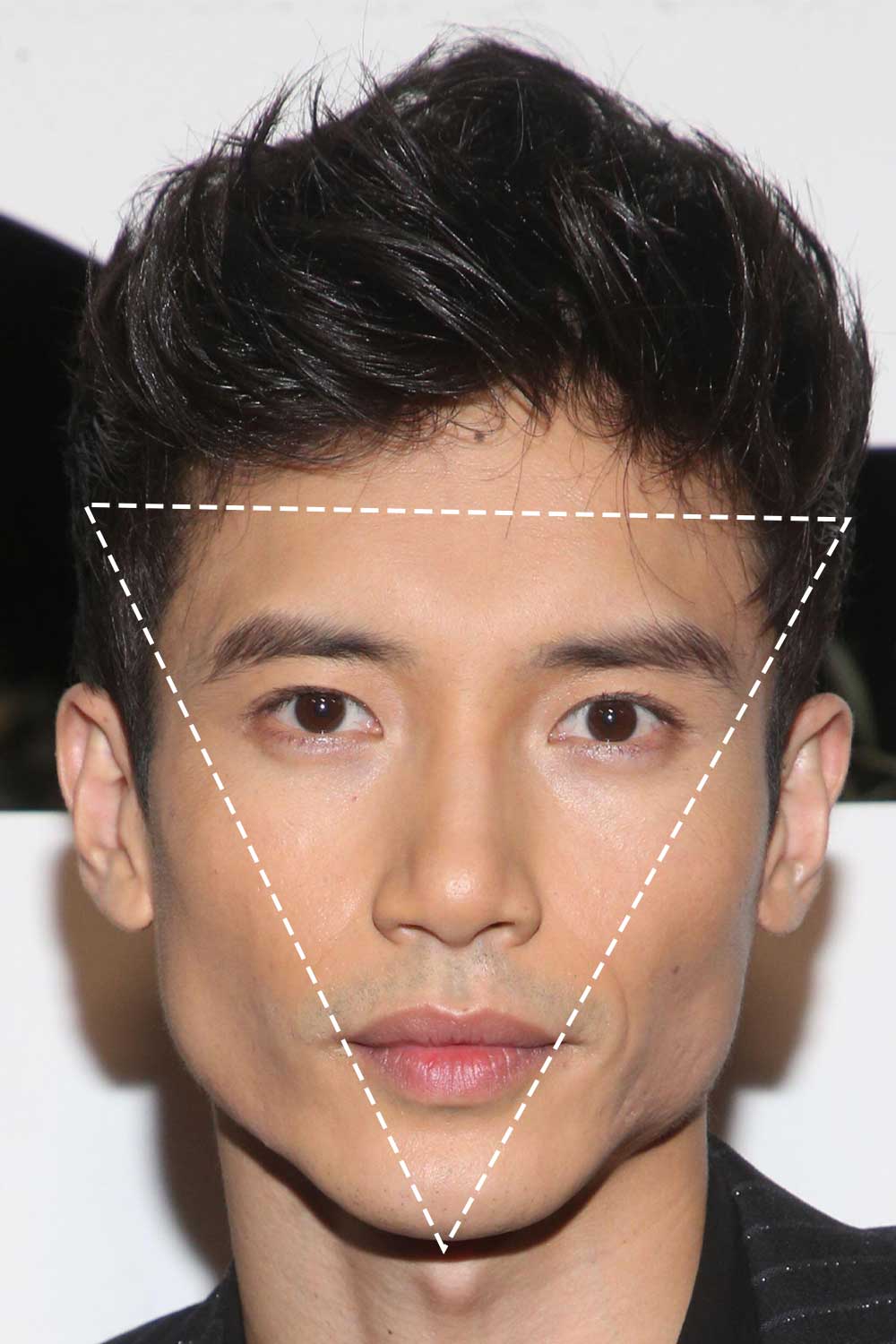
Manny Jacinto, pictured above, is often cited as an example of a triangle face shape.
The look this profile focuses on is a textured style with height on top and the temples left soft rather than taken very close.
Height through the top and fullness at the temples do different jobs, with the first adding length above the forehead and the second adding width beside it, so decide which you want before you sit in the chair.
This profile pairs the cut with a clean-shaven face; that is one option, not a rule for a broad jaw.
9. Pete Davidson

Pete Davidson, pictured above, is often cited as an example of a triangle face shape, and this profile focuses on how colour and length change where the eye goes.
Bleached or lightened hair draws attention to the top of the head because it contrasts with the skin and brows; it does not change the width of your forehead, and lightening is a colour service with its own upkeep, best discussed with a colourist.
Changing length on top changes the outline more than any styling product, because longer hair that lifts adds height, while a very short cut keeps attention on the face as a whole.
A matte finish shows texture without shine; whether you prefer that to a glossy finish is a matter of taste rather than face shape.
10. Rami Malek

Rami Malek, pictured above, is often cited as an example of a triangle face shape.
The look this profile focuses on is a textured cut with length on top and neat, controlled sides.
If you want some width at the temples with this cut, blow-drying the upper sides slightly outward before styling is one way to try it at home, and keeping the lower sides close stops the fullness collecting near the jaw.
Check the finished style dry, in daylight, from the front and the side; that mirror check tells you more than any description of a celebrity’s routine.
Styling Guide for Triangle Faces
If your goal is to draw the eye upward, the main lever is where your hair carries height and width; if you prefer to echo or show off a broad jaw, closer sides and a fuller beard do that instead.
Crown height and temple width are different effects. Height at the crown adds length above the forehead, width at the temples adds breadth beside it, and keeping bulk off the lower sides, around and behind the ears, stops fullness sitting at jaw level.
Tell your barber which of those you want, and mention your density, texture, curl, growth direction, hairline and how much daily styling you will do, because those decide how much length each area needs.
The top is styled daily, while the side length and any taper or fade at the neckline are set at the barber.
Then check the result dry-styled, facing a mirror and from the side, before deciding it works.
For facial hair, side fullness and chin length are separate choices, because short or close sides add little width at the jaw, extra length at the chin extends the lower face, and a full beard of even length makes the lower face read broader, which is fine if you like that look.
Clean-shaven, stubble and a full beard are all open to you; your growth coverage limits which outlines are achievable.
Choose a styling product by how your hair behaves, so if it falls flat, a lighter hold may help it stand, and if it frizzes, ask your barber for a product suited to your texture.
Accessory Selection for Triangle Faces
With eyewear, a frame with a strong or straight top line puts visual emphasis across the brow, if that is the effect you want; the frame still has to fit, meaning suitable overall width, a bridge that sits comfortably, temples of the right length and enough clearance, which an optician can check.
Aviators and other sunglasses that are deeper or wider at the top follow the same idea, and lens protection is a separate check from the shape.
A collar or tie sits at the neck and chest, so it frames the area below the jaw rather than changing the face. A narrower point collar or a slim tie gives a longer, vertical line, a spread collar gives a broader, level line at the throat, and either is a valid choice depending on whether you want to contrast or echo a broad jaw.
Final Considerations
A triangle face shape does not require any particular styling; the profiles above show options, not obligations.
How often you need a trim depends on the cut. Sharp, close sides lose their outline sooner than a longer, softer cut, and your growth rate matters too, so ask your barber how long your chosen style holds its shape.
Choose the goal first, whether that is drawing the eye upward, echoing a broad jaw or simply wearing a style you like, and then choose the cut and grooming that achieve it.
If your outline seems mixed, or a beard hides your jaw, read the neighbouring guides as well; a face label is a starting point for navigation, not a verdict.
Style Like A True Gentleman
Before you go, here is a simple order to follow, whether you work alone or with an image consultant.
Professional styling usually starts with knowing your body shape and seasonal colour palette, which help you choose well-fitting clothes in colours that suit your skin, eyes and hair.
Then you can plan outfits for each occasion, location, season and time of day, with garments, footwear, and accessories from heritage fashion brands that fit the way you want to look.
Take our three quizzes below, then book a paid consultation if you would like personal help.
1. Find Your Body Shape
Different garments flatter different silhouettes, so knowing your body shape is a useful first step.
To check your body shape, take our body shape quiz for men.
Next, take the second quiz to check your colour palette.
2. Find Your Seasonal Colours
Remember, the garments that compose your outfits come in various colours, and it helps to choose shades that suit your natural colouring.
To do that, find your seasonal colour palette by taking our seasonal colour quiz for men.
3. Find Your Fashion Style
Once you know your body shape and colour palette, the next step is to find your personal fashion style.
You can start with our fashion style quiz for men; it gives style suggestions, outfit ideas, relevant fashion brands, and much more.
Professional Image Consultancy with The VOU
If you would like personal help, you can book a paid consultation with our expert image consultants and fashion stylists.
Our styling services for men are paid consultations; the shop page lists what each one includes.
Remember, wearing luxury brands isn’t enough (see logo-heavy luxury brands and how to wear them); it also helps to know your body shape, colour palette, and ideal personal style, and then to dress by occasion, location, season, and time of day.
Contact us if you would like to book a paid consultation.