

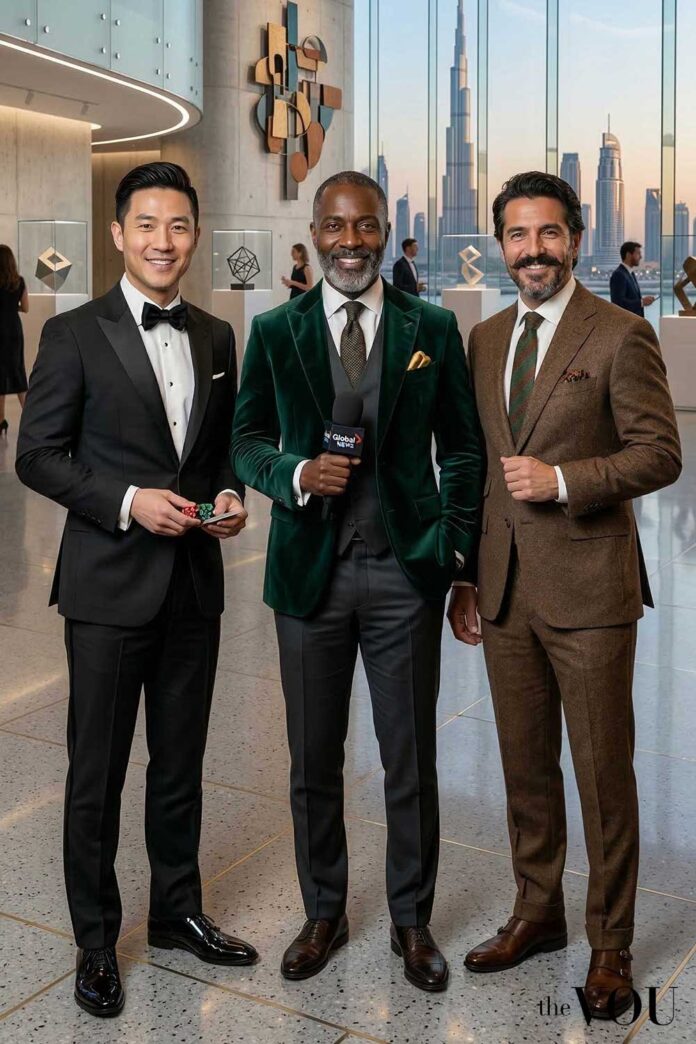
On screen, clothes do more than finish a look; they do a job and every industry that puts a human face in front of a camera has developed its own unspoken dress code.
Outfits aren’t just aesthetic choices but strategic decisions about credibility, attention, speed, and signal.
What a presenter wears tells the audience who is in control, what the tone of the event is, and where their eyes should go next.
What people wear on screen also reveals how each industry sees itself; some fields lean on ritual and formality, prioritising the old money wardrobe.
Others need speed, movement, or an accessible approach. Some want the presenter to stand out or want the presenter to guide attention somewhere else entirely.
Looking closely at these dress codes tells us something larger about modern media style and, more practically, about how clothes function as a visual tool under the pressure of the camera.
In this article, we break down three distinct media industries: news commentary, live casino streaming, and sports broadcasting, and decode exactly what their on-screen wardrobes are built to do.
News Anchors’ Look – Depicting Calm Authority
If you’ve been paying attention, the visual language of news broadcasting has shifted noticeably in the past decade.
Gone is the era of aggressively bold ties, bright statement blouses, and dramatic power dressing and what has replaced it is something quieter, more considered, and arguably more sophisticated, a kind of strategic understatement.
The goal is not blandness but control. News presenters today need to look credible in a studio, but they also need to hold up in cropped social clips, thumbnail-sized previews, replayed segments on muted screens in airports, and fast-moving social feeds, often all in the same 24-hour cycle.
Recent audience data explain exactly why this shift has happened. Across markets, social video news consumption rose from 52% in 2020 to 65% in 2025. Any video news use rose from 67% to 75%.
Overall trust in news held at 40%. British adults now spend 3 hours and 21 minutes a day on mobile, more than the 3 hours and 16 minutes they spend watching TV.
| Audience Signal | Latest Number | What It Suggests for Presenter Dress |
|---|---|---|
| Social video news use | 65% in 2025 | Clean blocks of colour read faster in short clips |
| Any video news use | 75% in 2025 | Wardrobes must work in close, face-led framing |
| Trust in news | 40% in 2025 | Quiet formality helps signal steadiness |
| Daily screen time in Britain | Mobile 3h 21m, TV 3h 16m | Looks need to stay clear on small screens |
What News Anchor Wear (and Why)
The most recognisable benchmark in news presenter style is CNN’s Anderson Cooper, consistently cited by fashion editors and stylists alike for his immaculate, entirely unflashy aesthetic.
Dark, well-fitted suits in charcoal or navy. White or pale blue dress shirts. No tie most of the time. No statement pieces.
The effect is that you notice his words, not his clothes and that is the point.
Other notable examples of this quiet-authority news wardrobe include:
- Huw Edwards (BBC): classic dark suits, white shirts — the visual equivalent of an institution
- Christiane Amanpour (CNN): known for bringing controlled colour — deep red, camel, charcoal — to a traditionally neutral palette. She demonstrates that restraint doesn’t have to mean colourless
- Norah O’Donnell (CBS): clean jewel tones in structured blazers, carefully chosen to read well on camera without feeling theatrical
What these presenters share isn’t just a dress code, it’s a philosophy and the wardrobe must serve the message.
In an era where trust in news is at 40%, clothes that feel stable, familiar, and serious are themselves part of the credibility signal.
In style terms, news commentary is one of the clearest examples of clothes functioning as visual discipline.
The presenter has to look polished, but the polish must feel measured rather than expressive as that is what authority looks like on screen now.
Casino Dealers’ Look – Showcasing Rules and Rhythm
Walk into a physical casino in Monte Carlo, Las Vegas, or Macau, and the dealer’s outfit immediately tells you something: this is a formal event, there are rules, and the atmosphere demands a certain comportment.
That same visual language has been carefully translated into the digital world.
In streamed table games, the clothes are usually somewhere between formal evening wear and a tailored uniform.
The style is neat, fitted, and composed, think structured jackets, fitted vests, clean dress shirts, simple shift dresses, and a palette of dark navy, deep burgundy, charcoal, and black.
These outfits are not there to impress but to organise, signalling that this is a hosted event with rules, rhythm, and clear hierarchy, and this is even more true in live casino online gaming settings than in other streamed formats.
The entire production atmosphere is crafted to replicate the feel of a premium casino floor and the host’s wardrobe is one of the most powerful tools for doing that.
Unlike a cooking show or a talk show where the presenter is the show, in a live dealer game the presenter is a facilitator.
The action, the cards, the roulette wheel, the bets, is the main event and the dealer’s style must reinforce the atmosphere without competing with it.
What Casino Dealers Wear (and Why)
The wardrobe choices for live dealers follow a logic that fashion insiders would recognise immediately: it is about controlled contrast. Key elements typically include:
- Dark base colours – navy, black, deep green that don’t distract on camera
- Clean white or neutral dress shirts underneath structured outerwear, creating a clear collar line that reads well in close-up shots
- Fitted silhouettes with no excess fabric that could look messy under studio lighting
- Minimal accessories – a simple watch at most, nothing that glints or moves in the light
- No bold patterns – stripes, checks, and prints can distort on-camera and pull the eye
Think of it as the screen equivalent of a classic old money aesthetic; understated, precise, and quietly authoritative.
Screen Visibility and Event Tone Matter
In live casino sessions, this balance is especially critical because the camera angle isn’t static. It may show more of the host in one moment, then zoom to the table in the next.
So clothes must look impeccable from multiple angles, under bright studio lighting, and on a compressed 5-inch phone screen, all at once.
Colour contrast matters enormously here. Hosts tend to wear tones that separate them visually from the background set, but not so dramatically that the outfit draws the eye away from gameplay.
There is also an important question of occasion-dressing. A streamed table is still an event space, even when it’s accessed through an app on a sofa.
Casual streetwear would immediately break the atmosphere. The semi-formal wardrobe connects the host to the centuries-old social language of the casino floor: controlled, composed, and ceremonial enough to feel special.
In fashion terms, think of what the late Karl Lagerfeld used to say about getting dressed: “Dress for the job you have, not the one you want.”
For a live dealer, the job is to make every player feel like they’re sitting at a real table. The clothes do half of that work before the host even speaks.
Sports Commentators’ Look – Polished Energy
Sports broadcasting has undergone arguably the most dramatic wardrobe evolution of any on-screen industry.
Take a look at this clip and consider what the presenters are wearing, and think about what the industry used to look like nearly six decades ago.
Those days are long gone. Today, sport is bigger, louder, and more global than ever, and its coverage demands a different kind of energy.
The presenter still needs authority, but the frame now carries movement, emotion, and live-event electricity.
As the 2025 Global Sports Report highlights, the global sports industry is experiencing a sweeping evolution as live sports continue to grow and extend into every corner of media.
The same report confirms that 51% of people globally are football fans, and that viewers aged 50 and older who use streaming to watch sports grew 21% in just two years.
That expanding, multigenerational, platform-agnostic audience changes everything, including what presenters wear.
What Sports Presenters Wear (and Why)
Sports presenter style sits in an interesting middle zone: more relaxed than news, more energised than a live casino dealer.
The classic broadcast suit still appears, particularly in studio-based roles, but it has been reworked, softened, and modernised.
Common choices across major networks and streaming platforms now include:
- Open collars – the removed tie signals approachability and contemporaneity
- Knit polos under structured blazers – a sharp, athletic-adjacent look that moves well on camera
- Textured blazers in boucle, tweed, or technical fabrics – adding visual interest without loud patterns
- Sleek outerwear for pitch-side and outdoor broadcasts – performance-influenced cuts in clean, non-distracting colours
- Sharper off-field footwear – loafers, Chelsea boots, and premium sneakers have replaced the traditional leather dress shoe in many pitchside contexts
Stephen A. Smith of ESPN’s First Take has become one of the most discussed style figures in sports media.
His evolution from conventional broadcaster to someone who regularly wears bold suits, interesting lapel details, and statement accessories is a case study in how sports media style has changed.
He is now featured in fashion publications, not just sports ones. His look says: I have opinions, I have energy, and I dress like it.
Compare that to a figure like Gary Lineker of the BBC’s Match of the Day, whose clean navy or grey suits project a more classic broadcast sensibility – authoritative but less theatrical.
Both work because they’re calibrated to the specific show and audience.
Dressing for Scale, Lights, and Live-Event Pressure
The numbers at the top of the broadcasting world are staggering. One 2025 championship broadcast in the United States drew 127.7 million viewers, the largest audience for a Super Bowl and for a single-network telecast in television history.
On a stage that size, everything a presenter wears is a decision made under a microscope.
Clothes at this scale need to work against a complex visual environment: turf, LED walls, crowd colour, flash photography, and dramatically shifting light levels.
They need to read clearly on a 75-inch television in a sports bar, but also on a 6-inch phone screen in someone’s pocket.
They must allow free movement, gesturing, pivoting, pointing at a screen, leaning into a co-presenter.
And they need to hold up under the physical heat of stadium lighting for hours at a time.
It’s a set of requirements that very few clothing choices can meet.
The ones that work tend to be structured, well-tailored, single-colour or simply-textured, and cut for movement rather than display. In this context, fit is everything.
A baggy jacket reads as unpolished at any resolution. A well-fitted blazer reads as professional at every resolution.
What These Industries Teach About Dressing for the Camera
Across live casino gaming, news commentary, and sports broadcasting, a clear set of visual principles emerges.
These aren’t just for professional presenters but applicable to anyone who appears on video, whether for a Zoom call, a YouTube channel, a podcast recording, or a brand partnership.
The Universal Rules of On-Screen Dressing
- Fit wins every time. A well-fitted garment in a modest fabric will always outperform an expensive piece that doesn’t sit right on camera. Cameras flatten volume and exaggerate looseness.
- Solid colors outperform patterns. Fine stripes, small checks, and busy prints can create a moiré effect on camera, a visual vibration that’s distracting. Solid mid-tones and deep colours (not pure black or pure white) tend to read best.
- The collar matters more than almost anything else. Because cameras are most often framed on the face and shoulders, the neckline is what the viewer sees most consistently. A clean, well-structured collar, whether from a shirt, a rollneck, or a dress, anchors the entire look.
- Dress for the occasion, not just the camera. Tone is part of the signal. Clothes that feel appropriate to the event’s register, formal for a news studio, energised for a sports set, composed for a casino stream, reinforce the audience’s sense of trust in the production.
- Less movement in the fabric means more authority. Heavy, structured fabrics photograph better and hold their shape. Lightweight, drapey pieces can shift, crease, or look disheveled under lights, undermining an otherwise polished look.
The Broader Lesson for Style-Conscious Readers
What the on-screen presenter wardrobe ultimately teaches us is something that great dressers have always understood: clothes are a form of communication.
The most interesting thing about studying what media professionals wear isn’t the specific items, it’s the underlying logic.
Every choice is made in service of a purpose and the question isn’t “what looks good?” but “what does this look need to do?”
For the live casino dealer, it needs to create atmosphere without stealing focus.
For the news anchor, it needs to project stability without showing off. For the sports presenter, it needs to carry energy without losing authority.
Each is a different brief, and each produces a different aesthetic, but all three are solving the same fundamental problem: how to use clothes to serve a larger goal than simply getting dressed.
That is, arguably, the highest level of dressing there is.
A passionate advocate for inclusivity and diversity, Aidan is the driving force behind The VOU as its Editorial Manager. With a unique blend of editorial acumen and project management prowess, Aidan's insightful articles have graced the pages of The Verge, WWD, Forbes, and WTVOX, reflecting his deep interest in the dynamic intersection of styling with grooming for men and beyond.
With years of expertise in high-end fashion collabs and a PhD in Sustainable Fashion, Ru specialises in eco-luxe wardrobes for the modern gentleman seeking understated refinement.
After years of managing hundreds of fashion brands from London's office of a global retailer, Mandy has ventured into freelancing. Connected with several fashion retailers and media platforms in the US, Australia, and the UK, Mandy uses her expertise to consult for emerging fashion brands create top-notch content as an editorial strategist for several online publications.
With over twenty years of front-row fashion and styling events, collabs with haute-couture houses, and a PhD in Luxury Fashion, Laurenti is an expert in crafting personalised looks that depict old-money sophistication.