Start here
What’s This About
A body-shape name is a styling shorthand for how your torso outline reads, meaning whether your shoulders look wider or narrower than your hips, and how much your waist comes in between them.
This guide helps you work out which of its seven descriptions fits you and what to wear with it, such as
how to read your own shoulder, waist and hip outline in a mirror
which tape measurements help when you buy clothes, and which can be compared with each other
where the seven descriptions overlap, including the two fuller-middle descriptions, Oval and Diamond, which this guide defines in its own words
outfits for Triangle, Inverted Triangle, Rectangle, Oval, Trapezoid, Hourglass and Diamond, with the effect each choice is meant to have
why fit and tailoring matter more than the label
and many more!
The names are descriptions, not diagnoses, and everything after them is a suggestion to try on your own body rather than a rule.
Key Points
01You can do this yourself with a tape measure and a mirror. No quiz, no purchase and no photograph is needed.
02Compare like with like. The shoulder-to-hip outline is a width observation and is the main step, while chest, waist and hips are circumferences, useful for buying clothes, that can be compared with each other but not with a width.
03The boundaries between these categories are drawn differently by different guides, and there is no agreed threshold. If you sit between two descriptions, read both.
04A shape label cannot tell you whether a garment fits. Fit is settled by the garment on your body, and our fitting guide covers how to judge it.
05These suggestions aim at a balanced silhouette, which is a convention rather than a fact. Wearing what you like is not a mistake, and a well-fitting garment usually matters more than a well-chosen shape.
06Fit and tailoring usually do more for how clothes look on you than the shape label does, which is why the last section of this guide is about them.
Want to learn more? Continue reading the full article below ↓
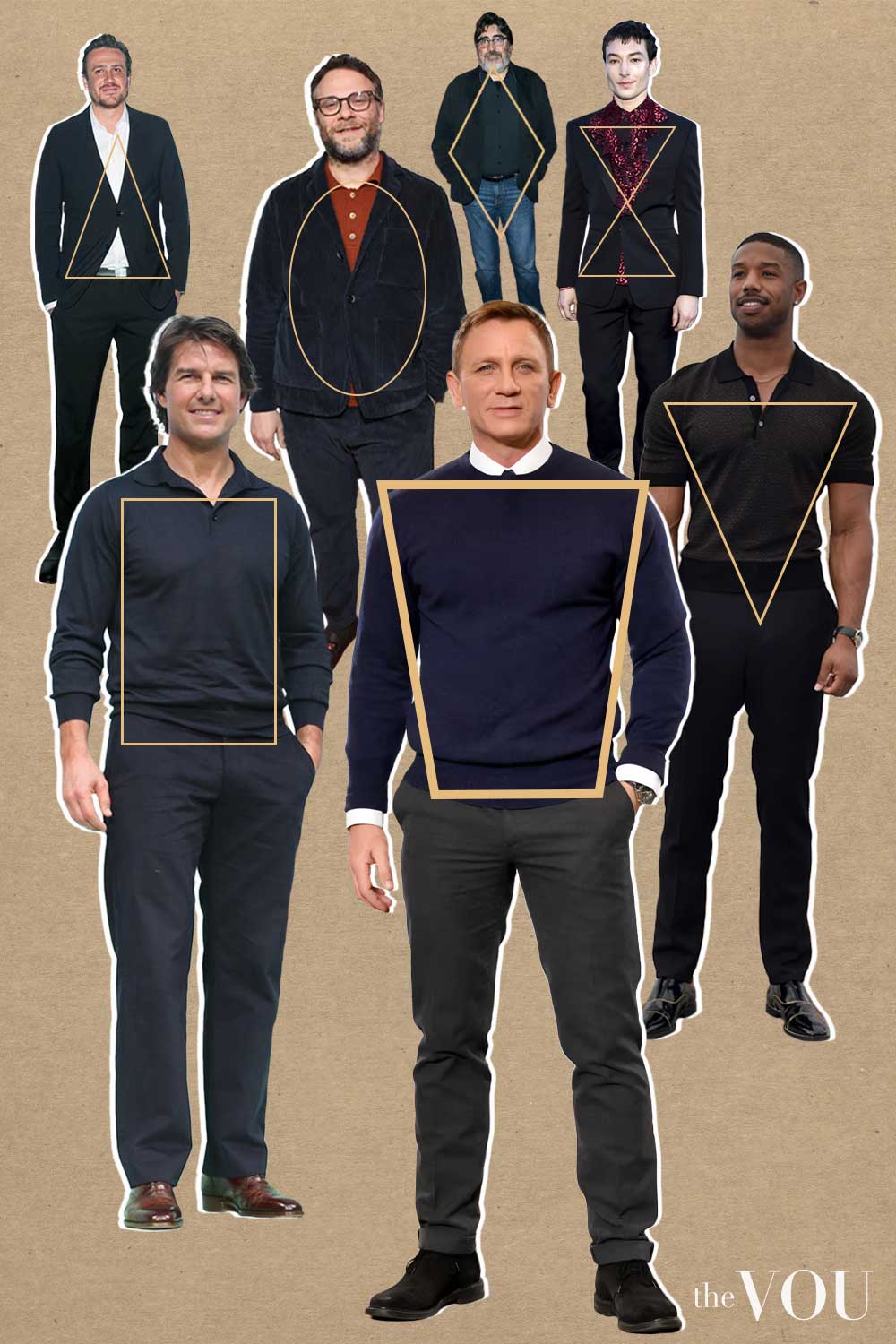
All 7 Male Body Shapes and Their Attributes
The American psychologist and physician William Sheldon set out three somatotypes, ectomorph, mesomorph and endomorph, in The Varieties of Human Physique in 1940.
Sheldon went on to link those three physiques to personality, and that link was criticised on straightforward methodological grounds, because his samples were not representative and he mistook correlation for causation.
Those three names are not the seven used here.
The seven are a styling convention, and the research done for this guide found no validated test that sorts men into them.
This guide uses the following seven body shapes.
Triangle, Inverted Triangle, Rectangle, Trapezoid and Hourglass follow familiar styling usage; Oval and Diamond are described in The VOU’s own words, as explained further down.
The links below go to the full guide for each one.
- Oval Body Shape, also known as Apple Shape, Round, O-Shape or Circular. In this guide, a rounded fuller-middle outline, with the fullness spread fairly generally through the torso.
- Diamond Body Shape, also known as Spade, Teardrop or Wedge Reversed. In this guide, an outline whose middle stands out more distinctly between a comparatively narrower upper and lower torso.
- Hourglass Body Shape, also known as X-Shape, Figure 8 or Wasp. Shoulders and hips look broadly balanced, with a visibly more defined waist between them.
- Trapezoid Body Shape, also known as Rhomboid or Regular. Shoulders look a little wider than the hips, with a gentle taper.
- Triangle Body Shape, also known as Pear Shape, Bell, A-Shape or Spoon. The lower torso and hip outline looks broader than the shoulders.
- Inverted Triangle Body Shape, also known as V-shape or Wedge. The shoulder and upper-torso outline looks noticeably broader than the hips.
- Rectangle Body Shape, also known as Straight Shape, Banana, Column or H-Shape. Little visible taper through the shoulders, torso and hips.
Scroll horizontally to see all columns →
 |
Don’t know your Body Shape? |
How to Compare Your Own Proportions
You can do this yourself with a tape measure and a mirror.
The seven descriptions are about the outline you see, so the mirror observation further down is the main step.
The tape measurements are useful when you buy clothes and can suggest which sections to read first; they do not decide the label.
Two points are worth knowing before you start.
First, a circumference and a width are different quantities and cannot be compared with each other.
Your chest measurement goes all the way around you; a shoulder width runs from one side of you to the other, and there is more than one of them. The outline you see in a mirror is one quantity, and a span measured across the curve of your back is another.
A shoulder span and a chest circumference describe different dimensions.
Dividing one by the other does not establish the width relationship this guide uses.
So this guide keeps them apart, with three circumferences compared with each other and the shoulder-to-hip width judged as a width against another width.
Second, there is no agreed arithmetic behind these labels.
Two calculators were read while this guide was written, and they go about it differently.
Calculator.net publishes its cut-offs and compares circumferences with circumferences only, and it says plainly that it is built for female proportions and that some bodies fit none of its categories.
Kikoi’s men’s calculator collects a shoulder span alongside three circumferences and publishes no thresholds or formula at all.
Those are the two this guide looked at, and no claim is made here about what calculators in general do.
None of this is a medical or scientific classification, so what follows produces a useful description, not a verdict.
The Three Circumferences
Take these over a t-shirt or bare skin rather than over a jumper, with the tape snug but not pulled tight, and keep the tape level all the way round.
Chest.
Around the fullest part, usually across the nipple line, arms down.
Waist.
Around the narrowest part of your middle.
Do not hold your stomach in.
If no narrowest point is obvious, ask someone to help you keep the tape level, choose a height you can find again, and write down where you measured.
If the number is for a particular maker, follow that maker’s diagram instead, because makers place the waist differently.
A natural-waist measurement and the fullest point of your abdomen may be at different heights, because a fuller stomach can sit below that narrowest point rather than at it.
Record them separately if you need both for clothes, because they do different jobs.
The natural waist is the number the three-circumference comparison below uses.
The fullest point of the abdomen is the one a shirt front, or a waistband sitting at that height, has to get round, and it is the number that decides whether a garment is comfortable through the middle.
Do not move the tape to whichever height produces a preferred shape, and do not let either number shut you out of advice. If your abdomen is visibly the fullest part of your torso, the sections on dressing a fuller middle are written for you whether or not your natural waist is your largest circumference.
Hips.
Around the widest part of your seat, feet together.
Now compare those three with each other, because they are the same kind of measurement.
Two questions do most of the work.
Which of the three is largest?
If the waist is the largest of the three, start with the oval and diamond sections.
If the chest is clearly the largest and the waist the smallest, start with the inverted triangle, trapezoid and hourglass sections.
If the hips are the largest, start with the triangle section.
If two of the three are close, read both of the sections they point to.
This question sorts the reading order; it does not lock a door.
The tape at the natural waist can read smaller than the chest while the abdomen below it is plainly the fullest part of the torso, and a man in that position needs the fuller-middle advice as much as anyone.
If that describes what you see in the mirror, read the oval and diamond sections too, whatever the three circumferences say.
Take a worked example, made up here to show the reasoning rather than taken from any real reader, with a chest of 108 cm (about 42.5 inches), a natural waist of 99 cm, a fullest abdomen of 112 cm and hips of 102 cm.
The largest of the three circumferences is the chest, so the question above would send him to the inverted triangle, trapezoid and hourglass sections, and the shoulder comparison may well fit him there.
His fullest abdomen, though, is larger than any of them, and it is the 112 cm that a waistband, a buttoned jacket or a shirt front has to go round.
So the trouser rise, the jacket buttoning point and the shirt front discussed in the oval and diamond sections are the ones that will decide whether he is comfortable, and both sets of advice are his to use.
A garment does not finish at the body measurement either.
Brooks Brothers publishes both figures side by side, and on its dress-shirt chart, read on 22 September 2026, the Regular Fit row for a 16-inch neck lists a body chest of 40 to 42 inches and a garment chest of 45.
How much room a particular garment adds is a property of that garment, so take the body number to the chart and let the chart tell you what the shirt measures.
How much difference is there between the chest and the waist?
A clear drop from chest to waist often goes with the hourglass and inverted triangle outlines, and very little difference often goes with the rectangle outline.
Circumferences and outline are still different measures, so a balanced outline with a defined waist does not need equal chest and hip measurements.
How much counts as clear is exactly the judgement no one has standardised, so read the sections either side of your own numbers.
The Width Observation
Shoulder width against hip width is a real and useful comparison, and it is a comparison of two widths rather than of two circumferences.
Stand square to a mirror with your arms down and look at where your shoulder line ends on each side, then at the widest point of your hips.
Are your shoulders clearly wider, about the same, or narrower?
That single observation separates the inverted triangle and trapezoid descriptions, which assume shoulders wider than hips, from the triangle description, which assumes the opposite.
If you would rather measure than look, measure two widths rather than a width and a circumference, and be clear which width you mean.
For the outline comparison, the landmarks are the outer edge of each shoulder and the widest hip outline as seen from the front.
An across-the-back shoulder measurement is a different quantity and is not the one to compare with your hips.
Proper Cloth’s own instructions are a good example of how one is taken for one garment. They ask for a partner, start the tape at “the outside edge of the shoulder where you want the yoke of the shirt to start”, and measure “up over the curve of the shoulders and to outside edge of the other shoulder”, suggesting you measure a well-fitting shirt instead if nobody can help.
That is a shirt-yoke method belonging to one maker’s ordering system.
Other makers and tailors ask for their own measurements in their own way, so follow the diagram on the form in front of you rather than assuming a single protocol.
If you would like a rough number rather than an impression, wall marks give one. Ask someone to help, stand upright with your back to the wall, have them mark the wall square-on at the outer edge of each shoulder, then at the widest point of your hips without you moving, and measure between each pair of marks.
A tape curved across the body does not give that projected width.
Treat the result as a rough observation rather than a measuring protocol, because how square the marks are and how you stand will move it; it is comparable with the other wall width and with nothing else on this page.
None of this is required, and the mirror observation above is enough for the comparison.
Where the Descriptions Overlap
Two of the seven names, the oval and the diamond, describe a fuller middle.
Because guides disagree about where one ends and the other begins, it is worth saying plainly how this guide uses them.
In this guide, we use oval for a rounded fuller-middle outline, with the fullness spread fairly generally through the torso.
We use diamond for an outline in which the middle stands out more distinctly between a comparatively narrower upper and lower torso.
That is a description of what the outline looks like, not a measurement, and neither name requires your waist to be your largest circumference.
Those are The VOU’s working descriptions rather than an industry standard.
Other guides use the same two names differently. Some separate them by which parts are slim, others by how the chest compares with the middle, and one men’s calculator this guide looked at drops the diamond name altogether.
The published classification that does define both, the Female Figure Identification Technique, was built on women’s body scans, and the 2020 paper that revisited it reintroduced oval and diamond with revised formulas after finding that the earlier ones misclassified some larger scans; those formulas describe female scan data and cannot settle a men’s description.
No reproducible men’s discriminator has been established, and this guide does not claim that none could be.
So the two overlap, and that is expected rather than a problem.
If both descriptions sound like you, read both sections and take whichever suggestions are useful; your actual fit needs, not the name, decide which advice helps.
The same is true elsewhere.
Trapezoid and inverted triangle are the same shape at different strengths, and rectangle and hourglass differ only in how much the waist comes in.
Kikoi’s men’s calculator says as much itself. “Many men exhibit characteristics of multiple body types, which is completely normal.”
What the Label Can and Cannot Do
A shape label is a way of describing proportion, and that is all it is.
It cannot tell you whether a garment fits you.
Two men with identical measurements will get different results from the same jacket depending on how the jacket is cut, and the only way to know is to put it on and check the shoulder line, the fastened chest and the seat.
Our guide to garment fit covers those checks.
It does not tell you what you are allowed to wear.
The suggestions in this guide aim at a balanced silhouette, which is a long-standing convention in menswear and not a law of nature.
Plenty of well-dressed men deliberately do the opposite.
It is not a fixed property either.
Shoulders, waist and weight change; a label that fitted you five years ago may not describe you now.
1. Triangle Body Shape
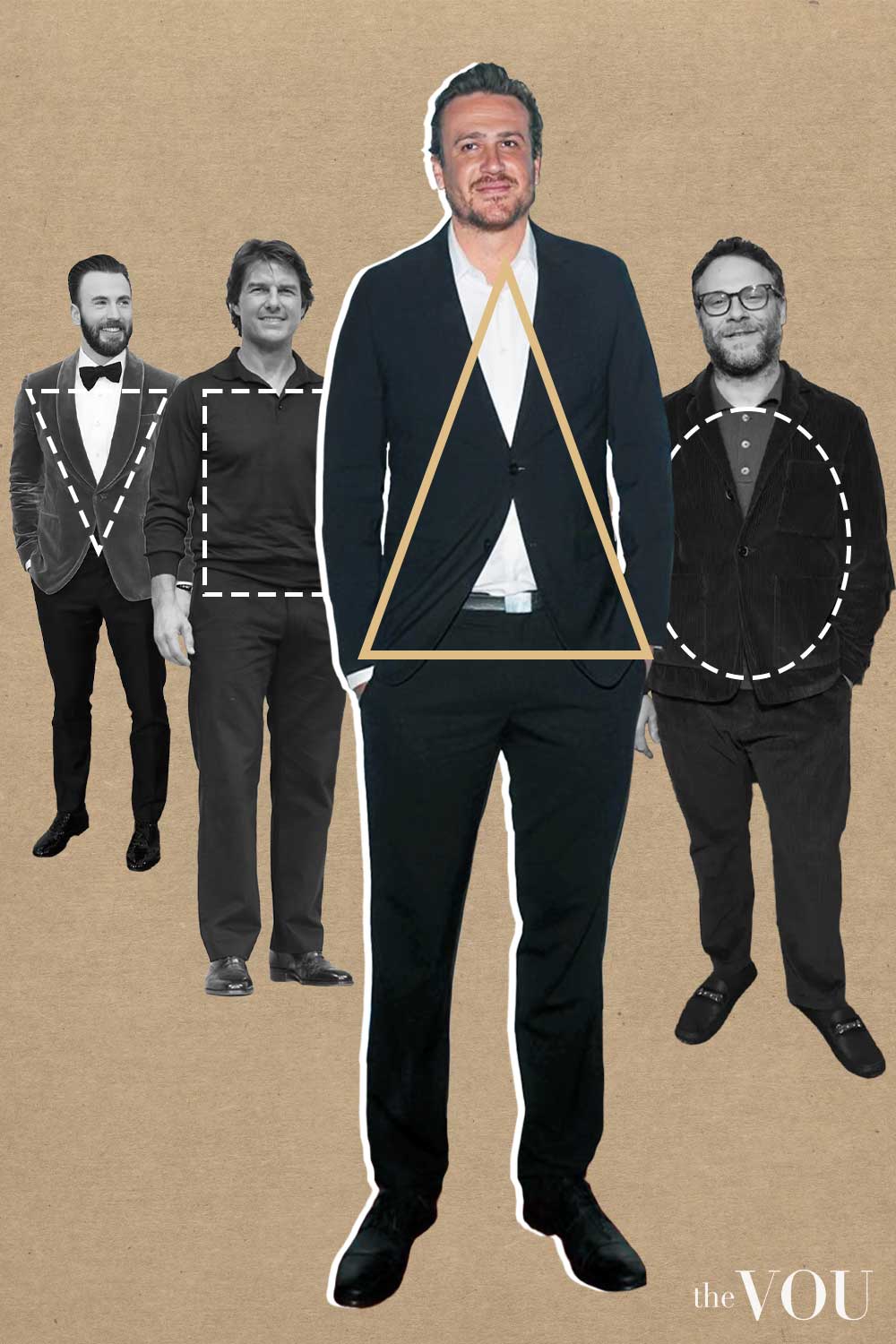
The triangle body shape, also known as the pear body shape or the A body shape, describes a lower torso and hip outline that looks broader than the shoulders, with the width carried in the hips, seat and thighs.
If you want the upper and lower body of a triangle body shape to read as more even, the usual approach is to add a little presence above the waist and keep the lower half plain.
If you are happy with the outline as it is, none of what follows is required.
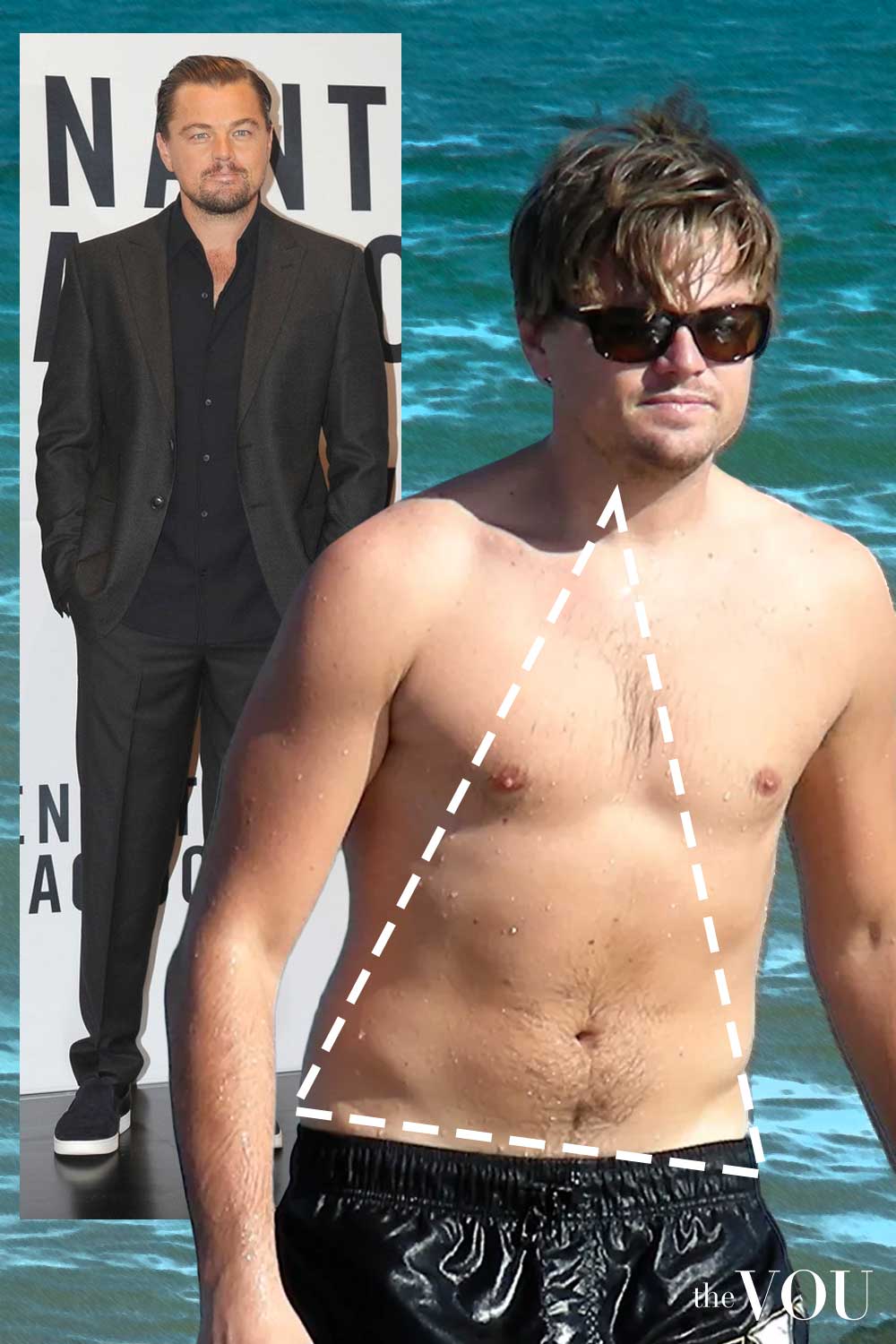
Patterned blazers put visual interest at the chest and shoulders, and a fine vertical stripe on the shirt is one way to add a little pattern there.
Compare the effect in a mirror, because what a stripe does depends on the whole outfit.
Some shoulder structure gives the shoulder line more definition.
A single-breasted suit is the simpler starting point; how slim any jacket looks depends on its cut more than on its fastening.
Incorporating brighter colour panels across the chest can also help broaden the upper torso.
Which brighter colour is a matter of what you like and what you already own, so try a contrast you are drawn to against the rest of the outfit and see whether the effect is the one you wanted.
If you use a seasonal colour palette, it is one way to narrow the choice, and it is not something you need settled before you can try this.
Close-fitting polo shirts and roll necks follow the body closely, including any fullness at the middle.
If you would rather not show that, choose a looser knit or wear them under a jacket.
Bold colour and busy print on the trousers put the attention on the lower half.
If that is not what you want, keep the louder colour or print above the waist, or in pocket squares, glasses and socks.
Scroll horizontally to see all columns →
| Do | Don’t |
|---|---|
| Wear tailored patterned blazers Fine shirt stripes, compared in a mirror Jackets with structured shoulders Single-breasted suits Bright colour panels |
Close-fitting polos and roll necks, if you would rather not show the middle Loud colour and print on the trousers, if you want the lower half quiet Skinny fits and extreme tapers that grip the thigh High-contrast belts, if you want no line at the hip |
Celebrity Examples
A note that applies to every section of this page.
Named examples for each shape are collected in the separate celebrity articles linked in each section.
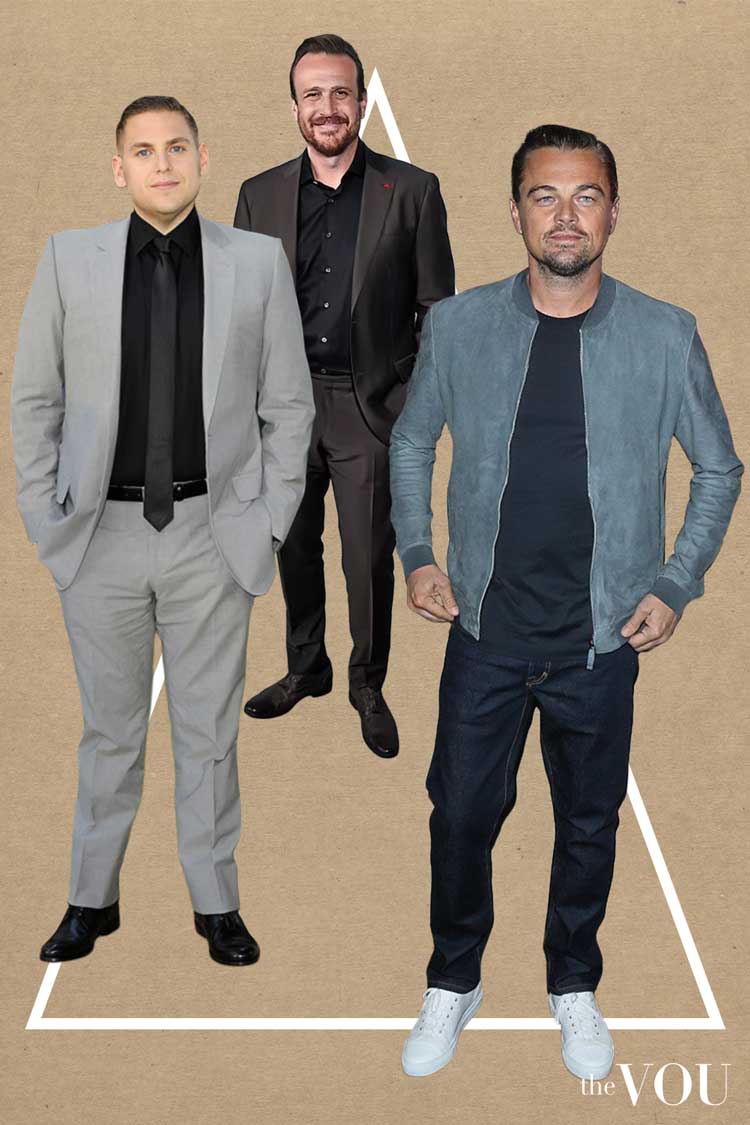
A separate article collects the names usually mentioned for this shape.
Formal Outfit
If you want to make a sophisticated impression in a formal setting, we recommend the following ensemble.
A navy single-breasted blazer with some shoulder structure, over a white cotton dress shirt with a fine vertical stripe.
Olive green chino trousers in a straight leg keep the lower half quiet rather than adding width to it, and a knitted tie in burgundy gives the chest a point of interest without pattern.
Brown leather Oxford shoes finish it.
The structured shoulder gives this outfit its shape; everything else is preference.
Casual Outfit
Off duty, the same idea works with less structure.
A charcoal crew neck over a collared shirt, so the collar adds a little width at the shoulder, with mid-blue straight-leg jeans rather than a slim fit, which sit more comfortably over the thigh.
White trainers and a belt that matches the jeans rather than contrasting with them, because a bright belt puts a contrasting line at the hip.
Styling Mistakes to Avoid
Chaps with triangle body shapes should be wary of these common pitfalls.
- Very tight shirts follow every line of the upper body, which tends to show the shoulder-to-hip contrast more rather than less.
- A low rise can sit below the fullest part of the hip and pinch there. Check where the waistband sits and whether it stays comfortable when you sit.
- Skinny jeans pull tight across the thigh, which shows the hip and thigh width that this section is trying to balance. A straight leg does the same job in cloth that skims.
- A bulky padded jacket that ends at the hip adds volume exactly where you may want less.
- Bold pattern or bright colour on trousers puts the attention on the lower half, which works against the balance this section describes if that balance is your aim.
2. Inverted Triangle Body Shape
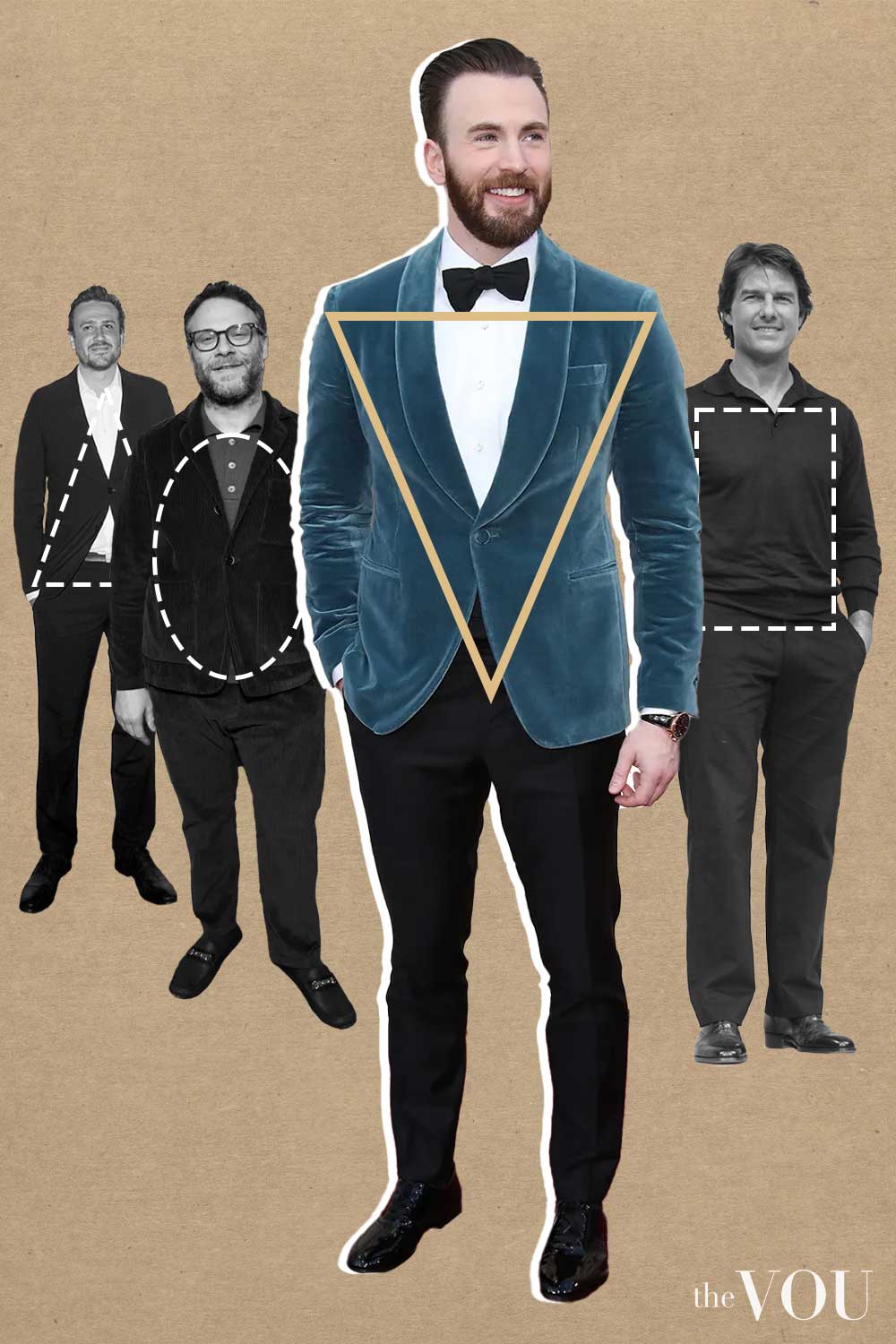
The inverted triangle body shape, also known as the V shape, describes a shoulder and upper-torso outline that looks noticeably broader than the hips.
The name says nothing about fitness or training.
If you want a more even outline, the usual approach for an inverted triangle build is to leave the upper body alone and give the lower half a little more presence.
If you would rather emphasise the shoulders you have, that is a legitimate choice and the opposite of the advice below applies.
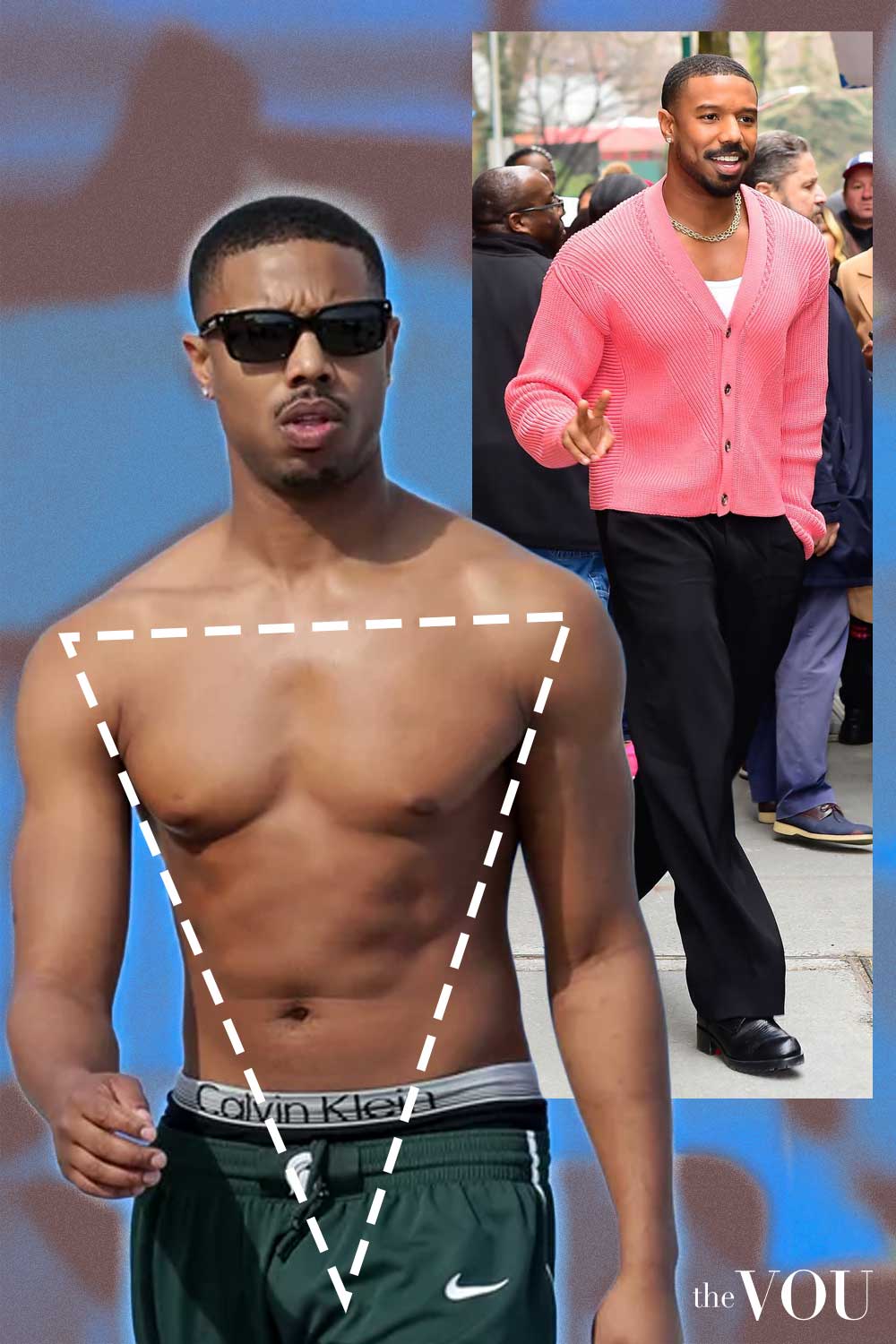
Pattern and colour carry weight wherever you put them, so a stripe or a brighter colour below the waist tends to give the lower half more presence; compare it in a mirror.
Slim-fit shirts and cotton polos follow the upper body without adding to it.
A V-neck opens the top of the chest.
Try it against a crew neck and keep whichever you prefer.
For trousers, straight-leg denim and chinos give the lower half some presence without clinging.
If a more even outline is the aim, the choices working against you are heavy shoulder structure and pattern placed across the chest, both of which add width where you already have it.
Pattern lower down does the opposite, which is why this section suggests it on the trousers.
A neckline changes how open the top of the chest reads. Try it with the rest of the outfit and choose the amount of openness and upper-body emphasis you prefer, because the body label alone does not decide it.
Scroll horizontally to see all columns →
| Do | Don’t |
|---|---|
| Stripes and pattern below the waist rather than across the chest Slim-fit shirts Slim cotton polo shirts V-neck or crew neck T-shirts, compared in a mirror Straight-leg trousers and jeans |
Heavy shoulder structure, if you want to soften the contrast Prominent pattern across the chest, if a more even outline is the aim Choosing a neckline from the body label alone Short, cropped jackets, if you want the top half to look less dominant |
Celebrity Examples
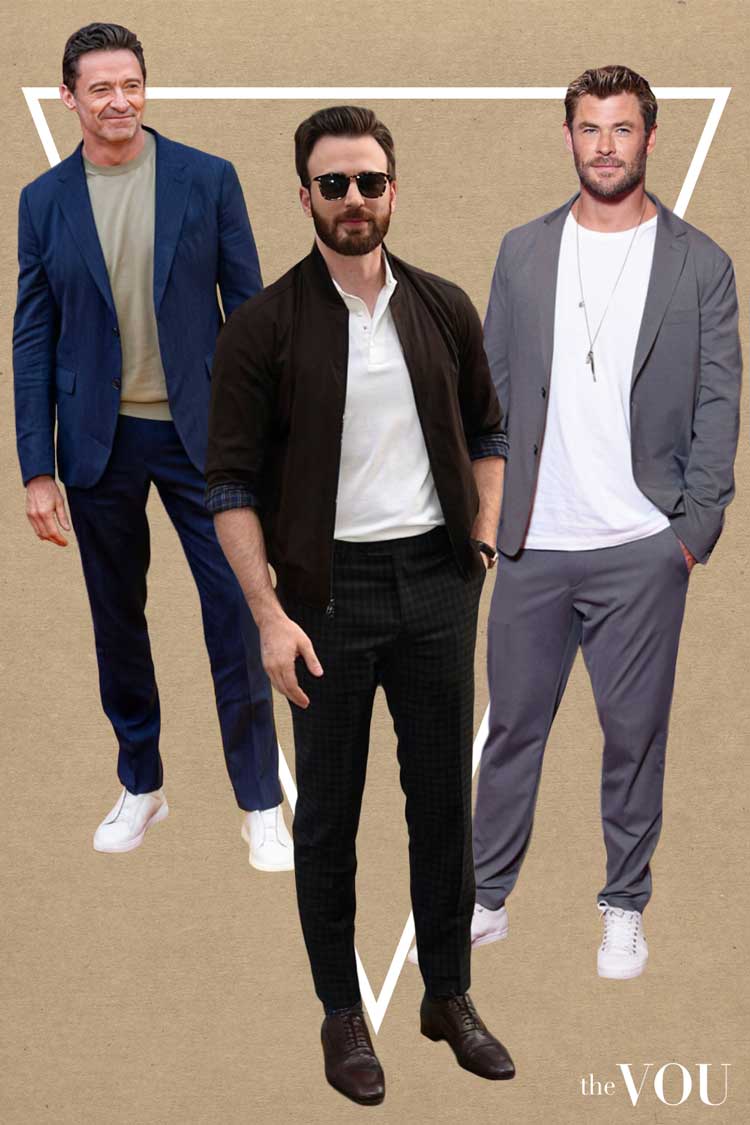
A separate article collects the names usually mentioned for this shape.
Formal Outfits
For a formal event, try a grey Prince of Wales check suit with a light blue Oxford shirt.
Choose the jacket with a soft, lightly padded shoulder rather than a built one, which is the same point the section makes above. Your own shoulder line is already the widest part, so the jacket does not need to add to it.
A Prince of Wales check is a pattern, and this section suggests keeping pattern off the chest, so it is worth saying why this one is here. It is an all-over cloth pattern rather than a band across the chest, and it reads as texture from a normal distance.
If you would rather keep the chest plain, a solid grey suit does the same job and the rest of the outfit is unchanged.
A jacket cut with a little shape at the waist keeps the line from looking boxy.
Complete the look with a navy knitted tie, brown cap-toe Oxford shoes, burgundy wool socks, and a stainless steel dress watch.
The soft shoulder and the shaped waist keep the jacket from adding width at the top, which is the balance this section describes.
Casual Outfits
For a casual, off-duty aesthetic, pair a charcoal grey crew neck sweater with light-wash straight-leg jeans.
The medium-gauge crew neck skims rather than clings, and the straight leg gives the lower half a little more presence than a slim cut would.
Complete the outfit with white low-top trainers, black sunglasses, and a brown leather belt.
The outfit keeps the shoulder line as it is and gives the lower half something to hold the eye, which is the balance this section is aiming at.
Styling Mistakes to Avoid
Gentlemen with an inverted triangle shape should avoid the following common errors.
- Very tight shirts and T-shirts emphasise the upper body. If softening the contrast is the aim, a little more room helps.
- Heavy shoulder padding adds width at the shoulder, which is the opposite of softening the contrast; it suits you if you want to emphasise it.
- Skinny trousers narrow the lower half, which increases the top-to-bottom contrast if that is what you are trying to reduce.
- A horizontal stripe across the chest tends to draw the eye across the part it sits on, which works against the balance this section aims at if your goal is to soften an already broad upper body. If that is the goal, the same stripe lower down, on the trousers or a lower-body garment, puts the interest where you want it instead. If you like the stripe on top and are not trying to soften the contrast, wear it and accept the effect. These are suggestions to compare in a mirror rather than optical certainties.
- Choose a neckline from the outfit rather than from the body label. Try it with the rest of what you are wearing and choose the amount of openness and upper-body emphasis you prefer.
3. Rectangle Body Shape
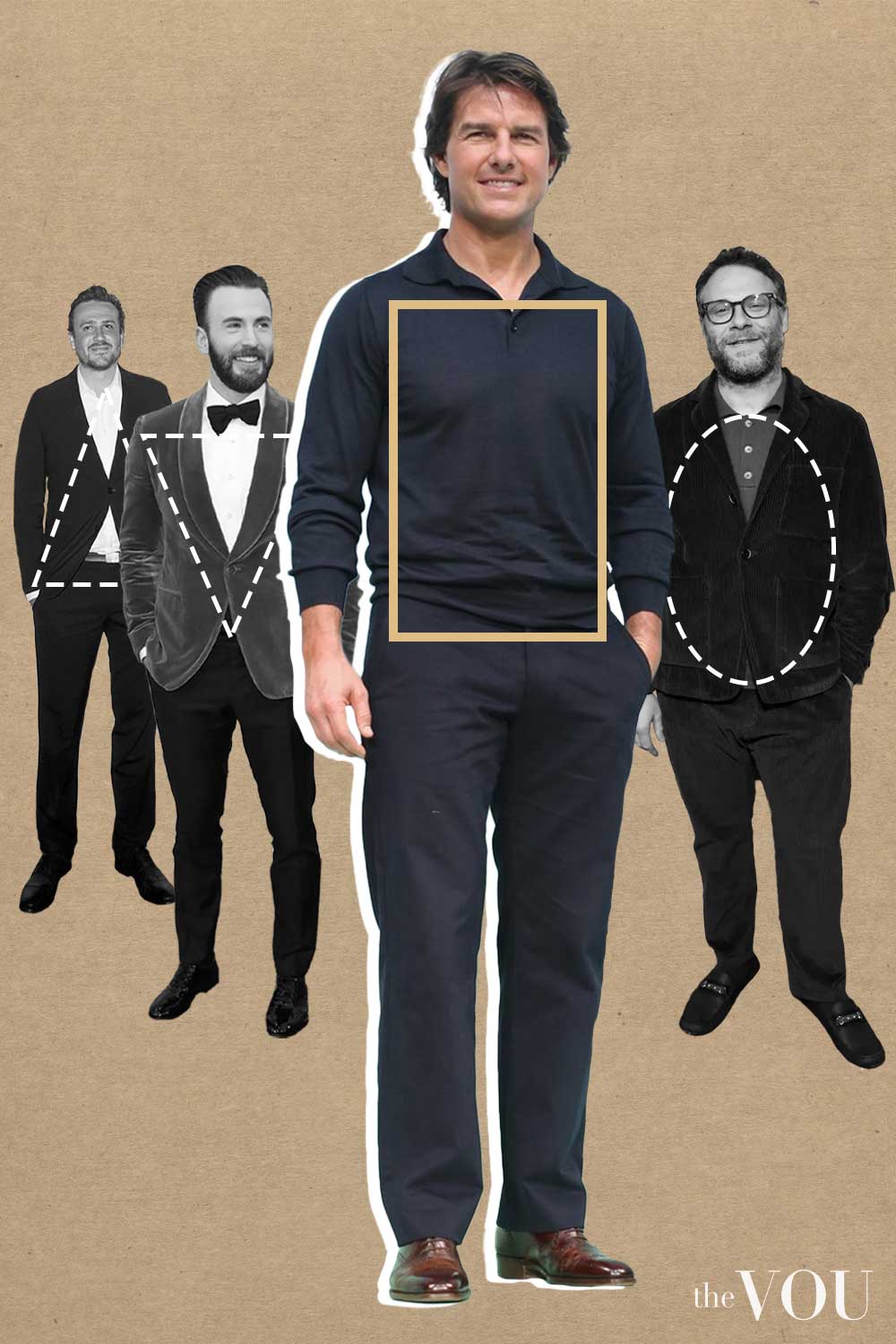
The rectangle body shape, straight body shape, banana body shape, or column shape is characterised by minimal curves with shoulders, waist, and hips in a similar alignment.
With shoulders and hips close in width and little visible taper through the torso, the rectangular body shape can be dressed for more visible shape or left straight.
If you want more shape, the usual approach is to add structure at the shoulder and some shaping at the waist; a straight, unshaped line is also a legitimate choice.
Structured tailoring, such as single-breasted blazers and suits with some shoulder build and waist shaping, gives the outline more taper than the body shows on its own.
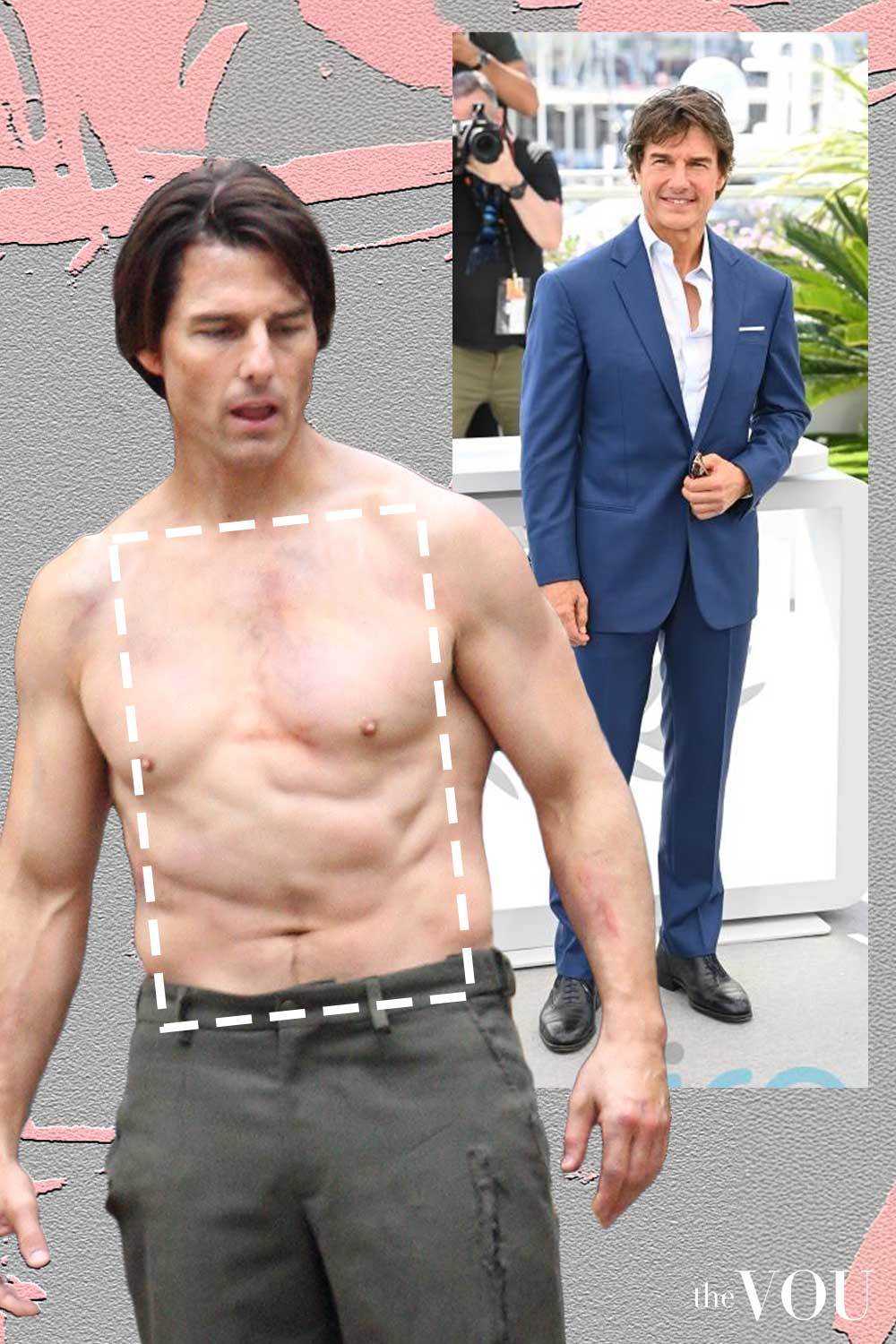
Horizontal stripes across the upper torso are often suggested to add width there.
Controlled studies do not show that a stripe direction has one fixed effect, so compare the outfit in a mirror.
Layering a button-down shirt under a fine-gauge crew neck adds some depth at the chest.
Scarves, prints and a brighter colour near the face put interest at the top of the outfit.
Very loose, unshaped clothing and very low-rise trousers work against the taper this section describes.
Deliberate relaxed volume is a different choice and can look intentional.
If you want the jacket to show a taper, compare its actual waist shaping rather than ruling out a fastening, because a double-breasted jacket does not by itself make the cut boxy, and a single-breasted one is not shaped by default.
Whether either suits a straight build depends on how that particular jacket is cut and on the effect you want.
Scroll horizontally to see all columns →
| Do | Don’t |
|---|---|
| Horizontal stripes, compared in a mirror Structured tailoring Layered looks Scarves Prints, colour pops, and detailing |
Jackets with no waist shaping, whatever the fastening, if you want a taper Unshaped, baggy cuts, if you want a taper Oversized T-shirts, for the same reason Extremely low-rise trousers |
Celebrity Examples
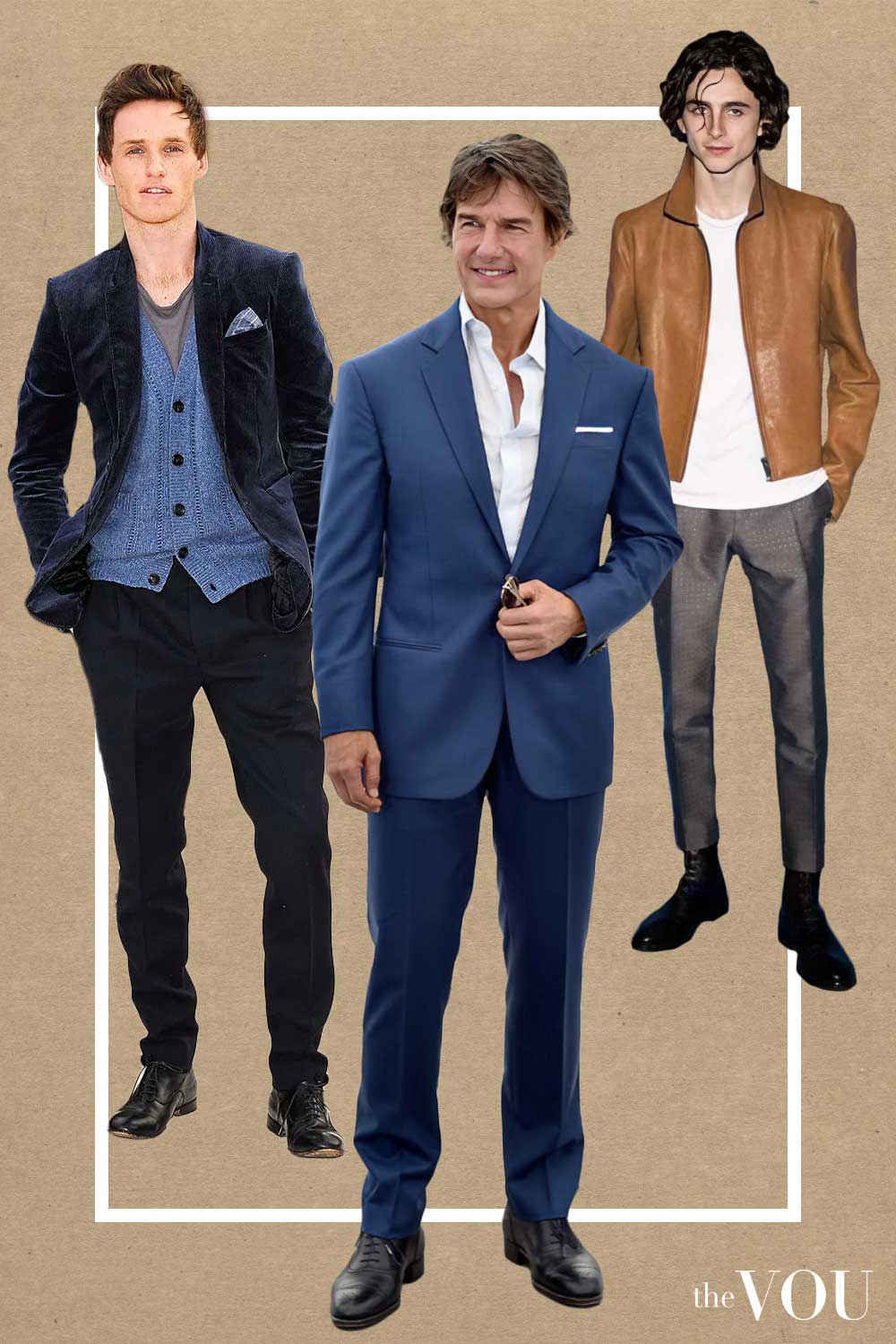
A separate article collects the names usually mentioned for this shape.
Formal Outfits
If you seek a refined, formal look, we suggest pairing a navy single-breasted suit jacket with a crisp white dress shirt.
The jacket’s structured shoulders give the outline more width at the top, and the slim-fit trousers keep the lower half clean.
Complete the ensemble with a burgundy knitted tie, dark brown leather Oxford shoes, and a stainless steel dress watch.
The structured shoulder gives this outfit its shape; the rest is preference.
Casual Outfits
To achieve a more relaxed, off-duty aesthetic, focus on layered garments that add visual interest and balance to the frame.
Start with a heather grey crew neck sweater layered over a light blue button-down shirt.
The contrast in textures and the open collar add interest at the top of the outfit.
Pair this with slim-fit dark wash denim jeans and white low-top trainers for a polished casual look.
To complete the ensemble, add a tan suede bomber jacket and your favourite aviator sunglasses.
The layers add depth to a straight outline; whether you want that depth is up to you.
Styling Mistakes to Avoid
Gents with a rectangle body shape should steer clear of the mistakes below.
- Very loose, unshaped clothing hides any taper you have, which matters only if you want the taper to show.
- Garments with no structure follow a straight outline. Add some shoulder build or waist shaping if you want more shape.
- Vertical stripes are commonly said to reinforce a straight line. The effect depends on the stripe and the outfit, so compare them with horizontal detail, layers and texture if you want more interest.
- Low-rise trousers move the waistline down, which can make the torso read longer; a mid rise keeps it higher if you prefer that.
- A single colour head to toe gives the eye no horizontal break, which can make a straight silhouette read as straighter. That can be exactly what you want, and our guide to breaking up a monochrome outfit covers how to add one contrast point when it is not.
4. Oval Body Shape
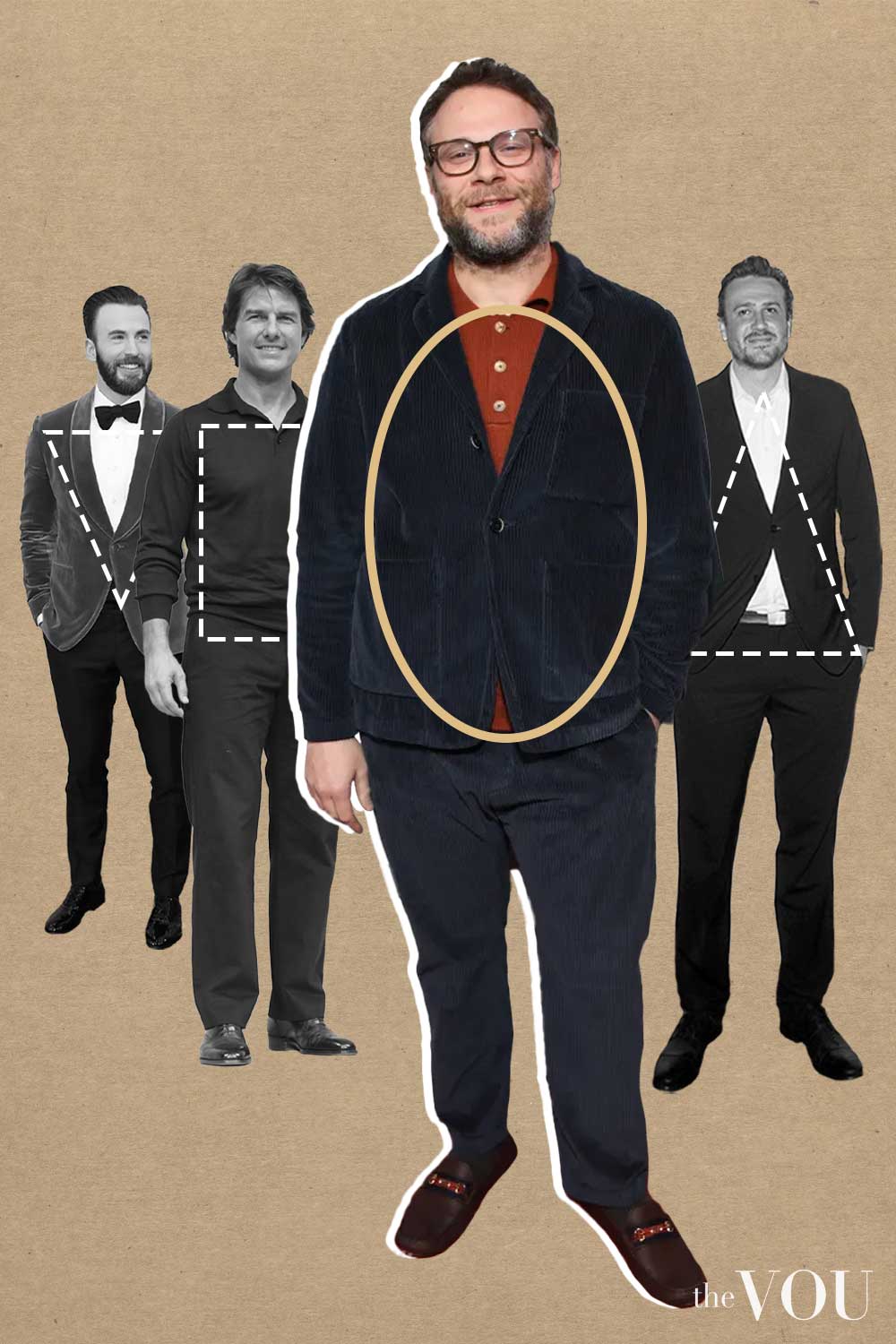
The oval body shape, or the O body shape (O for oval), is also known as the apple body shape and the round or circle body shape.
In this guide, Oval describes a rounded fuller-middle outline, with the fullness spread fairly generally through the torso rather than concentrated in one band.
Where the middle stands out more distinctly between a narrower upper and lower torso, the diamond description in section 7 may match what you see better, and because the two overlap it is worth reading both.
For the gentleman with an oval body shape, comfort and proportion are key.
Opt for trousers with a comfortable waist, whether belted or worn with braces, so the front lies smooth when you sit and stand.
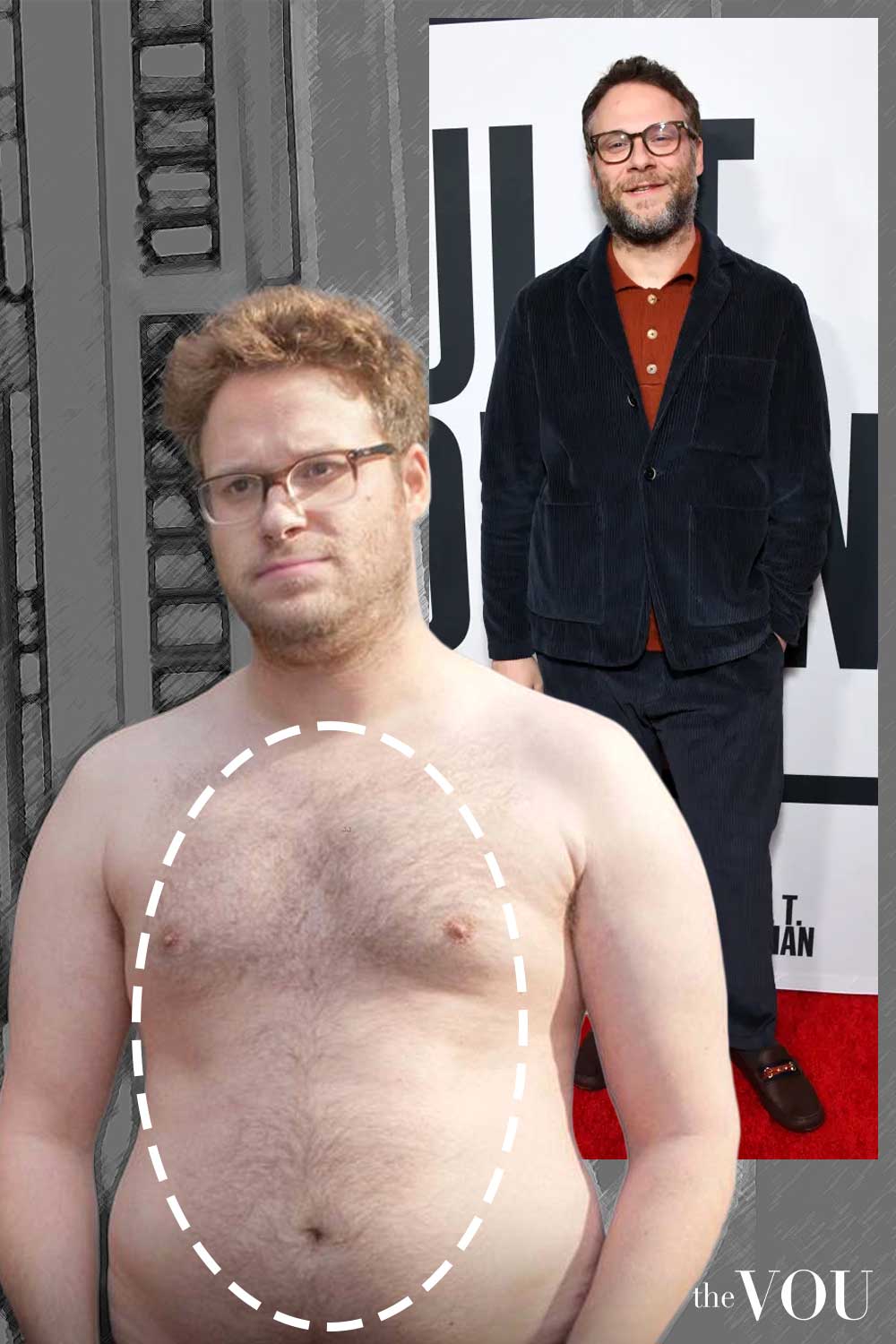
Pleated trousers can also provide extra room at the hip and thigh.
Regarding shirts, collar spread is worth trying both ways, since a wider spread fills the space inside a jacket’s lapels and a narrower one leaves more of it open.
Neither follows from the shape of your middle, so judge it against your own face and neck in a mirror.
A dark, single-breasted jacket is the quiet default here.
That is a starting point rather than a rule. Judge any jacket fastened, on you, for the effect you actually want.
Tight, clingy fabrics follow the middle closely, and busy pattern across it draws the eye there; choose them deliberately if you want them.
A longer rise is worth trying if you want the waistband to sit higher.
Check where it rests on you, whether it stays comfortable when you sit and move, and whether it needs a belt or braces.
Rise alone does not guarantee that trousers will stay in place.
Scroll horizontally to see all columns →
| Do | Don’t |
|---|---|
| Trousers with braces Pleated trousers Collar spreads tried against your own face and neck; body shape does not decide collar width Dark, single-breasted jackets |
Tight fits in the torso Busy patterns across the middle A low rise, if you want the waistband to sit higher Horizontal stripes across the middle, unless you want the emphasis Belted outerwear that cinches at the middle, if you would rather not mark it |
Celebrity Examples
A separate article collects the names usually mentioned for this shape.
Formal Outfits
A classic, well-tailored suit is highly recommended if you want to make a sophisticated impression in a formal setting.
Begin with a navy single-breasted suit jacket, with some structure and only light waist shaping, so it fastens without pulling.
Pair this with flat-front trousers in a complementary shade, worn where the waistband stays comfortable standing and seated, so they neither pinch nor bunch.
For the shirt, a crisp white button-down with a spread collar is one option for this outfit, and the collar is worth judging against your own face and neck rather than against where your torso is widest.
A tie in a single deep colour and brown leather Oxford shoes finish it.
The jacket’s light waist suppression and the flat-front trousers sitting where they stay comfortable give this outfit its shape.
Neither hides anything; together they give the outfit a vertical line to follow.
Casual Outfits
For a more relaxed, off-duty style, focus on comfortable garments that skim rather than cling.
Start with a navy cotton polo shirt, which provides a structured, slightly tailored fit through the torso.
Pair this with pleated khaki chinos.
Choose one way of holding them up rather than two. Braces carry the trousers from the shoulders and leave the waistband undisturbed, which is why they suit a fuller waist, while a belt cinches at the waist and is simpler under an untucked shirt.
Trousers cut for braces often have no belt loops at all.
Finish with white low-top trainers.
For a final touch of refinement, layer a grey crew-neck sweater over the polo and finish with tortoiseshell sunglasses.
The outfit is built around comfort through the middle, with room in the trousers, one way of holding them up and a layer over the polo.
Styling Mistakes to Avoid
Men with an oval body shape should avoid the common errors listed below.
- Clothes that are too tight report every line underneath them and pull at the fastenings, which is a fit problem rather than a body problem.
- Decide what you want horizontal stripes to do before reaching for them. Across the widest part of you a horizontal stripe draws the eye there, which is worth choosing deliberately rather than by accident.
- Low-rise trousers can sit under a fuller abdomen and roll or pinch. Check where the waistband rests and how it feels seated.
- A tucked shirt without a jacket puts a line at the waistband. An untucked shirt cut to the right length, or a jacket, avoids that if you prefer.
- Bold pattern or bright colour across the middle draws the eye there. Put it elsewhere if you would rather not.
5. Trapezoid Body Shape
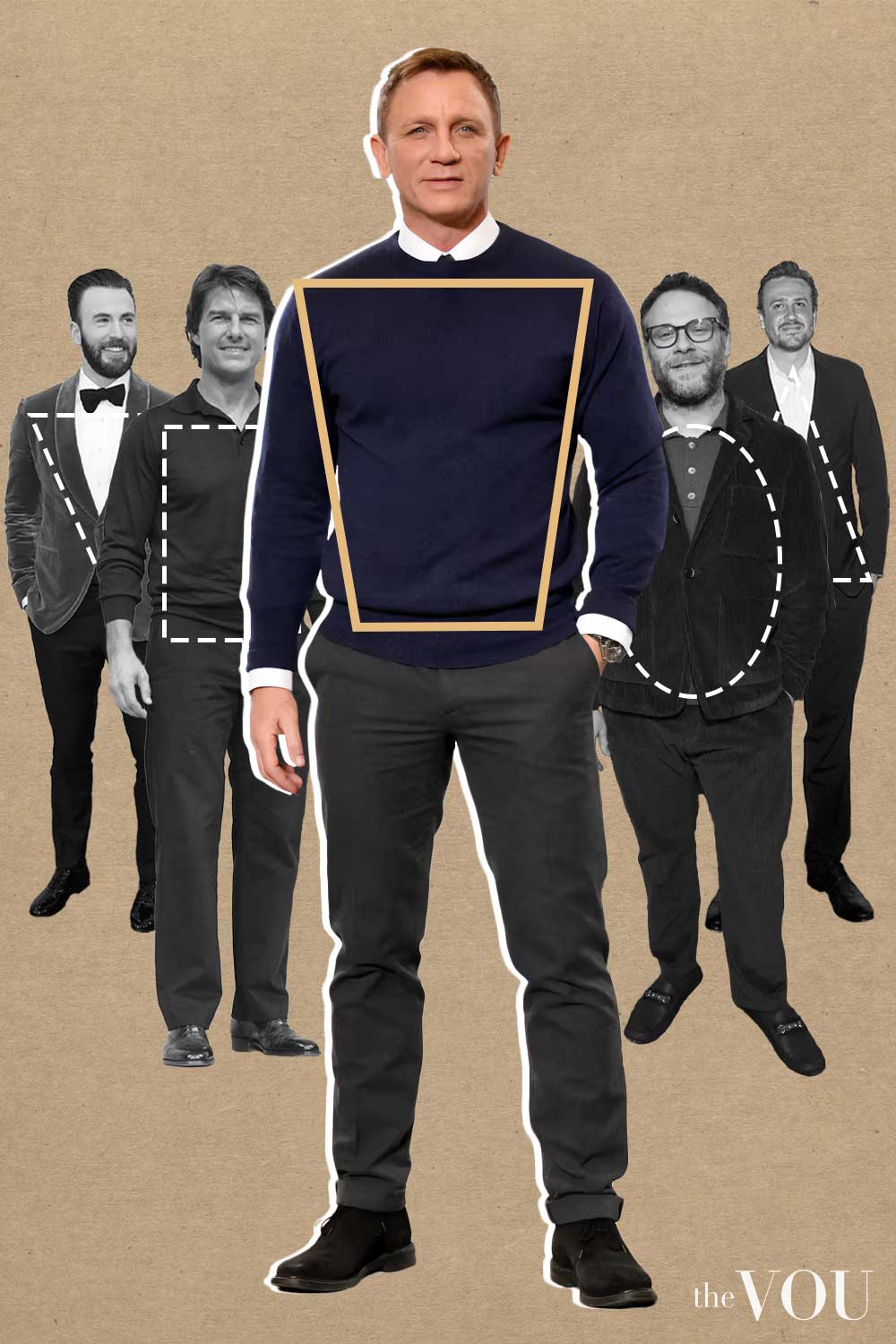
The trapezoid body shape, also known as the rhomboid body shape, describes shoulders that look a little wider than the hips, with a gentle taper between them.
It is sometimes called the standard or average shape, which is a habit of naming rather than a statement about how common it is or how well clothes will fit you.
Men with a trapezoid body shape have shoulders that look slightly broader than the hips, which describes a proportion rather than anyone’s fitness or training.
Because the taper is gentle, most cuts are worth trying, and the choice is mostly about how much of the taper you want to show.
Closer-fitting clothes show the taper and looser ones play it down.
Stripes, checks and plaids are worth comparing in a mirror for the effect you want, because the direction of a pattern does not have one fixed effect, and height comes from your actual leg and torso lengths rather than from a stripe.
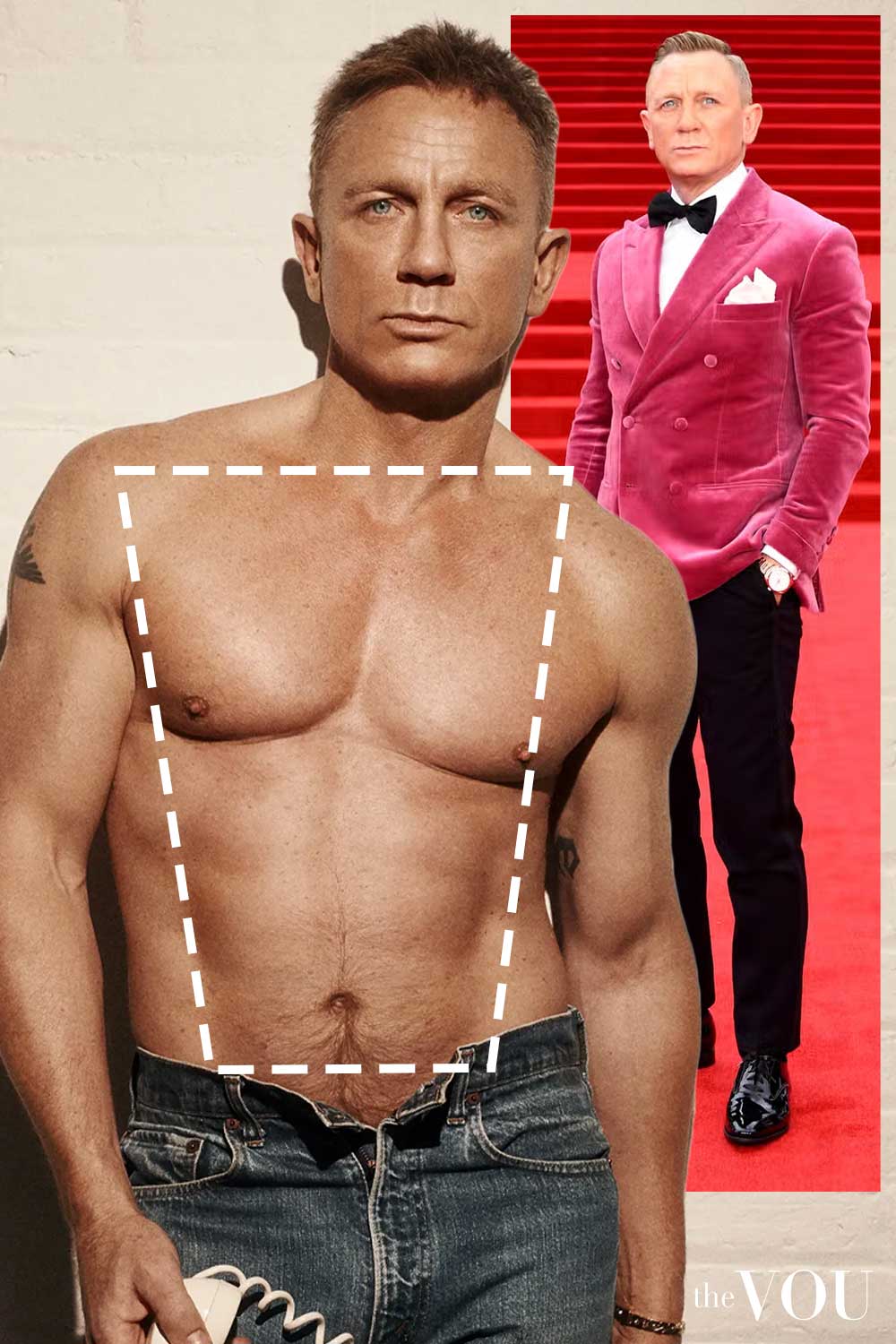
A blazer or suit jacket with some waist shaping follows the taper, especially when fastened.
If you want the outfit to stand out, add one distinct detail, such as a colourful pocket square, a striking watch or eye-catching shoes.
Very loose clothing hides the taper, which matters only if you want to show it.
Keep the detail to one or two points if you want the line of the outfit to stay clean.
Scroll horizontally to see all columns →
| Do | Don’t |
|---|---|
| Slim-fitted clothes, to show the taper Try stripes and checks for the effect you want Opt for blazers and suit jackets Incorporate distinct details Ties in a width that matches your lapels |
Very loose cuts, if you want the taper to show Outfits with no point of interest, if you want to stand out Ties much wider or narrower than your lapels Excessive visual clutter, if you want clean lines Unshaped garments, if you want the taper to show |
Celebrity Examples
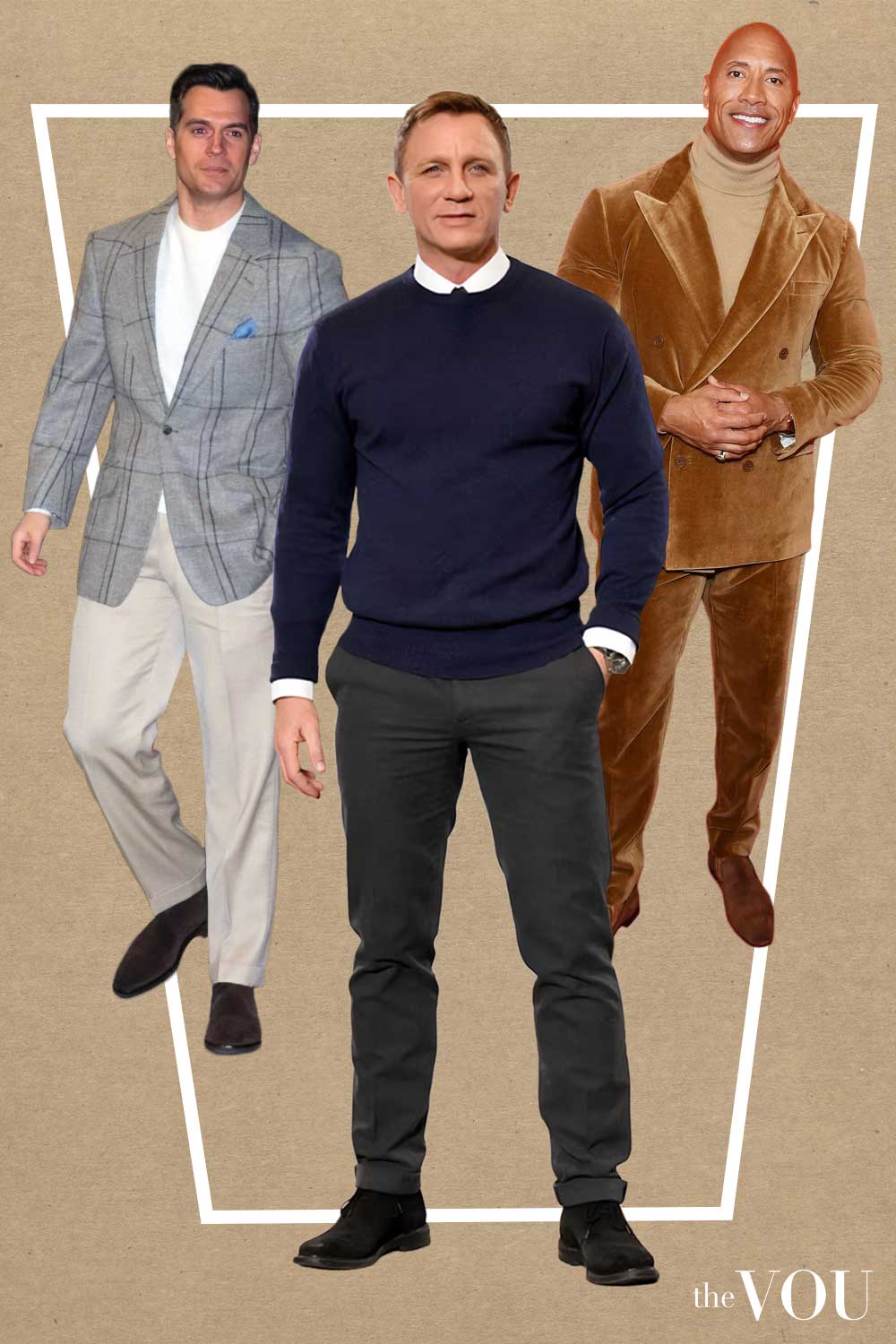
A separate article collects the names usually mentioned for this shape.
Formal Outfits
For a sophisticated, formal look that shows the gentle taper, consider this ensemble.
Start with a charcoal grey slim-fit suit that follows your frame without being overly tight and pair it with a crisp, light blue dress shirt featuring subtle vertical stripes.
To maintain proportionality, add a deep burgundy tie of standard width and length, and finish with polished black Oxford shoes, a matching leather belt, and a sleek silver watch.
The close but not tight suit follows the taper; everything else is preference.
Casual Outfits
For a stylish yet relaxed off-duty look, focus on well-fitted garments that suit your frame.
Begin with a navy blue, slim-fit cotton jumper that skims your torso without clinging and layer over a white crew-neck t-shirt for added depth and interest.
Pair these tops with straight-leg dark-wash jeans that provide a clean line from hip to ankle.
Add a brown leather belt with a subtle buckle to define your waist without overwhelming your outfit.
Complete the look with tan suede desert boots, a stainless steel chronograph watch, and classic wayfarers.
Styling Mistakes to Avoid
Chaps with a trapezoid body shape should be cautious of these styling errors.
- Clothes cut a good deal looser than your frame hide the proportion this section describes, which matters only if showing it is what you want.
- Assuming a double-breasted suit will look boxy on you is a mistake. Whether it keeps the taper you already have depends on that jacket’s waist shaping and on how it is cut, so compare it on yourself rather than ruling the style out.
- Low-rise trousers move the waistline down, which can make the torso read as longer and the leg as shorter. If you like the balance this build already has, a mid or longer rise keeps it.
- Fitted is not the same as tight. A garment you cannot move in reads as uncomfortable however well it is cut.
- Very loud pattern or colour takes the attention that this silhouette would otherwise get on its own, which is a trade you can make deliberately but is worth noticing.
6. Hourglass Body Shape
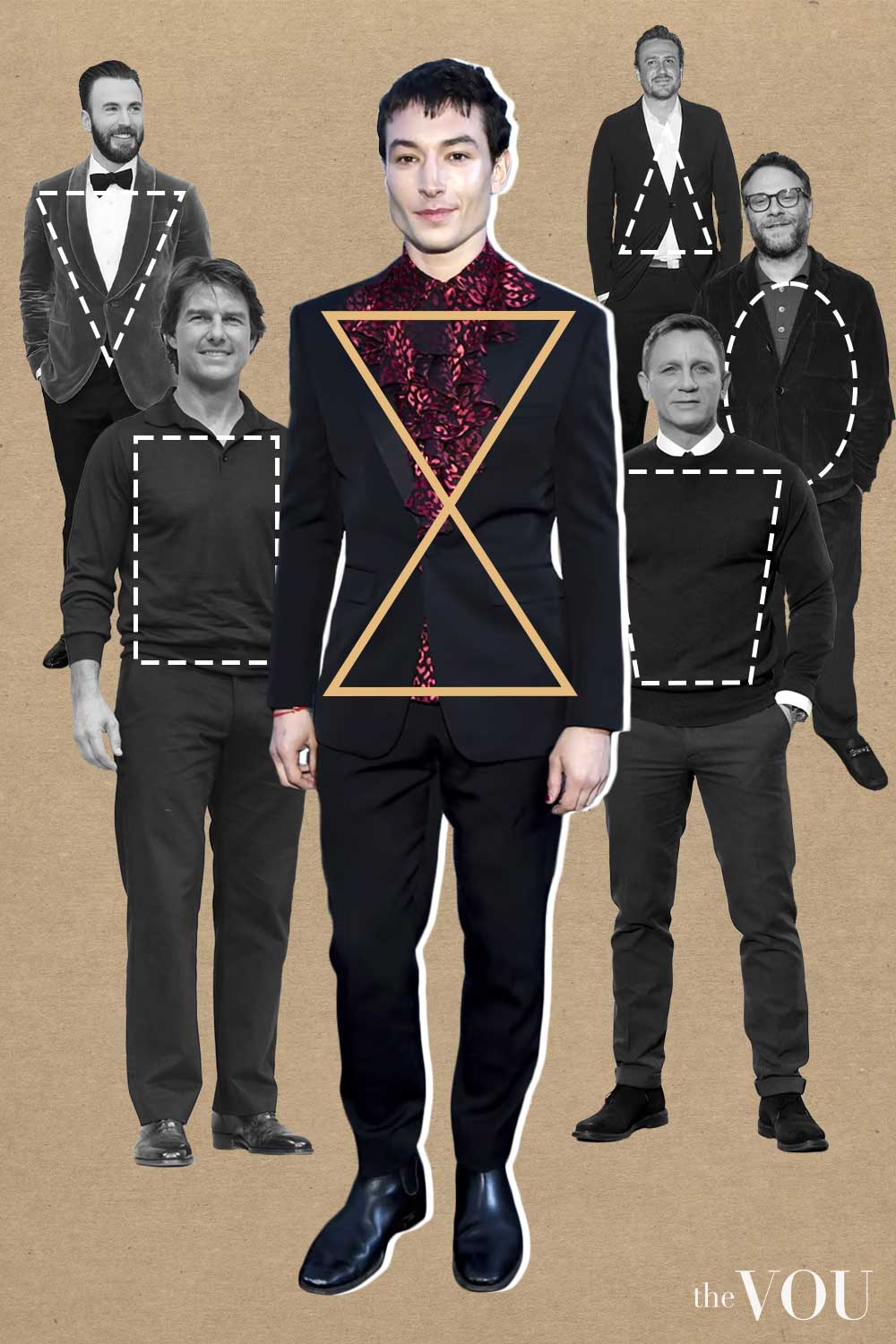
Men with an hourglass body shape have shoulders and hips that look broadly balanced, with a visibly more defined waist between them.
This versatile shape allows for two distinct styling approaches, either emphasising or de-emphasising the curves.
Scroll horizontally to see all columns →
| To show the shape | To play it down |
|---|---|
| Wear fitted waistcoats Choose tailored suits Opt for slim-fit jeans Use belts to define waist Select form-fitting knitwear |
Wear structured blazers Choose straight-cut trousers Opt for dark-coloured tops Use vertical stripes Select layered outfits |
If you aim to emphasise your hourglass shape, wear fitted waistcoats that follow the waist, with dress shirts for a polished look.
Choose tailored suits with a nipped-in waist to highlight your proportions or slim-fit jeans that follow your outline, with close-fitting knitwear in fine gauges.
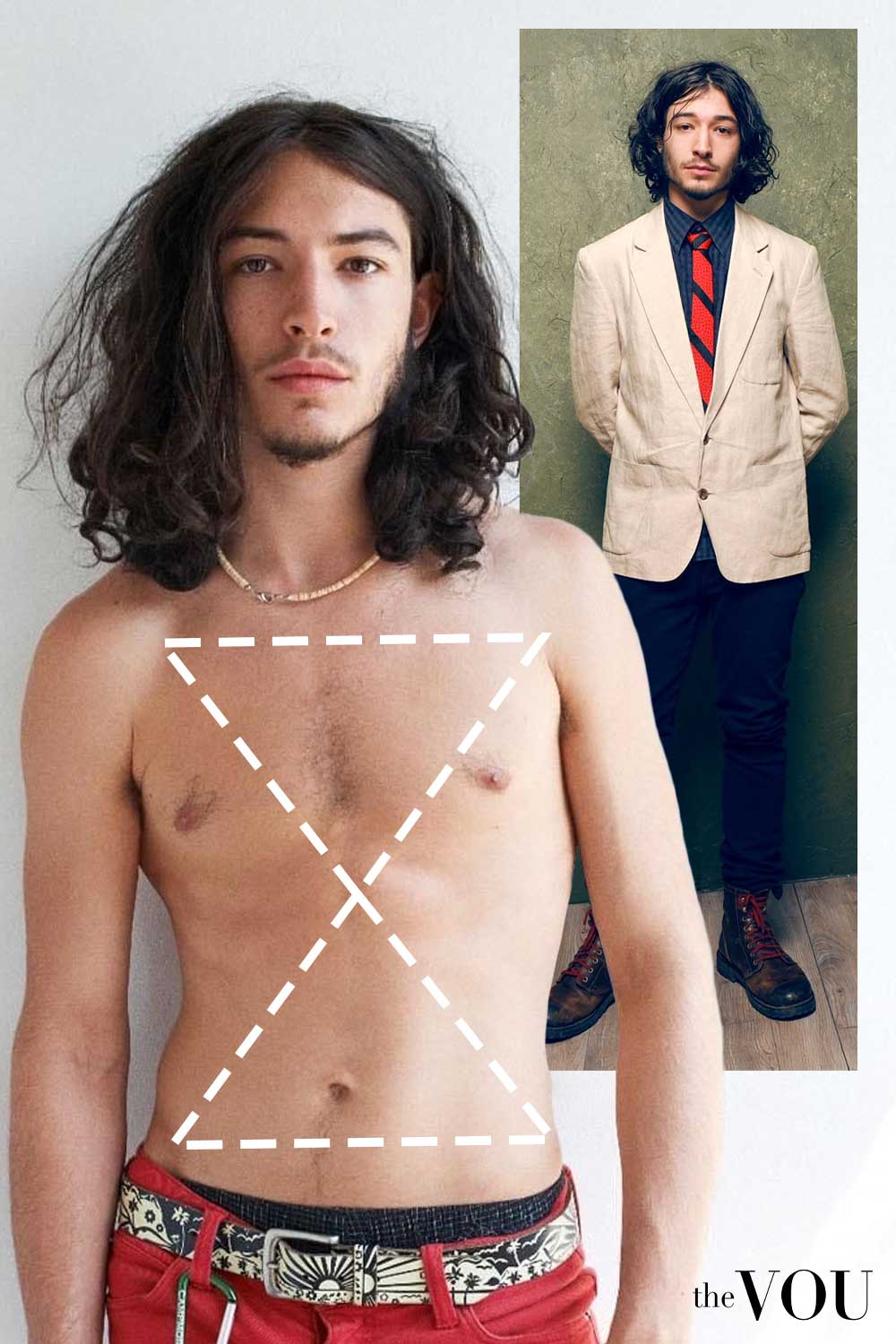
A belt and a tucked fine knit are two ways to mark the waist, especially with looser tops or jackets.
If you would rather play the waist down, structured blazers with stronger shoulders and straight-cut trousers give a straighter outline.
Vertical stripes in shirts and suits are often suggested for the same purpose.
Compare them in a mirror, since what a stripe does depends on the stripe and the rest of the outfit.
If you aim to de-emphasise your shape, a fine-knit jumper will follow your outline closely, so a heavier gauge or a looser cut does more to soften it.
A double-breasted jacket is worth judging on the jacket rather than the fastening. The overlapping front does add a layer of cloth across the chest and the waist button draws the eye to the waist, which is the opposite of what you want here, but a soft, lightly shaped one can read quietly while a sharply suppressed single-breasted jacket can emphasise the same waist you were trying to play down.
Try it fastened in a mirror and judge the effect you actually see.
If you want to show the shape, slim-fit clothing usually shows more of it.
If you prefer a more angular look, opt for structured jackets and straight-cut trousers that create straighter lines.
Celebrity Examples
A separate article collects the names usually mentioned for this shape.
Formal Outfits
For a sophisticated formal look that balances your proportions, start with a charcoal grey single-breasted suit, ensuring the jacket features structured shoulders and subtle waist suppression.
Pair with a crisp white dress shirt in a semi-spread collar.
If you want the shirt to follow your waist without clinging, look for one with back darts, which are the two vertical seams either side of the centre back that take out width at the waist; not every cut has them, so check the back of the shirt.
Select a silk tie in a deep burgundy shade, keeping the width proportionate to your lapels.
Complete the look with black Oxford shoes and a matching leather belt, choosing a belt with an understated buckle if you would rather not mark the waist.
Add a silver pocket square with a straight fold for a touch of elegance without adding bulk to your chest area.
The structured shoulder and light waist suppression follow the outline without exaggerating it.
Casual Outfits
For a relaxed off-duty look that follows an hourglass outline, wear a navy blue Henley shirt in medium-weight cotton that hits just below your hipbone to create a smooth line.
The open placket makes a small V at the neck, and the fitted cut skims your body without clinging.
Layer with a light grey, unstructured blazer in a breathable wool blend.
A length that covers the seat is the usual choice, though a shorter one marks the waist if you want that.
The blazer has minimal shoulder padding and a slightly tapered waist.
Pair with straight-leg dark wash jeans, which keep the outfit restrained below the shaped top half.
Choose a longer rise if you want the waistband higher rather than on the hips, and add a brown leather belt with a brushed nickel buckle.
Rise labels vary between makers, so check where the waistband actually sits on you; our trouser guide explains how.
For footwear, opt for brown suede Chelsea boots, because the ankle height can keep the line from trouser to shoe unbroken (compare in a mirror) and the sleek shape suits the straight-leg jeans.
Accessorise with a stainless steel chronograph watch, choosing a case size proportionate to your wrist, and complete with classic wayfarers.
Styling Mistakes to Avoid
If you have an hourglass shape, you should steer clear of the following common styling errors.
- Oversized clothing hides the outline, which matters only if you want to show it; garments that skim your body show it.
- A low rise can sit under the fullest part of the hip. If you would rather the waistband sat higher, try a mid or longer rise and check where each actually sits on you. That is a preference about where the waist reads, not a question of whether the trousers fit.
- Very tight tops report every line of the chest and waist, which is more shape than most outfits need. A fitted shirt that skims does the same job with more room to move.
- A horizontal stripe across the chest or hips puts the eye there. If that is not the emphasis you want, compare a vertical stripe or a solid in the mirror; neither direction has a guaranteed effect.
- An unstructured blazer leaves the shoulder line to your own shoulders, which is a legitimate choice and not a fault. If you want the jacket to draw the line instead, a little shoulder structure and a slightly suppressed waist will do it.
- A belt that contrasts sharply with your outfit marks the waist. If you do not want to mark it, choose a belt that blends with your trousers.
- A strong taper narrows the lower half against your shoulders; straight-leg or slim-fit styles are the alternative if that contrast is not what you want.
- Bulky knits add volume at the chest; fine-gauge knitwear keeps a closer line.
- Jacket length decides where a line falls. At the waist it marks the waist, at the hip it puts a line across the hip, and covering the seat, the usual tailored convention described in our guide to garment fit, avoids both. Choose by preference.
- Lapel width is worth judging against your shoulders; medium-width lapels are the neutral choice.
7. Diamond Body Shape
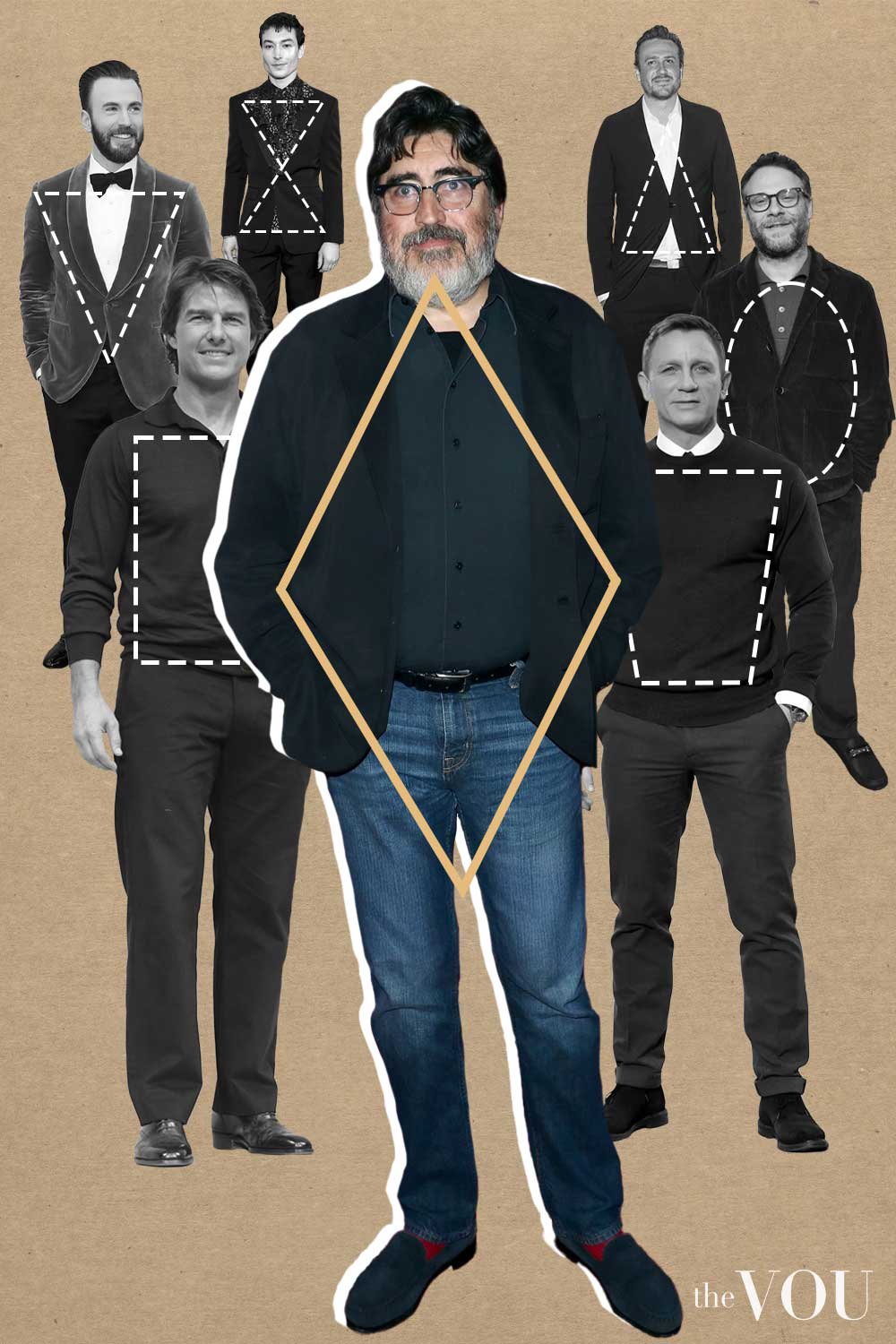
The diamond description is the seventh of the seven names used here, and it overlaps with the oval description above. Both put the fullness at the middle, and different guides draw the line between them in different places.
Read both and use whichever fits what you see.
As above, we use diamond for an outline in which the middle stands out more distinctly between a comparatively narrower upper and lower torso.
That is a description of how the outline reads rather than a required ranking of your measurements, and your natural waist does not have to be your largest circumference for this section to be the one you need.
If a more even outline is what you are after with a diamond build, the two most useful changes are giving the shoulder line more presence and keeping a clean vertical through the middle.
A jacket with some shoulder structure, and sleeve heads set with a little rope, gives the shoulder line more presence than a soft, unpadded jacket does.
There is no correct amount, and structure is not the same as a shoulder seam sitting past your own shoulder.
Our guide to garment fit covers what to look at, namely where the seam lands, whether the cloth rumples above it or dents below it, and whether the jacket still lets you reach forward.
A little extension past the bone is a feature of some cuts rather than a fault, so judge the jacket on your own shoulder line and on how it moves, not against a single rule.
Peaked lapels are worth trying.
The peaks sit high on the chest and point up and out towards the shoulder ends, so they can lead the eye outward rather than straight down, which is the opposite of what a narrow notch lapel does.
The effect is modest and it is a preference, not a correction.
A notch lapel on a jacket that fits you well will usually look better than a peak lapel on one that does not.
Pinstripes and a clean centre front give the torso a continuous vertical line; compare them in a mirror for the effect.
A slightly higher button stance closes the jacket above the fullest point, which some men find sits better over the middle.
Try it fastened.
If you would rather not draw the eye to the middle, keep horizontal stripes and details off it and put pattern higher up.
Tight clothing around the waist pulls at the fullest point, and bright colour or busy pattern there draws the eye; choose them deliberately if you want them.
Scroll horizontally to see all columns →
| Do | Don’t |
|---|---|
| Jackets with some shoulder structure Try peaked lapels against notch lapels Incorporate vertical details like pinstripes Utilise darker colours for the midsection Layer a structured jacket or coat over the top |
Horizontal stripes across the middle, unless you want the emphasis Stay away from tight-fitting clothing around the waist Bright colours at the middle, if you would rather not draw the eye there Check a double-breasted jacket fastened before buying, since the overlap adds cloth across the middle, though a soft one cut with a long lapel line can still work A tucked shirt with no jacket, if you would rather not mark the waistband |
Celebrity Examples

A separate article collects the names usually mentioned for this shape.
Formal Outfits
For a sophisticated, formal appearance that creates a more balanced silhouette, consider the ensemble below.
Begin with a navy single-breasted suit jacket featuring structured shoulders, discreet padding, and subtle sleeve head roping, paired with a crisp white shirt with subtle vertical stripes.
Peaked lapels point towards the shoulder ends and the fine shirt stripe adds a vertical line; both are preferences to compare in a mirror.
Complete the look with flat-front trousers in the same navy shade, a burgundy silk tie with a subtle pattern, and polished black Oxford shoes.
Add a simple silver tie clip just below the chest line to keep the tie in place.
The shoulder structure and the clean front give this outfit its shape.
Casual Outfits
For a relaxed off-duty look with the same aim, add some structure at the shoulder and keep a clean line through the middle.
Start with a navy structured blazer with subtle shoulder padding layered over a vertically striped button-down shirt in light blue and white.
The blazer gives the shoulder line definition, and the stripe adds a vertical line.
Pair with straight-leg dark wash jeans worn where the waistband sits comfortably, standing and seated.
Complete the outfit with brown leather Chelsea boots, and add a finely textured pocket square in a complementary shade for a point of interest at the chest.
Comfort through the middle comes first; the structure at the shoulder is optional.
Styling Mistakes to Avoid
Gentlemen with a diamond body shape should avoid the common styling errors that follow.
- If a more even outline is your aim, relying only on unstructured jackets and soft shirts, which leave the shoulder line to do the work on its own.
- Horizontal stripes or pattern across the middle draw the eye to it, which is worth choosing deliberately rather than by accident.
- Buy on the garment rather than on the fit name. A shirt or jacket that pulls across the middle will show it whatever the label calls the cut, so check it fastened on yourself.
- Bright colour or busy pattern at the middle gives it more emphasis.
- A low rise can sit under the fullest point and roll or pinch. Check where it rests, standing and seated.
Why Fit Matters More Than the Shape Label
Everything above is about proportion.
Fit is a different question, and it matters more. A jacket in the right cut for your shape that sits badly on the shoulder will usually look worse than a plain one that fits.
No matter how expensive or fashionable an outfit may be, ill-fitting clothing can undermine your look, and this is where the art of tailoring becomes invaluable.
A skilled tailor can bring off-the-peg garments closer to your measurements, within what the cloth and construction allow.
From taking in a jacket waist to adjusting trouser lengths, these alterations can make a visible difference.
If you have broad shoulders and a narrower waist, a tailor can often take a shirt in at the waist so it fits the shoulders without billowing below them.
If your middle is fuller, a tailor can check that jackets fasten without pulling and that trousers sit comfortably, which matters more than any illusion.
A tailor you trust, and who knows your garments, is worth finding.
When shopping, remember that it’s often worth investing in well-made garments that can be tailored rather than settling for poorly made ones that almost fit.
Pay particular attention to the fit of your suit jackets, trousers, and dress shirts.
These staples form the foundation of many outfits, so their fit is worth getting right.
A well-fitted jacket sits on your shoulders without pulling, and trousers stay where the rise puts them without sagging or straining.
Where that is depends on the rise you chose, which this guide treats as a preference rather than a rule.
Fit is about comfort as well as appearance, since clothes that fit let you move with ease.
So whichever of the seven descriptions fits you, spend on the fit before you spend on anything else.
Our fitting guide covers what to check on a jacket, trousers, a shirt and a coat, what a tailor can and cannot change afterwards, and what that work costs.
Optional Quizzes and Paid Analysis
Everything above works with a tape measure and a mirror.
If you would rather answer questions, The VOU runs quizzes for body shape, face shape, seasonal colour and fashion style.
We also sell styling services, which are a paid alternative rather than a next step. These services are a professional body shape analysis, whose scope is set out on its own page, and a complete image transformation package that combines the face shape, seasonal colour, body shape and fashion style analyses.
If you want to go further on any single shape, each of the seven sections above links to its own guide, and our trouser guide covers rise, break and leg line in more detail than this page has room for.