
Start here
What’s This About
Men’s hosiery today mostly means socks, and choosing the right length, colour and material makes outfits look neater and keeps your feet comfortable.
This guide explains how to choose and style men’s socks, such as
The five main sock lengths, from no-show to over-the-calf
Three ways to coordinate sock colour with your trousers and outfit
Which socks to wear for black tie, business, smart casual and sport
How pattern scale changes how formal a sock looks
Summer and winter sock materials
and many more!
These are conventions, not rules, so bend them once you know the effect you want.
Key Points
01Over-the-calf socks stay up and keep your shin covered when you sit.
02Matching socks to your trousers is the safest choice for business and formal wear.
03Smaller patterns look more formal than large ones.
04Merino wool is comfortable in both summer and winter.
Hosiery, the small detail that links trousers and shoes
Hosiery is the general word for socks and other knitted coverings for the feet and legs, and for most men today it simply means socks.
Socks are easy to overlook, but they affect how comfortable your feet are all day and how neatly your trousers meet your shoes.
They also show only when you sit or walk, which makes them a quiet place to add colour or pattern.
This guide covers sock lengths, colours, patterns and materials, and what to wear with each dress code, from casual weekends to black tie.
Men’s hosiery origins
The word hosiery comes from hose, the fitted leg coverings that European men wore from the Middle Ages until the 17th century, when breeches and stockings replaced them.
Today men’s hosiery is mostly socks, though the word also covers compression socks, thermal layers and sports legwear.
All 5 hosiery types and their lengths and heights
Sock length changes both comfort and how much skin shows when you sit or cross your legs.
Names vary between makers, so check the stated height or the picture before you buy.
1. No-show or invisible socks
No-show socks sit inside the shoe, so your ankle looks bare while your foot stays protected from rubbing and sweat.
Different shapes suit different shoes, and loafer liners, for example, are cut lower than no-show socks for trainers.
A silicone grip at the heel helps stop them slipping down inside the shoe.
They suit loafers, boat shoes, espadrilles and low trainers in warm weather, and they are less suitable with formal lace-ups or in cold weather.
Visibility. Hidden inside the shoe
The cut covers only the foot inside the shoe
Useful features are heel grips and thin edges
Best with loafers, deck shoes, espadrilles and low-profile trainers
Seasons. Spring and summer
2. Ankle socks
Ankle socks reach just above the ankle bone, which protects the back of the heel from rubbing better than a no-show sock.
A cuff that is firm enough to stay up without leaving deep marks makes them more comfortable for long wear.
They are mainly sports and casual socks for trainers and casual shoes.
With trousers and smart shoes, ankle socks often leave bare skin showing when you sit, so most men choose longer socks for business and smart casual outfits.
Visibility. Shows when worn with shorts or cropped trousers
The cut sits just above the ankle bone
A useful feature is an elastic cuff that stays in place
Best with trainers and casual shoes
Seasons run from spring to autumn
For smarter outfits, including dressy casual outfits, a longer sock usually looks neater.
3. Crew socks
Crew socks reach a few inches above the ankle, to the lower calf, and usually have a ribbed top.
They are the everyday sock for sport, trainers and boots, and thicker versions add warmth outdoors.
Sports crew socks often have extra cushioning under the foot and mesh panels for ventilation.
Wool and wool-blend crew socks are a warm choice for casual winter outfits with boots.
Visibility. Usually covered by trousers when standing
The cut runs from above the ankle to the lower calf
Useful features are a ribbed top and, on sports versions, cushioning
Best with trainers, boots and casual shoes
Seasons. All year, with wool versions for autumn and winter
4. Mid-calf socks
Mid-calf socks reach roughly halfway up the calf, and they are the length of most dress socks sold for wear with trousers.
They cover the shin when you stand and, if they stay up, usually when you sit too, which makes them a common choice for business attire and smart casual outfits.
Their main drawback is that some slide down during the day, so a firm, comfortable top band matters.
Visibility. Covered when standing, and sometimes shows skin when seated if the sock slips
The cut reaches around the middle of the calf
A useful feature is a supportive top band
Best with business shoes, desert boots and Chelsea boots and smart casual shoes
Seasons. All year
5. Over-the-calf socks
Over-the-calf socks, sometimes called executive socks, reach to just below the knee.
Because the top sits above the widest point of the calf, they stay up well and keep your shin covered when you sit or cross your legs.
Many menswear writers recommend them for suits, formal business clothes and black tie for that reason.
Some men find them warm in summer or unfamiliar at first; a fine cotton or lightweight wool version helps.
Visibility. Keeps the shin covered when seated
The cut reaches to just below the knee
A useful feature is a soft but firm top band
Best with business and formal shoes, suits and tailored trousers
Seasons. All year for business and formal wear
Over-the-calf socks are a good match for formal business and evening wear.
Hosiery colours and how to choose them
The colour of your socks can either continue the line of your trousers or add a small accent.
Black is the usual choice for black tie and for funerals, and easy with black shoes and dark suits
Navy is versatile for business and smart casual outfits
Grey is easy with grey and navy trousers
Burgundy is a traditional accent colour with navy and grey
Bottle green is a classic with tweed, flannel and country clothes
Brown works with earth-toned casual and country clothes
Brighter colours are most at home in casual and smart casual outfits
White is mainly for sportswear, and sometimes worn with loafers or trainers for a casual, retro look
A rough order of formality runs from black and dark plain colours, through quieter accents such as burgundy and green, to bright colours and white.
Black socks
Black socks are the traditional choice for black tie, and they suit dark business suits and black shoes.
Navy socks
Navy is one of the most useful sock colours, because it works with navy, grey and brown trousers and suits most business outfits.
Grey socks
Charcoal and mid-grey socks suit most grey suits, and grey with a navy suit gives a quiet contrast.
Burgundy socks
Burgundy adds colour without looking loud, and it sits well with navy and grey suits.
Bottle green socks
Bottle green is a traditional country colour that works with tweed, flannel and corduroy in autumn and winter.
Brown socks
From chocolate to caramel, brown socks suit earth-toned casual and country clothes and brown shoes.
Bright socks
Colours such as royal blue, pine green and purple are easiest in casual outfits, and they look most deliberate when they echo another colour you are wearing.
White socks
White socks are mainly for sport and trainers.
Some people wear them with loafers or with casual summer outfits for a retro look, but with suits and dark trousers they stand out sharply, so most men avoid them for business and formal wear.
These are conventions rather than rules, and you can bend them once you know which effect you want.
3 ways to coordinate sock colour
There are three common approaches, from the quietest to the most noticeable.
1. Match your socks to your trousers
The traditional approach for business and formal outfits is to match sock colour to trouser colour.
This continues the line of the trousers down to the shoe, so the eye moves past your ankles rather than stopping at them.
Aim for a close match, such as navy socks with navy trousers and grey socks with grey trousers.
With pale trousers, an exactly matching pale sock can look conspicuous, so a shade or two darker in the same colour often works better.
Matching is the safest option for conservative workplaces and formal events when you are unsure what to wear.
2. Choose a related shade
A sock in the same colour family as your trousers, but lighter or darker, adds a little interest while staying quiet.
Examples include light grey socks with charcoal trousers, or navy socks with mid-blue trousers.
Make the difference clear enough to look chosen rather than like a near miss.
This approach suits most business casual offices and smart casual outfits.
3. Pick up another colour in the outfit
Here the socks echo something other than the trousers, such as the tie, the pocket square or a stripe in the suit.
Burgundy socks might pick up a maroon stripe in a navy suit or the colour of a pocket square, and bottle green socks might pick up a check in a tweed jacket.
The link to another colour is what makes the contrast look deliberate.
This approach suits social occasions, creative workplaces and smart casual outfits, and it can work in business when the colours stay muted.
Choosing sock colour by occasion
Socks for black tie
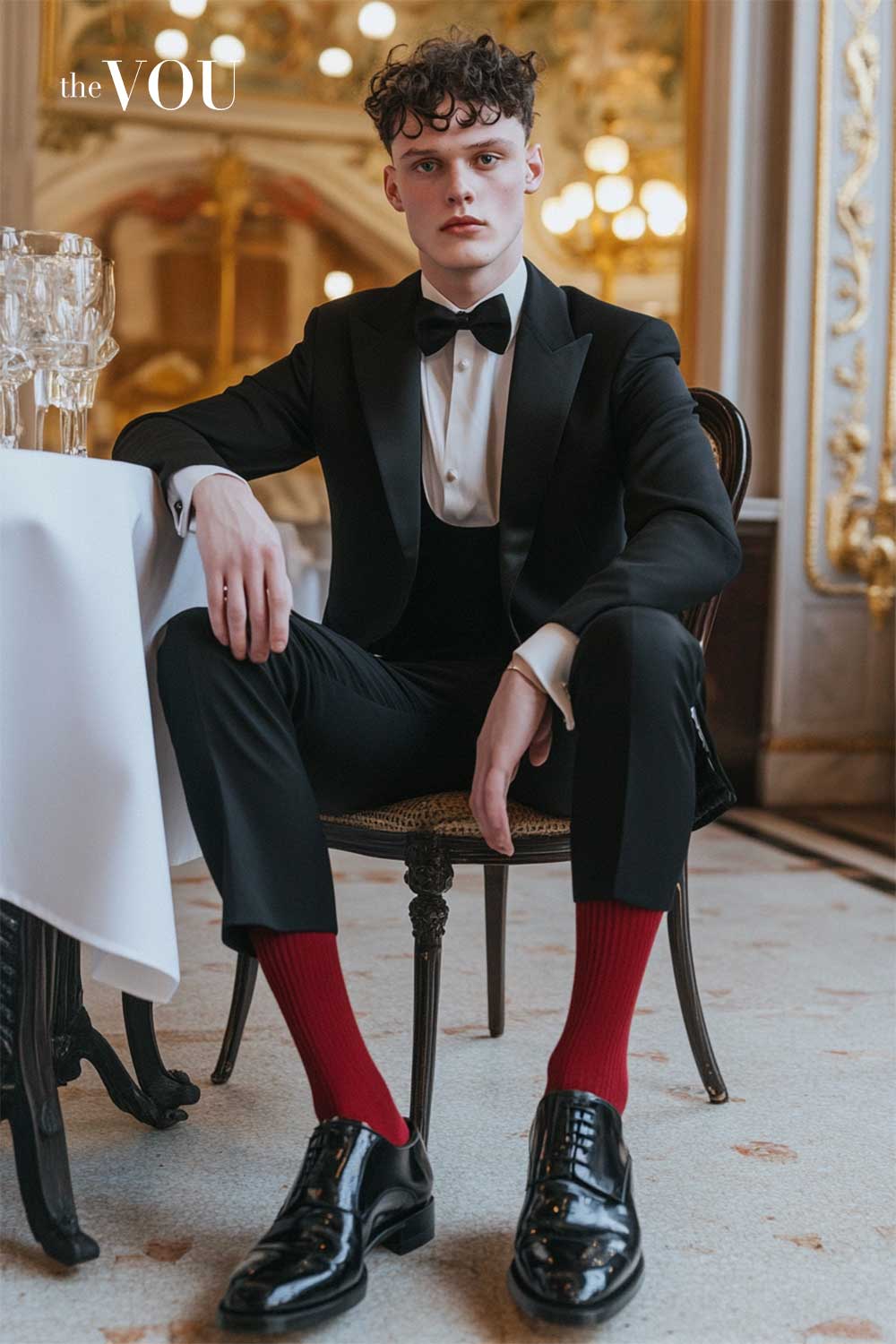
For black tie, the traditional choice is plain black dress socks in fine silk, wool or cotton.
Over-the-calf socks keep your shin covered when you sit, which matters more with formal trousers and patent shoes.
Choose a true black rather than charcoal or navy, so the socks match the trousers and shoes.
Some formal dress codes set rules of their own; for example, Royal Ascot’s Royal Enclosure requires gentlemen’s socks to cover the ankle.
Socks for business attire
For traditional business attire, navy, black and charcoal socks matched to the trousers are the usual choice.
Over-the-calf or well-fitting mid-calf socks keep your shin covered in meetings.
Fine merino wool and cotton with a little nylon are comfortable and hard-wearing.
Fine ribbing and small patterns in the trouser colour stay quiet enough for most offices.
In conservative workplaces, plain matching socks are the safest choice, and you can add colour in other settings.
Socks for business casual outfits
Business casual offices allow more colour, such as burgundy, bottle green and deep purple, alongside navy and grey.
For ideas on the dress code itself, see our guide to Amsterdam’s business casual style.
Mid-calf and over-the-calf socks both work, and over-the-calf socks are the neater choice when you meet clients.
Socks can pick up the colour of a tie, a pocket square or a check in a jacket.
Very loud patterns, novelty motifs and athletic socks are usually better kept for weekends.
Socks for smart casual outfits
Smart casual outfits allow richer colours such as burnt orange, mustard, teal and plum, especially in muted shades.
Classic patterns such as argyle, houndstooth and stripes work well, in a moderate scale.
Heavier knits, visible ribbing and contrast heels and toes add texture to tailored casual clothes.
Socks for casual and streetwear outfits
Casual outfits allow the widest choice, limited mainly by your taste and the rest of the outfit.
Bold patterns and graphic designs work well when the rest of the outfit is simple.
In streetwear, socks are sometimes the focal point, with bright colours or logos worn with trainers and shorts or cropped trousers.
If other garments already carry bold colours or patterns, plainer socks keep the outfit balanced.
Socks for sport
For sport, choose socks for the activity, with cushioning where your foot strikes the ground, moisture-wicking fibres and a snug fit that stops blisters.
Compression socks are made for specific uses, such as running recovery or long flights, so check the maker’s guidance.
White sports socks are the classic choice with trainers for exercise.
Hosiery patterns from subtle to bold
Patterns range from textures that look plain at a distance to bold designs that stand out across a room.
Pattern types and where they suit
Plain colours
Plain socks are the foundation of a sock drawer, because they work in almost every setting.
Start with black, navy and grey, the core colours in many classic wardrobes, then add colours that go with several of your trousers.
If you would like help choosing a classic palette, The VOU’s Old Money colours guide book covers the colours often used in that look.
Subtle textures
Fine ribbing, herringbone, birdseye and tiny geometric patterns look plain from a distance and show their detail up close.
They suit business outfits because they add interest without standing out.
Examples include charcoal micro herringbone, navy pin dots and black fine ribbing.
Classic patterns
Argyle, houndstooth, windowpane checks and stripes have long been used in menswear.
Smaller versions look more formal than large ones. A small houndstooth can work with a business suit, while a large one suits casual clothes.
Patterns look most deliberate when they include a colour from elsewhere in the outfit.
Classic patterns are a good first step into patterned socks, especially in business casual offices.
Statement patterns
Bold geometric, graphic and novelty patterns suit casual social events, creative workplaces and leisure time.
Keep the rest of the outfit quieter so the socks are the one bold detail, and link them to the outfit with at least one shared colour.
Pattern scale
The larger the pattern, the more casual it usually looks.
Micro patterns, such as pin dots, tiny checks and birdseye, read as a plain colour from a normal conversation distance and suit business outfits.
Small patterns, such as small argyles and narrow stripes, are visible but quiet, and suit business casual and smart casual outfits.
Medium patterns, such as classic argyle and bold stripes, are noticed straight away and suit smart casual outfits, especially with textured jackets and plain trousers.
Large patterns stand out from across the room and suit casual outfits.
Combining patterns
When your socks are patterned and other garments are too, a few guidelines help.
Vary the scale, because a broad-striped tie, a small-check shirt and micro-patterned socks sit together more easily than three patterns of the same size.
Vary the type. If your shirt is striped, choose dotted, checked or geometric socks rather than more stripes.
Share a colour by letting the socks pick up at least one colour from elsewhere in the outfit, ideally a secondary colour.
Decide on a focal point. In formal outfits, socks usually play a supporting role, while in casual outfits they can be the main detail if everything else is plain.
If you are new to patterned socks, start with one patterned pair and otherwise plain garments, and build from there.
Socks for different suits
Navy suit
Matching navy over-the-calf socks in the same shade as the trousers give an unbroken line and suit conservative workplaces and formal events.
For classic contrast, burgundy socks add colour while staying businesslike, a long-standing pairing with navy.
Patterned navy socks with small burgundy or sky blue details add a little personality.
Whichever you choose, a sock long enough to cover your shin when you sit looks neatest with a suit.
Grey suit
Matching grey socks in the same shade as the trousers suit traditional offices, and a close match matters more with light grey suits, where differences show.
Charcoal socks work with light, mid and dark grey trousers, which makes them an easy choice.
Patterned grey socks with small navy or burgundy details add interest; keep grey as the main colour so the socks still relate to the trousers.
Casual suit in linen, cotton or textured wool
Textured socks in the trouser colour, with ribbing or a fine pattern, suit the relaxed cloth.
For an echo, socks that pick up a shirt stripe, a pocket square or a jacket check look considered.
For pattern, argyle, houndstooth or geometric socks in colours from the outfit add character.
Casual suits are often worn with suede Derby shoes, loafers or boots, which leave more room for colour and pattern in your socks.
Socks through the seasons
Summer socks
Lightweight cotton, cotton and linen blends and fine merino wool are comfortable in hot weather.
Fine merino is often recommended even in summer, because wool handles moisture well and resists odour.
No-show socks give a bare-ankle look with loafers, boat shoes and trainers in casual settings.
In offices where bare ankles look out of place, choose thin cotton or fine wool dress socks.
Winter socks
Merino wool is a warm, comfortable choice for winter, because its crimped fibres trap air and manage moisture.
Mid-weight and heavyweight wool socks give progressively more warmth.
Cashmere and cashmere blends are very warm for their weight and thin enough for dress shoes.
For hiking and outdoor work, technical wool or synthetic socks with cushioning are the practical choice.
Longer socks, such as crew and over-the-calf, keep cold air off your shins under winter trousers.
Building a sock collection
A small, well-chosen set of socks covers most occasions.
A starting set
Here is one suggested starting point; adjust the numbers to your wardrobe and how often you do laundry.
Dress socks. Several pairs of over-the-calf or mid-calf socks in navy, charcoal and black for business and formal wear, in fine merino or cotton with a little nylon.
Smart casual socks. A few pairs in navy, grey, brown and burgundy for business casual and smart casual outfits.
Casual socks. A few pairs in colours that suit your weekend clothes.
No-show socks. A few pairs shaped for the loafers and trainers you wear most in summer.
Sports socks. Enough pairs for your training week, chosen for your activity.
Next additions
Subtly patterned dress socks add personality while staying office-friendly.
Different weights, thin for summer and heavier for winter, make your shoes more comfortable through the year.
A pair of cashmere or cashmere-blend socks is a comfortable treat for cold days and special occasions.
Bolder socks for casual outfits work best when they fit your personal fashion style.
Final observations on comfort and confidence
Socks show only briefly as you walk or sit, which makes them an easy place for a small personal touch.
Socks that stay up, fit well and suit the weather also stop you fidgeting with them, so you can forget about your feet and get on with your day.
Choose the length for the occasion, the colour for your trousers or your outfit, and the material for the season.
Take our four quizzes
Check your face shape with the Face Shape Quiz.
Find your seasonal colours with the Seasonal Colour Analysis Quiz.
Check your body shape with the Body Shape Quiz, and take the Fashion Style Quiz to find the styles you like wearing.
Book a consultation for personal help
If you would like personal help after the quizzes, you can book paid consultations with The VOU’s stylists, including body shape analysis, fashion style analysis and the complete image package.
You can see all the services on our styling services page.
Sources
Hose (clothing) and Sock, Wikipedia.
Permanent Style, Your socks should match your trousers (February 2026) and Viccel over-the-calf socks (2015).
Horse and Hound, Royal Ascot dress code (18 May 2026; summary of the Royal Enclosure rules, including that socks must cover the ankle; check the current rules on Ascot’s own site before attending).