
Start here
What’s This About
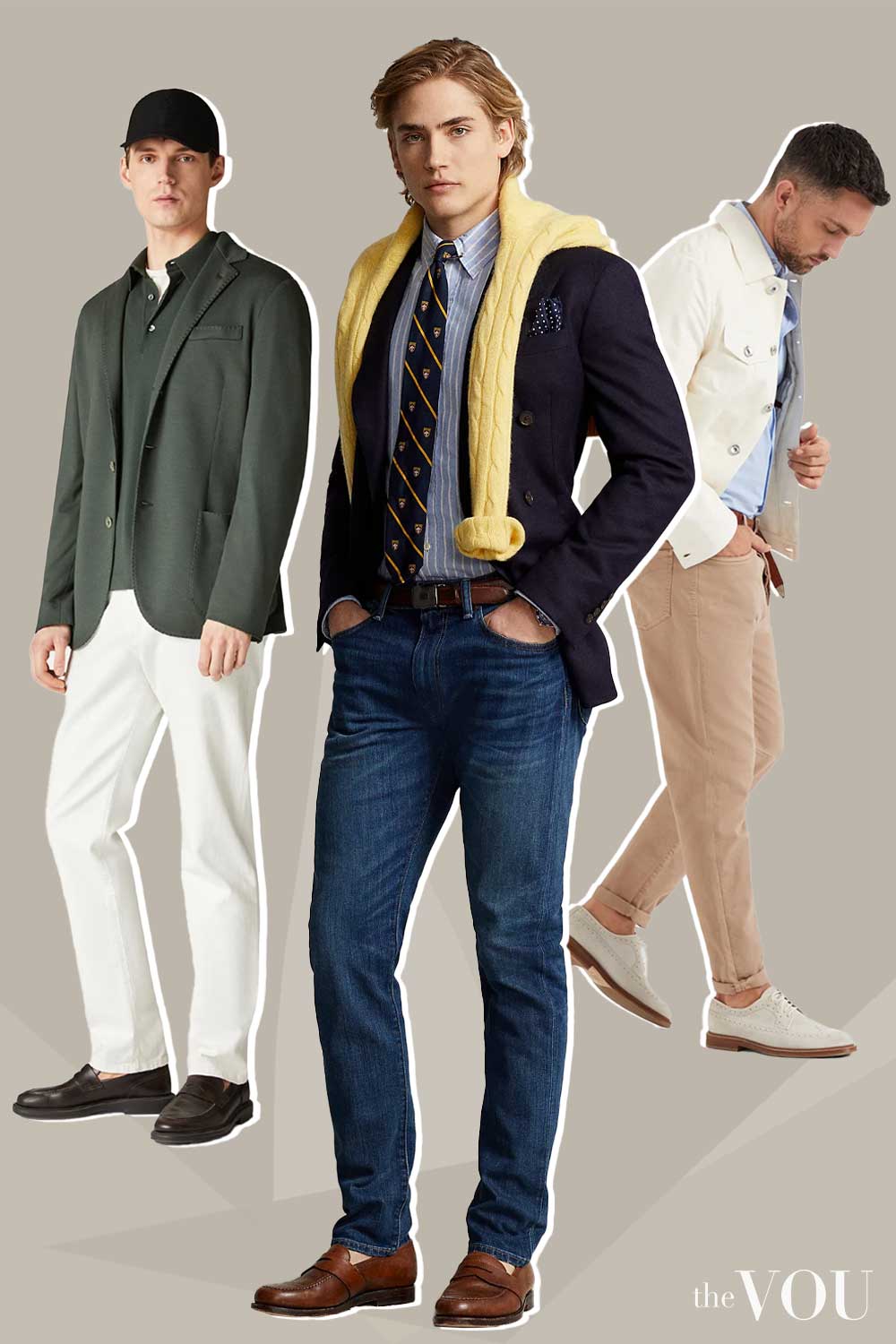
Smart casual usually means a collared shirt or fine-knit sweater, tailored trousers or chinos, and smart shoes, with a jacket to raise it, unless an employer, venue or host sets its own dress code.
This guide answers the questions men ask when an invitation says smart casual, such as:
what smart casual usually means, and how smart it is
whether jeans, trainers or a T-shirt are accepted
how it differs from business casual, and where the two overlap
what to wear to the office, to dinner or to a relaxed wedding
how to dress an outfit up or down without changing all of it
and many more!
A published dress code always comes first; this guide covers the common reading when there is none.
Key Points
01Smart casual has no governing body or fixed definition, so any dress code published by your employer, venue, cruise line or host is the one that applies.
02Most smart-casual outfits combine a collar or fine knit on top, tailored trousers or chinos, and shoes that look considered rather than sporty.
03Dark undamaged jeans, clean minimal leather trainers and a plain heavyweight T-shirt under a jacket are commonly accepted, but a workplace or venue can rule out any of them.
04A jacket is the easiest way to adjust the level, so take one you can remove when you are unsure how smart a room will be.
What Smart Casual Usually Means
In the most common reading, smart casual is a collared shirt or a fine-knit sweater, a tailored trouser or a chino, and a shoe that looks considered rather than sporting.
A jacket raises it, removing the jacket relaxes it, and condition does more work in this code than in any other because there is no tie or suit to carry the outfit.
The words “most common” matter in that sentence.
Wikipedia describes smart casual as an ambiguously defined code that mixes casual garments with formal ones, and sets out interpretations from dictionaries, fashion houses, broadcasters and a cruise line in several countries that do not agree with each other.
It quotes the Italian fashion house Brioni on the point that matters most to a reader holding an invitation: smart casual in a Sardinian summer is not smart casual in a Toronto winter.
So this page describes conventions, not requirements.
Where an employer, a venue, a cruise line, a club or a host publishes its own dress code, that published code is the one that binds you, and it can permit or forbid garments that the general convention treats the other way.
Read any published dress code first.
Where none exists, a collar or fine knit, a tailored leg and a considered shoe is the combination that works in the widest range of rooms.
Where Smart Casual Sits, Illustratively
Most confusion about this code comes from not knowing what it is being measured against, so the ladder below puts the common codes in a rough order of formality.
Treat it as an illustrative framework rather than a universal standard.
No authority publishes this ordering, the codes overlap heavily in practice, and the overlap between smart casual and business casual is wide enough that many workplaces use the two names interchangeably.
The ordering is also unstable across countries and industries: a London law firm, a Los Angeles studio and a Milan showroom would each place the same outfit differently.
Scroll horizontally to see all columns →
| Code, roughly ordered | Top, commonly | Bottom, commonly | Shoe, commonly | A rough test |
|---|---|---|---|---|
| Casual | T-shirt, polo, sweatshirt | Jeans, shorts, joggers | Trainers, boots, sandals | Comfortable with no one in particular to impress |
| Smart casual | Collared shirt, fine knit, polo, plain tee under a jacket | Tailored trousers, chinos, darker denim | Loafer, derby, chukka, clean leather trainer | Comfortable meeting someone you want to make an effort for |
| Business casual | Collared shirt, knitted polo, sweater | Chinos or wool trousers, denim less often | Loafer, derby, brogue | Comfortable in front of a client |
| Business professional | Dress shirt, often with a tie | Suit trousers | Oxford or derby | Comfortable in a boardroom |
| Black tie | Dress shirt and bow tie | Tuxedo trousers | Patent oxford or opera pump | The invitation said so |
Our guide to the dress codes sets out the full ladder including the formal codes, where the definitions are firmer because the formal codes carry more settled conventions than the casual ones do.
Smart Casual and Business Casual, and Where They Overlap
These two codes share most of their wardrobe, which is why the question keeps being asked and why no clean line exists between them.
The distinction that holds most often is who the outfit answers to.
Business casual is a workplace code aimed at colleagues and clients, so it tends to keep a corporate silhouette: a proper trouser, a shirt that would take a tie even when it is not wearing one, a shoe you could walk into a meeting in.
Smart casual is aimed at the occasion rather than the employer, so it tends to permit the more relaxed end of the same wardrobe: a fine merino crew neck instead of a shirt, darker denim instead of a wool trouser, a clean leather trainer instead of a derby.
Two cautions.
First, plenty of employers use “smart casual” as the name of their office code and mean what this page calls business casual, so the workplace’s own examples matter more than the label.
Second, the tendencies below are what is commonly accepted, not a specification, and an individual office can rule either way on any row.
Scroll horizontally to see all columns →
| Question | Business casual, commonly | Smart casual, commonly |
|---|---|---|
| Darker undamaged jeans | Accepted less often | Accepted |
| Clean minimal leather trainers | Accepted less often | Accepted |
| Plain T-shirt | Rarely accepted | Accepted under a jacket |
| Polo shirt | Accepted | Accepted |
| Unstructured blazer | Accepted | Accepted, and the most useful garment in the code |
| Tie | Optional and never out of place | Uncommon, and it can read as having aimed higher than the invitation |
| Who the outfit answers to | The employer and the client | The occasion and the room |
If you already dress for a business-casual office, one swap usually gets you to smart casual: the wool trouser for a chino or darker denim, or the poplin shirt for a fine-knit sweater.
Our notes on business-casual mistakes cover the errors common to both, and business professional attire covers the step above.
Telling a Styling Preference from an Actual Rule
Almost everything written about smart casual, on this page included, is a styling convention, and only a few requirements, such as a venue’s published dress code, are enforceable rules.
Mixing the two is what leaves men either overdressed and uncomfortable or turned away at a door.
Scroll horizontally to see all columns →
| Sort of guidance | Who decides | What happens if you ignore it | Examples |
|---|---|---|---|
| Styling convention | Nobody; it is the common reading | Some people may read the outfit as more casual than you intended | Dark denim over faded, leather over canvas, a plain tee under a jacket |
| Published venue or employer code | The venue, employer, club, restaurant or cruise line | You can be refused entry, sent home or asked to change | A restaurant that requires a collar, an office handbook, a club that bans denim |
| Host’s stated wish | The host | Social, not procedural | A wedding invitation asking for no jeans |
| Religious or cultural requirement | The place of worship or community | Entry, and giving offence | Covered shoulders or heads, removed shoes |
When the two conflict, the published code wins.
Nothing on this page overrides a dress code you were given.
Jeans, Trainers and T-Shirts
Most readers arrive with one of these three questions.
Each is answered as what is commonly accepted, with the condition that usually decides it.
Are Jeans Accepted as Smart Casual?
In most rooms, yes, at the smarter end of denim.
That usually means a dark indigo or black jean in a rigid or lightly stretched denim, a straight or slim straight leg, without fading, whiskering, rips or contrast stitching that draws the eye.
The reason is visual rather than moral: a dark unwashed jean reads as a trouser at conversational distance and a faded one reads as a jean.
If you cannot judge a particular pair, look at it in daylight, and treat visible lighter panels down the thigh as the casual end.
Some workplaces and venues exclude denim of any kind, which is a published rule rather than a styling question, so check before assuming.
Our guide to wearing dress shoes with jeans covers the combinations that work when denim is accepted.
Are Trainers Accepted as Smart Casual?
Commonly yes, when they are leather or a similarly smooth upper, clean, minimal and in a single colour.
A white or off-white leather trainer with a slim sole and little visible branding is the usual choice, and a darker one is the safer choice in the evening.
What is usually refused is footwear built for sport: running shoes with moulded soles, basketball silhouettes, mesh uppers, chunky trainers and contrast logo panels.
The sole is the quickest check, because a thick sculpted sole reads as performance footwear across a room.
Condition matters more here than anywhere else in the outfit, since a scuffed toe or a greyed midsole undoes the rest of it.
Our guide to dress sneakers covers what to look for.
Offices and restaurants that require a leather shoe are again setting a rule rather than expressing a preference.
Is a T-Shirt Accepted as Smart Casual?
Under a jacket, and plain, it commonly is.
A heavyweight crew neck in a single colour, with a neckline that has kept its shape and a hem sitting around the top of the fly, worn under an unstructured blazer or an overshirt, is a widely recognised smart-casual outfit.
Three failures come up repeatedly.
A thin jersey that shows the shape of the torso reads as underwear, a print or visible logo pulls the outfit toward casual whatever is worn over it, and a stretched wavy neckline is the detail that makes an otherwise good outfit look careless.
Without a jacket over it, a T-shirt is usually read as casual.
A heavier fabric and a better neckline improve how it reads; they do not move it into another code on their own.
One garment sidesteps all three questions.
A polo shirt, particularly a knitted or pique one in a plain colour, is read as smart casual on its own, needs no jacket, and works with both a chino and a darker jean.
Our polo shirt styling guide covers collar shapes and fit.
The Four Decisions That Do Most of the Work
Fit
Smart casual usually has no tie and often no structured jacket, so little in the outfit is holding a shape for you, and fit becomes the structure.
As a working guide: shoulder seams near the shoulder bone, sleeves ending around the wrist bone, trousers sitting at the waist without the belt straining, and a shirt worn untucked ending around the middle of the fly rather than lower.
Bodies differ, and a tailor’s judgement on your own proportions beats any general figure.
Colour
Two neutrals and one stronger colour is the combination that goes wrong least often: navy, grey, stone, white, olive and brown as the base, with a single stronger colour in the knit or shirt.
Colour goes wrong here more easily than in business casual because the code permits more texture and more casual garments at once, so a loud colour has less formality holding it down.
Fabric
With no tie and often no suit, fabric carries much of the smartness.
Fine merino, cashmere, cotton twill, flannel, brushed cotton, linen in summer and a hard-finished worsted in winter all read as considered.
Jersey, fleece, technical nylon and high-sheen synthetics generally do not.
The same shape in two fabrics lands differently: a merino crew neck and a cotton sweatshirt share a silhouette and are read as different codes.
Season and Place
This is where the ambiguity is most visible, and it is the point Brioni makes, as quoted in the Wikipedia entry, when it contrasts a Sardinian summer with a Toronto winter.
In summer, smart casual commonly means a linen or fine cotton shirt, a lighter chino and a loafer.
In winter it commonly means a roll neck or heavier knit, flannel or moleskin trousers, and a boot or derby.
The convention does not move; the cloth does.
Seven Garments That Cover Most of the Code
Scroll horizontally to see all columns →
| Garment | What it does | A common first choice |
|---|---|---|
| Unstructured blazer | Raises an outfit a step; the most useful adjustment in the code | Navy, in a soft wool or cotton |
| Fine-knit sweater or roll neck | Replaces a shirt without reading as more casual | Grey, navy or camel merino |
| Oxford cloth button-down shirt | Works under a knit or on its own | White and light blue |
| Chinos | Read as smarter than jeans, easier than wool trousers | Stone, navy and olive |
| Darker undamaged jeans | The relaxed bottom half that still reads tailored | Indigo, without fading |
| Loafers or derbies | The most widely accepted smart-casual shoe | Brown leather or suede |
| Clean leather trainers | The relaxed shoe that stays inside the code in most rooms | White or dark brown, minimal |
Those seven combine into most of the outfits below.
Our guides to chinos, knitwear, loafer types and the double-breasted blazer cover each in detail, and our vintage shopping guide is worth reading if you would rather buy a blazer or a knit secondhand than new.
Smart Casual by Occasion
The reading shifts with the room.
Each occasion below gives a workable outfit and the decision that changes with it.
These are summaries rather than full occasion guides.
A Smart-Casual Office
Oxford cloth button-down in white or light blue, chinos, brown leather derbies or loafers, and an unstructured navy blazer available for meetings.
What changes: the office’s own handbook.
Where an employer publishes examples, follow those rather than this page, and look at what the people a level above you actually wear.
Dinner Out
Fine merino crew neck in grey or navy, worn over a plain tee or on its own, darker jeans or wool trousers, and dark brown loafers or a chukka boot.
What changes: restaurants vary, and some publish a code requiring a collar or a jacket.
Evening light also flattens colour, so a mid-tone outfit that looked considered at lunchtime can look washed out at eight o’clock.
Lunch or a Gallery
Light blue oxford shirt worn open at the collar, stone chinos, clean white leather trainers, and a knit or overshirt if the weather asks for one.
What changes: this is the setting where a trainer is most comfortably inside the code, because the whole outfit sits at its relaxed end.
A Wedding Where the Invitation Says Smart Casual
Unstructured blazer, a plain shirt or fine knit, wool trousers, and a polished leather shoe.
What changes: the hosts decide, and a smart-casual wedding invitation usually signals that no suit is required rather than that weekend clothes are welcome.
Ask the couple if you are unsure, and check whether the ceremony is in a place of worship, which may carry its own requirements.
Hotel Dining Rooms and Cruises
A collared shirt, chinos or lightweight wool trousers, a loafer, and a jacket that survives being folded.
What changes: cruise lines and hotels publish their own evening dress codes, and those codes differ from line to line and by restaurant within a ship.
Read the code your line or hotel publishes for the specific venue and date, because it decides what is permitted and this page does not.
Several occasions that sound adjacent follow their own conventions and are not covered here, among them graduations, rehearsal dinners, first dates, conferences and the theatre.
Each is worth checking on its own terms rather than reading across from this page.
Moving an Outfit One Step in Either Direction
Being able to change the formality of an outfit you are already wearing is the most useful habit in this code.
Each swap below moves it roughly one step.
Scroll horizontally to see all columns →
| To make it smarter | To make it more relaxed |
|---|---|
| Put the blazer on | Take the blazer off |
| Trainers to loafers or derbies | Derbies to clean leather trainers |
| Denim to wool trousers or chinos | Chinos to darker denim |
| Tuck the shirt | Leave the shirt untucked, at fly length |
| T-shirt to a collared shirt | Shirt to a fine-knit crew neck |
| The darker of two colours | The lighter or more textured of two |
Two swaps usually move an outfit a full step on the ladder above, which is why a small wardrobe covers a weekday office, a dinner and a relaxed wedding.
A Note on the Term’s History
The origins of “smart casual” are not well documented, and what follows should be read as a secondary-source claim rather than settled history.
Wikipedia cites an appearance of the phrase in an Iowa newspaper, The Davenport Democrat and Leader, in May 1924, and says the term merged into business casual in the 1950s.
We have not examined the 1924 newspaper ourselves, so treat the date as Wikipedia’s citation rather than a verified first use; no advice on this page depends on it.
One way to read the code is as formal dress relaxed rather than casual dress tightened, which is why most reliable smart-casual outfits start from a tailored shape.
Common Questions
Q. What does smart casual mean for men?
Most commonly, a collared shirt or fine-knit sweater, a tailored trouser or chino, and a considered shoe, with a jacket available to raise it.
It has no official definition, it is read differently in different places, and a published dress code from an employer or venue always takes precedence over the general convention.
Q. Is smart casual the same as business casual?
Not usually, although they overlap heavily and some employers use the names interchangeably.
Business casual tends to answer to the workplace and keeps a more corporate silhouette; smart casual tends to answer to the occasion and admits the more relaxed end of the same wardrobe.
Where your employer has defined either term, that definition is the one that applies to you.
Q. Are jeans accepted for smart casual?
In most rooms, if they are dark and undamaged.
A dark indigo or black jean without fading or rips reads as a trouser at conversational distance.
Some workplaces and venues exclude denim entirely, and that is a rule rather than a matter of styling, so check the published code where one exists.
Q. Are trainers acceptable as smart casual?
Clean minimal leather trainers in a single colour are commonly accepted.
Sports trainers with technical soles, mesh uppers or contrast branding usually are not.
Where a venue or employer requires a leather shoe, that requirement decides it.
Q. Can I wear a T-shirt if the invitation says smart casual?
Under a jacket, plain, in a single colour and with a neckline that has kept its shape, it is commonly accepted.
On its own it is usually read as casual.
Q. Do I need a tie?
Rarely, and a tie can read as having aimed higher than the invitation.
If you want the outfit smarter, the jacket is the usual adjustment.
Q. What shoes work best?
A loafer or derby in brown leather or suede covers the widest range of occasions.
A chukka boot suits winter and the evening, and a clean leather trainer suits daylight and the relaxed end.
Condition matters in all three cases, because this code has no tie to distract from a scuffed toe.
Q. What is usually best avoided?
Shorts, sportswear, flip-flops, printed T-shirts worn without a jacket, heavily distressed denim, and anything creased or visibly worn.
Condition is the quickest way to look out of place and the cheapest to put right.
Q. How do I dress for a venue that publishes its own dress code?
Follow the published code and read it for the specific restaurant, evening or event rather than the venue as a whole, since many hotels, clubs and cruise lines set different requirements by venue and by night.
Where the published code and this page disagree, the published code is the one that decides.
Sources
Wikipedia, Smart casual (checked 6 October 2026)
The Art of Manliness, A man’s guide to smart casual
FashionBeans, Smart casual dress code for men
Mandy Meyer’s focus at The VOU is men’s body-shape styling, garment fit and outfit proportions. Her coverage addresses the practical questions behind a wardrobe choice: how a jacket sits across the shoulders, how trousers fall and how different cuts change the silhouette a wearer wants to create.
Her subject areas include the triangle, inverted triangle, rectangle, oval, trapezoid, hourglass and diamond labels used in body-shape styling. These provide starting references for comparing visible proportions; they do not capture every body or prescribe one correct way to dress. The focus connects those observations with garment shape, construction, length and the relationship between the upper and lower parts of an outfit.
Mandy’s editorial coverage combines visual comparisons with fit checks for comfort and movement. Readers can consider whether a cut gives them the room they need, where clothing pulls or gathers and which changes might support their preferred look. The aim is to make menswear choices more understandable while keeping personal preferences and the wearer’s own styling goals central.