
Start here
What’s This About
A suit looks leanest when it fits first, with the cut, colour and pattern then chosen for the outline you want; no cut or colour slims everyone in the same way.
This guide covers choosing a suit for a leaner look, with detail for Triangle and Oval outlines, such as:
the fit checks for jacket, trousers and waistband that come before any style choice
shoulder structure, lapels and single or double-breasted jackets as options
trouser cuts for wider hips and for a fuller middle
dark colours, pinstripes and tailoring adjustments, and what each can and cannot do
and many more!
Looking slimmer is a goal you may or may not have, so every suggestion here is an option to compare in a mirror.
Key Points
01Fit first: a jacket that fastens without pulling and trousers with room in the seat, thighs and waistband do more than any colour.
02With a Triangle outline, buy trousers for the hips and thighs; with an Oval outline, fit the jacket to the fullest point of the middle and choose where the waistband sits, checking it standing and seated.
03Dark, solid colours reduce contrast and are a common choice, but navy is not slimming for everyone and no shade has a guaranteed effect.
04Lapel width, stripe spacing and pattern are choices to compare on you, not fixed measurements.
Many men want a suit that makes them look a little leaner.
A suit cannot change your body, but its fit, cut, colour and pattern change how your silhouette and proportions read, and some choices are more likely than others to give the longer, cleaner line you are after.
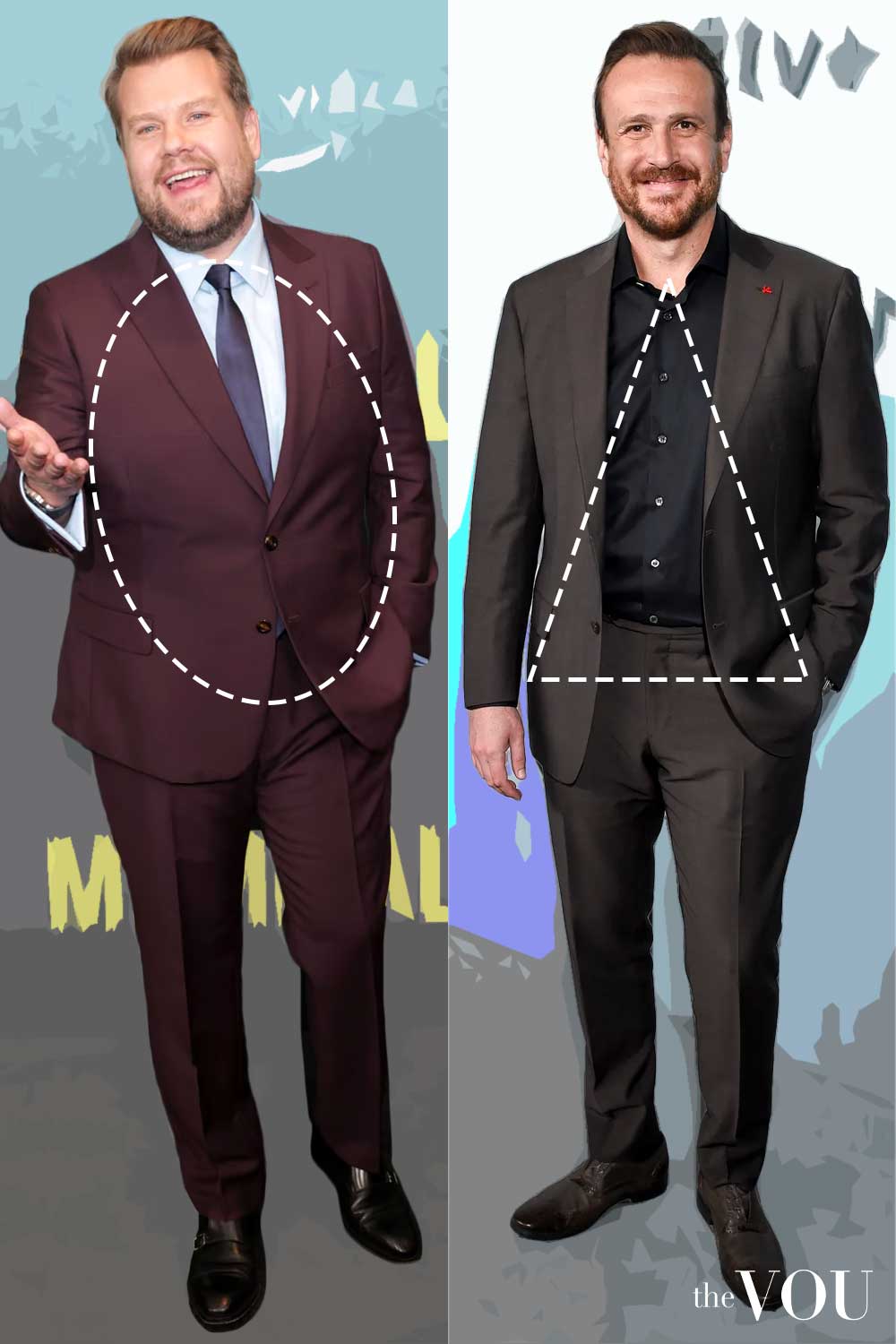
The VOU describes seven body shapes for men: Triangle, Inverted Triangle, Rectangle, Trapezoid and Hourglass follow familiar styling usage; Oval and Diamond are described in The VOU’s own words.
A man with any of these outlines may want a leaner look.
This guide goes into detail for Triangle and Oval, where the questions about hips and the middle come up most, and the fit principles apply to every outline.
Fit comes before everything else.
Image consultants and tailors start with how the jacket and trousers sit on you, and only then look at cut and colour.
Our guide to suit selection and styling rules covers the general conventions; this guide focuses on the leaner look.
If you would like to compare your proportions first, our body shape quiz for men is optional, and our seasonal colour quiz for men can help you narrow down suit colours; everything here also works without them.
Men with Triangle Body Shape
Fit the Hips First, Then Consider Some Shoulder Structure
A triangle (pear) body shape describes a lower torso and hip outline that looks broader than the shoulders, with the width carried in the hips, seat and thighs.
It is roughly the reverse of an inverted triangle, whose shoulders look broader than its hips.
If your abdomen is also the fullest point of your outline, the Oval section below is worth reading too.
The usual fit problem with ready-to-wear suits is that a suit sold as one size is cut for a man whose hips are narrower than yours, so trousers that fit the hips are loose at the waist, or a jacket that fits the shoulders pulls across the hips.
If you want a more even outline, the common approach is to add a little presence at the shoulders and keep the area around the hips plain and well fitted.
Start the jacket with fit: it should fasten without pulling across the hips, and the skirt below the button should hang straight over the seat rather than flaring or gripping.
A jacket long enough to cover the seat is the usual choice.
Light shoulder padding or a structured shoulder can add a little width at the top, which many men with a Triangle outline like; a natural shoulder is equally correct if you prefer a softer look.
The shoulder still needs to fit your own shoulders, because padding cannot fix a jacket that is too wide.
A single-breasted jacket is the simplest choice.
A double-breasted suit is an option too: its overlapping front adds presence across the chest, which can suit a Triangle outline, but it is worn fastened and needs enough room at the hips for the front to lie flat.
Compare both in a mirror.
A little waist shaping gives the jacket a defined line; too much can pull at the hips, so ask the tailor to keep enough room below the waist.
Dark, solid colours such as charcoal, navy and deep forest green are a common choice for a leaner look.
A dark suit reduces the contrast between the suit and its shadows and edges, so the outline reads more quietly; whether that looks slimmer on you depends on the cloth, the lighting and your colouring, so it is not a guaranteed effect.
Cloth weight changes how the suit hangs.
A smooth, medium-weight wool tends to drape cleanly over the hips; a very light cloth can show every crease, and a heavy one adds some bulk.
Pinstripes and herringbone add a vertical texture that some men like for a longer line.
Studies of stripes do not support a universal rule that vertical stripes slim or horizontal stripes widen, so judge any pattern on you.
Bold checks draw more attention to the lower half, which you may or may not want.
For trousers, buy for the hips, seat and thighs first; a waist that is too big is usually the easier alteration.
Flat-front and pleated trousers both work: pleats add room over the hips and thighs, which many men with this outline find more comfortable, while a flat front looks plainer if there is enough room.
A straight leg follows the thigh down to the hem in an even line; a gentle taper below the knee looks more modern but can make the thighs look fuller by contrast if it is tight.
Compare both.
A well-fitted waistcoat adds a layer above the waist, which some men like for the extra presence on top.
Choose waistcoats in complementary colours rather than strong contrasts if you want the outfit to read as one line.
Tailoring is often worth it with this outline, because ready-to-wear sizes rarely match both your hips and your shoulders.
Taking in a trouser waist or shaping a jacket waist are common alterations; changing jacket shoulders is a much bigger job that not every jacket allows, so buy jackets that fit your shoulders.
A tie, pocket square or lapel pin with some colour or pattern puts interest near your face, which many men use to draw attention upwards.
Men with Oval Body Shape
Fit the Middle First, Then Choose the Cut
In this guide, we use Oval for a rounded, fuller-middle outline, with the fullness spread fairly generally through the torso.
If your middle stands out more distinctly between a narrower chest and hips, the Diamond description may fit as well, and the same suit advice applies.
Start with measurements.
Your natural waist and the fullest point of your abdomen can be in different places, and the navel is not a fixed waist, so record both and follow the maker’s or tailor’s diagram for each garment.
The jacket should fasten over the fullest point of your middle without pulling into an X, and the fronts should hang straight below the button rather than spreading apart.
A one or two-button single-breasted jacket is the usual choice, and a button stance that sits close to the fullest point helps the jacket close cleanly.
A length that covers the seat keeps the line continuous.
Notch lapels of moderate width are a simple, versatile choice.
Peak lapels point up towards the shoulders, and some men with a fuller middle like them for the line they draw away from the waist; both work, so try each on.
Light shoulder structure can give the jacket more definition at the top if you want it; a natural shoulder is also fine.
For the trousers, decide where the waistband should sit, above, at or below the fullest point of your abdomen, and check it standing and seated, because rise labels vary between makers.
Braces or side adjusters are an option if a belt below the middle is uncomfortable.
Dark suit colours are a common choice for a leaner look with any outline.
If your colouring suits the Winter colour season, its darker shades, such as True Winter’s pure black and Deep Winter’s navy, are natural suit colours for you; if it does not, the section below suggests dark shades from the other seasons.
Choosing Dark Suit Colours Within Your Seasonal Palette
Your seasonal colour analysis can help you choose which dark shades to wear near your face.
Darker suits are a traditional choice for a leaner look, and picking a dark shade that suits your colouring is one way to narrow the choice.
For example, Autumn men might look at Autumn’s sophisticated chocolate browns and midnight blues, which give depth without harsh contrast.
Similarly, Winter men can draw on Winter’s stark blacks and deep navies, worn with crisp white shirts for a high-contrast look.
Spring men might look at Spring’s navy options, which provide structure while maintaining harmony with warmer complexions.
Summer men find their match in Summer’s grey spectrum, from light pearl to deep charcoal, all with cooling blue undertones.
Use Advanced Tailoring Techniques
Beyond basic alterations, a few fitting and tailoring details can make a suit look cleaner.
What is possible depends on how the jacket is made and how much cloth it has, so ask your tailor before assuming any change is routine.
A higher, closer armhole, which is usually a made-to-measure or bespoke detail rather than an alteration, lets you raise your arms without the whole jacket lifting, so the jacket stays in place when you move.
Sleeves that narrow gently from the upper arm to the wrist, without gripping, keep a neat line and avoid spare cloth around the forearm.
Ask your tailor about vents: single, double or none.
Whichever you choose, the vents should hang closed when you stand; vents that pull open over the seat suggest the jacket needs more room there.
Related Questions
Q. Which suit colour is most slimming for all body types?
No single colour slims every man.
Dark, solid colours such as navy and charcoal are the most common suggestions because they reduce contrast, but how a colour looks on you depends on the cloth, the lighting and your colouring.
Q. How can I make my suit look more slimming without buying a new one?
Have it fitted.
Correct sleeve length, a trouser hem that suits the leg width and your shoes, a waistband that sits where you want it and a jacket waist taken in or let out to fasten cleanly usually make the biggest difference.
A tailor can tell you which changes the suit’s construction and spare cloth allow.
Q. Should I choose pinstripes for a slimming effect?
Pinstripes are a matter of taste rather than a proven slimming tool.
Studies of stripes do not support a universal rule, so compare a pinstripe and a plain cloth on you.
Finer, closer stripes look quieter; wider, bolder stripes make a stronger statement.
Q. What suit construction suits a fuller middle?
Rather than concealing, aim for a jacket that fastens over the middle without pulling and hangs straight.
Many tailors prefer a canvassed front because it tends to hang more softly than a stiff fused front, and a jacket long enough to cover the seat keeps the line continuous.
Shoulder structure is a separate choice.
Q. How do different suit lapel styles affect perceived body shape?
There is no single correct lapel width.
A moderate lapel suits most jackets and frames; very narrow or very wide lapels make more of a statement.
Notch lapels are the simple choice, and peak lapels point towards the shoulders.
Choose the width and style in proportion with your shoulders and chest, and compare them on you.
Final Thoughts
A suit for a leaner look starts with fit: a jacket that fastens without pulling and hangs straight, and trousers with room where your outline needs it and a waistband that stays where you want it.
After that, colour, pattern, lapels and shoulder structure are choices with likely effects rather than guarantees, so compare them in a mirror.
Knowing your body shape and seasonal colour palette can make those choices quicker, and a good tailor can tell you which changes your suit allows.
A suit that fits and that you are comfortable in is the best starting point for any occasion.
Style Like a True Gentleman
Before we say goodbye, fit does most of the work, whether or not you ever work with image consultants.
Professional styling starts with getting the fit right and choosing clothes that suit the occasion; knowing your body shape and seasonal colour palette can make the choosing quicker.
Our guides also cover styling by occasion, location, season and time of day, garments, footwear, accessories and heritage fashion brands.
Take our three quizzes, then book a consultation if you would like personal help:
1. Find Your Body Shape
Different garments suit different silhouettes.
To compare your outline with the seven body shape descriptions, take our body shape quiz for men.
2. Find Your Seasonal Colours
The garments in your outfits come in many colours.
To see which seasonal colour palette may suit you, take our seasonal colour quiz for men.
3. Find Your Fashion Style
To explore your personal fashion style, take our fashion style quiz for men; it suggests styles, outfit ideas and brands to explore.
Book a Consultation with The VOU
For personal help, you can book paid consultations with our image consultants and fashion stylists.
Our styling services for men page lists the paid consultations.
Wearing luxury brands is not enough on its own; how your clothes fit and suit the occasion matters more, and our personal style guide covers the rest.
For more on labels, see our guide to logo-heavy luxury brands and how to wear them.
Contact us if you would like to book a consultation.
Mandy Meyer’s focus at The VOU is men’s body-shape styling, garment fit and outfit proportions. Her coverage addresses the practical questions behind a wardrobe choice: how a jacket sits across the shoulders, how trousers fall and how different cuts change the silhouette a wearer wants to create.
Her subject areas include the triangle, inverted triangle, rectangle, oval, trapezoid, hourglass and diamond labels used in body-shape styling. These provide starting references for comparing visible proportions; they do not capture every body or prescribe one correct way to dress. The focus connects those observations with garment shape, construction, length and the relationship between the upper and lower parts of an outfit.
Mandy’s editorial coverage combines visual comparisons with fit checks for comfort and movement. Readers can consider whether a cut gives them the room they need, where clothing pulls or gathers and which changes might support their preferred look. The aim is to make menswear choices more understandable while keeping personal preferences and the wearer’s own styling goals central.