

Start here
What’s This About
Stefano Ricci is expensive because its price pays for Italian manufacture, rare materials, small runs, lavish shops and a no-discount policy, but the price alone does not prove its clothes are better made than other fine tailoring.
This guide explains what the price pays for, such as:
The house’s history in Florence since 1972
Its own silk mill and rare materials such as vicuña and crocodile
Small fabric runs and one-off orders
The no-discount policy and the destruction of unsold stock
Whether Stefano Ricci counts as a luxury brand
Criteria for deciding whether it is worth it to you
and many more!
Buy for the style, fit and use first, and the name second.
Key Points
01Stefano Ricci was founded in Florence in 1972 and is still run by the Ricci family.
02CNBC reported suits at $6,000 to $12,000 in December 2019.
03The company does not discount and has said it destroys unsold stock.
04Its opulent style suits buyers who like that look; quieter brands suit a plainer style.
Stefano Ricci is a Florentine menswear house known for silk ties, tailoring, crocodile leather and a deliberately opulent style.
In December 2019, CNBC reported prices of $6,000 to $12,000 for a suit of jacket and trousers, $1,400 for a handmade silk shirt and $10,000 for crocodile leather boots at its Beverly Hills boutique.
This guide explains what those prices pay for, how the company sells, and how to decide whether a Stefano Ricci garment is worth it to you.
Stefano Ricci’s Heritage
Stefano Ricci and his wife Claudia founded the company in Florence in 1972, starting with silk ties before adding shirts, suits and a wider range of clothes.
The company is still run by the family: their elder son Niccolò Ricci is chief executive and their younger son Filippo Ricci is creative director.
By 2010 it had bought the Antico Setificio Fiorentino, a historic silk-weaving mill in Florence’s Oltrarno district, which gives it its own source of silk fabrics.
NUVO Magazine reported in September 2020 that the mill was opened in 1786 by a group of Florentine families and keeps manual and semi-mechanical looms from the 18th century.
The first boutique opened in Shanghai in 1993, and Wikipedia now counts around 78 monobrand boutiques worldwide.
Beyond clothes, the company sells leather goods, eyewear, fragrances, furniture, tableware and wine, and it offers interior design for yachts and homes.
What the Price Pays For
Italian Manufacture
Stefano Ricci makes its products in Italy, and its tailoring is made in Florence.
Italian manufacture, skilled labour and small production runs all cost more than large-scale production elsewhere.
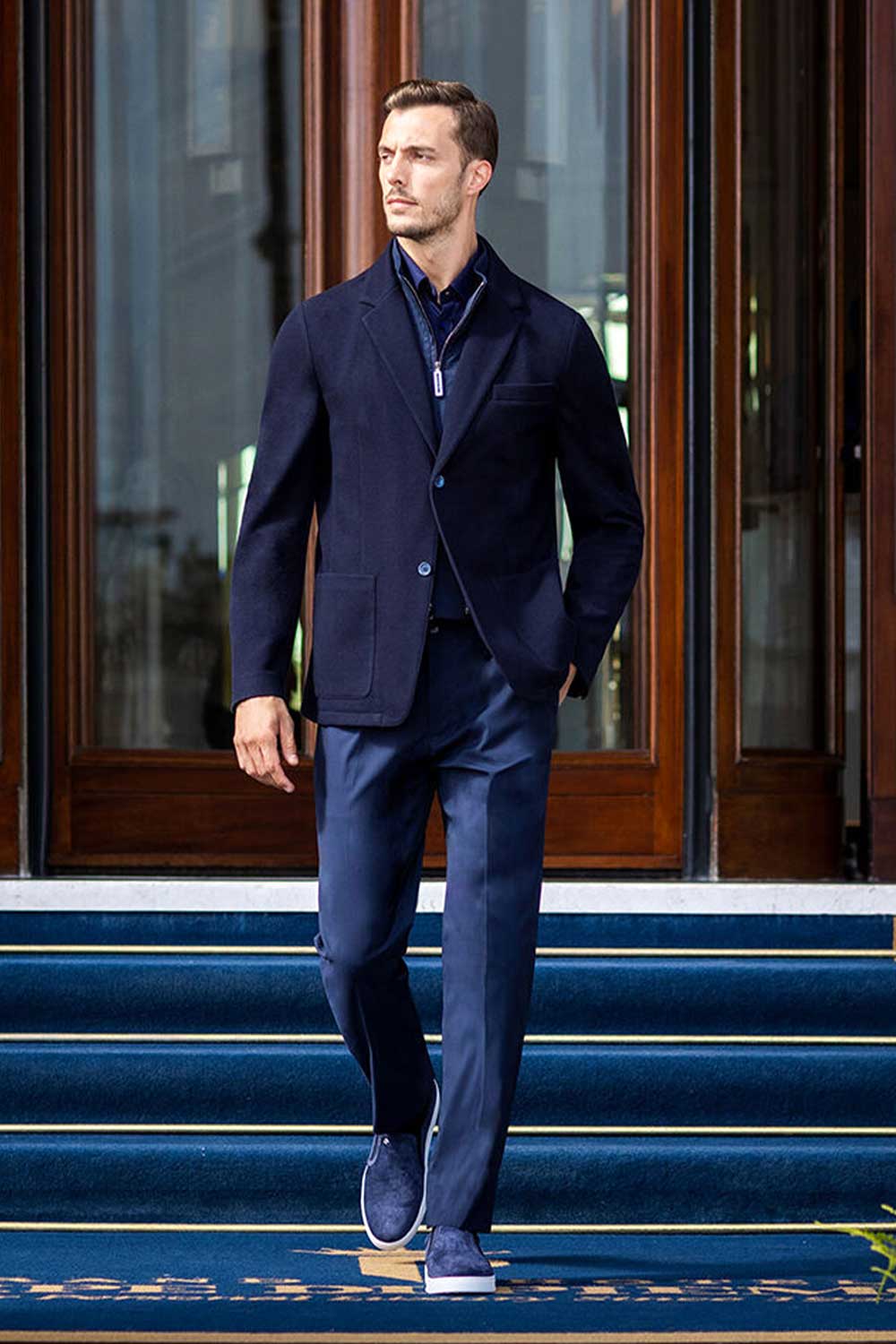
The photograph shows a relaxed navy outfit: a soft jacket, a zip-front layer and suede slip-on shoes, all in one colour family.
Wear: a navy unstructured jacket, a navy knitted zip-front layer or fine jumper, a dark blue shirt, navy wool trousers and navy suede slip-on shoes.
Rare Materials
The house uses costly materials such as silk from its own mill, vicuña, a rare wool from a wild South American animal related to the llama, and crocodile and ostrich leather.
Its accessories show how far the prices go: in 2019, CNBC listed a gold and diamond belt buckle at $124,000 and a crocodile belt at $2,800.
Small Runs
Speaking to Verdict in January 2019, Filippo Ricci said: “When you do 60m on a fabric, that means you have 20 suits around the world with that [design]. Most of the time 10 suits are made, so the chance that you will find another gentleman around dressed like you, it’s almost impossible.”
The house also makes one-off orders; Verdict reported a yellow crocodile trench coat made to match a customer’s motorcycle.
Shops and Service
Filippo Ricci told Verdict that the boutiques are designed to make customers feel “powerful, strong”, with polished black briar-root wood, pietra serena stone and crocodile-skin armchairs.
In Shanghai, the company runs the Stefano Ricci Mansion, which Verdict described in 2019 as a private club open to customers who spend more than €50,000 a year.
Filippo Ricci told Verdict: “We sell to people that have got everything.”
Shops, staff and service of this kind are paid for out of the price on the tag, and none of them makes a seam stronger.
No Discounts and Destroyed Stock
Stefano Ricci does not sell at a discount.
CEO Niccolò Ricci explained the policy to CNBC in 2019: if a suit goes on sale soon after a customer buys it, the customer comes to see the sale price as the real price.
The company has said that it destroys unsold stock instead: Filippo Ricci told Verdict in January 2019, “we burn it at the end of the year because we don’t want it to spread around”, and CNBC reported in December 2019 that, according to the company, it had destroyed around $2 million worth of unsaleable products the previous year.
Destroying unsold goods keeps prices consistent, but it has drawn criticism across the fashion industry on environmental grounds.
Who Wears Stefano Ricci?
CNBC reported in 2019 that the house’s clothes had been worn over the years by Tom Cruise, Michael Bublé, Andrea Bocelli and Nelson Mandela; our list of celebrities who wear Stefano Ricci covers more names.
A famous customer tells you about that customer’s taste, not about how a garment will look on you.
Is Stefano Ricci a Luxury Brand?
By its prices, materials, small runs and no-discount policy, Stefano Ricci is priced at the top end of menswear.
It is young by luxury standards, though: it was founded in 1972, while Hermès dates from 1837 and Louis Vuitton opened its first shop in 1854.
Its style is bold and opulent, so if you prefer a quieter look, compare it with other Italian tailoring houses such as Brioni and Kiton before you buy.
Is Stefano Ricci Worth the Price?
Judge a Stefano Ricci garment against these criteria rather than on the price or the name.
Style: the house’s look is opulent, with rich silks, bold patterns and exotic leathers, so it suits you only if you like that look; quieter brands suit a plainer style.
Construction and cloth: check the stitching, the lining, the pattern matching and the fibre content, as you would with any tailoring.
Fit: try the exact garment and use the in-store tailoring; no fabric helps a jacket that does not fit.
Use: a navy jacket or a silk tie you wear often repays its cost far faster than a crocodile coat worn once a year.
Price: because the house does not discount, you pay full price; compare similar tailoring from other tailors and Italian makers first.
A high price does not prove higher quality, and clothing does not tell anyone about your wealth or success.
On balance, Stefano Ricci can be worth it to a buyer who loves its opulent style, can easily afford full price and will wear what he buys; for most men, similar tailoring and silk ties are available for far less.
Conclusion
Stefano Ricci’s prices pay for Italian manufacture, rare materials, small runs, lavish shops and personal service, and for a no-discount policy that the company backs by destroying unsold stock.
Whether it is worth it depends on how much you like the house’s style, how well the garment fits and how often you will wear it.
If you choose Stefano Ricci, start with versatile clothes such as a navy jacket or a silk tie rather than the most expensive exotic leathers.
Sources
CNBC, Some of the world’s richest shop at this luxury boutique (4 December 2019).
Verdict, Targeting the top 1% with luxury lifestyle brand Stefano Ricci (3 January 2019).
NUVO Magazine, A Treasure Trove of a Textile Mill in Florence (14 September 2020).
Comité Colbert, member pages for Hermès and Louis Vuitton, read 7 October 2026.
Stefano Ricci, Wikipedia (history, family roles, boutiques, products and interior design services).