
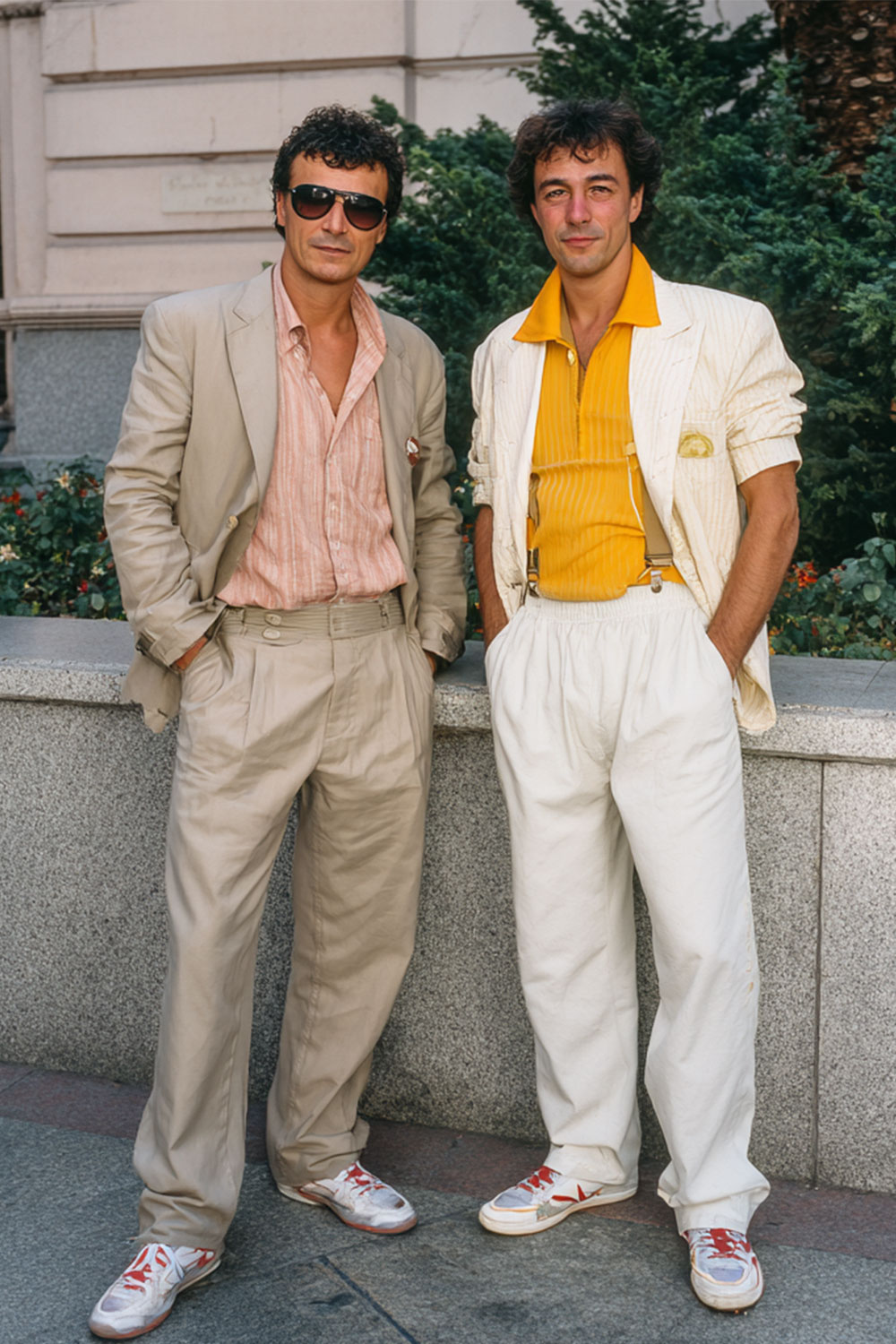
Start here
What’s This About
The essentials of 80s menswear were acid wash jeans, parachute pants, racer and leather jackets, polo shirts, slogan T-shirts, tracksuits, high-top trainers and accessories such as Wayfarers and Swatch watches.
This guide covers where each came from and how to wear it now, such as
Acid wash denim and the difference between parachute pants and Hammer pants
The Members Only jacket and the red leather jacket from Thriller
Slogan T-shirts from Katharine Hamnett to Frankie Goes to Hollywood
The real story behind the Air Jordan 1 ban
How Risky Business changed Wayfarer sales
and many more!
Use one or two 80s garments in a current outfit rather than recreating the whole decade.
Key Points
01The NBA’s objection concerned the Nike Air Ship prototype, though Nike’s advertising told it as an Air Jordan ban.
02Run-DMC’s My Adidas led to the first endorsement deal between a sportswear brand and non-sporting performers, according to Guinness World Records.
03Wayfarer sales rose from about 18,000 pairs in 1981 to 360,000 in 1983.
04Balance one oversized 80s jacket with straight or slim trousers.
Men’s clothes in the 1980s mixed sharp office tailoring, gym wear worn on the street, preppy polo shirts and the outfits of new music and youth scenes.
The decade ran from the power-dressing yuppie look to the leather and denim of rock bands and the early days of streetwear.
Interest in 80s clothes is high again, helped by period television such as “Stranger Things” and by the habit of reviving earlier decades, as the later Y2K revival did with the early 2000s.
The decade’s clothes were shaped by music television such as MTV, which launched in 1981, by the fitness boom and by films aimed at teenagers.
This guide covers the garments, shoes and accessories that defined 80s menswear, where they came from, and how to wear them now without looking as if you are in costume.
1. Acid wash denim and parachute pants
Acid wash and stonewashed jeans
Stonewashed and acid wash denim, bleached to leave a high-contrast, marbled pattern, became one of the most recognisable looks of the decade.
Jeans were often cut to sit high on the waist and taper towards the ankle.
Many wearers “pegged” or tight-rolled the hems to narrow them further and show off high-top trainers.
Some rock-influenced styles had zip details at the ankle.
Denim on denim was a common styling choice, usually with jacket and jeans in slightly different washes, and jeans were often worn with white sports socks and chunky trainers.
Brands included Levi’s (especially the 501), Guess, with its triangle logo on the back pocket, Jordache and Girbaud.
Parachute pants and muscle pants
Parachute pants were made of shiny synthetic fabric, such as nylon, with elastic or zipped ankles, many zips and a loose cut through the thigh.
Breakdancers favoured them because smooth nylon slides easily on the floor and allows a wide range of movement.
Muscle pants had a similar loose shape in printed cotton, and Zubaz, founded in 1988, sold zebra-striped versions first aimed at weightlifters.
Hammer pants, made famous by MC Hammer around 1990, are a different, drop-crotch style; he told Racked in 2016 that he prefers that name to “parachute pants”.
The brands behind these styles were Bugle Boy and Zubaz.
Today, relaxed joggers and technical cargo trousers carry a similar loose-to-tapered shape in quieter, more breathable fabrics.
2. Members Only and leather jackets
Outerwear was one of the clearest signs of which scene a man belonged to, whether preppy, rock or street.
The Members Only racer jacket
Members Only, founded in 1975 by Herb Goldsmith, introduced its jacket to the American market in 1980, and it became one of the best-known casual jackets of the decade.
The design was a lightweight zip jacket with narrow epaulettes, a strap across the collar and knitted cuffs and hem, which gave a blouson shape.
Complex has described it as a cross between a Harrington and a cafe racer jacket.
The jacket was often worn with the collar turned up and sleeves pushed back, over a pastel polo shirt or a plain white T-shirt.
Many department-store imitations followed the same design.
Leather motorcycle and varsity jackets
The double-rider motorcycle jacket was a staple of punk and metal scenes, which often customised it with studs, badges, pins and painted band names on the back.
Michael Jackson’s red leather jacket in the “Thriller” video (1983) was designed by Deborah Nadoolman Landis, who has explained that she chose red to capture the spirit of a horror film and shaped its black panels into a strong V from the waist to the shoulders.
Varsity or letterman jackets, originally made for school and college sport, were also widely worn as casual jackets by adults.
For leather, the brands were Schott NYC and Vanson, alongside many fashion versions.
3. Polo shirts and slogan T-shirts
Tops ranged from preppy to political, and the line between high fashion brands and shopping-mall fashion began to blur.
The preppy polo shirt
As for fit, polo shirts were usually worn tucked in, with a slightly boxy body and a longer back hem, sometimes called a tennis tail, that stays tucked during sport.
When it came to details, a visible logo was a large share of the appeal, and some men wore two polo shirts in different colours at once, with both collars turned up.
Pastel colours such as salmon, mint, lemon and sky blue were popular, and the look of “Miami Vice” made pale colours fashionable for men more widely.
For context, the preppy polo belonged to the yuppie wardrobe, a term Newsweek made famous when it called 1984 “the year of the yuppie”, and it drew on traditional Ivy League clothing.
Brands associated with the preppy polo were Ralph Lauren, Lacoste, Izod and Benetton.
Brand names on a polo shirt say nothing reliable about its quality; for one example of how price and label interact, see our guide to why Ralph Lauren Purple Label costs what it does.
Graphic and band T-shirts
Katharine Hamnett launched her large-lettered slogan T-shirts, including “CHOOSE LIFE”, in 1983, and George Michael wore one in Wham!’s “Wake Me Up Before You Go-Go” video.
The “Frankie Say” T-shirts of 1984, made for the band Frankie Goes to Hollywood, were modelled on Hamnett’s approach and became hugely popular.
Ringer T-shirts, with contrasting collar and cuff ribs, were a common cut, and many concert T-shirts used raglan sleeves in a contrasting colour, baseball style.
Skate brands such as Santa Cruz and Powell-Peralta put bold graphics on T-shirts as skateboarding grew, an early example of pop culture shaping what we wear.
Graphic T-shirt brands included Ocean Pacific (OP), Santa Cruz and Powell-Peralta.
4. Tracksuits and short shorts
The fitness boom of the 1980s, with aerobics and jogging, brought gym clothes onto the street on a large scale.
Velour and nylon tracksuits
The design paired matching jackets and trousers, from velour leisure suits to the thin, crinkly nylon shell suit of the late 1980s, often in blocks of bright colour.
Run-DMC wore Adidas tracksuits and shell-toe trainers on stage, and their song “My Adidas”, released on 29 May 1986, led to what Guinness World Records lists as the first endorsement deal between a sportswear brand and non-sporting performers.
Tracksuits came from brands such as Adidas, Fila, Sergio Tacchini and Ellesse.
Athletic shorts
Shorts were much shorter than in the 1990s, with inseams of around 2 to 4 inches common for basketball, running and casual wear.
Corduroy shorts were popular in surf style, and nylon “dolphin” shorts, with white piping and rounded side hems, were common among runners.
Short shorts were standard in the NBA throughout the decade, before longer basketball shorts took over in the 1990s.
5. Footwear that defined the 80s
High-tops and court shoes
The 1980s turned athletic shoes into collectibles.
Basketball shoes included the following.
The Air Jordan 1 (1985) was the first shoe of the Air Jordan line, in red and black among other colours. Nike’s “Banned” advertising claimed the NBA had thrown the shoe out of the game, but the league’s objection concerned the Nike Air Ship, the black and red prototype worn earlier, under its rule on mostly white shoes.
The Adidas Forum (1984), a basketball high-top with an ankle strap, was later adopted as a casual street shoe.
The Converse Weapon (1986) was a high-top Converse promoted with NBA players, including Larry Bird and Magic Johnson.
Run-DMC wore the Adidas Superstar, the shell-toe, without laces, and the “My Adidas” deal of 1986 made it a hip-hop staple.
Then there were casual trainers.
The Reebok Freestyle (1982), a soft garment-leather shoe made for aerobics, also became a casual shoe.
The Vans checkerboard slip-on was worn by Sean Penn as Jeff Spicoli in “Fast Times at Ridgemont High” (1982), which made the brand known nationwide in the US; the pattern began with skateboarders customising their shoes.
Nike launched the Air Max 1 (1987) with a visible Air unit in the sole, which changed how running shoes looked.
Penny loafers and boat shoes
Among boat shoes, Sperry Top-Siders were central to the preppy look, usually worn without visible socks and with chinos rolled at the ankle.
Penny loafers were worn across preppy and Ivy wardrobes, and Michael Jackson’s black loafers with white socks and cropped black trousers became one of his signatures.
6. Essential 80s accessories
Wayfarers and aviators
Ray-Ban Wayfarers were designed in the 1950s, but sales rose sharply after Tom Cruise wore them in “Risky Business” (1983), from about 18,000 pairs in 1981 to 360,000 in 1983, following a product-placement agreement Ray-Ban had signed in 1982.
They also appeared in “The Breakfast Club” and “Miami Vice”.
As for aviators, “Top Gun” (1986) put Ray-Ban Aviators on Tom Cruise’s character, Maverick, alongside his patched G-1 flight jacket.
Digital watches and Swatches
Calculator watches, digital watches with built-in calculators such as Casio’s Databank models, became a popular gadget.
Swatch, the Swiss brand, launched its first 12 watches in Zurich on 1 March 1983, and its colourful plastic designs became collectible; some wearers stacked several on one wrist.
Bum bags and the Walkman
The bum bag, or fanny pack in the US, was a practical nylon pouch worn at the waist, often in bright colours.
The Sony Walkman, a portable cassette player first sold in 1979, was not clothing, but with its foam headphones it shaped how many men looked on the street.
How to wear 80s clothes today
To bring 80s trends that are hard to wear now into a current wardrobe without a costume effect, change one or two garments rather than the whole outfit.
Balance volume by pairing a boxy, oversized 80s denim or leather jacket with straight or slim trousers rather than wide, tapered ones.
Broad padded shoulders exaggerate an already broad upper body; if you have an inverted triangle body shape and want a softer look, choose softer shoulders, though this is a preference rather than a rule.
Go lighter on washes, since a vintage stonewash gives the period feel without the strong contrast of late 80s acid wash.
Start with the shoes. The Air Jordan 1, the Adidas Superstar and Reebok’s white leather court shoes are still made, and a clean pair is the easiest nod to the decade.
Tuck it in, because a T-shirt or polo shirt tucked into straight-leg jeans is a strong 80s signal that still looks current.
Wear a white T-shirt tucked into mid-blue straight jeans, a black leather motorcycle jacket and white leather high-tops.
Or wear a pastel polo shirt, stone pleated chinos, brown penny loafers and Wayfarer-style sunglasses.
For a full survey of the decade’s styles, see our guide to 80s fashion for men and how to wear it today, and for documented outfits to copy, our 80s celebrity outfit ideas.
Related guides
80s fashion for men, the styles and how to wear them
90s men’s styles to recreate now
What is the 20-year rule in fashion?
Sources
The Museum at FIT, Fashion History Timeline, 1980 to 1989.
Guinness World Records, first non-sporting sneaker endorsement.
UPI, “Year of the Yuppie”, 23 December 1984.
Jian DeLeon, “The Greatest 80s Fashion Trends”, Complex, 1 January 2018.
Jake Rossen, “A Brief History of MC Hammer’s Pants”, Mental Floss, 30 March 2017.
Scripps News, “Deborah Landis explains Michael Jackson’s Thriller jacket”.
Nike, Air Max Day (Air Max 1 launched in 1987).
Wikipedia, Air Jordan and Ray-Ban Wayfarer (reference summaries with cited sources).