

Start here
What’s This About
The main loafer types are the penny, tassel, horsebit, Belgian, kiltie, saddle and butterfly loafer, and each one suits slightly different outfits.
This guide explains how to recognise and wear each loafer type, such as
What makes a shoe a loafer, and why guides disagree
Where the penny loafer name and the Weejun come from
The Gucci horsebit loafer and when Kering dates it
Belgian, kiltie and butterfly loafers explained
Whether to wear socks with loafers
and many more!
Pick the loafer that suits the outfits you already wear, and start with a dark brown penny loafer if you want one pair.
Key Points
01Penny loafers are the most versatile loafer and suit smart casual and business casual outfits.
02Tassel and horsebit loafers look a little dressier, while Belgian and driving loafers are soft, summer shoes.
03Loafers are not the traditional choice for black tie, where Oxfords or evening shoes are expected.
04Socks are optional. Wear thin matching socks with tailoring and no-show socks with summer outfits.
A loafer is a laceless leather or suede shoe that you slip on, and it covers more occasions than most men expect, from a weekend in chinos to a summer suit.
The differences between loafer types come down to what sits across the top of the shoe, whether a leather strap, tassels, a metal bit, a fringe or a small bow.
Those details change how dressy each loafer looks, so knowing the main types makes it easier to pick the right pair for your outfit and the occasion.
This guide explains seven common loafer types, how to wear each one, whether to wear socks, and how loafers fit formal and casual dress codes.
What is a loafer?
A loafer is a low-cut slip-on shoe with no laces, a low heel and an open ankle.
Most loafers are made of leather or suede, and many use a moccasin-style construction with a stitched apron on top of the toe.
Shoemakers and style writers draw the boundaries of the category differently.
Some count only loafers with a separate, stitched sole and a heel, while others also include softer driving loafers, Venetian loafers and slipper-style shoes.
Boat shoes have laces, so most guides treat them as a separate shoe, even though they share the moccasin toe.
In this guide, six of the seven types have a structured sole and a low heel; the Belgian loafer is softer, and other soft slip-ons are covered in a short section afterwards.
1. Penny loafers
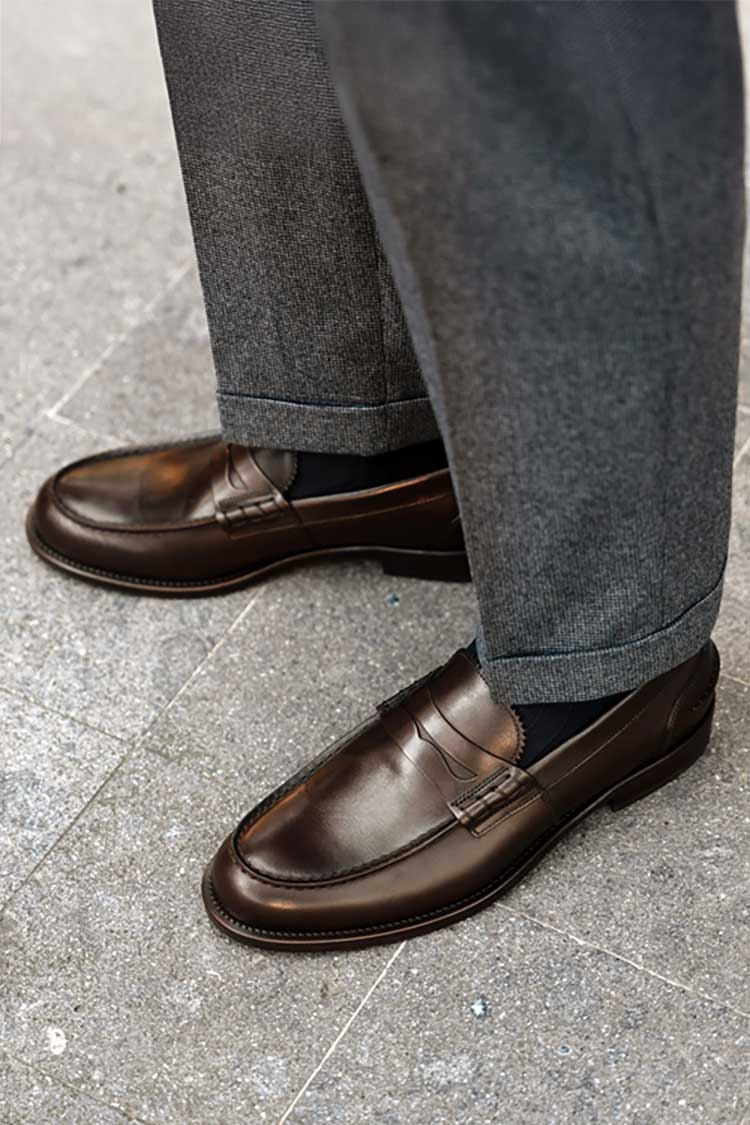
The penny loafer has a leather strap, called a saddle, stitched across the top of the shoe, with a small cut-out in the middle.
The name is usually explained by students slipping a coin into that cut-out.
G.H. Bass introduced its Weejun loafer in 1936, based on Norwegian slip-on shoes, and Bass calls it the original penny loafer.
The penny loafer became a staple of American Ivy League style and is still the most versatile loafer to start with.
The penny loafer fits smart casual and business casual outfits, and works with a lightweight suit in warm weather.
Wear it all year in smooth leather, with suede most at home in spring and autumn.
The styles it suits are Ivy League, Southern Preppy and BCBG.
Wear dark brown penny loafers with grey flannel trousers, a light blue Oxford cloth button-down shirt and a navy blazer.
2. Tassel loafers

The tassel loafer replaces the saddle strap with a leather lace that runs around the collar and ends in two tassels on top of the shoe.
According to menswear writer G. Bruce Boyer, the American tassel loafer began when actor Paul Lukas asked shoemakers to copy a pair of tasselled European shoes, and Alden put its tasselled slip-on into production in 1950.
Brooks Brothers later sold the style, and it became a preppy favourite for smart casual and business casual outfits.
Many people see a polished tassel loafer as a little dressier than a penny loafer, especially in dark brown or burgundy leather.
Tassel loafers fit business casual offices and smart casual dinners, and go with a suit where loafers are accepted.
Leather pairs work all year, with suede tassel loafers easiest in spring and autumn.
The tassel loafer sits well with Sloane Ranger, BCBG and American preppy.
Combine burgundy tassel loafers with mid-grey wool trousers, a white poplin shirt and a navy hopsack blazer.
3. Horsebit loafers

The horsebit loafer, often just called a bit loafer, has a metal bar across the top of the shoe shaped like a horse’s snaffle bit.
Gucci’s version is the best known, and Kering, Gucci’s owner, dates the Gucci Horsebit loafer to 1953.
The hardware draws the eye, so a bit loafer suits outfits that are otherwise simple.
It became a common shoe in American offices, and our guide to business casual shoes shows where it works at work today.
Horsebit loafers fit business casual and smart casual outfits; gold or silver hardware is more noticeable than a leather strap.
In leather, a bit loafer works all year, with lighter colours and suede for spring and summer.
Styles it suits include Ivy League, Southern Preppy and BCBG.
Team dark green or brown bit loafers with black or charcoal trousers and a white shirt or a navy knitted polo.
4. Belgian loafers

The Belgian loafer is a soft, lightweight slipper-style loafer with a small leather bow on top and a thin, flexible sole.
The name comes from Belgian Shoes, the New York shop that Henri Bendel founded in 1955, which sells handstitched loafers made in Izegem, Belgium.
Because the construction is soft and the sole is thin, Belgian loafers are made for dry days and relaxed evenings rather than long walks or wet streets.
Belgian loafers suit smart casual summer outfits, dinners and holidays.
Keep them for spring and summer, usually in suede.
Style-wise, the Belgian loafer works with Ivy League, Southern Preppy, BCBG and Nautical Preppy.
Wear chocolate suede Belgian loafers without socks, alongside cream cotton trousers, a white linen shirt and a light navy cotton jacket.
5. Kiltie loafers

The kiltie loafer has a fringed leather flap, called a kiltie, over the top of the shoe.
The fringe is usually linked to Scottish dress and to traditional golf shoes, which often carry the same fringe.
The fringe adds texture and movement, so kiltie loafers suit tweed, flannel and corduroy as well as summer chinos.
They are a natural fit for country club outfits and for the classic, Old Money-inspired look.
Kiltie loafers belong with smart casual outfits; a polished black kiltie, like the one shown, can also sit with dark tailoring.
A kiltie works all year, with brown suede and pebble-grain leather most at home in autumn and winter.
It suits Ivy League, BCBG, Sloane Ranger and Northern Preppy.
Pair brown kiltie loafers with olive corduroy trousers, an ecru Shetland crew-neck jumper and a brown tweed jacket.
6. Saddle loafers

“Saddle loafer” is a looser name than the others in this guide.
Most makers use it for a penny-style loafer with a wide leather saddle across the top, and some use it for a loafer whose saddle runs further down the sides of the shoe towards the sole.
On the shoe, it looks much like a penny loafer, so you can wear the two in the same way.
The saddle loafer suits smart casual and business casual outfits.
In leather, it is an all-year shoe.
Matching styles are Ivy League, Southern Preppy, BCBG and Countryside Chic.
For example, wear mid-brown saddle loafers with stone chinos, a white Oxford cloth button-down shirt and a navy crew-neck jumper.
7. Butterfly loafers

The butterfly loafer has a split strap across the top of the shoe, with two overlapping leather tabs that look a little like a butterfly’s wings.
Makers who sell the style describe it as more involved to make than a standard penny loafer.
It reads as a variation on the penny loafer, so the colour and leather matter more than the strap for how formal it looks.
Butterfly loafers fit smart casual outfits, and business casual in dark, smooth leather.
Any season works, with suede in spring and autumn.
A butterfly loafer goes with Ivy League, Southern Preppy and BCBG.
Try snuff suede butterfly loafers with navy seersucker trousers, a white shirt and patterned pink socks.
Other slip-ons often called loafers
Venetian loafers have a plain upper with no strap, tassel or hardware, which gives them a clean, simple look.
Driving loafers have soft uppers and a sole made of rubber pebbles that continue up the back of the heel, so they suit driving and relaxed summer days rather than city walking.
Slipper loafers, often in velvet, are evening and at-home shoes, and a black velvet pair can work with a dinner jacket at less traditional black tie events.
Lug-sole loafers put a chunky rubber sole under a penny or tassel upper, which makes them sturdier and more casual.
How dressy is each loafer?
Scroll horizontally to see all columns →
| Loafer type | Look | Easiest occasions |
|---|---|---|
| Penny | Plain strap, classic | Smart casual, business casual, summer suits |
| Tassel | Tassels add a little polish | Business casual, smart casual, summer suits |
| Horsebit | Metal hardware, noticeable | Business casual, smart casual |
| Belgian | Soft, bow detail | Summer smart casual, dinners |
| Kiltie | Fringed, textured | Smart casual, country outfits |
| Saddle | Wide strap, close to the penny | Smart casual, business casual |
| Butterfly | Split strap, a penny variation | Smart casual, business casual |
Across every type, dark, smooth, polished leather looks dressier than light suede, and a slim sole looks dressier than a chunky one.
Loafers are not the traditional choice for formal dress codes such as black tie, where black Oxfords or patent evening shoes are expected, although velvet slippers are accepted at some events.
Should you wear socks with loafers?
Both ways are accepted, and the choice depends on the outfit and the weather.
With tailoring, wool trousers or cold weather, wear thin socks that match your trousers or add a subtle pattern, as in the butterfly loafer photo above.
With chinos, linen or shorts in warm weather, many men wear loafers without visible socks, using no-show socks to protect the lining and reduce odour.
Avoid thick athletic socks with loafers, as they fill the shoe and look out of place with a low-cut slip-on.
How to choose the right loafer
Fit comes first. Because a loafer has no laces, it needs to hold your heel without slipping and without rubbing.
Try loafers on later in the day, when feet are slightly larger, and walk on a hard floor to check heel slip.
If you want one pair for most outfits, a dark brown penny loafer in smooth leather covers the widest range of clothes.
A second pair in suede, or a tassel or bit loafer, adds variety once you know which outfits you wear most often.
Loafers built with a stitched, welted sole can usually be resoled, which extends their life; softer Belgian and driving loafers are lighter but harder to repair.
Price alone does not tell you how well a loafer is made, so check the construction, the leather and the fit.
Take our quizzes
None of these tools is needed to wear the loafers in this guide, but some readers like extra help when choosing clothes and colours.
Check your body shape with the body shape quiz for men, and read our guide to dressing for your body type.
Find your seasonal colours with the seasonal colour quiz for men, and read more about seasonal colour palettes for men.
Book a consultation for personal help
If you would like personal help after the quizzes, you can book paid consultations with The VOU’s image consultants and stylists, including a professional fashion style analysis for men.
Sources
G.H. Bass, What’s a Weejun (Weejun introduced 1936).
G. Bruce Boyer, Tasseled Loafers, Cigar Aficionado, March/April 1998.
Kering, Gucci house history (Horsebit loafer, 1953).
Belgian Shoes, Wikipedia (founded by Henri Bendel, 1955; made in Izegem).
Real Men Real Style, 10 loafer styles (Venetian, driving, slipper and lug-sole definitions).
J.FitzPatrick Footwear, butterfly loafers (maker’s description of the split strap).