
Start here
What’s This About
Casual style is comfortable everyday clothing chosen with care, so it fits, is in good condition and suits where you are going.
This guide explains casual style and how to build and wear it, such as:
How casual differs from smart casual and business casual
Where casual style came from, from campus clothes to streetwear
A versatile casual wardrobe, from Harrington jackets to loafers
Outfits for European, American and Asian cities and different climates
Eight common mistakes and how to fix them
and many more!
Brands are examples only, and workplaces and hosts differ, so adapt every suggestion to your own setting.
Key Points
01Casual is the most relaxed level; smart casual adds polish; business casual depends on your workplace.
02A few versatile garments, such as an Oxford shirt, dark jeans, chinos and a navy blazer, cover most situations.
03Fit comes first; whether you prefer a slim or relaxed shape is a separate, personal choice.
04Condition matters: pressed shirts, clean shoes and T-shirts that still hold their shape.
Casual style is the everyday way most men dress today: comfortable clothes chosen with enough care that they look intentional.
It grew out of the relaxing of strict dress codes in the twentieth century, and it leaves far more room for personal taste than formal dress.
Casual never has to mean careless; the difference is that each garment fits, is in good condition and suits the place you are going.
This guide explains where casual style came from, how it differs from smart casual and business casual, and how to build and wear a casual wardrobe for different places and occasions.
From formal to casual style
The move from formal to casual dress followed wider social change.
After the Second World War, more people had leisure time, and they wanted clothes for weekends, sport and holidays rather than the office.
Sportswear and relaxed clothing spread through the 1950s, and the youth movements of the 1960s pushed casual dress further into everyday life.
University campuses played a big role: students at American colleges, especially Ivy League schools, mixed traditional clothes such as Oxford shirts, chinos and blazers in relaxed ways, and that look spread worldwide.
Casual vs business casual vs smart casual
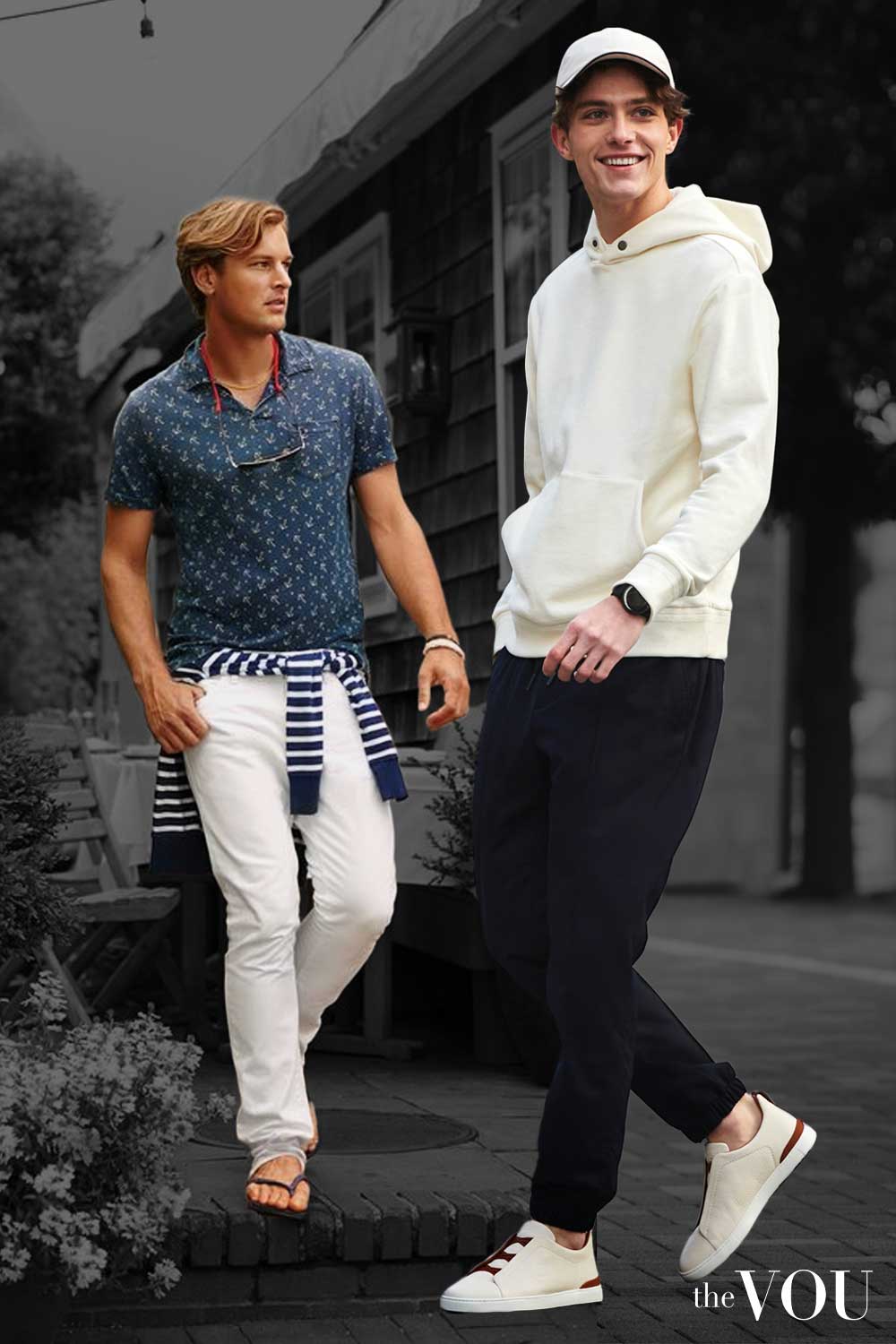
Casual is the most relaxed of the three: jeans or chinos, a T-shirt, polo or casual shirt, and clean trainers or casual shoes, for weekends and informal social plans.
Smart casual adds some polish, such as a blazer or fine knit with chinos or dark jeans and leather shoes; our smart casual dress code guide covers it in detail.
Business casual is the office version, and it varies from one workplace to the next, so your employer’s policy and what colleagues wear on an ordinary day are the best guide.
Our guide to men’s dress codes compares all three with the more formal codes.
Streetwear’s influence on casual style
Streetwear changed casual style by bringing new shapes, logos and attitudes into everyday dress.
It grew from 1980s Californian surf and skate culture and New York hip-hop, and it values comfort, authenticity and links to music and sport.
Many casual wardrobes now mix streetwear staples such as trainers, hoodies and graphic T-shirts with traditional casual clothes, and our guide to what streetwear is explains the style in full.
Classic, Old Money-inspired casual
“Old Money” is a contemporary label for classic, lightly branded casual clothes linked to sailing, golf and country sports: cable-knit jumpers, chinos, Oxford shirts and boat shoes.
The clothes say nothing about the wearer’s background or wealth; what they offer is a focus on good fit, durable cloth and garments that last for years.
That approach is a useful starting point when you build a first casual wardrobe.
Why casual style matters today
Many workplaces have relaxed their dress codes, and social occasions now range widely in how formal they are.
Knowing how to dress casually but well helps you meet those changing expectations without guessing.
A well-chosen casual wardrobe also works across many situations, from weekend errands to informal meetings, which saves money and decision time.
Casual styles around the world
The styles below are broad tendencies that menswear writers often describe, not rules; people in every city dress in many different ways.
Californian casual
Californian casual favours relaxed shapes, natural fabrics and neutral colours: well-fitted T-shirts, good denim and minimal trainers.
It borrows from surf culture and the tech industry’s relaxed office dress.
Mediterranean casual
Mediterranean casual uses light, breathable fabrics such as linen and cotton in relaxed but tidy cuts.
Whites, beiges and sea blues are common, with earthy tones, and typical garments include unstructured blazers, loose linen shirts, tailored shorts and leather sandals.
Ivy League casual
Ivy League casual is the American collegiate look: Oxford cloth button-down shirts, navy blazers, khaki chinos and penny loafers.
Stripes, checks and, in summer, madras are traditional patterns, and modern versions often use slimmer or more relaxed fits.
Japanese minimalist casual
Japanese minimalist casual relies on clean lines, careful details and muted colours, often with interesting textures and technical fabrics.
Typical garments include well-made denim, unstructured blazers and technical outerwear.
Scandinavian casual
Scandinavian casual is functional and minimal, with black, white and grey palettes and the occasional muted earth tone.
Layers that combine easily, minimal trainers, structured outerwear and simple knitwear are the core.
British heritage casual
British heritage casual draws on country and outdoor clothing: waxed cotton jackets, wellington boots and thick wool jumpers.
Herringbone and tweed are typical, and the rugged cloths tend to look better with age.
A complete casual wardrobe
The list below covers a versatile casual wardrobe in which most garments work with most others.
Brand names are examples only, at a range of prices; many high-street brands make similar versions, and fit and condition matter more than the label.
Navy Harrington jacket
A light, water-resistant cotton jacket with a short body and a tartan lining that works through spring and autumn.
Baracuta’s G9, first made in Manchester, is widely credited as the original, and the style took its name from Rodney Harrington, a character in the 1960s television series Peyton Place.
It goes with T-shirts and Oxford shirts alike and gives light weather protection.
Navy unstructured blazer
A light wool blazer with little padding and patch pockets keeps a relaxed character while making an outfit smarter.
Drake’s and Boglioli are well-known examples; look for a soft shoulder and a length that covers the seat of your trousers.
Light rain jacket
A plain technical rain jacket in navy or olive protects the layers underneath all year round.
Choose one long enough to cover a blazer if you plan to wear the two together.
Grey crewneck sweatshirt
A loopback cotton sweatshirt in grey marl is the comfortable weekend layer, over a T-shirt or an Oxford shirt.
Navy merino crew-neck jumper
A fine merino jumper in navy works across seasons, smart enough for many business casual offices and easy at weekends.
John Smedley and William Lockie are long-established knitwear examples.
White or light blue Oxford button-down shirt
An Oxford cloth button-down shirt in white or light blue works in almost any casual setting and adds polish over a T-shirt.
Our Oxford button-down shirt guide covers fit and styling.
White spread-collar shirt
A fine cotton shirt with a spread collar sits between casual and formal and suits evenings and dressier smart casual plans.
Navy cotton piqué polo shirt
A plain navy piqué polo shirt with a structured collar is a smart alternative to a T-shirt for summer and for business casual offices that allow polos.
White cotton crew-neck T-shirt
A plain white T-shirt in mid-weight cotton works alone or under other layers.
Replace it when it loses its shape or turns grey, especially if you wear it under tailoring.
Grey marl crew-neck T-shirt
A grey marl T-shirt adds texture while staying neutral and shows marks less than white.
Dark indigo jeans
Dark, plain jeans in a straight or slim-straight cut are the casual trouser standard.
Raw (unwashed) denim fades with wear into a pattern of its own, while washed denim is softer from the start; both work.
Beige chinos
Khaki or beige chinos are the main alternative to jeans and suit weekdays and weekends.
Olive chinos
Olive chinos add variety and go with navy, white, grey and brown.
Light grey wool trousers
Mid-weight grey wool trousers are the smartest casual trouser and pair with blazers and knitwear.
White leather trainers
Clean white leather trainers without large logos work across most casual settings; Common Projects is one well-known maker of the style.
Brown suede chukka boots
Two- or three-eyelet suede chukkas bridge casual and smart casual outfits.
Dark brown penny loafers
Suede or leather loafers give an easy, smart finish across the seasons.
Brown leather belt
A plain leather belt with a simple buckle in a brown that sits close to your shoe colour finishes the outfit.
Steel sports watch
A plain steel watch with a simple dial suits casual clothes and daily wear.
Canvas tote bag
A heavy canvas tote, with or without leather trim, carries a laptop and daily essentials.
Navy knit tie
A silk or wool knit tie adds texture when an occasion calls for a tie without full formality.
Adapting casual style by place and occasion
The outfits below are examples of how the same wardrobe can be adjusted for different cities, times of day and climates.
European cities
Morning casual: navy merino jumper over an Oxford shirt, grey wool trousers and suede chukka boots, suitable for a weekend market or an informal breakfast meeting.
Daytime business casual: white spread-collar shirt, navy blazer, beige chinos and brown penny loafers, with the rain jacket on wet days.
Evening: dark jeans, the white spread-collar shirt, the unstructured blazer and penny loafers.
American cities
Morning casual: grey sweatshirt, dark jeans and white trainers, adding the Harrington jacket when it is cool.
Daytime business casual: offices vary widely; some expect an Oxford shirt, blazer, wool trousers and loafers, while some technology companies accept a good T-shirt with dark jeans and minimal trainers.
Evening: dark jeans, an Oxford shirt and the unstructured blazer, with loafers or minimal trainers depending on the venue.
Asian cities
Morning casual: a polo or Oxford shirt tucked into chinos, with minimal trainers.
Daytime business casual: many offices lean towards a spread-collar shirt, wool trousers and loafers, sometimes with a blazer; in hot, humid cities, tropical-weight wool trousers are more comfortable.
Evening: dark jeans with a spread-collar shirt and a blazer, or lighter layers where the climate is hot.
Climate
Cold, wet climates: layer a merino jumper under the blazer and add the rain jacket; wool trousers and boots see more use.
Hot, dry climates: light polo shirts, linen or cotton shirts, light unstructured blazers and loafers.
Tropical climates: cotton and linen shirts and polo shirts, tropical-weight wool if you need a blazer, and loafers or minimal trainers.
Common casual style mistakes and how to fix them
1. Confusing casual with careless
Creased shirts, faded T-shirts under a blazer and running shoes with chinos make an outfit look accidental.
Fix: press shirts, keep trainers clean, and retire T-shirts that have lost their shape or colour.
2. Going too casual for business casual
Large logos, distressed denim and gym trainers often fall outside business casual.
Fix: check your workplace policy, choose a plain polo or Oxford shirt, dark jeans only if they are allowed, and leather shoes; when unsure, add the blazer.
3. Mixing formality levels
A crisp spread-collar shirt with gym trainers, or a short sporty jacket over a blazer, can look mismatched.
Fix: keep the outfit at one level, for example a spread-collar shirt with loafers or minimal trainers, and an overcoat or long rain jacket over a blazer.
4. Ignoring fabric and season
Heavy denim in a heatwave or a thin knit in winter is uncomfortable, and very different textures can clash.
Fix: match cloth weight to the season, and pair rough with rough and smooth with smooth, such as a sweatshirt with jeans or a merino jumper with wool trousers.
5. Getting the fit wrong
Clothes that are too big or too tight both look unplanned.
Fix: get the fit right first, with shoulder seams at the shoulder and trousers that sit comfortably at the waist, then choose the slim, straight or relaxed shape you prefer; a deliberately relaxed cut is a style choice, not a mistake.
6. Too few or too many accessories
No accessories can look unfinished, while several bracelets, a dress watch and a bold belt together can look busy.
Fix: keep to a watch, a belt and perhaps one other accessory.
7. Choosing colours at random
Colours that almost match, such as two slightly different olives, can look like a mistake.
Fix: build on neutrals such as navy, grey, white, beige and olive, and add one or two colours you like wearing; if you want a structured approach, our seasonal colour analysis guide explains one optional method.
8. Misreading the occasion
A T-shirt and jeans at a smart casual event, or a blazer and wool trousers for a casual coffee, can feel out of place.
Fix: for smart casual, wear a blazer, Oxford shirt, wool trousers and loafers; for a weekend coffee, a polo or T-shirt with chinos and trainers.
Casual style frequently asked questions
Q. What defines casual style?
Casual style is comfortable, practical clothing chosen with care, such as an Oxford shirt, dark jeans and minimal trainers that look good together.
It offers more freedom than formal dress, but each choice still suits the setting.
Q. What makes a casual outfit?
A good casual outfit uses garments that fit, sit at the same level of formality and suit the occasion.
Smart casual: navy blazer, white Oxford shirt, grey wool trousers, brown penny loafers.
Casual: grey sweatshirt, dark jeans, white leather trainers.
Business casual (where your workplace allows polos): navy polo shirt, beige chinos, brown suede chukka boots, with the navy blazer on hand.
Q. How do you dress casually without looking sloppy?
Choose fabrics that hold their shape, such as cotton Oxford cloth and merino wool.
Get the fit right before choosing a slim or relaxed shape.
Keep clothes clean and pressed and shoes polished or clean.
Keep each outfit at one level of formality.
Build on a few classic garments before adding trend-led clothes.
Q. What are examples of casual outfits for different occasions?
Morning coffee: white T-shirt, olive chinos and white trainers, adding the Harrington jacket if needed.
Office Friday: light blue Oxford shirt, navy blazer, grey wool trousers and penny loafers, with the canvas tote.
Evening dinner: navy polo or white spread-collar shirt, dark jeans or beige chinos, brown suede chukkas and, if you like, the unstructured blazer.
Q. Does casual always mean jeans?
No; jeans are one option, alongside beige and olive chinos, grey wool trousers and light cotton trousers for summer.
Q. What type of casual is appropriate for work?
It depends on your workplace, so check the policy and look at what colleagues wear.
A common business casual base is a navy blazer or merino jumper, an Oxford or spread-collar shirt, wool trousers or chinos, and loafers or chukka boots.
Many offices still avoid T-shirts, gym trainers, ripped denim and large logos, while others, especially in technology and creative work, accept plain T-shirts, dark jeans and minimal trainers.
Q. How do I build a casual wardrobe on a budget?
Start with two Oxford shirts (white and light blue), dark jeans, beige chinos and white trainers.
Then add a navy blazer, grey wool trousers and brown loafers, and finish with a brown leather belt and a simple watch.
Spend more on what you wear most, look for value in basics, and build gradually.
Q. How should casual clothes fit?
Shirts: the collar allows a finger’s space, shoulder seams sit at the edge of the shoulder, cuffs end at the wrist bone and the body skims without pulling.
Trousers: the waist fits without needing a belt to hold it up, the rise is comfortable when you sit, and the hem sits on the shoe with little or no break.
Whether you prefer a slim, straight or relaxed leg is a matter of taste once the fit is right.
Q. How do I make casual clothes look more polished?
Buy fewer, better-made garments.
Have key garments altered to fit.
Keep clothes clean, pressed and in good repair.
Combine garments of the same formality.
Choose plain designs with little branding.
For more ideas, see our guides to a classy but casual look and to fancy casual style.
Conclusion
Casual style is more than dressing down: it is a set of versatile, comfortable clothes that you can adjust to many situations.
A white Oxford shirt, a navy blazer, dark jeans and clean white trainers already cover a large share of everyday life.
You do not need a large wardrobe; you need garments that fit, work together and are kept in good condition.
Regional habits and occasions change the details, but the same principles of fit, condition and coherence hold in London, Tokyo or New York.
Optional tools from The VOU
Some readers like extra help when choosing clothes, although none of these tools is needed to follow this guide.
You can read about choosing an image consultant and what an image consultant does, and our guides to dressing for your body shape and seasonal colour analysis explain two optional frameworks for thinking about proportion and colour.
Our guide to styling by occasion, location, season and time of day builds on the outfits above.
For the vocabulary behind this guide, see our explainers on clothing, garments, fashion accessories, menswear silhouettes and outfits.
We also cover heritage luxury brands and how logo-heavy luxury designs come across, and our fashion style guide explains personal and historic styles.
You can start with The VOU’s three quizzes: a body shape quiz for men, a seasonal colour quiz for men and a fashion style quiz for men.
For personal help after the quizzes, you can book one of our paid consultations: read about The VOU’s image consultants and stylists, see our styling services for men or contact us with questions.
Sources
Wikipedia, Harrington jacket (accessed 7 October 2026), for Baracuta’s G9 and the Peyton Place name.
The VOU, men’s dress codes guide, for the business casual and smart casual readings used here.
Mandy Meyer’s focus at The VOU is men’s body-shape styling, garment fit and outfit proportions. Her coverage addresses the practical questions behind a wardrobe choice: how a jacket sits across the shoulders, how trousers fall and how different cuts change the silhouette a wearer wants to create.
Her subject areas include the triangle, inverted triangle, rectangle, oval, trapezoid, hourglass and diamond labels used in body-shape styling. These provide starting references for comparing visible proportions; they do not capture every body or prescribe one correct way to dress. The focus connects those observations with garment shape, construction, length and the relationship between the upper and lower parts of an outfit.
Mandy’s editorial coverage combines visual comparisons with fit checks for comfort and movement. Readers can consider whether a cut gives them the room they need, where clothing pulls or gathers and which changes might support their preferred look. The aim is to make menswear choices more understandable while keeping personal preferences and the wearer’s own styling goals central.