
Start here
What’s This About
Choosing glasses comes down to two decisions. The first is whether the frame physically fits your nose, head and cheeks, and the second is whether you want its outline to contrast with your face or follow it.
This page is the hub for both, covering the ground the nine individual guides assume you already know, such as
how to read the three numbers stamped inside a temple
why the width of a front is not the same as its lens width
what to do when your features do not match one description cleanly
which checks matter before a prescription is ordered
where each of the nine shape guides picks up the story
and many more!
Fit is what can be checked; everything about outline is a preference, honestly stated.
Key Points
01Matching a frame outline to a face is a styling choice rather than a tested method, so every outline recommendation on this site is a suggestion you are free to reject.
02The nine names we use are navigation routes rather than anatomical categories, and several other systems use different names, and sometimes the same name, for different outlines.
03Lens width, bridge width and temple length describe the frame, not your face, and the overall width of a front is considerably more than its lens width.
04Prescription suitability, lens thickness and where the lenses are measured to sit are dispensing decisions, so raise them with your optician before you shortlist by outline.
05Mixed features are ordinary, and where two descriptions fit you, both shortlists are open and the fit checks decide.
On this page
Step 1. Work out which description fits you
Step 2. How frames are measured and fitted
Step 3. The nine guides and what each one covers
Step 4. Frame colour and your seasonal palette
Two different questions decide a pair of glasses, and most advice runs them together.
A better approach separates what can be checked from what is taste. Whether a frame fits your nose, your head and your cheeks is a matter of measurement and a few seconds in front of a mirror; whether a rectangular front suits you better than a round one is a preference, and treating the second question as though it had a right answer is what leaves men mistrusting their own choice.
This page covers that ground in full, then sends you to whichever of the nine shape guides matches what you see in the mirror.
Step 1
Work Out Which Description Fits You
Stand in front of a mirror in even light, head upright and facing straight ahead, with a relaxed expression and your hair moved aside if that is comfortable.
Then make four separate observations rather than trying to reach a single verdict. Note overall length against width, the relative breadth of your forehead, cheekbones and jaw, whether the jaw corners are angular or curved, and the outline of your chin.
Those four answers point at a description. If you would rather answer questions than judge for yourself, take our face shape quiz for men, which sorts your answers into one of our navigation categories and gives you a place to start reading.

Be clear that the quiz result is a route into the guides, not an anatomical measurement or a professional assessment. If the description on the page you land on does not match your mirror, read the neighbouring guide instead, and nothing is lost.
When the answer is not clean
Mixed features are the normal case rather than the awkward exception, and the honest response is to record what differs instead of forcing an answer.
A long face with a broad angular jaw is a common combination and reads across two descriptions, which means both shortlists are open to you. Cheekbones that stand out further than the forehead point towards diamond, while a forehead broader than the cheekbones points towards heart, and a pointed chin on its own settles neither.
A receding or covered hairline makes length uncertain, so rely on the width and corner observations instead and keep the neighbouring descriptions available. A beard changes the visible lower outline without changing the jaw beneath it, so describe the bearded outline you can actually see and treat the underlying jaw width as unknown; nothing here requires you to shave.
If you work from a photograph rather than a mirror, use a level, straight-on shot taken from a few steps back, since a close camera changes the apparent proportions of the middle of the face, an effect measured by Derakhshan and colleagues in their study of facial distortion in digital photography. That research is a caution about close selfies rather than a correction you can apply, and no arm’s-length rule makes a photograph reliable.
The one sentence to leave with
A face-shape name is a way of finding the right page, not a fact about your skull, and no frame is required of you once you have found it.
Step 2
How Frames Are Measured and Fitted
This is the section the nine shape guides point back to, because it applies whichever description fits you, and it is the only stage of choosing glasses where there are right answers.
The three numbers on the temple
Open the left temple of a pair you already own and you will usually find three numbers, printed as something like 52-18-145, which give lens width, bridge width and temple length in millimetres.
Lens width measures one lens at its widest, not the front as a whole. The total width of the front is both lenses plus the bridge plus the rim and hinge material on each side, so two 52 mm lenses and an 18 mm bridge come to 122 mm before the rims and hinge ends are counted, and the maker’s own front-width figure is the one to compare with your head.
Bridge width is the gap between the lenses, and the printed bridge figure is a frame dimension rather than a measurement of your nose, and how the frame actually sits depends on the shape and projection of that bridge, on the pads if it has them and on the tilt of the front, so the printed figure narrows a search rather than settling whether a frame will sit well.
Temple length is the whole side, from the hinge along your head and around behind the ear, so a frame can be the right width at the front and still grip or slip because the sides are wrong.
Lens depth, which decides how much of the face between brow and cheek the frame covers, is usually the one measurement missing. Depth is rarely stamped and often absent from product pages, so judge it on your own face or from the maker’s diagram, and note that it is the measurement your varifocal and your cheeks both care about.
Sizes also vary within a single model. Long-running models are commonly sold in more than one size, so a model name without a size tells you nothing about fit, and the figures have to come from the maker’s own listing. Ray-Ban’s size and fit guide explains how its frame measurements are given and describes bridge and nose-pad types as fitting features rather than styling ones.
The quickest starting point is a pair you already wear comfortably, so note its three numbers and use them as your reference, remembering that two frames sharing a lens width can still sit differently because of the bridge, the pads and the curve of the front.
The five checks to run with the frame on your face
Warby Parker’s guide to how glasses should fit sets out the consumer version of these checks, and optician Sue Deal’s frame fitting article for the Association of British Dispensing Opticians gives the professional account, covering prescription suitability, lens size and weight, bridge contact, head width and side length, and distinguishing sides that grip too tightly from a frame that simply sits loose.
01Nose. The bridge or the pads should carry the weight without pinching or leaving a mark, and the frame should stay put when you look down at a phone.
02Head width. The frame should sit securely with no uncomfortable pressure where the sides cross your head, and some designs curve the sides outward on purpose, so judge pressure and stability rather than whether the sides look parallel.
03Behind the ear, the bend should hold the frame without digging in, and it can be adjusted by an optician in a couple of minutes.
04Cheeks and lashes. Smile fully and the lower rim should stay clear of your cheeks, and blinking should not brush your lashes on the lenses.
05Prescription. Your optician decides which frames suit your lenses, how thick the edges will run, whether a rimless or cord-mounted frame suits your prescription, and where the lenses need to sit.
Two claims frames cannot deliver
A frame sits around your eyes, so it cannot widen a forehead, a jaw or a chin, and it cannot lengthen or shorten a face. What a wide front or a defined top rim does is place a horizontal line across the upper face, which changes where the eye travels first, and that is a real effect worth choosing deliberately without overselling it.
Nor should a frame be worn higher or lower than it fits in order to change your proportions. With a prescription the lenses are made for the position the frame sits in, and a progressive lens has a fitting height that depends on its design, so the height a frame sits at is set by the bridge and the pads and adjusted by your optician.
Step 3
The Nine Guides and What Each One Covers
Each guide below opens with the same fit checks and then works through five frame families with the reasoning stated, so you can disagree with it. The brief beside each name is the aesthetic aim that guide starts from, which you are free to take, invert or ignore.
Oval Face Shape

Men with oval faces have an outline longer than it is wide with gentle curves and no single dominant width, and the eyewear guide starts from a simple aim. An angular front sets a straight edge against those curves, and a round one repeats them, and both are available to you.

The families covered are rectangular, square, Wayfarer, aviator and Clubmaster frames.
Square Face Shape
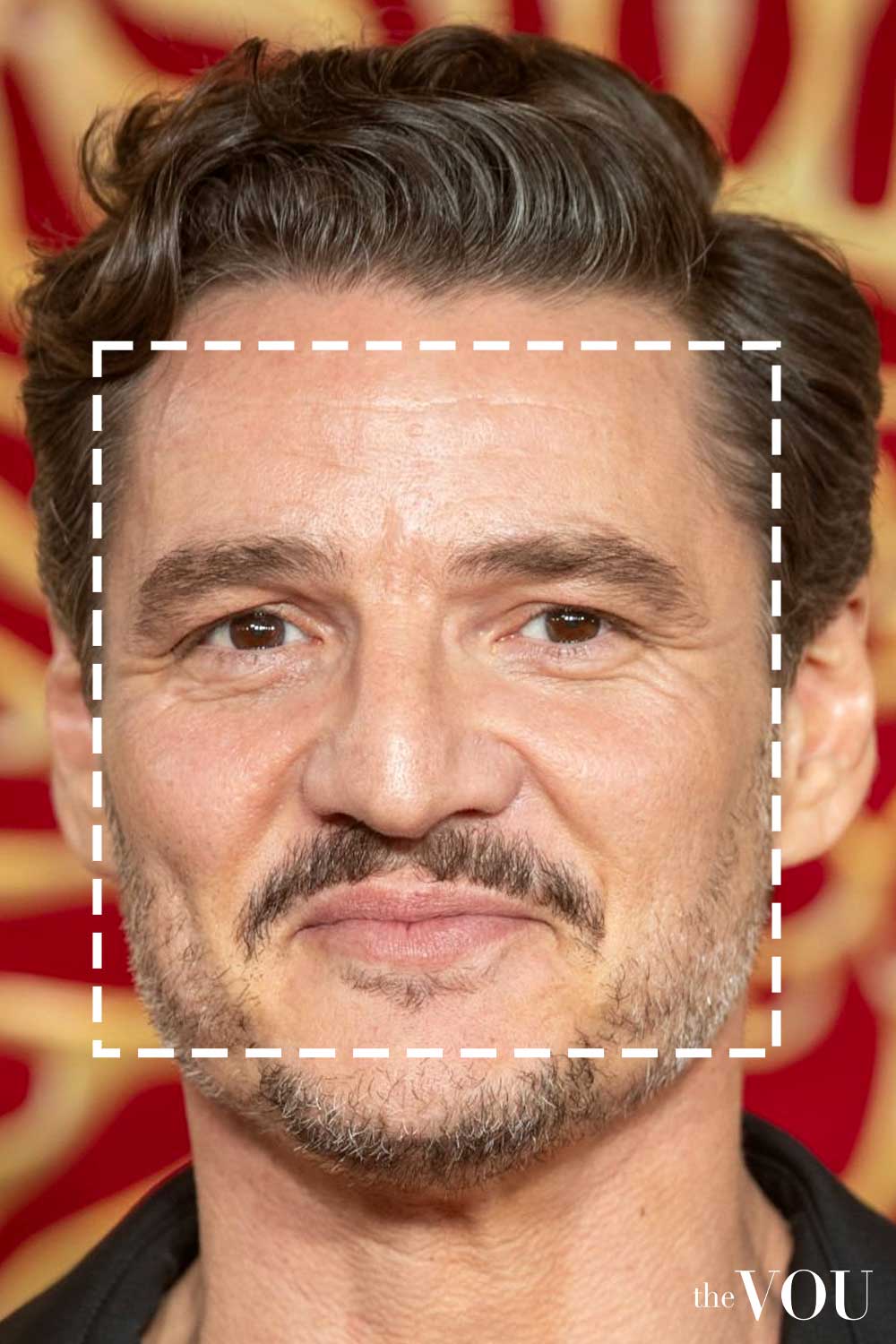
Men with square faces have a relatively compact outline, with widths running close together, length not strongly dominant, and clearly angular jaw corners, and the eyewear guide covers both routes, either a curved front against the corners or a squared front that repeats them deliberately.

In the square guide, the families are round, oval, aviator, Clubmaster and thin-rimmed frames, with a note on why frame height is a dispensing decision rather than a styling lever.
Round Face Shape

Men with round faces have curved jaw corners with length and width running close together, and the eyewear guide sets a straight top line against those curves while making clear that a round frame on a round face is a deliberate look rather than an error.

Rectangular, square, Wayfarer, geometric and D-frame glasses are the families covered, with what to do if the lower rim touches your cheeks.
Rectangular Face Shape
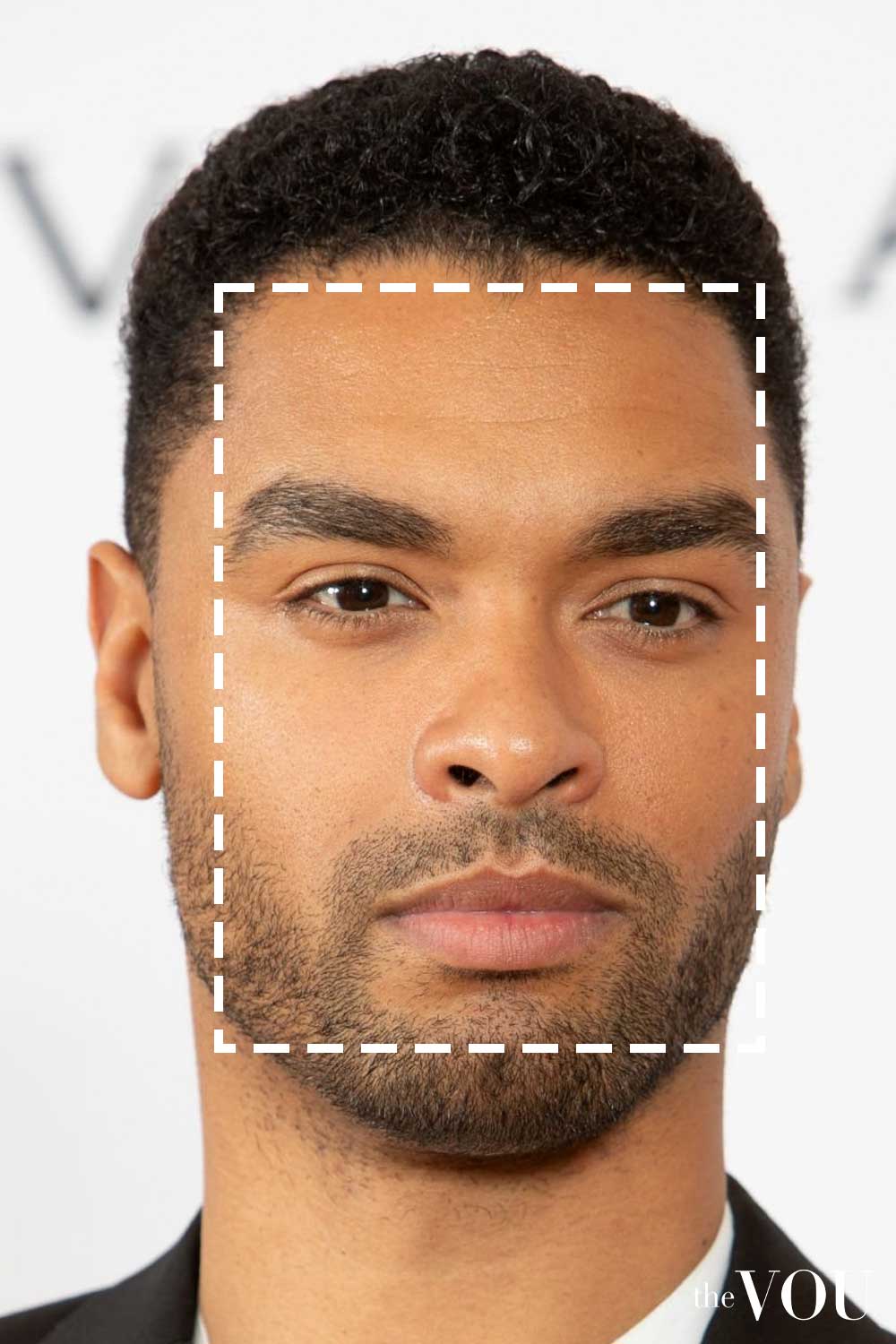
Men with rectangular faces have a clearly longer outline with angular jaw corners, and the eyewear guide separates the two aims that most advice runs together, a wider front for a horizontal line and a curved front against the corners.

The guide for rectangular faces takes in round, oval, aviator, browline and oversized frames, with a note on what the bridge number does and does not tell you.
Diamond Face Shape

Men with diamond faces have cheekbones broader than both forehead and jaw, and the eyewear guide spends most of its space on what to do when the lower rim rests on your cheeks, which is a fitting question rather than an outline one.

The families that guide covers are rimless and semi-rimless, oval, browline, rounded rectangular frames sometimes sold as walnut, and fine metal frames with a straight top line.
Heart Face Shape

Men with heart-shaped faces have a forehead broader than the jaw with the outline tapering towards the chin, and the eyewear guide keeps weight off the brow and, if you want it, places some interest lower down.

Rectangular, square, aviator, bottom-weighted and oval frames are covered, with an explanation of what the bridge number does and does not tell you.
Triangle Face Shape

Men with triangle faces have a jaw broader than the forehead, and the glasses styles guide opens with the naming problem, because several well-known guides use triangle for the opposite outline and their advice arrives upside down if you match by label.

The triangle guide works through browline, aviator and navigator, D-frame, thick-topped acetate and semi-rimless frames, with an honest answer to how wide a front can safely be.
Oblong Face Shape

Men with oblong faces have the same length as a rectangle with softer jaw corners, and the eyewear guide keeps the width advice and treats deep frames as a fitting and prescription question.

Covered in that guide are round or oval, oversized rectangle, browline, aviator and navigator frames, with a warning about how easily oversized fronts outgrow a head.
Pear Face Shape

Men with pear-shaped faces share the jaw-wide outline described under triangle, and the glasses styles guide explains the single mechanism behind every top-weighted recommendation and the three ways of buying it.

The pear guide covers browline, thick-topped acetate, aviator, bold geometric and contrast-topped frames, with rimless frames included as a legitimate quiet option.
A note on the nine names
Nine names do not mean nine anatomical categories. Oblong and rectangle share one outline and are separated here by how angular the jaw corners are, while triangle and pear share the jaw-wide outline. Our face shape quiz treats them as one result, and some guides separate them by how sharply the face tapers. Both distinctions are conventions rather than validated splits.
Our guide to choosing frames by face shape groups those pairs together, uses seven names as a result, and explains how to judge a specific model rather than a category.
Step 4
Frame Colour and Your Seasonal Palette
Colour changes nothing about the geometry of a frame, and no colour widens, narrows or lengthens a face, but colour does decide how far the frame separates from your skin, hair and eyes, which is the difference between glasses people notice and glasses they look past.
If you don’t know your seasonal colour, take our quiz, and treat a seasonal palette as one styling aid alongside fit, comfort, lens needs and your own preference.
Depth and brightness vary within each family and by subseason, so read the four groups below as directions to compare rather than fixed rules, and judge the actual frame shade on your own face.
Spring colour suggestions
Spring palettes lean warm and clearer, which points to frames in caramel, amber, warm tortoise, golden brown or clear warm tones.
Summer colour suggestions
Summer palettes lean cool and softer, which points to frames in cool grey, blue-grey, mauve, rose brown or cool tortoise patterns, and how far any of them stands out depends on your own colouring and on the frame.
Autumn colour suggestions
Autumn palettes lean warm and softer, at whatever depth suits the subseason, which points to deep brown, olive green, bronze, copper, or warm tortoise carrying amber highlights.
Winter colour suggestions
Winter palettes lean cool and clearer, with depth varying by subseason, which points to black, navy, clear crystal, burgundy, or cool tortoise with black through it.
For a fuller reading of your own colouring, see our Professional Seasonal Colour Analysis; its product page lists what it includes.
Step 5
What You Are Paying For in a Frame
Price in eyewear covers several separate qualities at once, and knowing which of them you are buying makes the decision easier than any general advice about investment.
Material and finish. Titanium, steel, other alloys and acetate differ in weight, in how they hold an adjustment and in how the finish wears, and finished frames vary widely even within one material, so compare the actual frames rather than the material names.
Hinges take the wear every time you put the frame on, so look at how a hinge is built, whether it is sprung, and whether the maker supplies spare hinges and screws.
Weight and how it is carried. A heavier frame is not necessarily less comfortable if the weight sits over a well-fitted bridge, and a light frame with a poor bridge will still slide all day.
Service, meaning adjustment, replacement pads and a warranty, matters more over three years than the name on the temple, and a local optician who will re-bend a frame for you is worth real money.
None of that requires an expensive frame, and an inexpensive pair that fits and that you like will serve you better than a costly one that does neither.
Glasses as Part of the Whole
Glasses are worn every day and sit at eye level, which gives them more presence than almost anything else in a wardrobe, and they are read alongside your haircut, your beard if you wear one, and the collar underneath.
A heavy acetate frame and a heavy beard together make a strong combination that some men want and others find overwhelming, and a fine metal frame sits more quietly against either. Those are judgements to make in a mirror with the rest of your face as it actually is, rather than calculations from a face-shape label.
Questions People Ask
Q. Does this guide offer a tested method for matching frames to faces?
No. What this guide offers is optional styling suggestions with the reasoning stated, alongside the fitting checks in step two, which belong to a professional discipline with real standards. Outline matching here is a styling convention rather than a validated test, so the decision stays with you.
Q. How wide should my glasses be?
Wide enough to sit securely with no uncomfortable pressure where the sides cross your head, which is not the same as looking parallel, because some designs curve the sides outward on purpose. That is a measurement of your head rather than your face shape, and the quickest way to settle it is to take the three numbers from a pair that already sits well and compare them with whatever you are considering.
Q. My features match two descriptions. Which guide should I read?
Both. Mixed features are ordinary, the neighbouring guides overlap heavily by design, and the fit checks in step two are identical on every page. Take the shortlist from both, try two frames that fit properly side by side, and let your own eye finish the job.
Q. Can I buy glasses online without trying them on?
You can, if you work from the numbers rather than the photographs. Compare lens width, bridge width and temple length against a pair that fits, check whether the model comes in more than one size, and buy where there is a home trial or a returns policy. A prescription still needs your optician, both for the lenses and for the final adjustment.
Q. Does a beard change which glasses suit me?
It changes the outline people see, without changing the jaw beneath it or any of the fitting measurements. Judge the combination in the mirror as it is now, and if you are trying to work out your face shape, describe the bearded outline you can see rather than guessing at what is underneath.
Q. What about sunglasses?
Everything on this page about fit and outline applies, with one addition that has nothing to do with your face. Check the ultraviolet protection the lenses provide, since how dark a tint looks and how much ultraviolet it blocks are separate properties.
Professional Styling Support
If you would like personal help, you can book a paid consultation.
Our Professional Face Shape Analysis, Fashion Style Analysis, and Complete Image Transformation services are paid consultations; the shop page lists what each one includes.
Visit our styling services page to see our paid consultations.