
Start here
What’s This About
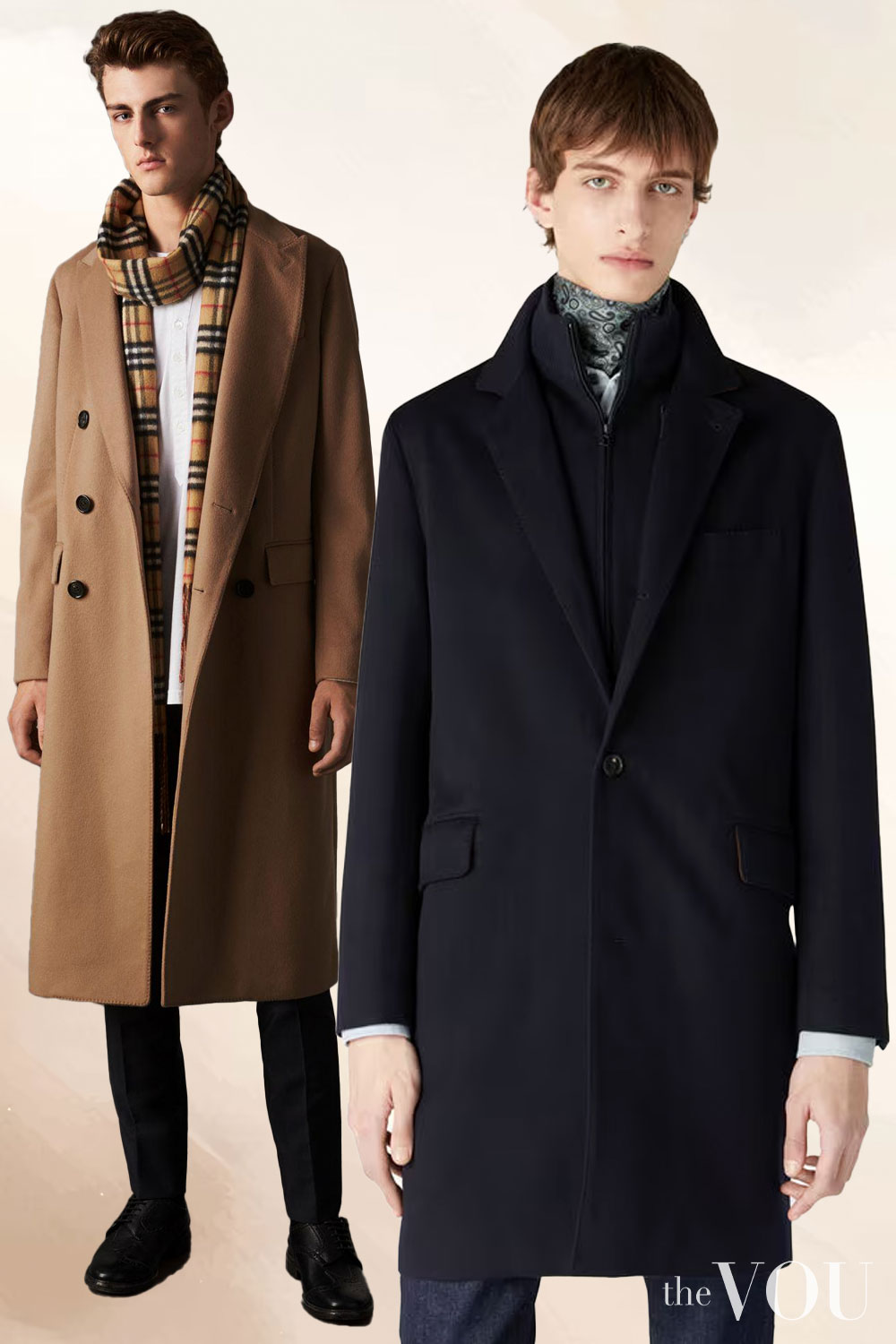
Pick the coat style for the dress codes you need, then check cloth, colour, fit over your layers and length.
This guide covers the practical decisions behind a good overcoat, such as:
what separates a Chesterfield, polo coat, covert coat, trench and pea coat
what cashmere, vicuña and wool cloths mean for warmth and wear
why camel, navy and charcoal are the classic coat colours
how an overcoat should fit over a jacket and where the hem should end
overcoat outfits from business formal to black tie
and many more!
Start with the coat your week actually needs.
Key Points
01A knee-length Chesterfield in a dark colour covers business and black tie, while a pea coat stays casual.
02An overcoat is cut to go over other layers, so try it on over the jacket or knit you will wear underneath.
03Camel, navy and charcoal go with most outfits; compare any colour near your face in daylight before buying.
04Standard black tie under the coat is a black or midnight blue dinner suit, white shirt, black bow tie and black shoes.
For several months of the year, an overcoat is the garment people see first, so it does a lot of work: it covers whatever you wear underneath, sets how formal you look, and keeps you warm and dry.
Choosing one well comes down to a few practical decisions: the style of coat, the cloth, the colour, the fit over your other layers, and the dress codes you actually need the coat for.
This guide covers the main overcoat styles and what each one is for, then cloth, makers, colour, fit and length, accessories, and outfits by occasion.
Why an Overcoat Is Worth Getting Right
An overcoat is first a practical garment for cold weather, but because the coat is the outermost layer, it also sets the first impression of the whole outfit.
Whether you’re drawn to the classic, preppy aesthetic of the Ivy League elite, the understated elegance of the Sloane Ranger set, or the timeless sophistication of the French BCBG (bon chic, bon genre), a well-chosen overcoat fits naturally into each of these looks.
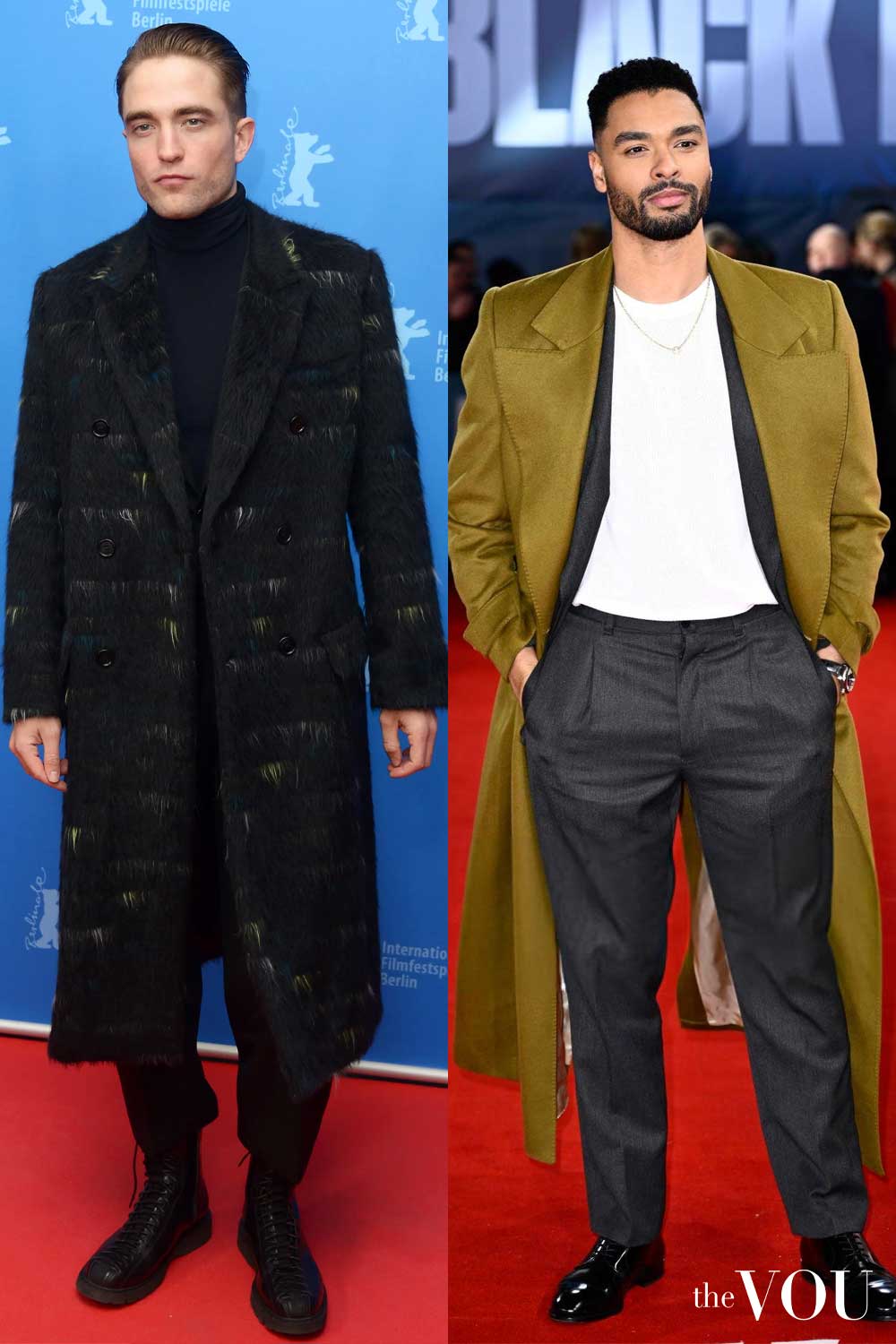
A coat that fits over your other layers and suits the occasion makes a plain outfit look deliberate.
A clean, unbroken line from shoulder to hem can also make the body look longer, while a coat that is too big or too long tends to swamp the frame.
Choose the Right Overcoat for You
Start with the style of coat, because each traditional style has its own length, cloth and level of formality.
Chesterfield: a knee-length tailored overcoat, usually single-breasted (double-breasted versions exist), with no waist seam and often a fly front that hides the buttons; some have a velvet collar. The Chesterfield is the most formal of the everyday styles and the natural choice over a suit or a dinner suit.
Crombie: the name of a Scottish cloth and coat maker, also used loosely for a knee-length, single-breasted wool overcoat cut much like a Chesterfield.
Covert coat: a shorter coat, usually ending above the knee, in covert cloth (a hard-wearing twill, traditionally fawn or greenish brown), with a fly front, often a velvet collar and rows of stitching at the cuffs and hem. The covert coat began as a country and riding coat and sits between smart and smart casual.
Polo coat: a double-breasted coat, traditionally in camel hair, with patch pockets, turned-back cuffs and often a half belt at the back. A polo coat usually reaches the knee or below and is less formal than a dark Chesterfield, though smart enough to wear over a suit.
Trench coat: a double-breasted, belted raincoat in closely woven cotton gabardine, with a storm flap and epaulettes. The trench is a rain layer for mild weather rather than a winter overcoat, and it works from business wear to casual wear.
Pea coat: a short, double-breasted coat in heavy navy wool, ending around the hip, with broad lapels and naval origins. The pea coat is casual and does not cover a suit jacket.
Choose the style that suits the occasions you dress for most often: a man who wears a suit every day and a man who works from home need different first coats.

Cloth and construction then decide how warm the coat is, how well the coat keeps its shape and how long it lasts; the table below summarises what to look for.
Scroll horizontally to see all columns →
| Important | Description |
|---|---|
| Material |
|
| Craftsmanship |
|
| Makers |
|
Cloth and construction matter more on an overcoat than on most garments, because a coat is worn hard over several winters.
Natural fibres such as wool and cashmere are the traditional choice because they are warm for their weight and drape well.
Three fibres come up most often when buying a good overcoat: cashmere, vicuña and wool.
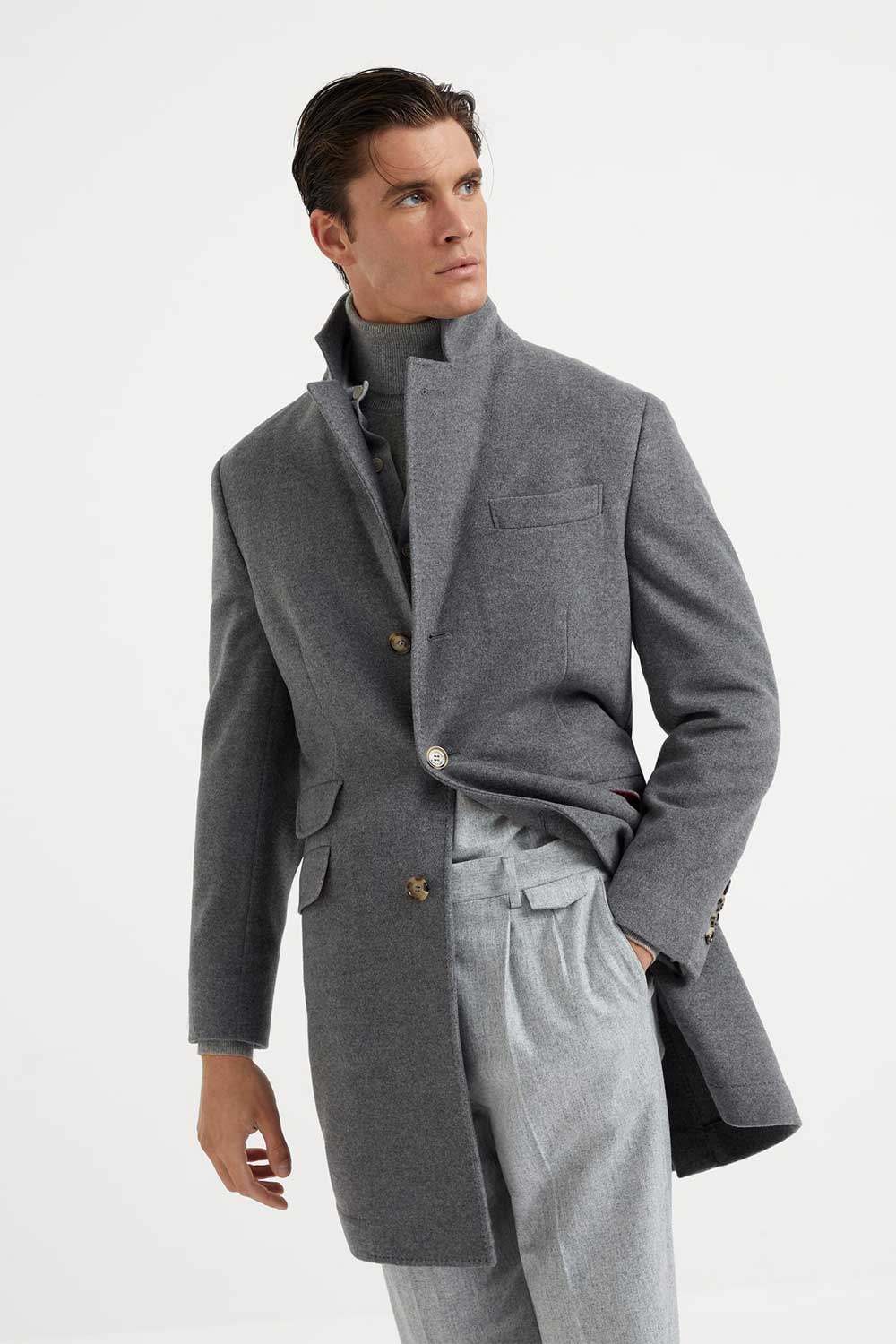
Cashmere comes from the soft undercoat of cashmere goats and is valued for its softness, warmth and slight sheen. Pure cashmere is less hard-wearing than a dense wool, so a wool and cashmere blend is a common compromise for an everyday coat.
Vicuña comes from the vicuña, a wild relative of the llama that lives in the high Andes, mainly in Peru. The fibre is among the finest of any animal and is gathered in small quantities, which is why vicuña cloth is so expensive.

A vicuña overcoat is priced far above a cashmere one, so for most readers vicuña is a curiosity rather than a realistic purchase.
Wool and wool blends, including merino, alpaca or mohair blends and dense cloths such as melton and loden, are the practical choice for most overcoats.

A well-made wool coat that is brushed, hung and cleaned with care can last many winters.
After the cloth, look at the construction.

Feel the front of the coat: a canvassed or half-canvassed front helps the coat keep its shape and drape, while a fused front can feel stiffer and, on cheaper coats, may bubble over time.
Hand-sewn buttonholes with a slightly raised edge are a sign of careful making on expensive coats; neat, dense machine buttonholes are normal and fine at lower prices.
The lining should be made from a smooth, luxurious fabric like silk or cupro and neatly attached without puckering or pulling.
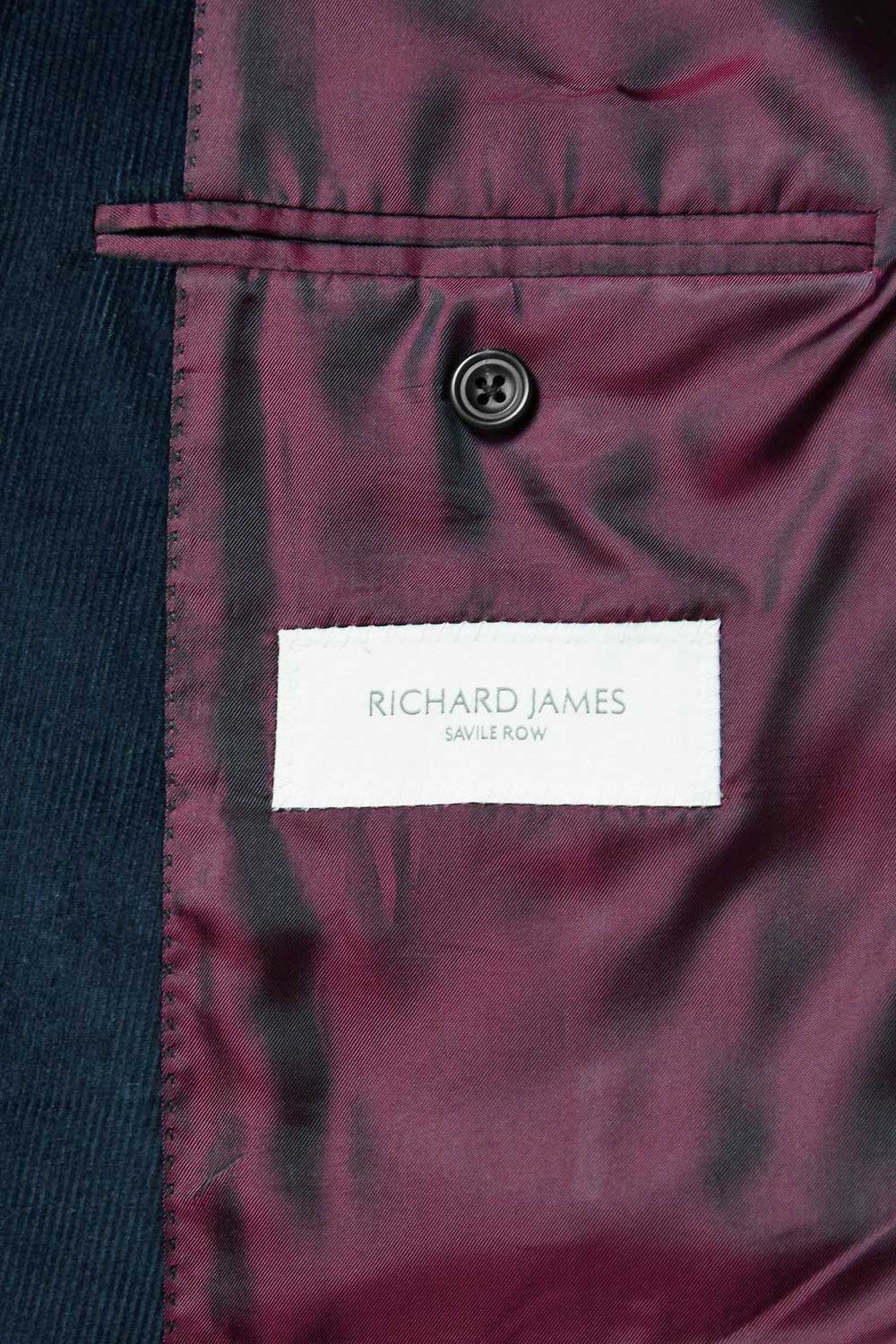
A maker’s reputation can help you draw up a shortlist, but it does not replace checking the coat itself.
If you want names to start from, we have a separate guide to Old Money designer brands.
Renowned Overcoat Brands
The makers below are long-established names in men’s outerwear, and our guide to Old Money clothing brands lists more.
A famous name is not a guarantee, so check the cloth, construction and fit of the particular coat as described above.
Burberry (UK)

Founded in 1856, Burberry is a British fashion house known for its trench coats and its check pattern; Thomas Burberry developed gabardine, the closely woven cloth used for trench coats.
Burberry’s outerwear ranges from wool and cashmere overcoats to coats in technical fabrics.
Aquascutum (UK)
Established in London in 1851, Aquascutum is a British outerwear brand whose name is Latin for “water shield”.
Aquascutum is known for early water-repellent wool cloth and for trench coats, and it makes overcoats for both formal and casual wear.
Loro Piana (Italy)
Founded in 1924, Loro Piana is an Italian cloth and clothing maker.
Loro Piana is best known for fine fibres such as cashmere, vicuña and very fine merino wool, and its coats sit at the top of the price range.
Loden-Frey (Germany)

Founded in Munich in 1842, Loden-Frey is a family-owned German company known for its traditional loden coats.
Loden is a dense, fulled wool cloth from the Alpine region; the fulling makes the cloth naturally water-resistant and windproof.
Loden-Frey makes practical, durable overcoats in a traditional Alpine style.
Crombie (UK)

Established in Aberdeen in 1805 as a woollen mill, Crombie is a Scottish brand known for wool and cashmere overcoats.
The name “Crombie” is also used loosely for a knee-length, single-breasted wool overcoat cut much like a Chesterfield, often with a velvet collar.
Classic Overcoat Colours
Scroll horizontally to see all columns →
| Colour | Why | Occasion |
|---|---|---|
| Camel |
|
|
| Navy |
|
|
| Charcoal |
|
|
| Burgundy Forest Green Midnight Blue |
|
|
Colour decides how many outfits a coat will go over, so for a first coat it pays to start with a neutral.
Camel, navy and charcoal are the classic overcoat neutrals.
These three colours go with most suit and trouser colours and patterns, which makes them a sensible base for an Old Money capsule wardrobe.
Camel is closely associated with quiet luxury dressing.

Camel is a warm, sandy colour that has been a classic overcoat shade for decades, traditionally in camel hair or wool.
A camel coat works over a navy or grey suit as well as over jeans and knitwear.
A light camel shows marks more readily than a dark coat, so expect to brush and clean it more often.
Navy is a dark, adaptable coat colour that suits both business and casual wear.

A navy overcoat goes over a grey or navy suit and over dark evening clothes.
Pair it with a crisp white shirt and grey flannel trousers for a smart look, or dress it down with a chunky turtleneck and dark wash jeans for a more casual yet refined ensemble.
Charcoal is a plain, dark grey that suits business and city wear.

A charcoal overcoat looks particularly striking when paired with monochromatic separates in shades of black, white, and grey.
A coloured scarf adds a point of interest against the grey.
Neutrals are not the only option, and a coat in a deeper colour becomes the focus of the outfit.
Burgundy, forest green and midnight blue are the usual choices; midnight blue is the easiest of the three to wear over evening clothes, while burgundy and green go with fewer outfits than a neutral coat.

An overcoat colour sits just below your face, so compare a few before you buy.
Hold coats of similar depth but different warmth near your face in the same daylight, for example a camel against a cool mid grey, and look for an unwanted colour cast on the skin or for the coat drawing attention before your face.
Such a comparison is a practical styling trial, not a measurement of skin undertone, and colours you are often complimented in reflect taste as well as colouring.
If the comparison stays unclear, a neutral that goes with most of your wardrobe is a sound first coat, and a scarf in a colour you like can do the work near the face.
If you follow a seasonal colour palette, its neutrals are a good place to start, but the dress codes you need the coat for come first.
Correct Overcoat Fit and Silhouette
Scroll horizontally to see all columns →
| Factor | Description |
|---|---|
| Measurements |
|
| Silhouette |
|
| Coat Length |
|
Fit matters as much as cloth, and an expensive coat that fits badly looks worse than a modest coat that fits well.
The main difference from a jacket is that an overcoat is cut to go over other layers, so always try one on over the jacket or heaviest knit you plan to wear under it.
Knowing your measurements helps, especially when buying online; a tailor or a shop can measure you.
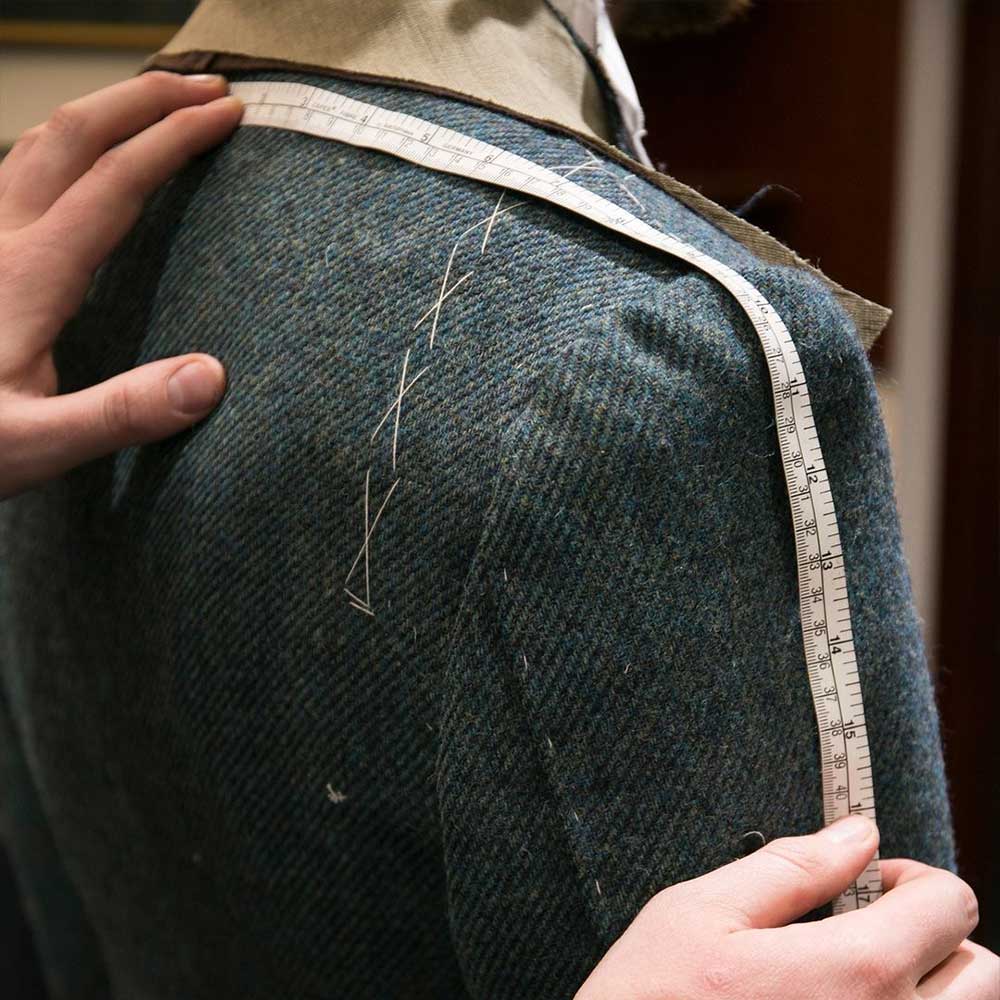
Key measurements include your chest circumference, shoulder width, sleeve length, and desired coat length.
Compare those numbers with the maker’s size chart, remembering that an overcoat needs more room in the chest than a jacket.
When trying overcoats, pay close attention to how the garment drapes and moves with your body.
The shoulders should sit cleanly over your jacket shoulders, with the seam at or just past the edge of your own shoulder and the collar resting against your neck.
The sleeves should be wide enough for a jacket sleeve and long enough to cover your shirt and jacket cuffs when your arms hang at your sides.
Buttoned over a jacket, the front should lie flat without the buttons pulling, and you should be able to reach forward without strain.
Length depends on the style and on what you wear underneath.
A coat worn over a suit should at least cover the jacket hem, which is why classic overcoats usually end around the knee; covert coats end above the knee, and pea coats end around the hip.
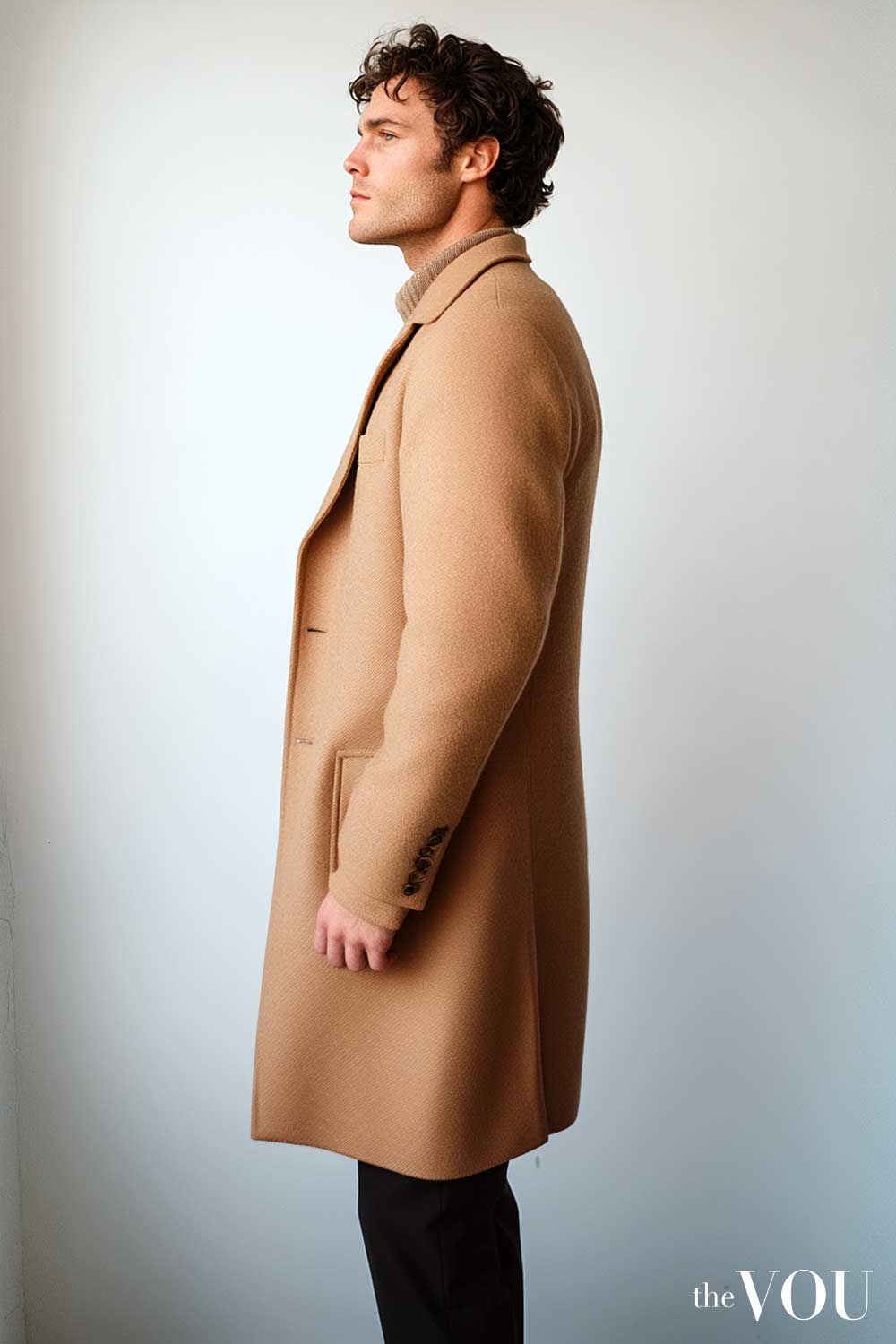
A knee-length coat gives warmth and coverage without a great deal of extra weight.
If you’re taller, you may prefer a slightly longer coat that hits at or just below the knee, while shorter men may opt for a coat that falls marginally higher on the thigh.
Three features shape the outline of a coat.
A structured shoulder, built with padding and canvas, gives a sharper, more formal line, while a soft or raglan shoulder looks more relaxed.
A shaped waist, through darts or a belt, gives a closer outline; many classic overcoats hang straighter, which leaves room for layers.
A slightly flared skirt, through pleating or a gentle A-line cut, adds movement and makes walking easier.
Most ready-made coats need small alterations, and a tailor can make most of them.
Sleeve length, waist shaping and a small amount of let-out at the seams are routine work; shortening is possible on many styles, while shoulders that are too wide are hard to fix.

When you budget for a coat, include the cost of alterations.
Made-to-measure and bespoke overcoats are another route to a close fit.
These custom-tailored options allow you to select every detail of your coat, from the fabric and lining to the buttons and pockets.
Made-to-measure adjusts an existing pattern to your measurements, while bespoke means a tailor cuts a pattern for you and fits the coat over several sessions.
Both cost more than ready-made coats, so whether they are worth it depends on your budget and on how well ready-made sizes fit your build.
Overcoat Accessories by Season
Scroll horizontally to see all columns →
| Season | Accessories | Key Points |
|---|---|---|
| Autumn |
|
|
| Winter |
|
|
| Spring |
|
|
| Summer |
|
|
Accessories keep you comfortable in a coat and finish the outfit.
Overcoats are mainly autumn and winter wear; the spring and summer suggestions below suit lighter coats such as a cotton trench or mac, and the outfit underneath once the coat comes off.
Autumn and Winter
Scarves, Leather Gloves, and Boots
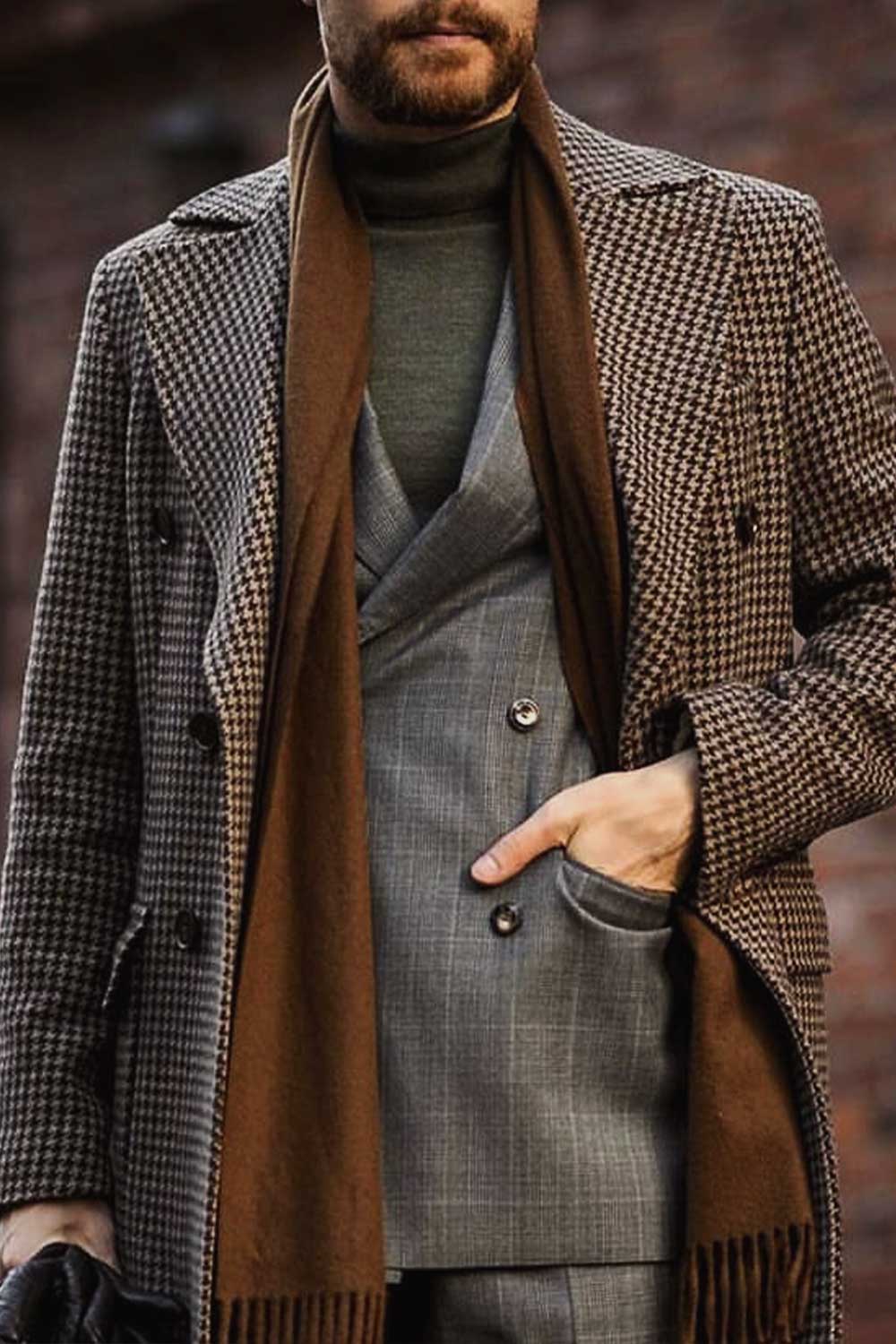
Opt for a scarf made from luxurious materials like cashmere or merino wool in a classic pattern such as houndstooth or paisley, tied in a scarf knot.
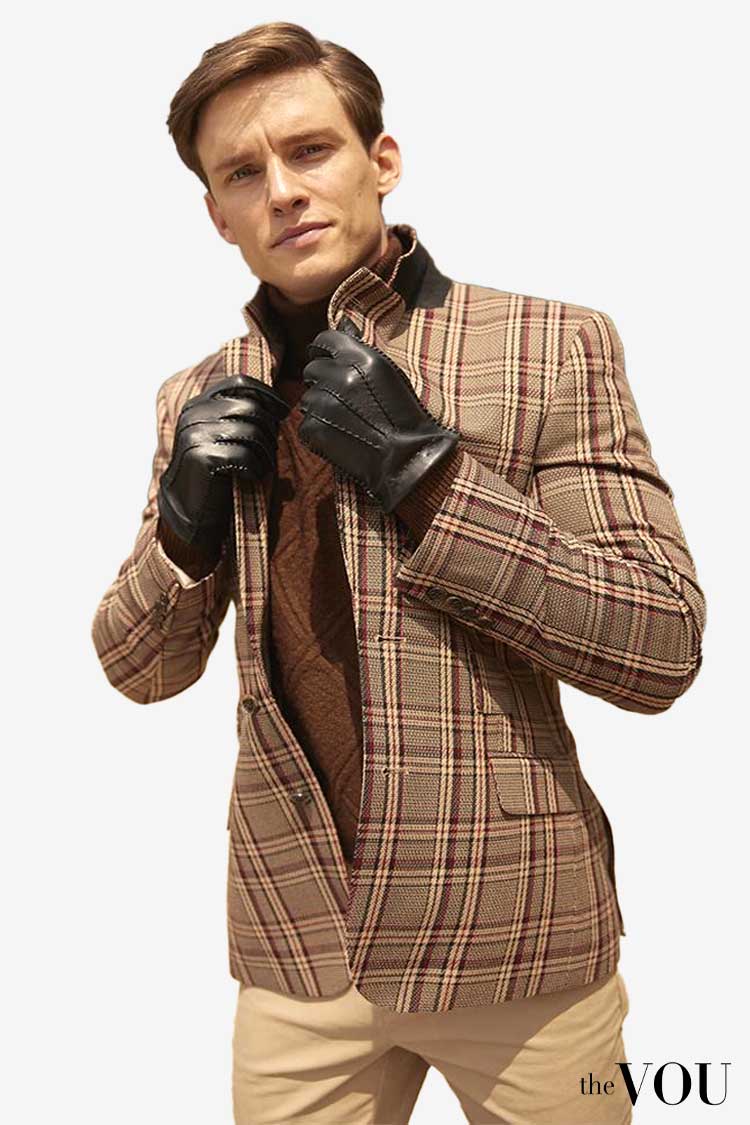
Leather gloves in dark brown or burgundy go with most coat colours and keep your hands warm.
For colder days, choose leather gloves lined with cashmere, wool or shearling.
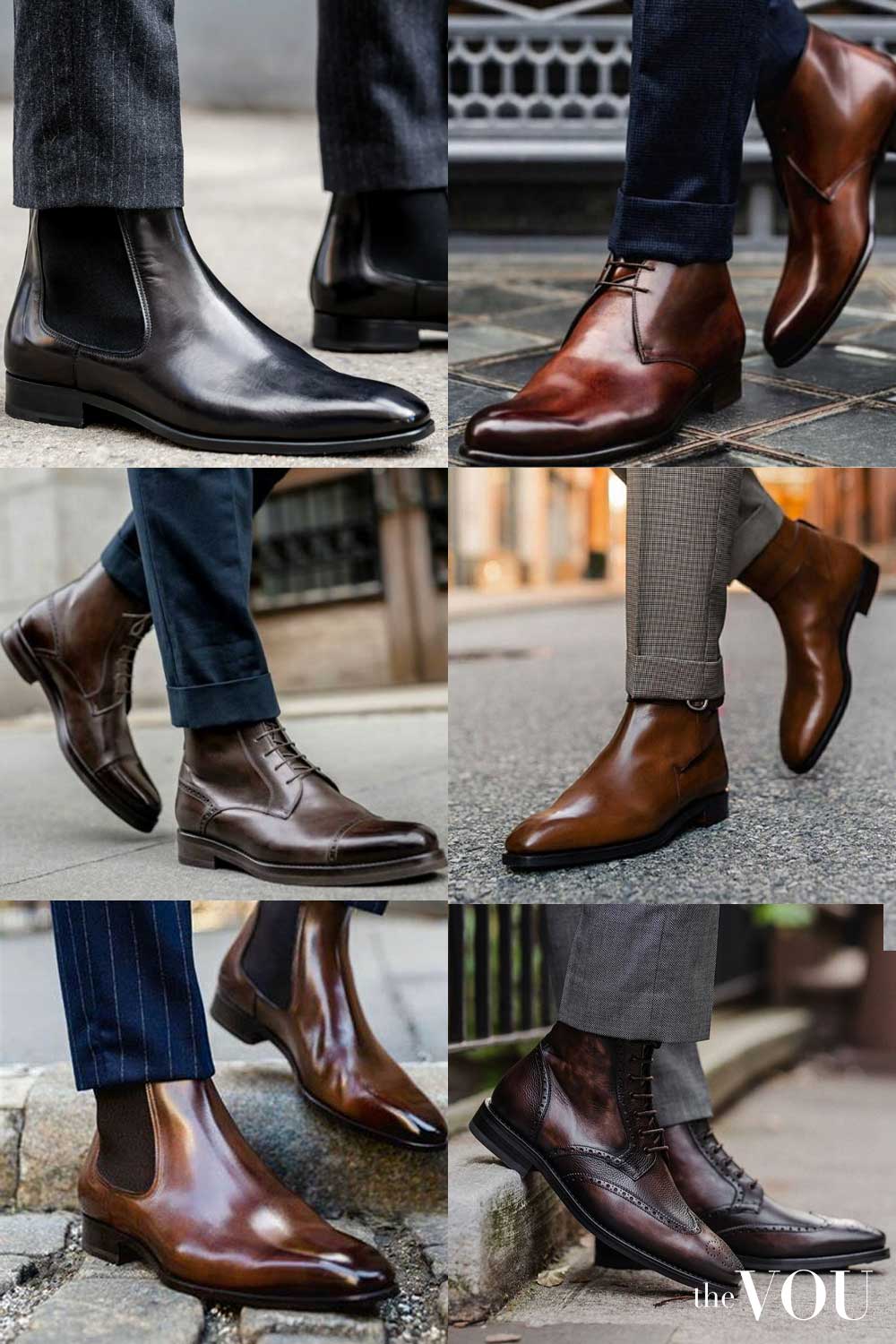
Complete the look with a pair of sturdy leather boots in a shade similar to your gloves for a cohesive ensemble.
A wool beanie in a neutral shade like black, navy, or grey can provide an extra layer of insulation for your head and ears while maintaining a sleek, minimalist look.
Spring and Summer
Lightweight Scarves, Driving Gloves, and Loafers
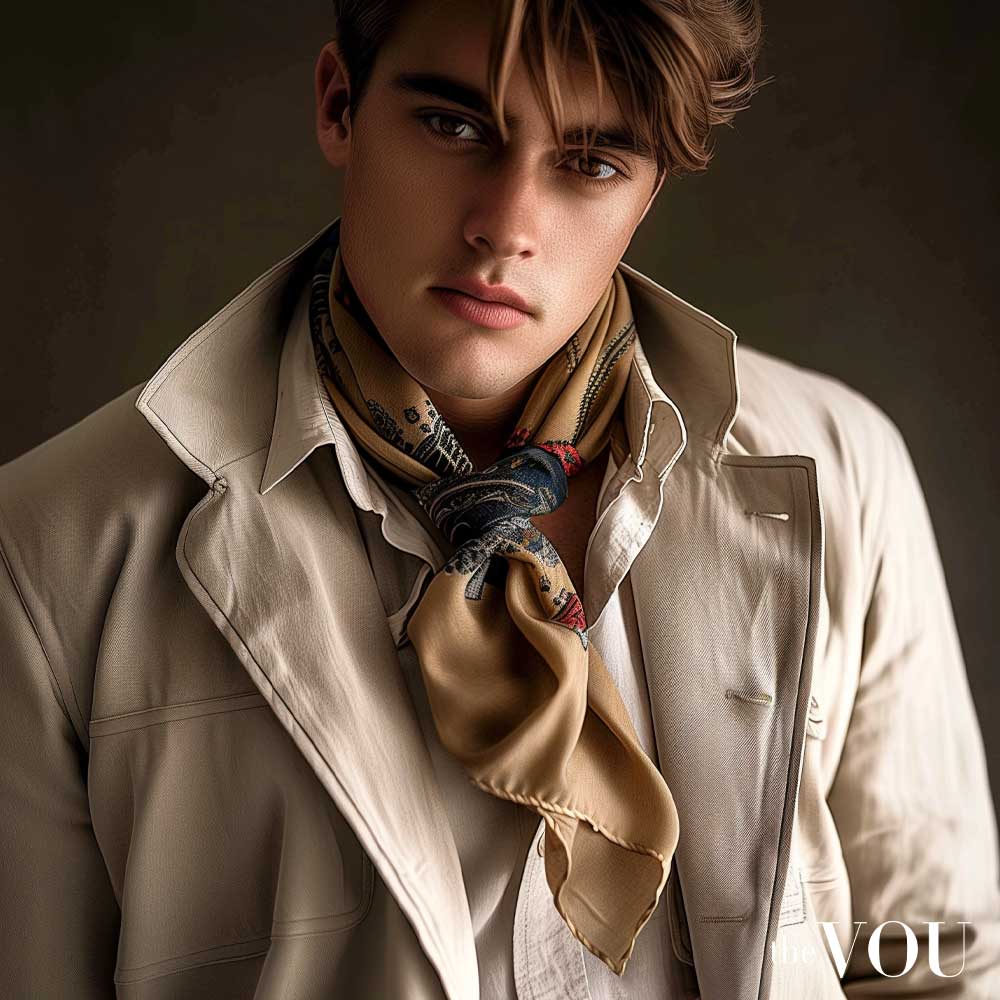
A lightweight scarf in a breathable material like cotton or linen can add a pop of colour or pattern to your overcoat, keeping you comfortable on breezy days.
A pair of driving gloves in supple leather can add a touch of rakish charm to your look while providing grip and protection when behind the wheel.

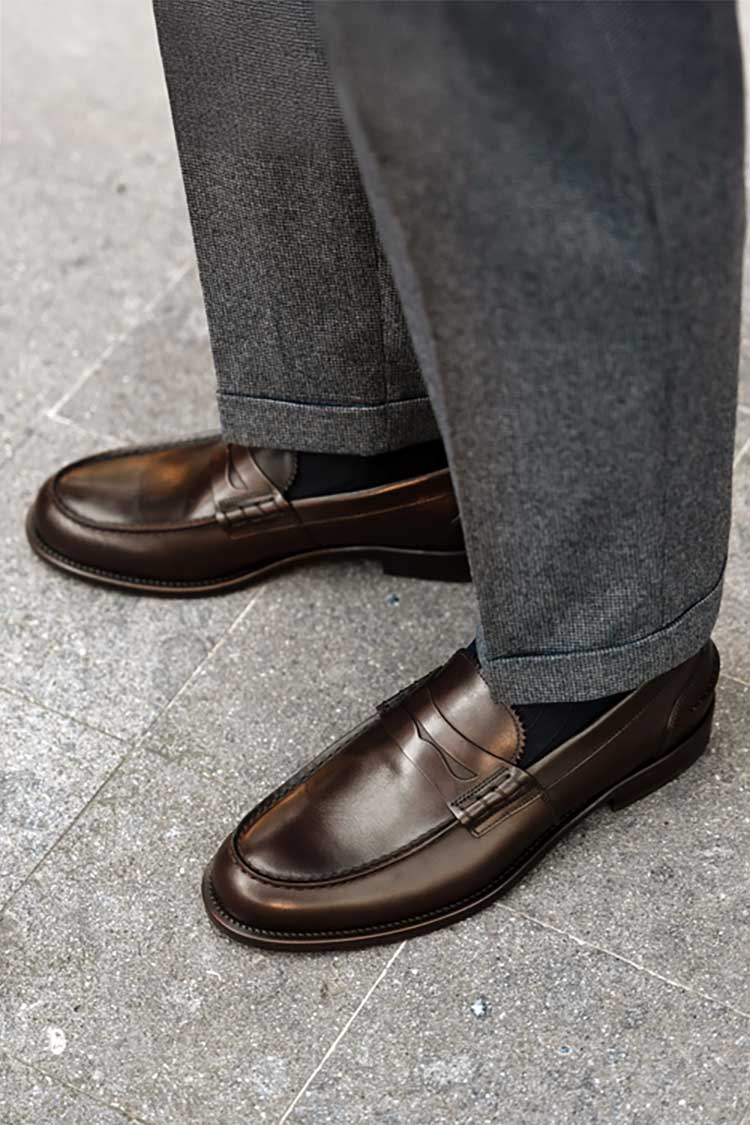
Leather penny loafers suit a lighter spring coat worn with chinos.
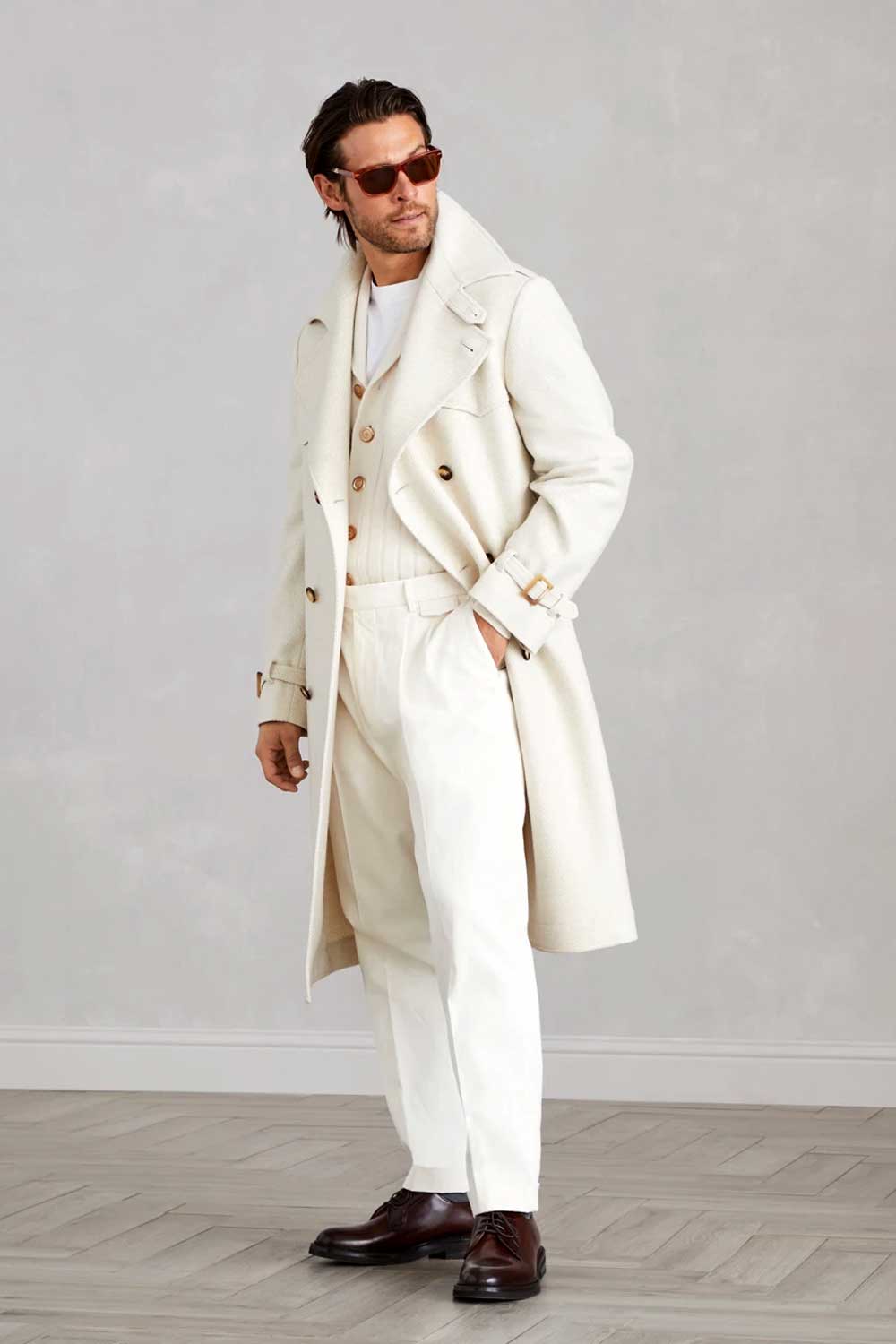
Choose sunglasses in a classic shape, such as aviators or Wayfarer-style frames, with a stated UV protection rating; the right shape depends on your face.
A plain dress watch on a leather strap suits tailored outfits; the case metal is a matter of taste rather than a rule.
Overcoat Styling by Occasion
The same overcoat can be dressed up or down, but the style of coat sets the limits: a dark Chesterfield covers business and evening wear, while a pea coat stays casual.
The outfits below run from business formal to casual, with black tie last.
Business Formal
Overcoat with a Tailored Suit

For business formal, wear a dark suit under a knee-length overcoat; our guide to wearing a coat over a suit covers the proportions.
Choose the coat in navy, charcoal or camel, long enough to cover the jacket hem.
A double-breasted suit with peak lapels is one option; a single-breasted suit is equally correct.
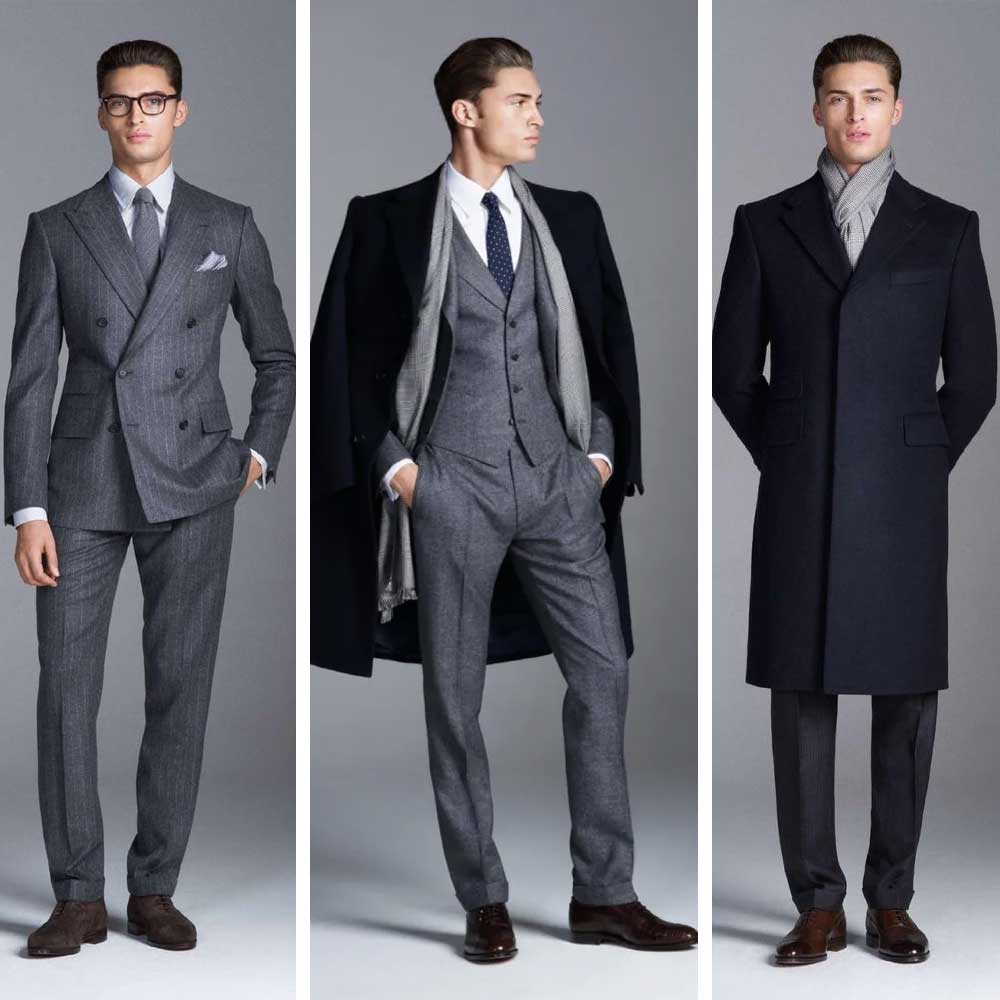
Layer your coat over a crisp white dress shirt, a silk tie in a subtle pattern, and polished leather dress shoes.
A leather briefcase and a plain watch finish the outfit.
Business Casual
Overcoat Over a Blazer and Slacks

Business casual drops the suit and often the tie, and an overcoat keeps the outfit smart outdoors.
Start with a pair of well-tailored wool trousers in a neutral shade like khaki or grey.
Add a cotton button-down shirt, such as an Oxford, and a textured blazer over it.

A tweed or herringbone jacket in brown or green adds texture.
Top it off with a camel or navy overcoat in a streamlined, single-breasted silhouette.
Finish with leather loafers or ankle boots.
Smart Casual
Overcoat with a Turtleneck, Trousers, and Dress Shoes
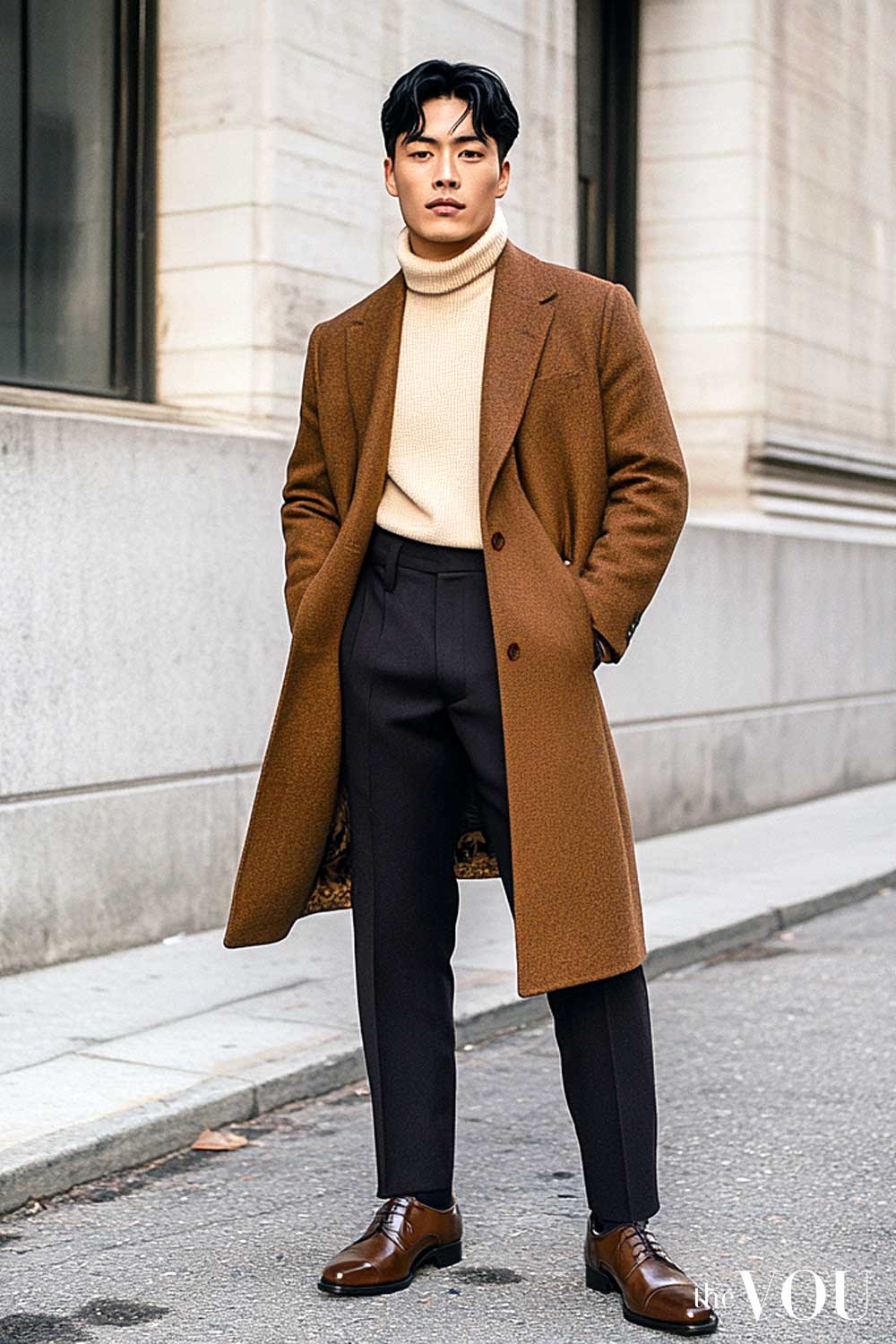
For smart casual, pair your overcoat with a fine turtleneck sweater and tailored trousers.
This combination suits a dinner, a gallery opening or a work event with no stated dress code.
Choose a turtleneck in fine gauge wool or cashmere in a shade that complements your overcoat.
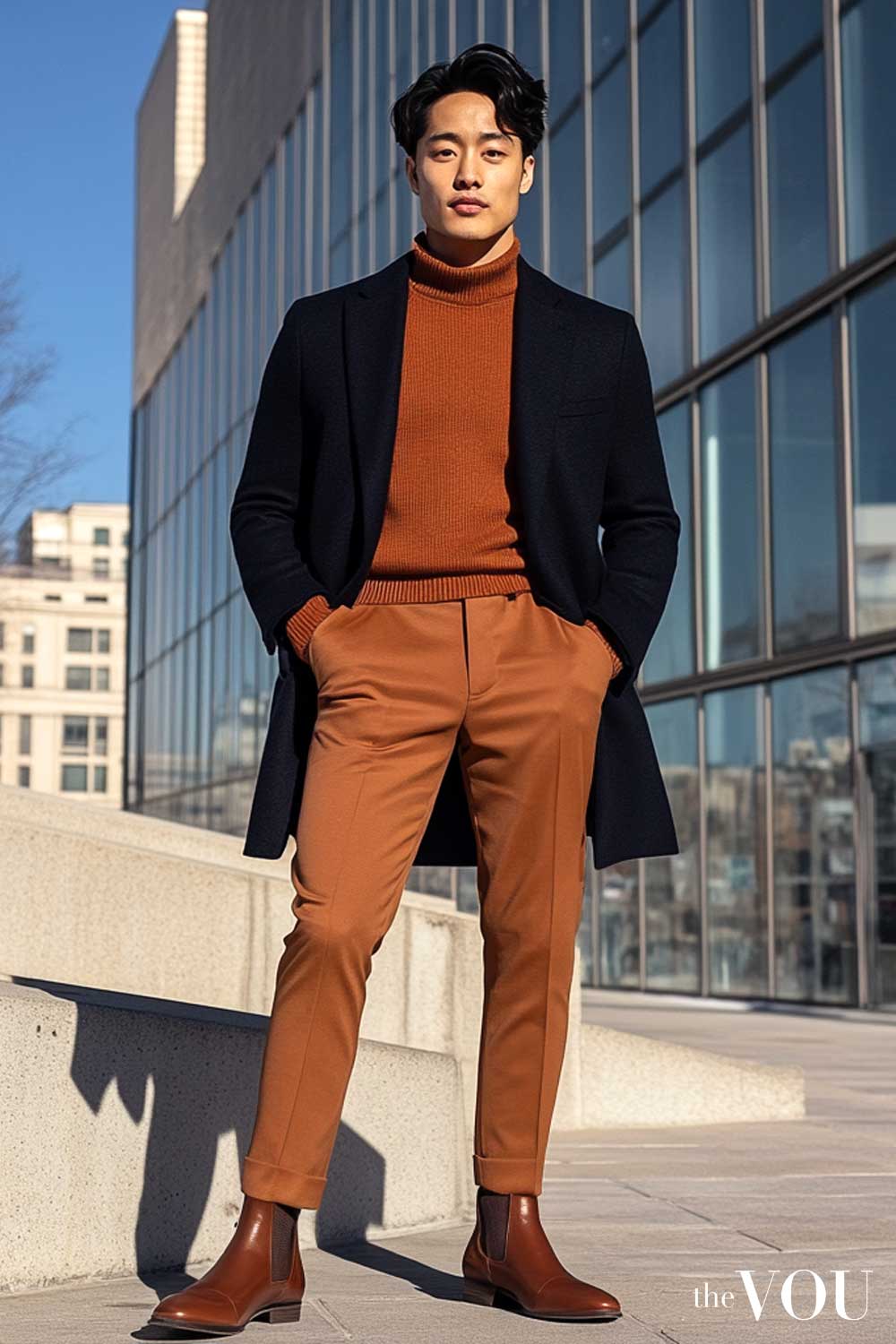
Opt for trousers in a contrasting hue, like a rich burgundy or deep green.
Polished leather shoes keep the outfit smart.
A camel or grey overcoat, or a camel polo coat, finishes the outfit.
Relaxed Weekends
Overcoat with Jeans and Sneakers

An overcoat also works over casual clothes.
For a weekend outfit, wear your overcoat with dark-wash jeans and a warm sweater.
A chunky knit in a neutral shade, like cream or oatmeal, will add texture and depth to your ensemble.
Roll up the cuffs of your jeans to show off a pair of sleek leather sneakers or ankle boots.
Top the outfit with an overcoat in olive or chocolate brown, or with a navy pea coat, which is cut for casual wear.
This outfit suits errands, coffee with friends or a walk in the park.
Festive Evening
Overcoat with a Dinner Jacket and Bow Tie
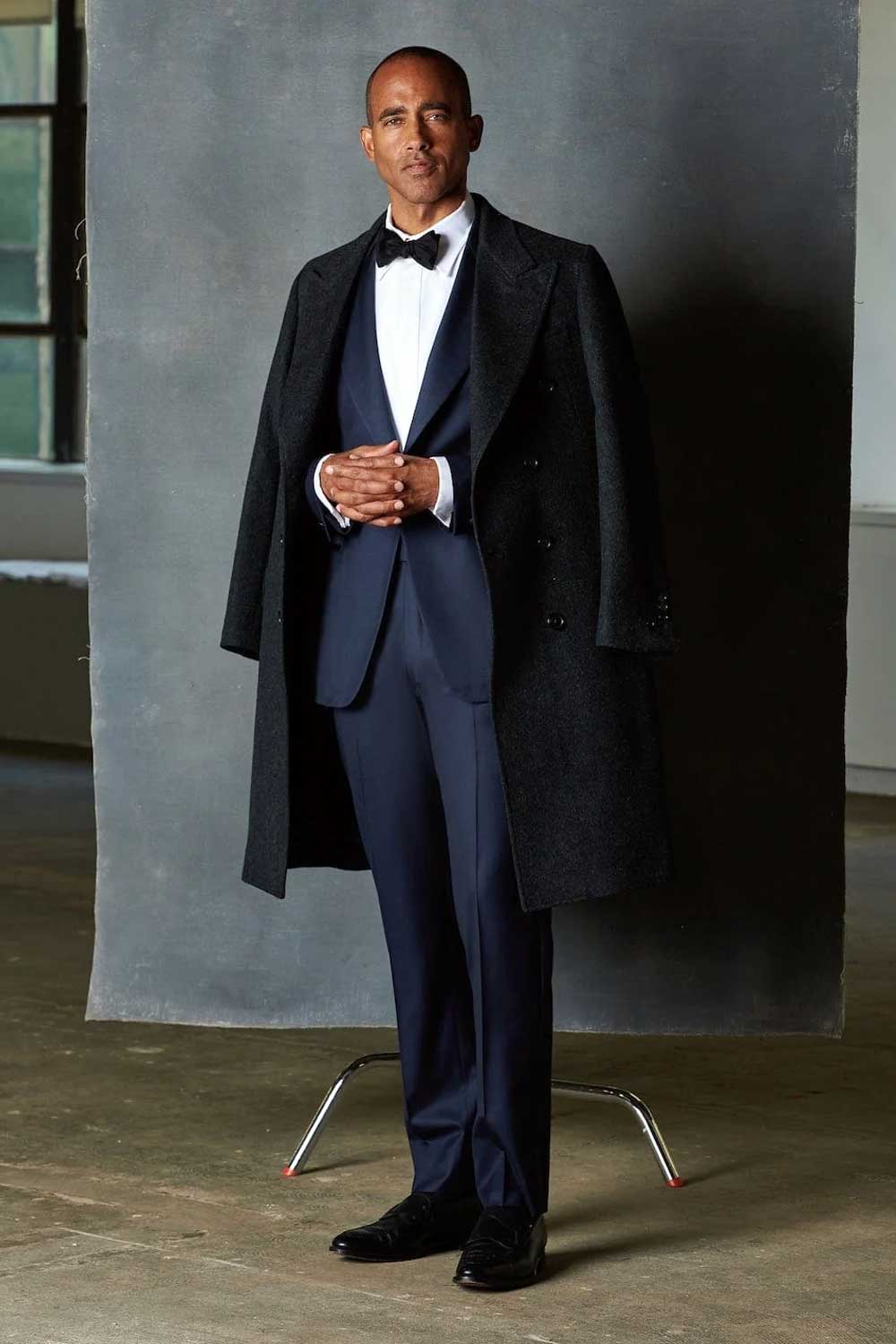
At a formal evening event, the overcoat goes over the dress code rather than changing it; this outfit is for black tie and festive evening invitations, while white tie is a separate code with a tailcoat, white waistcoat and white bow tie.
Standard black tie is a black or midnight blue dinner suit with a white dress shirt, a black bow tie and black patent or highly polished black shoes.
A velvet dinner jacket in emerald, burgundy or midnight blue suits a festive or creative black tie invitation rather than standard black tie; keep the white dress shirt and black bow tie with it, as in a classic Old Money look.
Over the top, wear a dark overcoat in black, midnight blue or charcoal, such as a Chesterfield, long enough to cover the dinner jacket; a white silk scarf is the traditional finish.
A white pocket square in linen or silk completes the outfit.
Take the First Step With The VOU’s Styling Quizzes
Start your style journey with our resources. First, take our Face Shape Quiz to check your face shape.
Then, try our Seasonal Colour Analysis Quiz.
After that, try our Body Shape Quiz and our Fashion Style Quiz.
Personal Help From The VOU
If you want personal help beyond this guide, The VOU offers paid consultations.
Our Professional Face Shape Analysis package is one of these paid consultations.
The VOU also offers a Complete Image Transformation Package.
The package combines the face shape, seasonal colour, body shape and fashion style analyses.